by Pigeon Patrol | Jan 4, 2016 | Animal Deterrent Products, Bird Netting, UltraSonic Bird Control
Helikite Vigilante
OVERVIEW
The ‘Helikite’ is a combination of a helium balloon and a kite with two models recommended for the purpose of bird control. The two versions of the Helikite offered for bird control are the ‘Vigilante’ Helikite and the ‘Lightweight’ Helikite. The essential difference between the two products is that the ‘Vigilante’ Helikite has a tough mylar protective cover that will prevent the balloon from becoming damaged if it falls to the ground in strong winds or in rain. The Lightweight Helikite is designed to be used in conjunction with lightweight collapsible aluminium Helikite Poles for use on buildings, landfill sites and for the protection of high-value crops that have good crop cover. The Lightweight Helikite cannot be used on winter crops, overnight or anywhere where the balloon may come down on bare ground when wet. The Lightweight Helikite is ideal for use in hot climates due to the lighter construction. The Vigilante Helikite is a more versatile balloon due to its protective heavy-duty mylar cover and therefore can be used for all agricultural applications irrespective of crop-type and for most other bird-scaring applications.

Lightweight Helikite
The Helikite, unlike conventional kites, will fly when there is no wind at all due to the helium gas used to inflate the balloon. Unlike most balloons that are shaped like kites, the Helikite is fat and rounded which is essential to provide good helium lift. A conventional kite-shaped balloon will collapse when it hits cold air due to shrinkage of the gas inside the balloon and subsequent loss of pressure required to retain shape. This is not a problem for the Helikite due to its unique shape. The Helikite will also fly in winds of up to 25 mph unlike a conventional balloon, with the wind actually generating uplift rather than bringing the kite down. In winds of above 25 mph the drag caused by the Helikite will bring the balloon down. Although the Vigilante Helikite will come down in rain, the protective mylar cover supplied with the product will ensure that the balloon is not damaged. Once the rain abates and the Vigilante Helikite dries out the balloon will re-launch itself. The Lightweight Helikite is more vulnerable and may become damaged when falling to the ground.

Lightweight Helikite
As previously mentioned, the Lightweight Helikite is designed for use with the Kite Pole, a 13 metre, lightweight collapsible aluminium pole with just over 12 metres of line extending from the top of the pole to which the Helikite is attached. Each section of the Kite Pole has a ring attached to the side of it through which the Helikite flying line runs. The benefit of the Kite Pole is that in the event of strong wind or rain, the Lightweight Helikite will remain tethered to it rather than plunging to the ground and becoming damaged. The Kite Pole will collapse down to 130cm x 4cm x 8cm allowing it to be transported easily. The pole can be tethered to a fence post or a similar vertical object or it can be held in place with guy ropes.
The Helikite is really just a variation on the predator balloon theme with the product being marketed as a device that mimics the flight of a bird of prey as it hunts. The Helikite would normally be used for agricultural applications with one of the main benefits of the product being that it will climb to a very considerable height and, as a result, is visible over a large area. The Vigilante Helikite will cover and protect an area of up to 8 hectares (20 acres) and will ascend to 60 metres (200 feet) in ideal conditions. The Lightweight Helikite will achieve a height of up to 300 metres (1000 feet) in ideal conditions. Although the Helikite is not shaped or coloured to resemble a bird of prey, the manufacturer suggests that due to the erratic flight pattern of the balloon it will be perceived as a danger by most species of birds. Although most birds rapidly habituate to conventional predator balloons, the manufacturer of the Helikite suggests that there is considerably less chance of habituation with this product.

Helikite Kite Pole
According to the manufacturer the Helikite has many applications for use as a bird scarer including agricultural sites such as arable farms, livestock farms, fish farms and fruit farms as well as numerous urban applications including sports centres, office blocks and hotels. Broadly speaking the manufacturer recommends Helikite for virtually every bird control application, rural or urban. The manufacturer also suggests that the product can be used for the control of a wide variety of bird species including widely controlled urban/rural species such as the pigeon and the gull.
The main advantages of the Helikite is that it is silent, unlike many conventional scarers, requires little or no maintenance other than topping up helium gas and it is easy to move, a strong requirement for bird scarers. Although the Helikite looks quite fragile it is in fact quite rugged with the mylar cover on the Vigilante model protecting the balloon when it falls to the ground. The Helikite balloons are also easy to transport with the Vigilante fitting into the boot of a standard saloon car with ease. Running costs for the Helikite are relatively low with the manufacturer suggesting that the Vigilante will only use “…a few pence worth of gas a day.” This combined with the relatively low purchase price of both the Lightweight and Vigilante Helikites make the product a cost-effective option when considering bird scaring products. The disadvantages of the Helikite is that it cannot be flown in the rain and the device will require human interaction if it is to be moved regularly to reduce habituation. The Helikite cannot be flown in strong winds either and therefore, if sited in a rural location and some distance away from human habitation, the user will need to be in the position to be instantly responsive in the event of gales or high winds to prevent potential damage to the balloon.
DEFRA’s view:

Helikite Vigilante
The Department of the Environment, Food and Rural Affairs (DEFRA) is the UK’s Government body that oversees the Wildlife and Countryside Act and produces legislation to which the pest control industry must adhere. The following information is taken from a document provided on DEFRA website entitled: ‘Review of international research regarding the effectiveness of auditory bird scaring techniques and potential alternatives’. By J Bishop, H McKay, D Parrott and J Allan. We have included the relevant sections on both balloons and kites as the Helikite range is part kite, part balloon.
Balloons
“Balloons tethered in a crop are an inexpensive method of bird deterrence, but studies show that they are not very effective and birds quickly habituate to them. Blue balloons were used in an attempt to deter oystercatchers from a Naval airfield. The birds attacked the balloons and burst them (Wright 1969).”
“Toy balloons were also used to reduce damage to cherries and blueberries (Pearson 1958). Tied to branches of the trees, the balloons deterred starlings, but robins and Baltimore orioles were seen to continue feeding only a few feet away. Balloons were also found to be ineffective in deterring waterfowl from the sites of oil spills (Greer and O’Connor 1994, cited in Reilly 1995).”
“To increase the effectiveness of balloons, eyespots, consisting of a circular pattern that resembles the general appearance of vertebrate eyes, can be printed on the side. These eyes mimic the eyes of large raptors, but may also mimic the eyes of conspecifics, which is alarming as many avian species have frontal threat displays in which the eyes are prominent (Inglis 1980). Two circular eyespots arranged horizontally, each containing concentric rings of bright colour appear to be the most alarming. Those that have a three-dimensional appearance may enhance the effect, and large eyespots are better than small ones (Inglis 1980).”
“At present there are a number of different designs commercially available and may either bear a single pair of eyes on one side or multiple eyespots encircling the entire balloon. Studies indicate that the deterrent effect of eyespot balloons varies between bird species, the eyespot design and with the mode of presentation. In New Zealand, numbers of house sparrows Passer domesticus visiting a bird-feeding table were significantly reduced by deployment of both a commercially available balloon and a homemade device (eyes painted on a beach ball) (McLennan et al. 1995). The commercial device had a greater deterrent effect than the beach ball. The effect of both devices decreased with distance and was negligible at 40m. The deterrent effect increased when reinforced with a rotating light and playback of alarm calls. With continuous use, however, the deterrent effect declined and ceased after nine days.”
“McLennan et al. (1995) also evaluated eyespot balls as a bird deterrent in vineyards. In the first three weeks the balls repelled 90% of all birds except song thrushes, which had started to ignore them in the second week. Their deterrent effect had almost ceased after four weeks, but by this stage the grapes had ripened and become increasingly attractive to the birds. It could not be determined whether the balls failed because the birds had habituated to them or because the lure of food overcame the deterrent effect.”
“McNamara et al. (2002) found that scare-eye balloons failed to protect the plastic film surrounding bales of silage from bird damage, though ‘eyes’ painted onto the black plastic reduced damage by 65% compared to control bales.”
“Although easy to set up and move around, balloons can be easily damaged in high winds and can deteriorate in sunlight leading to a loss of helium and thus height. They also need to be regularly checked to ensure they cannot break free from their moorings and present a hazard to aircraft. In the UK, the flying of balloons is governed by the Air Navigation Order, which states that without the written permission of the Civil Aviation Authority, a tethered balloon can not be flown at a height of more than 60 m or within 5 km of any aerodrome (CAA 2002). Their effectiveness at scaring birds appears to be dependent on the species concerned and effects are only short-term.”
Kites
“Kites and kite-hawks work as mobile predator models, which birds perceive as a threat. The kites bear an image of a soaring raptor and are tethered to the ground. Conover (1983, cited in Harris and Davis 1998) tested four designs of hawk-kites, but none effectively deterred birds from feeding on corn. To be effective, kite-hawks need to be ‘flown’ beneath helium balloons in order to possess sufficient ‘threatening’ movement (Conover 1984). When this was done, the kites became more effective at scaring birds from the cornfields.”
“Other studies have found kite-hawks to be ineffective or are quickly habituated to (Inglis 1980). Hothem and Dehaven (1982) tested a hawk-kite resembling an immature golden eagle, suspended from a helium balloon. Although there was a slight decrease in percent of grapes damaged, it was effective only over a very small area, and damage increased elsewhere in the vineyard.”
“Helium-filled bird scaring kites have been deployed between dawn and dusk at landfill sites. Numbers of gulls, corvids and starlings on sites remained relatively unchanged and there was little evidence that birds were deterred from the sites (Baxter 2002c; undated).”
“Like balloons, kites and hawk-kites can be damaged by strong winds and may be difficult to keep up in the air when wind speeds exceed 8 km/hr (Hotherm and Dehaven 1982). As they pose no real threat to birds, do not behave like raptors and remain visible for long periods of time, birds quickly habituate to them. They are effective only over a small area and for a short period of time. As with balloons, their use in the UK is governed by the Air Navigation Order, requiring the written permission of the CAA for kites within 5 km of an aerodrome or at a height of more than 60 m.”
Price range:
The ‘Vigilante’ Helikite is available in the UK at a cost of: £113.00 + VAT
The ‘Lightweight’ Helikite is available in the UK at a cost of: £98.00 + VAT
The ‘Kite Pole’ is available in the UK at a cost of: £150.00 + VAT
User reviews:
To date we have been unable to find any user reviews for The Helikite but we will update this section as and when user reviews are made available to us. If you are able to provide a user review for The Helikite please contact the Pigeon Control Resource Centre.
Comments from the Manufacturer/Distributor:
The manufacturer says the following of the ‘Vigilante’ Helikite:
“A unique combination of kite, helium balloon and protective balloon cover, the Vigilante Helikite flies up to 200 feet with up to 20 mph or without any wind to scare birds over areas as large as 25 acres.”
“The hovering Helikite mimics the action of birds of prey as it moves around the sky. Helikites have been shown to be the most powerful bird-scarer available in all the comparative bird-scaring trials they have participated in. The instinctive fear created within bird pests is very hard for them to overcome and so the bird control effect is extremely long lasting and over far larger areas than normal startle reaction bird-scarers.”
“The Vigilante Helikite will come down in the rain but the protective cover protects the balloon from punctures until it dries out and automatically re-launches itself again. They are very frugal with helium – only using a few pence worth of the gas per day. We consider Helikites to be the best bird-scarers in the world and we offer a money back birdscaring guarantee if birds get used to them within two months. As far as we know, no other birdscarer manufacturer in the world offers such a guarantee. If you have critical bird problems or large areas to control the Vigilante Helikite is the answer.”
The manufacturer says the following of the ‘Lightweight’ Helikite:
“Unlike a simple balloon, the Lightweight Helikite is a true aerostat, capable of keeping station steadily in winds up to 25 mph. It has 30 grams of pure helium lift and far more in a breeze. The Lightweight Helikite flies reliably near buildings, trees, etc. The Lightweight Helikite is formed by combining an extra large Mylar balloon with a specially made kite to form a Helikite which is aerodynamically sound and pushed up by the wind rather than pushed down. These Helikites have excellent helium holding properties so that topping up is only necessary once a week. Lightweight Helikites are very portable. When uninflated they can be folded up to fit in a coat pocket and yet will fly to over 1000ft once inflated.”
A US-based distributor of the Helikite range says the following of the Helikite range:
“Until now, bird control has always been a hit or miss affair, with old fashioned scarecrows or even the more modern noise makers and flashing scarers giving variable protection, making it impossible for property managers to rely on them for long to prevent expensive damage and often crippling losses. Birds are unpredictable and planning for them is difficult. However, unlike other scarers, the Vigilante Helikite will control birds even after they have acclimated to an area and started to eat a crop.”
“The scientifically designed, patented Vigilante Helikite is the first and only bird control system that really works well over a long period of time because birds find it extremely difficult to overcome the innate terror of predatory hawks that Helikites create. Wild hawks reinforce, so habituation is very unlikely – even after months without shooting. If you have a difficult bird problem, the powerful Vigilante Helikite is probably the only scarer really capable of protecting your livelihood.”
“With the Vigilante Helikite, angry neighbors, frightened livestock, and visits from the noise complaints authorities are a thing of the past. Noise is not required for effective bird control. Sight is the major sense in birds and so they are affected far more by an instinctive visual stimulus than by anything they hear – just like the human fear of snakes and spiders. Silent control makes Bird Scaring feasible in many previously impossible situations – like pig and cattle facilities, grain storage, land fill sites, or near built-up areas. Humane to all, and safe no explosive gas.”
“You can launch a Vigilante Helikite next to populated areas where noisy bangers or wailers would cause objections. Local people will appreciate your concern for them and the environment. You will get a better night’s sleep as well!”
Back to top
Editorial comments:

Helikite Vigilante
The Helikite is an interesting variation on the predator balloon and offers the user a relatively inexpensive and maintenance-free bird scaring option for more entrenched bird-related problems. The device provides a good bird-scaring option for applications where noiseor other visual media has the potential to cause disturbance to humans or farm animals. The Helikite can be used for urban bird control applications as a complementary control but there will be numerous logistical problems inherent with this usage. The ‘Lightweight’ Helikite is recommended for urban applications and it is likely that in most cases the product would be tethered to a ‘Kite Pole’ where it is less likely to cause problems when the balloon is brought down in strong winds or rain.

Helikite in Car Boot
The Helikite is extremely easy to transport with the ‘Lightweight’ Helikite fitting into a coat pocket when uninflated. The ‘Kite Pole’ is also relatively easy to transport reducing down to just 1.3 metres by 8cm when collapsed. Most bird scarers will need to be moved regularly in order to be effective and to keep habituation down to a minimum, so the ease with which this product can be transported is a major plus point. The range of birds that will be deterred by the Helikite is also impressive making the product ideal for use in areas such as landfill sites.

Helikite Deployed
Over Landfill
The Helikite is praised for its effectiveness as a bird scarer on both manufacturer and distributor websites but these views are not shared by DEFRA where the use of balloons and kites are concerned. DEFRAsuggests that habituation to these products is normal, in some cases within a matter of days, and that both kites and balloons pose no real threat to pest species of birds. DEFRA also suggests that kites and balloons are only effective for a short period in small areas. As with all bird-scaring products, it seems likely that the Helikite will only be effective if provided as part of an overall control system involving other scaring products with, where appropriate, anti-perching products.

Helikite Vigilante
Operational problems include the requirement for the user to apply for a written licence from the CAA if flying the Helikite within 5 kilometres of an aerodrome or airport and the obvious problems inherent with the Helikite coming down in strong winds or rain. The Helikite will also need to be moved regularly, again in an effort to reduce habituation, and this will require human interaction. The helium gas will also need to be topped up from time to time but we have no information on how easy or difficult this process will be and how often it will need to be carried out. We have contacted the manufacturer with several questions about The Helikite but they have failed to provide the information and therefore this review is less than comprehensive as a result.
Sources:
DEFRA quotes:
PDF on DEFRA website entitled: ‘Review of international research regarding the effectiveness of auditory bird scaring techniques and potential alternatives’. By J Bishop, H McKay, D Parrott and J Allan.
Also commonly known as:
Bird kite, kite, helium balloon, bird blimps, aerostat, deterrent balloon, helikite scarer, bird balloon, vigilante helikite, lightweight helikite, pigeon kite, heli kite
Relevance to pigeon control:
The ‘Helikite’ is not commonly associated with pigeon control but the product is marketed for the control of feral pigeons. The ‘Helikite’ is more commonly used for agricultural applications but could be used to compliment an existing pigeon control system
About Pigeon Patrol:
Pigeon Patrol Products & Services is the leading manufacturer and distributor of bird deterrent (control) products in Canada. Pigeon Patrol products have solved pest bird problems in industrial, commercial, and residential settings since 2000, by using safe and humane bird deterrents with only bird and animal friendly solutions. At Pigeon Patrol, we manufacture and offer a variety of bird deterrents, ranging from Ultra-flex Bird Spikes with UV protection, Bird Netting, 4-S Gel and the best Ultrasonic and audible sound devices on the market today.
Voted Best Canadian wholesaler for Bird Deterrent products four years in a row.
Contact Info: 1- 877– 4– NO-BIRD (www.pigeonpatrol.ca)
by Pigeon Patrol | Jan 3, 2016 | Bird Netting, Pigeon Patrol's Services, Pigeon Spikes
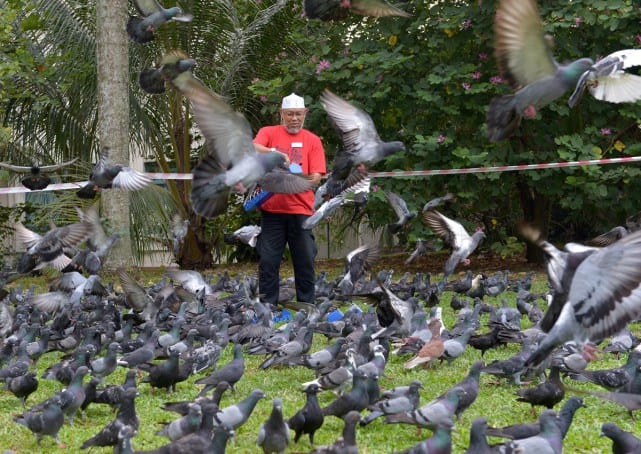
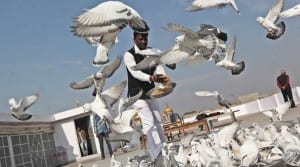
Ajay Sood is one amongst many professional Kabootarbaaz, whose family has lived in the gullies of the Dhobi Bada, Kinari Bazar in Old Delhi. Everyday, he spends hours training his flock of pigeons in kabootarbaazi. Express Photo by Tashi Tobgyal New Delhi 291215
Scarecrow Bird Scarer
OVERVIEW
‘The Scarecrow’ bird scarer is a multi-purpose bird and animal deterrent that is designed to be used in a garden to deter larger species of birds and animals. The Scarecrow bird scarer is a water-based deterrent that operates on a 24/7 basis and uses a passive infra-red motion sensor to detect both heat and movement. The Scarecrow bird scarer is triggered when the infra-red sensor beam is broken and the unit will shoot a stream of water, at garden hose pressure, for 3 seconds. The Scarecrow bird scarer then re-sets itself after 7 seconds. The Scarecrow bird scarer is designed to be used in a garden but could, in certain circumstances, be installed on a building as a pigeon control device. The Scarecrow bird scarer is sold with several decals that mimic the eyes and beaks of predatory birds. These decals are designed to be applied to the ‘head’ of the unit as an additional scaring technique but one supplier warns that these decals could scare small garden birds. If small birds are fed in the garden the decals should not be applied.

Scarecrow Bird Scarer
Mounting Bracket
The Scarecrow is powered by a 9-volt battery within the unit which powers both the infra-red sensor and the ‘high flow’ valve. The Scarecrow bird scarer will operate under normal circumstances for up to 6-months (or 3000 + activations) on one 9-volt battery. The Scarecrow’s water source is provided by a garden hose which is attached to a valve on the base of the unit. For larger areas several Scarecrows can be ‘daisy-chained’ using a single hose as the water source courtesy of the ‘flow through’ valve. The Scarecrow bird scarer will protect an area of up to 10 metres (90 square metres in total) from the unit in an arc ranging from 0°-300°. The Scarecrow bird scarer will use the equivalent of 2 – 3 cups of water during each activation making the unit extremely economical. The Scarecrow’s heat and motion sensor allow the unit to operate at night as well as during the day with the main benefit being the deterrence of nocturnal birds and animals.

Scarecrow Bird Scarer
Deterring Cat
The Scarecrow bird scarer is intended to operate at water pressures of between 30 and 80 psi (2-5.5 Bar) but if water pressure exceeds 80 psi it will be necessary to fit a pressure-reducing valve to the tap. The Scarecrow bird scarer cannot be operated in sub-zero temperatures or heavy frosts due to the potential for water to freeze in both the hose and the Scarecrow bird scarer unit itself. The infra-red sensor window on the top of the unit must be kept clean and free of dust and dirt in order to maintain maximum sensitivity. If operating in an area of hard water the sensor window will need extra attention to ensure that calcium does not build up on the lens. The Scarecrow bird scarer should not be pointed at flowing water, in the direction of a road with moving traffic or, if in a particularly windy area, in the direction of the prevalent wind. The unit may be triggered by any of the above. As false triggering of the unit reduces battery life, the on-board optics automatically reduce sensitivity to reduce false triggering of the unit during daylight hours. When false triggering occurs the unit will re-set itself to a lower sensitivity setting within 5 minutes.
The Scarecrow bird scarer is designed to be installed in a garden and therefore the base of the unit reduces to a spike so that the unit can be pushed into a lawn or flower bed. A footrest is provided near the base of the spike for the purpose of pushing the spike into the ground. An optional mounting bracket is also available that will allow the unit to be installed onto a vertical surface such as the wall of a house if no appropriate soft ground or lawn is available. This optional bracket could be used to install the device on any area of a building to deter pigeons from perching.

Scarecrow Bird Scarer
Deterring Dog
The Scarecrow must be assembled prior to use and once assembled the unit must be set-up to enable the unit’s sensor to ‘see’ the target species within its 10-metre operating range. This operation is undertaken via the unit’s sensitivity knob. The sensitivity settings allow the unit to be calibrated to ensure that the unit will operate effectively once motion or heat is detected within the 10-metre range. Once The Scarecrow bird scarer has been positioned correctly and calibrated for sensitivity, the arc and distance of the water spray must then be adjusted. When operating correctly the sprinkler head will cycle back and forth from side to side effectively protecting the 10-metre area in front of the unit.
One supplier of The Scarecrow bird scarer recommends that in order to mitigate water damage risks to the property, the amount of water available to the unit should be limited. This can be achieved by opening the hose valve to a maximum of ¾ of one turn, using a good quality hose pipe (or ideally using hard-plumbed irrigation pipes) and ensuring that the water pressure is within the normal operating range.
The Scarecrow bird scarer has some disadvantages in respect of its ability to provide year-round protection, particularly when used in a climate with cold winters. In some areas the unit will be out of action for 4-6 months due to the potential for frost damage and yet it is in the winter when birds need to forage more widely for food and therefore may become a problem in the domestic garden. Another minor disadvantage of The Scarecrow bird scarer is that the unit cannot face in the direction of a road where there is constant motion as this may trigger the device. Neither can the unit be used close to running water. This may reduce the potential for the unit to be used to protect ponds from predation by herons and the like. The Scarecrow bird scarer may also be triggered by human motion or pet activity in an adjoining garden.

Scarecrow Bird Scarer
The Scarecrow bird scarer may have one application that is not discussed by the manufacturer or its suppliers and that is for use as a pigeon deterrent on buildings. Clearly the unit would have certain limitations in this respect, particularly in relation to use over the winter and in sub-zero temperatures, but The Scarecrow bird scarer is available with a mounting bracket and providing that a water supply was readily available the unit could potentially be used for deterring pigeons from the roof of a building. Protecting the roof of a building from pigeon occupancy is one of the most challenging problems facing any property owner and yet The Scarecrow bird scarer appears to offer an extremely low-cost option. The conventional method of protecting the roof of a building is to install nylon bird netting but this product is not only extremely expensive to install, in most cases costing several thousand pounds, but the system is prone to failure if not maintained. The Scarecrow bird scarer may offer property owners a method of protection that could be used alongside anti-perching products such as the anti-roosting spike to provide a greater level of protection at a much lower cost. The Scarecrow bird scarer could also potentially be used to protect flat roof areas as well as light-wells and inner-courtyards, all areas which suffer extensively from pigeon-related problems. A further application for The Scarecrow bird scarer might be large flat roofs that are used by gulls for the purpose of nesting. Gull-related problems of this type cause major problems for property owners. The Scarecrow bird scarer is unlikely to be effective as a stand-alone deterrent in this application but if combined with anti-perching products and/or other scaring products the unit may have some value.
DEFRA’s view:
Water-based deterrents are not discussed on the DEFRA website.
Price range:
The Scarecrow bird scarer is widely available in the UK with a recommended retail price of £69.95 but The Scarecrow bird scarer can be sourced for as little as £54.00 from a UK-based supplier called ‘Deteracat’.
User reviews:
To date we have been unable to find any user reviews for The Scarecrow bird scarer but we will update this section as and when user reviews are made available to us. If you are able to provide a user review for The Scarecrow bird scarer please contact the Pigeon Control Resource Centre.
Comments from the Manufacturer/Distributor:
One US supplier of The Scarecrow bird scarer said the following of the product:
“The Scarecrow bird scarer protects any open area of the garden or yard that receives the unwanted attention of animals. Its sprinkler directs water accurately up to 10 m (35 feet), protecting a 90 square meter (1000 square foot) area. The Scarecrow bird scarer can see large animals farther away than it can small animals.”
“The Scarecrow bird scarer uses a passive infrared sensor to ‘see’ the temperature difference between an animal and the background. However, if the animal and the background are similar temperatures the Scarecrow bird scarer will have difficulty detecting movement.”
“When an animal or person moves into the field of view, the Scarecrow bird scarer notices the change and opens an electronic valve to release a three second burst of water through the sprinkler. The Scarecrow bird scarer then pauses for 8 seconds before resuming sensing. This pause creates an element of randomness and unpredictability preventing animals from becoming used to the device.”
One UK supplier of The Scarecrow bird scarer said the following of the product:
“The Scarecrow bird scarer is the smartest scarecrow ever invented. When it sees an intruder, it instantly sprays the trespasser with water under full garden hose pressure. It is completely harmless but extremely effective. The effect is both startling and immediate! Animals quickly get out of the area and avoid it in the future. Scarecrow protects day and night for up to 6 months (or 3000+ activations) on one 9 volt battery.”
“Besides being one of the most effective deterrents available today, the Scarecrow bird scarer is an alternative to smelly, poisonous, or visually disruptive products available. It is widely endorsed and less expensive than physical barriers. If you’ve tried other solutions that failed, you’re ready for a Scarecrow. You will love how it works! Sprinkler deters: Cats, Dogs, Rodents, Squirrels, Garden Pests, Deer, Rats/ Mice, Moles, Geese, Heron, Cranes or just about any outdoor animals!”
“Specifications: sensitivity setting, fully adjustable water spray up/down and side to side, battery operated; water conserving design (only uses about 2 cups of water per activation); runs for months, fires 100’s of time on a single 9v battery; safe and environmentally friendly; up to 10.5m (35 ft) range ahead and an impressive 50° either side of centre; go to bed at night knowing nothing is going into your flower beds!”
“Other reasons why the Scarecrow works:
- Training/repelling is consistent at the location, 24 hours a day.
- It is the environment rather than a person or other animal doing the ‘conditioning’.
- The water spray is sufficiently surprising and unpleasant to communicate an immediate, ‘Leave now’ message. Sudden unexpected noise unexpected movement, and water spray.
- The animal immediately associates this unpleasant experience with the location. To avoid similar surprises, they begin to avoid the area. While humans flee several steps after activating a Scarecrow motion-activated sprinkler, animals are scared to a much greater degree, run much further and stay away longer. We attribute this difference in part to the inherent fight or flight survival response found in most animals and their lack of intelligence or ability to figure out what caused the annoying noise and motion.
- Fully Automated.
- Safely and effectively repels animals without chemicals, visually objectionable barriers or shock. Operates unattended and ‘sprays’ when movement is detected (Day and Night).
- Works when motion is detected.
- Scarecrow bird scarer protects day and night for up to 6 months (or 3000+ activations) on one 9 volt battery.
- 2 year warranty.”
Editorial comments:

Scarecrow Bird Scarer
Deterring Dog
The Scarecrow bird scarer is a unique and well designed deterrent that can be used for both the control of birds and animals in a variety of environments. The main application for The Scarecrow bird scarer is the domestic garden where scaring larger species of birds and cats is the main requirement but the unit also has the potential to be used as part of a conventional pigeon or gull control system. The Scarecrow bird scarer is inexpensive to purchase at just over £50.00 and as a result must be seen as worthy of a trial on the basis of cost alone.
The Scarecrow bird scarer is straightforward to use but setting up the unit may require some time and patience. Once The Scarecrow has been assembled and positioned correctly, the sensitivity must be set to ensure that the unit can ‘see’ the target species within its 10-metre operating range. Once the sensitivity has been set the arc and distance of the water spray must then be set. Once these parameters have been correctly set the unit is more or less maintenance-free. The unit can be switched off to allow the user to enter the area protected by The Scarecrow bird scarer without triggering the unit. The one main requirement for The Scarecrow is an outside tap as the unit needs the benefit of mains water pressure to operate. Due to the fact that The Scarecrow bird scarer is a water-based device and requires a hose to feed the unit one minor disadvantage of the product is that it cannot be used in frost or in sub-zero temperatures. This may or may not be a disadvantage based on the proposed usage. Another potential disadvantage of The Scarecrow bird scarer is the fact that the unit may be triggered by passing traffic on a road or by activity in a neighbouring garden. In most domestic applications, however, these issues should not be a problem.
If larger areas need to be protected, such as large gardens or possibly flat roof areas on a building, The Scarecrow bird scarer has the added advantage of being simple to ‘daisy-chain’ with additional units. Due to the fact that the device uses mains water pressure one hose will service countless units for more extensive applications. The Scarecrow bird scarer is extremely economical product where both power and water usage is concerned with the unit operating for up to 6-months on one 9-volt battery and only using 2-3 cups of water per spray.
The Scarecrow bird scarer is an extremely versatile device offering limitless applications for the domestic user as well as having the potential to be used commercially for the control of pigeons and gulls. Clearly the only limiting factor is the need to have a water supply close to hand (and where the domestic garden is concerned an outside tap), but in most cases this should not be a problem. Even in the event that an outside tap will need to be installed in order to install and operate the device, the effectiveness of the product and the low purchase price would almost certainly justify the outlay.
Also commonly known as:
Water jet, water scarecrow, hose spray, water gun, cat spray, water spray gun, water deterrent, scarecrow water jet, scarecrow sprinkler, scare crow water jet
Relevance to pigeon control:
‘The Scarecrow’ is a general bird scarer and although there is potential for the product to be used for the control of pigeons it is not commonly used for this purpose
About Pigeon Patrol:
Pigeon Patrol Products & Services is the leading manufacturer and distributor of bird deterrent (control) products in Canada. Pigeon Patrol products have solved pest bird problems in industrial, commercial, and residential settings since 2000, by using safe and humane bird deterrents with only bird and animal friendly solutions. At Pigeon Patrol, we manufacture and offer a variety of bird deterrents, ranging from Ultra-flex Bird Spikes with UV protection, Bird Netting, 4-S Gel and the best Ultrasonic and audible sound devices on the market today.
Voted Best Canadian wholesaler for Bird Deterrent products four years in a row.
Contact Info: 1- 877– 4– NO-BIRD (www.pigeonpatrol.ca)
by Pigeon Patrol | Jan 2, 2016 | Bird Netting, Pigeon Patrol's Services, Pigeon Spikes
 Flashing Buddha Eyes
OVERVIEW
Flashing Hawkeye (FHE) and Flashing Buddha Eyes (FBE) are two visual scaring products produced by a UK-based company that combine the use of mirrors and predator/human images with movement to deter a wide variety of birds. Although both products would normally be associated with use in agricultural applications, where they can be extremely effective, the addition of a roof-mounted option renders both products considerably more versatile. Both the FHE and the FBE are effectively identical products but with different scaring images. The FHE uses a predator image for scaring and the FBE uses a human image – both images use bright primary colours to increase effectiveness.

Flashing Hawk Eyes
Both products comprise a plastic thermoformed aerofoil-shaped board, printed with images of predator eyes or human (Buddah-type) eyes, mounted on a metal post. Below the board a series of 4 reinforced high-impact mirrors are provided in a pyramid-shape and at an angle of approximately 45°. Both the board and the mirrors rotate courtesy of a series of high-quality sealed bearings in a bracket at the top of the post and according to the manufacturer will rotate in even the lightest wind. The products are solely wind powered with no motor or mechanical drivers. As the units rotate in the wind the light reflected from the mirrors produces a bright flash, even in dull or cloudy conditions, which can be seen from a considerable distance. The flash of the mirrors combined with the flashing colourful images printed on the board (at a rate dictated by wind speed) will have the effect of making any birds in the vicinity feel unsafe.

Flashing Hawkeye
on Roof
Both products are extremely simple to install irrespective of which installation option is chosen. For ground installations the unit is quick and easy to install via the optional and inexpensive post driving and crossbar/post removal tool. The post driving and crossbar/post removal tool (weighing 4.25 kilos) is a robust metal bar with a crossbar at one end which allows the user to drive the central post into the ground by pumping the bar up and down. The same tool allows the unit to be removed, with relative ease, from the ground. Both the FHE and the FBE have a finned spike base, which ensures that once the post is driven into the ground it will remain in situ and continue to stand upright even in strong winds. This is because the fins on the spike stop the unit from moving laterally once installed into the ground.

Flashing Buddha
Eyes in Field
In order to operate as designed both the FHE and the FBE must be installed vertically. Once the spike has been driven into the ground a spirit level must be used on each side of the base of the spike to ensure that the unit is standing at 90°. Once the unit is standing vertically the final adjustment is made courtesy of 4 adjustable locking screws located at the base of the unit. Assuming that the unit is provided in a vertical position even the lightest wind will rotate the board and mirrors.
The major benefit of the FHE and the FBE is complete lack of running costs. No batteries to charge or power sources to worry about, the unit will continue operating 24/7 with little or no human interaction required other than to check the vertical alignment of the unit periodically to ensure that it is maintaining its vertical position. Of course the downside of this is that the unit will not operate on days when there is no wind. The FHE and FBE will be effective on cloudy days, according to the manufacturer, and even at night as the mirrors will reflect light from the moon as well as the sun. This would allow the unit to be used against night-time predation of crops or fish from fish farms. Another major advantage of the FHE and the FBE is completely silent operation, allowing the unit to be used in areas of human habitation.
Applications for the FHE and the FBE include use with all types of arable crops, vineyards, horticultural applications, landfill sites, fish farms and as scarers for the protection of soft fruit. Both products can also be used in urban and semi-urban applications courtesy of the roof-mounted model, which allows the unit to be installed on the roof of an industrial building or any commercial site where the reflection of the mirrors will not cause human disturbance. The roof-mounted option differs from the ground spike-mounted option in that the vertical post is considerably shorter than the ground spike-mounted post (which stands at chest height). The plastic aerofoil-shaped board on the roof-mounted version also has a lower profile than the ground spike-mounted board. This is to reduce wind resistance and potential damage to the board in extremely strong winds based on the fact that the unit will be provided at height. The special bracket supplied with the roof-mounted model provides the user with a number of mounting options, further increasing the versatility of the product, certainly where installation is concerned. The FHE and FBE can be installed in the following ways when using the mounting bracket:
- on a flat vertical surface
- into the corner formed by two adjacent vertical surfaces
- onto the top of a wall/post and embracing the two adjacent vertical sides of a corner

Flashing Hawkeye
in Field
Although bird scarers are normally designed and used in rural and agricultural applications where they are considered to be reasonably effective as part of an overall scaring operation, their use in urban environments is less common. This is, in the main, due to their potential for human disturbance. The FHE and FBE roof-mounted models are designed to be used in this application, which sets them aside from conventional scaring products. The most obvious problem associated with their use in urban environments is the flashing created by the mirrors revolving and the potential for the visual disturbance of motorists and those within line of sight of the product. Other than this potential problem there would appear to be no reason why the FHE and FBE could not play a major scaring role as part of an existing control system. Although the product could be used as part of a pigeon control system it is more likely to be effective for the control of roof-nesting gulls. The fact that the unit employs movement combined with two types of visual stimulus make it a good option for gull control.
Habituation is an ongoing problem with all scaring products, but the added advantage of the FHE and FBE is movement. Not only do the units revolve in light winds but, unlike many scarers with flashing lights, the FHE and FBE are intermittent in operation, certainly in as much as they will speed up and slow down according to the strength of the wind or stop if there is no wind at all. A light that flashes constantly and with timed flashes will be habituated to far more quickly than an intermittent light source.
This straightforward and well-designed product has a number of applications for a variety of different birds, making it a good choice for anyone experiencing problems with more than one species. The product is also sensibly priced, making it a good option to trial – if it proves to be ineffective the loss will not have been great. As with all the products manufactured by this company, high quality components have been used and although the products could have been produced at a lower price point, the emphasis has been placed on quality, not price. Whether the product proves to be visually disturbing in urban applications is an unknown, but even if the product can be used on industrial sites where human disturbance would be kept to a minimum, it would be an interesting and potentially effective tool.
DEFRA’s view:
The Department of the Environment, Food and Rural Affairs (DEFRA) is the UK’s Government body that oversees the Wildlife and Countryside Act and produces legislation to which the pest control industry must adhere. The following information is taken from a document provided on the DEFRA website entitled ‘Review of international research regarding the effectiveness of auditory bird scaring techniques and potential alternatives’ by J. Bishop, H. McKay, D. Parrott and J. Allan.
As both products involve the use of both mirrors and (in the case of Flashing Hawkeye) raptor images we have included relevant sections on both types of scaring:
Reflective Mirrors
Mirrors and reflectors work on the principle that sudden bright flashes of light produce a startle response and drive the bird from an area. However, the response of free-living birds to mirrors has been investigated in only a handful of species.
Foraging by black-capped chickadees Parus atricapillus at feeding stations was depressed by the presentation of either a standard mirror or an aluminium foil covered mirror; feeding was depressed the most by the standard mirror (Censky & Ficken 1982). When placed in nesting territories mirrors evoked aggressive responses from blue grouse Dendragapus obscurus (Stirling 1968) and glaucous-winged gulls Larus glaucesens (mirror combined with playback of gull calls) (Stout et al. 1969).
Reflective objects have been reported as being effective in deterring raptors, such as sparrowhawks and goshawks, from game release pens. Experiments in Europe showed that large silvered balls were effective in protecting reared game and chickens from diurnal raptors, particularly sparrowhawks and goshawks (Mansfield 1954; Pfeiffer & Keil 1963, cited in Lloyd 1976). Various gamekeepers in the UK also advocate the use of reflective objects. Opportunistic trials using such suspended materials successfully ended sparrowhawk predation at three different release pens.
Mirrors and reflectors have also been found to be inexpensive but effective against waterfowl, gulls and some herons (Greer and O’Connor 1994 cited in Reilly 1995). However, although aluminium pie plates suspended on varying lengths of twine deterred some waterfowl species, ducks were regularly seen to swim within 4-5 m of the reflectors (Boag and Lewin 1980).
In a survey of 336 fish hatchery managers in eastern USA, eight reported using tin reflectors of which seven said they had limited or no success as a depredation control technique (Parkhurst et al. 1987). In the same survey only one manager used mirrors and that was unsuccessful. Mirrors placed inside nest-boxes did not deter starlings from nesting within (Seamans et al. 2001).
A device consisting of a rotating pyramid of mirrors has been recommended for preventing crow damage to seedling corn (Anon. 2002d). This device is available in the UK and the manufacturer claims it is effective over four hectares against pigeons, blackbirds, starlings and crows on a variety of crops, but no scientific research has been can carried out to substantiate these claims (Anon. 2000a).
Although easy and inexpensive to put up and easy to relocate, the effectiveness of mirrors and reflectors as a bird scaring technique is variable. As they are only effective when they reflect sunlight and so are useless before sunrise (Nakamura 1999), they are best combined with other methods of scaring.
Raptor models
The basis for this deterrent is mimicry of real predators and evocation of fear and avoidance in the target species. Most potential prey species react to predator models; the strength of the response, however, varies between species (Conover 1979), and in some cases raptor models can attract rather than repel birds as species like blackbirds and crows often mob owls or owl models (Conover 1983, cited in Harris and Davis 1998).
Model raptors fail to incorporate behavioural cues, which may be critical to the induction of fear and avoidance in the target species. Falcons which are “in the mood” to hunt are said to be “sharp set”; such bird are invariably hungry enough to fly at quarry. Although it is difficult for human observers to differentiate between a falcon when it is sharp set and conversely well fed, birds will mob a hawk more frequently when sharp set than when well fed. Thus, model raptors will be inherently less threatening and consequently less effective than live raptors (Inglis 1980).
In the USA, museum-mounted models of a sharp-shinned hawk Accipiter striatus and goshawk Accipiter gentilis both reduced the numbers of birds visiting feeding stations. Habituation to the models, however, was relatively quick with birds reentering the feeding area after only 5-8 hours exposure (Conover 1979).
For some bird species the avoidance response to large avian predators appears to be, in part, a learned behaviour. Juvenile gray jays Perisoreus canadensis showed little response to a model great horned owl Bubo virginianus, whereas adult jays reacted intensely (Montevecchi & Maccarone 1987). Interestingly, with repeated exposure, juveniles developed a greater fear toward the model whereas adults habituated to the decoy.
As for scarecrows, movement can enhance scaring effectiveness. An animated crowkilling owl model was more effective in protecting vegetable plots from crows than an unanimated model (Conover 1985). This model consisted of a plastic owl model with a plastic crow model in its talons that either had wings that moved in the breeze or battery-powered wings that could move in the absence of wind. Both versions of this device reduced crop damage by 81%. The deterrent effect was maximised by combining movement with an implicit risk. No indication is given of how long the deterrent effect lasted.
In general, raptor models are inexpensive (£5-£25 for plastic owl models, Network Pest Control Systems Ltd.) and easy to deploy. Their effectiveness is increased if they are animated and if they are moved frequently. However, birds quickly learn that the model poses no threat and rapidly habituate to it.
Price range:
Flashing Hawkeye/Flashing Buddha Eyes for ground mounting: £134.00 + VAT
Flashing Hawkeye/Flashing Buddha Eyes for roof mounting: £151.00 + VAT
Optional post driver and crossbar/post removal tool: £16 + VAT
User reviews:
To date we have been unable to find any user reviews for Flashing Hawkeye or Flashing Buddha Eyes but we will update this section as and when user reviews are made available to us. Anybody that can provide a user review for Flashing Hawkeye or Flashing Buddha Eyes please contact the Pigeon Control Resource Centre.
Comments from the Manufacturer/Distributor:
The following information about the use of Flashing Hawkeye and Flashing Buddah Eyes is taken from the scaringbirds.com website:
“The Flashing Hawkeye (and Flashing Buddah Eyes) with mirrors comprises a thermoformed aerofoil-shaped board which is secured in a bracket mounted on the top of a metal post which revolves in the lightest wind on high quality sealed bearings. Hanging downwards from the same bracket is a multi-angled series of reinforced high impact mirrors shaped like a lampshade which rotate with the aerofoil board.
As the Flashing Hawkeye revolves in the wind, it reveals an image of a pair of menacing and vibrant coloured predator’s eyes in contrasting colours on either side which gives a blinking effect as it rotates. At the same time, the mirrors provide a powerful and very eye-catching flash which can be seen at great distances, thus protecting large acreages. In conditions of bright sunlight, this can be equivalent to looking directly at the sun, but even on more overcast days and at first light of dawn, it reflects sufficient light to be significantly eye-catching. It can also be effective at night time under a full moon when it can resemble a flash from a powerful torch.
The optional driving tool and crossbar/post remover is a heavy bar with a cross-bar fitted through one end which provides an easy way of driving the post into the ground by pumping the bar up and down in the mouth of the post. Just as importantly, it enables the spike to be moved without resort to lever bars and spades. This is achieved by inserting the crossbar through the side of the metal ground spike, thus providing a horizontal surface against which to swing upwards with the heavy bar and the spike then lifts out with comparative ease.”
Editorial comments:

Flashing Buddha
Eyes in Field
Bird scarers are not normally associated with use in urban areas and this is what sets the FHE and the FBE apart from a majority of other scaring products. As scarers for agricultural applications the FHE and the FBE offer the user a good solid product that has been designed and manufactured to stand the test of time rather than being manufactured to a price. Even so, the units are relatively inexpensive to purchase, with the optional post driver offered at an extremely keen price, allowing for quick and easy installation and removal.
Habituation is always a worry with scarers and no more so than with the roof-mounted model due to the fact that the installation bracket supplied with this model requires a permanent fixing. Therefore, if the product has to be moved due to habituation, or for any other reason, it is likely that another suitable site will need to be found where the bracket can be installed. This may not always be easy. The advantages of a heavy-duty mounting bracket, however, is that it will provide the unit with an extremely strong base and dramatically reduce the potential for the product to be blown down in high winds, a constant headache with wind-powered scarers. The mounting bracket also allows for a variety of fixings into different surfaces, which increases its versatility where re-siting is concerned.
The unit may cause human disturbance in urban areas and this may restrict its use, but in the event that the Hawkeye or Buddah eye images are effective in their own right, the mirrors could be blanked off to stop reflected light causing problems. It may even be possible to detach the mirrors altogether. Movement is a critical factor when scaring birds and intermittent movement is much more effective than pre-timed operations from battery or mains powered devices. Due to the high quality bearings used for the FHE and the FBE the unit will revolve in very little wind and if installed on top of a building, where there is usually considerably more wind than at ground level, the unit should continue to move even on still days. On a windy day the unit will revolve a staggering 70,000+ times a day.
The FHE and the FBE are not guaranteed to be effective, neither will they be effective as a stand-alone bird control, but they represent excellent value for money and have the potential to be effective in a wide variety of applications. Of all the bird scarers this is one of the most simple to power and install and other than regular checks to ensure the product is aligned correctly to the vertical, it can be left to operate without human interaction. When compared to the excessively high price of some bird scaring products, particularly electronic products, the cost of the FHE and FBE pale into insignificance and must be worth consideration as a result.
Sources:
DEFRA quotes:
PDF on DEFRA website entitled: ‘Review of international research regarding the effectiveness of auditory bird scaring techniques and potential alternatives.’ By J. Bishop, H. McKay, D. Parrott and J. Allan.
Also commonly known as:
Mirror scarers, flashing scarers, wind scarers, predator scarers, flashing hawks, human scarers, scarecrows, predator scarecrows
Relevance to pigeon control:
Both products are suitable for use as general scarers in virtually all agricultural applications and with all species of birds. The roof-mounted version of the products can be used to scare both feral pigeons and gulls in urban applications
About Pigeon Patrol:
Pigeon Patrol Products & Services is the leading manufacturer and distributor of bird deterrent (control) products in Canada. Pigeon Patrol products have solved pest bird problems in industrial, commercial, and residential settings since 2000, by using safe and humane bird deterrents with only bird and animal friendly solutions. At Pigeon Patrol, we manufacture and offer a variety of bird deterrents, ranging from Ultra-flex Bird Spikes with UV protection, Bird Netting, 4-S Gel and the best Ultrasonic and audible sound devices on the market today.
Voted Best Canadian wholesaler for Bird Deterrent products four years in a row.
Contact Info: 1- 877– 4– NO-BIRD (www.pigeonpatrol.ca)
by Pigeon Patrol | Jan 1, 2016 | Animal Deterrent Products, Bird Netting, Pigeon Patrol's Services
 Council officers say they think killer bait has been put down to tackle pigeons – but warn it is a danger to children, pets and wildlife
Lives have been put at risk after rat poison was scattered on a busy city street, say council officers.
Twice this week large quantities of pellets were found on the pavement of Great Cheetham Street East in Higher Broughton, Salford.
It is suspected it was put down to kill pigeons but the council says the culprits are putting local children, pets, and wildlife at risk – and say the bait is not effective for tackling pigeons.
They have warned that those responsible could face criminal charges for littering and are asking the public to come forward with information to help catch the culprit.
A spokesman for Salford council said: “We’ve had four previous reports of someone scattering rat poison pellets in Great Cheetham Street East at the junction with Bevendon Square, near the Oriental Pearl takeaway.
“We cleaned it up on Monday and the following day had to go back again and clean up an even more widespread scattering. We estimate about half a bucket load was put down.
“We’re not sure why someone would do such an irresponsible thing but we suspect they think it will kill pigeons roosting on the roof of the Oriental Pearl takeaway.
“The pigeons are unlikely to touch pellets like this but if children or pets or wildlife ate a lot of them they could become seriously ill.
“The most effective way to get rid of pigeons is for local people to stop feeding them. People may think it’s harmless to throw a bit of bread out for the pigeons or throw down bits of their lunch for them but it only encourages them to hang around the area. If there is no food for them they will move on elsewhere.
“Though these pellets are widely available to the public, council officials only use them after a careful risk assessment.
“We make sure they are placed where rats and mice can get to them but other wildlife and humans can’t. To simply throw them down in the middle of a busy street is totally irresponsible and it must stop immediately.”
The pellets are thought to contain difenacoum which has been used in Europe for over 30 years and is particularly effective against rodents.
However it is a potent poison for all mammals and should be kept well away from non-targets animals and humans. Anyone with any information should call 0161 909 6500
About Pigeon Patrol:
Pigeon Patrol Products & Services is the leading manufacturer and distributor of bird deterrent (control) products in Canada. Pigeon Patrol products have solved pest bird problems in industrial, commercial, and residential settings since 2000, by using safe and humane bird deterrents with only bird and animal friendly solutions. At Pigeon Patrol, we manufacture and offer a variety of bird deterrents, ranging from Ultra-flex Bird Spikes with UV protection, Bird Netting, 4-S Gel and the best Ultrasonic and audible sound devices on the market today.
Voted Best Canadian wholesaler for Bird Deterrent products four years in a row.
Contact Info: 1- 877– 4– NO-BIRD (www.pigeonpatrol.ca)
by Pigeon Patrol | Dec 31, 2015 | 4-S Gel Bird repellent, Animal Deterrent Products, Bird Netting, Pigeon Patrol's Services
 Earlier this week Senator Denis O’Donovan became the second Fianna Fail senator to raise the issue of tackling the “vicious seabird”.
Speaking in the Seanad he said that seagulls were “invading the towns and the villages.”
“Seagulls have actually killed lambs and they’ve killed rabbits and I think it is coming to the stage where they are actually endangering society,” Mr O’Donovan said.
He added that “maybe we should look at a cull on this vicious seabird.”
However, animal rights organisation Aran has said that killing the animals won’t keep them away from urban areas.
“Calling for an all-out assault on seagulls is completely irresponsible, cruel and short-sighted,” Aran said in a statement.
The group highlighted that nothing has been done to tackle the real problem of people and businesses leaving out rubbish which “lures the birds in.”
The statement continues: “We are destroying their ecosystem and taking their food from the seas to feed ourselves and the gulls are only doing what is necessary to them by coming inland to try and get food.
“Maybe we, as in society, should take a step back from sucking our seas dry of marine life and letting the fish to the birds and laying off.
“Maybe laying off Senator O’Donovan might not be a bad thing either.”
Speaking to UTV Ireland Senator O’Donovan said some of his comments in the Seanad have been misconstrued.
“I haven’t called for the army to come in. I don’t agree with killing seagulls but a cull can be done in a different way.”
“Their [Aran] response by attacking me is not the response I have been getting from the public,” he added.
He said he had asked for a debate on the issue in the Seanad, and unless a solution can be put forward “people will take the law into their own hands” by poisioning and shooting the animals.
Asked if he would accept Aran’s offer to help draft a humane plan, he said: “I’m willing to meet with them once they acknowledge there is a problem.”
Last year Senator Ned O’Sullivan told the Seanad seagulls had “lost the run of themselves” – and were taking lollipops from young children.
Mr O’Sullivan said while the topic might seem funny to some it was a serious issue in Dublin.
Speaking to UTV Ireland, an expert from Rentokill explained that seagulls are actually protected under animal protection laws.
He admitted the company do receive callouts regarding the marine bird, but rather than killing them there are non-deadly methods like nest removal, netting, bird repellent gels and larus gull wires.
The stainless steel spring wires are apparently effective in preventing birds from roosting on exposed ledges and rooftops.
Nest removal, meanwhile, requires permission under Section 22 of the Wildlife Act.
Removing the habitat without sanction is an offence and breaks wildlife conservation legislation.
“There are very high populations [of seagulls]. Climate and behaviour wise these birds are becoming more established.”
“But from that point of view we are encroaching, we provide food,” he said.
Regarding any cull of the bird, he added that “the last you want to do is to kill, and you have to look at other methods first.”
He said the best course of action would be for an environmental assessment to be carried out, to see how bird populations could be reduced.
About Pigeon Patrol:
Pigeon Patrol Products & Services is the leading manufacturer and distributor of bird deterrent (control) products in Canada. Pigeon Patrol products have solved pest bird problems in industrial, commercial, and residential settings since 2000, by using safe and humane bird deterrents with only bird and animal friendly solutions. At Pigeon Patrol, we manufacture and offer a variety of bird deterrents, ranging from Ultra-flex Bird Spikes with UV protection, Bird Netting, 4-S Gel and the best Ultrasonic and audible sound devices on the market today.
Voted Best Canadian wholesaler for Bird Deterrent products four years in a row.
Contact Info: 1- 877– 4– NO-BIRD (www.pigeonpatrol.ca)
by Pigeon Patrol | Dec 30, 2015 | Bird Netting, Pigeons in the News, UltraSonic Bird Control
 SWANSEA Council has denied its fines for feedings birds could be offensive to some religions.
It follows a decision by Conwy Council not to impose such fines for just that reason.
The north Wales council tweeted that it had been told there was a right to feed birds in certain religions.
But a spokesman for the Swansea authority said: “The council has never been advised of any aspect of feeding birds being related to religion.”
Seagulls and pigeons have become a menace in the city centre with people complaining they are being dive-bombed by the birds and having their food stolen.
Now, anyone caught feeding the birds in the city centre could face a £75 fine.
“However, it is worthwhile noting that the rules do not prevent people from feeding birds, including pigeons and gulls, in Swansea as they only apply in places like the city centre,” added the council spokesman.
“They do not affect people feeding birds on their own property or land.”
He said gulls and pigeons left a mess on shops and street furniture and food on the ground encouraged more of them to circle the city centre.
“There have even been cases where people say they have been attacked by gulls in the city centre for their snacks.”
But he added: “People issued with fixed penalty notices are entitled to appeal against the decision.”
About Pigeon Patrol:
Pigeon Patrol Products & Services is the leading manufacturer and distributor of bird deterrent (control) products in Canada. Pigeon Patrol products have solved pest bird problems in industrial, commercial, and residential settings since 2000, by using safe and humane bird deterrents with only bird and animal friendly solutions. At Pigeon Patrol, we manufacture and offer a variety of bird deterrents, ranging from Ultra-flex Bird Spikes with UV protection, Bird Netting, 4-S Gel and the best Ultrasonic and audible sound devices on the market today.
Voted Best Canadian wholesaler for Bird Deterrent products four years in a row.
Contact Info: 1- 877– 4– NO-BIRD (www.pigeonpatrol.ca)
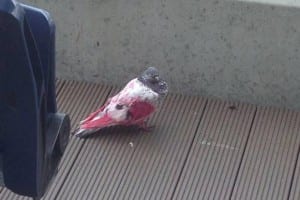
by Pigeon Patrol | Dec 29, 2015 | Animal Deterrent Products, Bird Netting
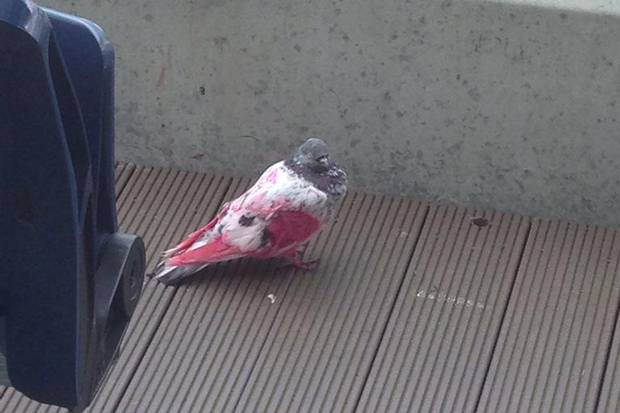
 People are being warned not to dye pigeons pink after several of them were spotted in London and around the UK.
The brightly-hued pigeons have been spotted as far north as Northumbria, and as far south as Bristol, with sightings of the birds also reported in Manchester, West Yorkshire, and in London.
Pink pigeons were first seen in Walthamstow and at Royal Ascot last month, and the sightings continue, with a bird spotted in Stockport, Greater Manchester just two days ago.
Pictures of the birds have been posted on twitter, with people cooing over their distinctive plumage.
Pink Pigeon in Liversedge in Kirklees, Yorks
A pigeon in Kirklees, West Yorkshire (Ashleigh Richardson)
However, the birds have ruffled feathers at the RSPCA, where it is suspected fowl play may be behind the unusual colouring.
A spokeswoman said: “This is a cruel and unnecessary thing to do to an animal.
“Dyeing a bird could cause allergic reactions and compromise the animal’s’ ability to communicate with other animals of their own and other species and make them more vulnerable to predators.”
About Pigeon Patrol:
Pigeon Patrol Products & Services is the leading manufacturer and distributor of bird deterrent (control) products in Canada. Pigeon Patrol products have solved pest bird problems in industrial, commercial, and residential settings since 2000, by using safe and humane bird deterrents with only bird and animal friendly solutions. At Pigeon Patrol, we manufacture and offer a variety of bird deterrents, ranging from Ultra-flex Bird Spikes with UV protection, Bird Netting, 4-S Gel and the best Ultrasonic and audible sound devices on the market today.
Voted Best Canadian wholesaler for Bird Deterrent products four years in a row.
Contact Info: 1- 877– 4– NO-BIRD (www.pigeonpatrol.ca)
by Pigeon Patrol | Dec 28, 2015 | Animal Deterrent Products, Bird Netting, Pigeon Patrol's Services, Pigeon Spikes
 MONDOVI, Wis. (WEAU) — It looks like a scene from Alfred Hitchcock’s famous movie “The Birds,” pigeons flying from building to building in downtown Mondovi.
“I look up and the pigeons are kind of swooping around and I have to dodge in the door really quick because they’re really creepy,” said Heidi Michels of Mondovi.
People aren’t taking issue with pigeons’ creepiness, but rather what they are leaving behind.
Tuesday night, the Mondovi City Council will meet to talk about some options to get rid of the birds.
“The droppings were getting dragged into my business on my carpet and it’s just a mess and it’s really gross,” said Lorie Larson.
Larson has owned Petal Pusher Floral and Gifts for five years.
“I would have to clean my sidewalks at least twice a week with bleach water because the pigeon droppings were so bad,” Larson said.
“They like to roost and sit at the very top,” Brian Evans explained, talking about the top of his building.
“We had a lot of issues with droppings and being on the sidewalk and having to scrape them up,” Evans said.
This isn’t the first time the city has had an issue with pigeons.
“We tried Owl decoys, we had some stuff you painted on the sills (window sills) downtown. It was supposed to give them discomfort in their feet,” said City Administrator Dan Lauersdorf.
Lauersdorf explained the city is also dealing with a geese dropping issue.
“They’re dropping their droppings all over the park; I don’t know how you get them out of there,” Lauersdorf said.
No decisions will made at Tuesday night’s meeting, but Lauersdorf says cost will be a factor in the option the city chooses.
About Pigeon Patrol:
Pigeon Patrol Products & Services is the leading manufacturer and distributor of bird deterrent (control) products in Canada. Pigeon Patrol products have solved pest bird problems in industrial, commercial, and residential settings since 2000, by using safe and humane bird deterrents with only bird and animal friendly solutions. At Pigeon Patrol, we manufacture and offer a variety of bird deterrents, ranging from Ultra-flex Bird Spikes with UV protection, Bird Netting, 4-S Gel and the best Ultrasonic and audible sound devices on the market today.
Voted Best Canadian wholesaler for Bird Deterrent products four years in a row.
Contact Info: 1- 877– 4– NO-BIRD (www.pigeonpatrol.ca)
by Pigeon Patrol | Dec 27, 2015 | Animal Deterrent Products, Bird Deterrent Products, Bird Netting, Pigeon Patrol's Services
 If it seems there are a lot less pigeons in Washington Square Park, it’s because there are.
Earlier last week, on Tuesday afternoon, birdnappers were reportedly out in force on the park’s far west side. In an orchestrated maneuver taking just minutes, the peaceful pigeons were lured to a spot near the Washington Place park entrance, where they were captured by net — they netted three batches — and then whisked away in a van.
Larry the Birdman was near the fountain and missed the abduction of possibly more than 200 birds.
“It happened so fast,” he said. “It was a silver-colored van.”
One member of the cadre who hang out on the park’s western side near the Holley monument said, “We know these birds and some of us have relationships with individual birds.”
Doris Deither, a Community Board 2 member, is among the F.O.B. (Friends of the Birds). She said the pigeon she calls Opal likes her and comes to her as she walks assisted by a walker. Deither said, thankfully, “her bird” is still in the park.
“But they got two of William’s birds,” she said, explaining that William cares for pigeons that are injured.
Seven years ago, the New York Post wrote about “pigeon netting,” the black-market act of snatching pigeons off the streets and selling them for $5 and $10 each, mostly to legal, out-of-state (frequently Pennsylvania) pigeon shoots.
It was believed that the purloined Washington Square pigeons were destined for a similar fate. Diether said word was that the van had New Jersey license plates.
Phew! Some of the lucky survivors, thanking their tail feathers they weren’t scooped up by the birdnappers.
Phew! Some of the lucky survivors, thanking their tail feathers they weren’t scooped up by the birdnappers.
Saturday afternoon at the Holley bust, a memorial service was held for the avian abductees organized by Tina Trachtenberg, an artist and animal advocate. She creates the felt pigeons at Washington Square.
Days later, flowers marked the memorial site and a weathered sign read: “This park is a safe haven for many animals. Today we mourn the tragic death of 200-300 resident pigeons. We loved and cherished their magical presence. They will be deeply missed.”
By Tuesday, flowers and sign were gone.
Joyce Friedman the New York City coordinator at The Humane Society of the United States, read on social media about the memorial and came to the park to learn more.
“I reported it to the N.Y.P.D. Animal Cruelty Investigation Squad,” she said. “We can’t give out any more detailed information, because now it’s an ongoing investigation.”
She reiterated that the investigating officers take it seriously, also mentioning that the same sort of birdnappings took place a couple months ago on the Upper West Side and are also under investigation.
For four days, Tuesday through Friday, security at the Parks Department office at Washington Square Park, the bicycle police on patrol and police in a van watching on Sunday morning were totally unaware of the birdnapping. As of this Tuesday, not all the local patrolling police or Parks employees were aware of the nefarious netting.
However, on Tuesday, Parks spokesperson Crystal Howard warned the pigeon pluckers to beware.
“Don’t steal our animals!” she said in a phone interview. “Pigeons are core to the character of New York City, and it is illegal and dangerous to remove animals from New York City parks.”
Friedman also emphasized that birdnapping is illegal.
“If you see someone doing it, take a picture of the license plate,” she said. “Then call 911. If you become aware afterward, report it by calling 311.”
Early Sunday evening, Haley, a friend of Larry, swung by the park to see if he was all right.
Larry now sits on his usual bench, but no longer bedecked with birds, keeping a vigilant eye on the park’s Washington Place entrance to see if there are any more lurking vans.
“There are surveillance cameras,” he said, hoping they would have caught useful information to bust the birdnappers.
About Pigeon Patrol:
Pigeon Patrol Products & Services is the leading manufacturer and distributor of bird deterrent (control) products in Canada. Pigeon Patrol products have solved pest bird problems in industrial, commercial, and residential settings since 2000, by using safe and humane bird deterrents with only bird and animal friendly solutions. At Pigeon Patrol, we manufacture and offer a variety of bird deterrents, ranging from Ultra-flex Bird Spikes with UV protection, Bird Netting, 4-S Gel and the best Ultrasonic and audible sound devices on the market today.
Voted Best Canadian wholesaler for Bird Deterrent products four years in a row.
Contact Info: 1- 877– 4– NO-BIRD (www.pigeonpatrol.ca)
by Pigeon Patrol | Dec 26, 2015 | Bird Deterrent Products, Bird Netting, UltraSonic Bird Control
 A gullA gull
If you are about to take a holiday in Cornwall beware – the gulls there are said to be on the warpath. Local papers in the south west are full of stories about them robbing people of ice-creams and other snacks, and generally making a nuisance of themselves.
At first sight there is nothing really unusual about this. So far as I am aware gulls have always behaved like this, both here and in other parts of the world. They are very general feeders and instinctive raiders, taking food not only from us but also from other birds. What seems to be different in this case is that most unfortunately (and unusually) they are said to have killed both a small dog and a tortoise. This is enough to involve the Prime Minister: David Cameron has said, somewhat patronisingly, that we need a ‘big conversation’, whatever that is, about the issue.
This was in response to local MPs who are demanding a change in the law so that gulls and their nests can be destroyed. Not only will this not help (more gulls just move in) it is not necessary. The law already provides for control of otherwise protected birds through a licencing system. The answer lies in making buildings and other places where the birds nest or roost unwelcome to them. This is already done with both pigeons and starlings by the use of strips of spikes where they would otherwise perch.
Of course, people being people, whilst some want to kill the gulls others encourage them by feeding. In West Bromwich town centre a large flock of pigeons, boosted by this, has become a mixed flock of pigeons and gulls. This is something I have not previously seen, although the species do have a lot in common. Feral pigeons are rock doves and, as the name suggests, they originally nested on cliffs alongside gulls.
You may have noticed that I have not described the birds as ‘seagulls’, a name never used by ornithologists, and rightly so. Gulls are at home almost anywhere in Britain, witness the breeding colonies in Birmingham city centre and elsewhere locally, where the buildings are just surrogate cliffs to them. Guard your lunch box carefully if you take your break in St. Phillip’s churchyard!
About Pigeon Patrol:
Pigeon Patrol Products & Services is the leading manufacturer and distributor of bird deterrent (control) products in Canada. Pigeon Patrol products have solved pest bird problems in industrial, commercial, and residential settings since 2000, by using safe and humane bird deterrents with only bird and animal friendly solutions. At Pigeon Patrol, we manufacture and offer a variety of bird deterrents, ranging from Ultra-flex Bird Spikes with UV protection, Bird Netting, 4-S Gel and the best Ultrasonic and audible sound devices on the market today.
Voted Best Canadian wholesaler for Bird Deterrent products four years in a row.
Contact Info: 1- 877– 4– NO-BIRD (www.pigeonpatrol.ca)
by Pigeon Patrol | Dec 25, 2015 | Animal Deterrent Products, Bird Netting, Pigeon Spikes
Carnegie Library project manager Jack Sandezer had the gathering on Monday all agog.
He was taking the Patchogue-Medford Library staff, Friends of the Carnegie Library, Greater Patchogue Historical Society members and Legis. Rob Calarco and his staff, as well as library trustees, through some of the building’s areas.
“We’ve had the demolition contractor in and there were things revealed,” said Sandezer, who works for the Facilities Management Group, of some of the surprises.
For example, he pointed out a support issue that needed tackling.
“It’s hard to tell what’s original and what’s changed,” he said of the building’s past lives. “This would be a header, but it’s not shored up and we have some framing issues.” Sandezer was standing over by the rear entrance. “We had pigeons living on the upper story,” he added. The pigeons have been vacated humanely.
Patchogue-Medford Library director Lauren Nichols said they were now hoping for a winter or spring grand opening.
The Patchogue Carnegie Library opened in 1908 and led the state in circulation in 1915. Tritec, who owned it, donated it to the village and paid for its move to its current location in August 2012. The library’s new address, on the corner of West Avenue and West Main Street, was secured by Calarco. The village turned it over to the Patchogue-Medford Library two years ago for use as a young adult library; it will also be the home of the Greater Patchogue Historical Society. The library board committed to allow $1.5 million for renovations and Nichols said funds were achieved through the Knapp-Swezey Foundation and Priscilla Knapp Teich’s own private donations, as well as grants and fundraising from Friends of the Carnegie Library.
“I spent many an hour here as a kid,” reminisced Teich, who was looking at the gutted interior.
Historian Hans Henke was also among the interested parties. “One of the most important details was the interior woodwork,” he said.
Sandezer pointed out where there will be a wheelchair lift. “The floor will get demolished and dropped two feet,” he said, pointing to the side that faces Main Street.
The balusters made of mahogany that encircled the main entrance steps will be replicated. “I enjoy the details the old craftsmen have done, and it’s interesting to talk to people who can replicate them,” Sandezer said. “With these balusters, I’ll look for something close.”
The next steps would include redoing the outer brickwork and trim and the remainder of the demolition work.
About Pigeon Patrol:
Pigeon Patrol Products & Services is the leading manufacturer and distributor of bird deterrent (control) products in Canada. Pigeon Patrol products have solved pest bird problems in industrial, commercial, and residential settings since 2000, by using safe and humane bird deterrents with only bird and animal friendly solutions. At Pigeon Patrol, we manufacture and offer a variety of bird deterrents, ranging from Ultra-flex Bird Spikes with UV protection, Bird Netting, 4-S Gel and the best Ultrasonic and audible sound devices on the market today.
Voted Best Canadian wholesaler for Bird Deterrent products four years in a row.
Contact Info: 1- 877– 4– NO-BIRD (www.pigeonpatrol.ca)
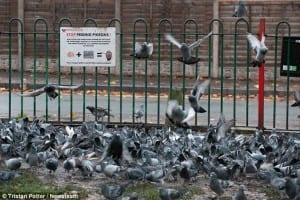
by Pigeon Patrol | Dec 24, 2015 | 4-S Gel Bird repellent, Animal Deterrent Products, Bird Deterrent Products, Bird Netting
 A mystery surrounding a missing flock of pigeons and a white van has been unfolding in Washington Square Park.
The Washington Square Park Blog reported Monday that a group of approximately 300 pigeons were lured with bird seed before being scooped up by a net and loaded into a white van by two unidentified men on Tuesday, July 21 at around 3 p.m. The NYPD Animal Cruelty Investigation Squad is currently investigating the case.
Pigeon trapping on private, commercial or public property without a permit is illegal in New York City, however the city does not accept complaints about netting, “the use of nets to collect large amounts of pigeons,” according to NYC.gov.
Artist and pigeon enthusiast Tina Trachtenberg, who is known for the felt pigeons she creates and sells in the park, initially informed the blog of the alleged abduction.
Trachtenberg, who also goes by the name “Mother Pigeon,” says she learned of the incident from a man named Larry, “a constant presence in the park,” who claims to have seen the pigeons placed in the van and taken away, according to the blog. Trachtenberg and her family held a memorial for the 300 missing pigeons on Saturday, July 25.
Trachtenberg believes the motive for the bird-napping is clear, though this has not been confirmed by authorities.
“The person who did this will transport them to Pennsylvania where they will have their wings clipped and be put into a mechanism that will shoot them in the air and men will shoot them for sport,” Trachtenberg posted on Facebook. “Our hearts are crushed.”
There have been reports in the past of pigeon brokers trapping and sell pigeons to people who participate in legal pigeon shootings in Pennsylvania. At these shoots and hunts, pigeons are propelled from a mechanical launcher and shot in midair.
Although these practices do not occur legally in New York, activists are alleging that there is a pattern where large quantities of pigeons are disappearing about a week before these scheduled Pennsylvania shoots take place.
In an interview with the Washington Square Park blog, a spokesperson for the NYC Parks Department pleaded with New Yorkers: “Don’t steal our animals! Pigeons are core to the character of New York City, and it is illegal and dangerous to remove animals from NYC Parks.”
Real estate agent and pigeon owner William Macleod has observed the pigeon flocks in Washington Square Park for eight years. Macleod regularly takes his birds to the park to fly alongside the wild birds and said he noticed a significant decrease in the park’s pigeon population after the July 21 incident. He said four of his banded pigeons are missing.
“I’m absolutely devastated. When I started letting my original two out, Jacko and Jix, I knew I may never see them again,” he said of his red belgian racers, whom he rescued eight years ago from a park garbage can three days after their birth. “But to know that they may be killed is what really upsets me.”
Joyce Friedman, NYC coordinator of the Humane Society of the United States, said there are ways for witnesses to report pigeon netting. “If you witness the netting in action, call 911; try to record license plate, and description of perps and vehicle,” Friedman said. “Witnesses to the recent Washington Square pigeon netting or any other pigeon nettings learned about after the fact should contact 311.”
There is also a $500 reward poster that was created by a concerned NYC photographer, Andrew Garn, looking for anyone with information about the Washington Square Park nettings.
About Pigeon Patrol:
Pigeon Patrol Products & Services is the leading manufacturer and distributor of bird deterrent (control) products in Canada. Pigeon Patrol products have solved pest bird problems in industrial, commercial, and residential settings since 2000, by using safe and humane bird deterrents with only bird and animal friendly solutions. At Pigeon Patrol, we manufacture and offer a variety of bird deterrents, ranging from Ultra-flex Bird Spikes with UV protection, Bird Netting, 4-S Gel and the best Ultrasonic and audible sound devices on the market today.
Voted Best Canadian wholesaler for Bird Deterrent products four years in a row.
Contact Info: 1- 877– 4– NO-BIRD (www.pigeonpatrol.ca)
by Pigeon Patrol | Dec 23, 2015 | Animal Deterrent Products, Bird Netting, Pigeon Patrol's Services, Pigeon Spikes
 According to the blog, on July 21st, in the afternoon, a van pulled up next to the park and netted between 250 and 300 pigeons. The blog states that the NYPD is investigating this issue, but a spokesperson from the police stated: “There was no crime committed. Animal Cruelty Unit is not going to investigate something that isn’t a crime.”
This isn’t the first time pigeons were snatched from the streets of New York City. There have been reports for more than 10 years of pigeons getting netted by men in vans (usually white). These pigeons are then allegedly taken to Pennsylvania, where they are clipped and sold to be used in live canned shooting events.
If you think a couple of New York’s flying rats won’t be missed, you don’t know the power of nature. A memorial service was held last Saturday for the pigeons at the park. Tina Trachtenberg, artist and animal rights advocate, was behind this memorial.
Trachtenberg told the Washington Square Park blog: “You can’t go into a park and take a tree, take a squirrel. That’s not there for us to take.”
Park regular William MacLeod has rescued and raised number of pigeons since they were babies. He had a few trained to fly to his apartment window at night, and could call them to his shoulders just by walking through the park and calling their names.
“My pet birds,” he told the blog, “my five flyers are gone. There are 300ish birds in the park at any given time. I’ve counted about 30 are left.”
Taking wildlife from NYC is a crime, but the city seems to be turning a blind eye to this. The NYPD seems aware that “this happens” from time to time, but has not been willing to open any investigation into the issue.
About Pigeon Patrol:
Pigeon Patrol Products & Services is the leading manufacturer and distributor of bird deterrent (control) products in Canada. Pigeon Patrol products have solved pest bird problems in industrial, commercial, and residential settings since 2000, by using safe and humane bird deterrents with only bird and animal friendly solutions. At Pigeon Patrol, we manufacture and offer a variety of bird deterrents, ranging from Ultra-flex Bird Spikes with UV protection, Bird Netting, 4-S Gel and the best Ultrasonic and audible sound devices on the market today.
Voted Best Canadian wholesaler for Bird Deterrent products four years in a row.
Contact Info: 1- 877– 4– NO-BIRD (www.pigeonpatrol.ca)
by Pigeon Patrol | Dec 22, 2015 | 4-S Gel Bird repellent, Bird Netting, Pigeon Patrol's Services, UltraSonic Bird Control
Mysterious pink pigeons have left the people of Eastville and surrounding areas baffled.
With a number of theories about how the birds ended up so luminous, people have called the Post, sent in pictures and demanded answers.
But now it can be revealed that the pigeons belong to a family man who lives in Eastville.
After chasing confused residents who sent in pictures and speaking to people who live in the area, the Post has discovered that a Mr Singh, of Glenfrome Road, paints a number of his pigeons pink.
The long-term pigeon keeper from India paints his pigeons to protect them from preying birds.
In Mr Singh’s back garden are close to 100 birds – not all pink – kept in pens with the ability to fly free if they wish.
Mr Singh’s daughter said that the birds can fly away but they always return to their keeper.
The pigeon keeper has been awarded trophies for his hobby of pigeon racing and makes sure that they are in tiptop form by feeding them and giving them a lot of special care and attention.
A number of theories surfaced about the pigeons after a family sent in pictures of the garish birds.
One woman went as far to say that the birds can actually change colour if they eat pink foods.
While others said that there was a possibility that the birds might even be a pink tinted breed known as the Columba mayeri.
But if that was the case, the bird – which is native to Mauritius, over 6,000 miles away – would have escaped from a zoo. The family who originally sent in the pictures said that the bird had definitely been painted.
And Bristol Zoo bird expert, Evelyn Guyett, agreed.
She said: “That is definitely not a pink pigeon. I think the family are right in thinking it is a common rock dove that has been painted pink.
“We have Mauritius pink pigeons on show at Wild Place Project, and they are much larger than our native species, and not quite that fluorescent.”
It was also revealed that in Mr Singh’s native country, pigeon racing is a popular sport.
But although the collector’s intentions of marking his birds might be good, the RSPCA told the Post that painting pigeons is wrong.
This is because if the birds were to ingest the dye, there is the potential that it could be toxic.
An RSPCA spokesperson also said that the pigeons may find being restrained – so the owner can paint them – a stressful ordeal.
But a bird expert from the RSPB said that people often paint pigeons at certain events – such as weddings.
Mr Singh was unavailable for comment.
About Pigeon Patrol:
Pigeon Patrol Products & Services is the leading manufacturer and distributor of bird deterrent (control) products in Canada. Pigeon Patrol products have solved pest bird problems in industrial, commercial, and residential settings since 2000, by using safe and humane bird deterrents with only bird and animal friendly solutions. At Pigeon Patrol, we manufacture and offer a variety of bird deterrents, ranging from Ultra-flex Bird Spikes with UV protection, Bird Netting, 4-S Gel and the best Ultrasonic and audible sound devices on the market today.
Voted Best Canadian wholesaler for Bird Deterrent products four years in a row.
Contact Info: 1- 877– 4– NO-BIRD (www.pigeonpatrol.ca)
by Pigeon Patrol | Dec 21, 2015 | 4-S Gel Bird repellent, Animal Deterrent Products, Bird Netting, UltraSonic Bird Control
 Several pigeons are trapped under netting put up by Primark last week.
Residents in Westgate Street are able to see the rooftop netting from their windows and say the scene is a “real horror show”.
They are calling on the Stall Street business to set the pigeons free and to secure the netting to stop other birds getting trapped.
The netting was erected to cover Primark’s air conditioning units on Tuesday July 28- to prevent pigeons from roosting there.
Paul Beresford has lived on Westgate Street for 16 years and has come to know the birds well, even raising a baby pigeon at one point.
He believes this bird is one of the birds trapped under the net.
The 54-year-old says it is distressing to see trapped birds trying to find a way out, as well as birds on the outside of the netting trying to reach birds inside.
He said: “The pigeon I’m talking about was evicted from somewhere else by the council. I took him on, winged and fledged him, and let him go.
“He has been back to see me and is one of the few birds I have looked after who has done that. He has remembered me and he has now got a mate.
“These creatures mate for life and they are touchingly affectionate parents.
“It’s a real horror show. In one way the pigeons might be better off dead. To be separated from their mate- it’s torture for them.
“It’s distressing watching them in distress.”
About Pigeon Patrol:
Pigeon Patrol Products & Services is the leading manufacturer and distributor of bird deterrent (control) products in Canada. Pigeon Patrol products have solved pest bird problems in industrial, commercial, and residential settings since 2000, by using safe and humane bird deterrents with only bird and animal friendly solutions. At Pigeon Patrol, we manufacture and offer a variety of bird deterrents, ranging from Ultra-flex Bird Spikes with UV protection, Bird Netting, 4-S Gel and the best Ultrasonic and audible sound devices on the market today.
Voted Best Canadian wholesaler for Bird Deterrent products four years in a row.
Contact Info: 1- 877– 4– NO-BIRD (www.pigeonpatrol.ca)
by Pigeon Patrol | Dec 20, 2015 | Bird Netting, Pigeon Patrol's Services, Pigeons in the News, UltraSonic Bird Control
You can look at pigeons one of two ways: as pooping, disease-ridden pests, or ambassadors of nature in an otherwise urban setting.
Last week’s news that 100 pigeons went missing from Washington Square Park — after perhaps being lured and netted by hunters — has polarized New Yorkers. Some were happy to say “good-bye to a huge flock of ‘rats,'” as one commenter on our story wrote. Others, like animal activist Tina Trachtenberg, worried about the welfare of “these innocent, trusting, loving pigeons.”
In an attempt to weigh the arguments of both sides, we’ve listed the pros and cons of pigeons, otherwise known as rock doves, below.
THE CONS:
► With so much food to be scavenged from garbage cans and sidewalks, and with humans feeding them, pigeons in the city can spend less time searching for sustenance and more time mating. That leads to overpopulation — and lots of pigeon droppings.
► Pigeon droppings are associated with three diseases: histoplasmosis, a fungal infection that causes flu-like symptoms; cryptococcosis, another fungal disease; and psittacosis, a bacterial disease characterized by a rash and sometimes pneumonia. (Note: the Department of Health and Mental Hygiene says that contact with droppings doesn’t pose a serious health risk; people with compromised immune systems are most likely to contract one of the three diseases.)
► Speaking of pigeon excrement, a single pigeon excretes 25 pounds of droppings a year. Those droppings deface buildings, quicken the pace of their deterioration and add to their costs of maintenance.
► Pigeons are technically an invasive species: colonists brought them to this country from Europe in the 1600s as barnyard animals, raised to be eaten. (Squab — it’s what’s for dinner?)
THE PROS:
► Let’s not forget that pigeons served this country in both World Wars as stealthy message carriers.
► Pigeons do more than eat and poop: they can compete in races. During a competitive pigeon race, competitors are released simultaneously from one location and the pigeon that makes it home to its own coop first wins.
► Some people find them aesthetically pleasing. Photographer Andrew Garn, who snapped pictures of 5,000 pigeons over the course of four years, told New York magazine he finds them “really quite beautiful” up close. And we have to admit, the iridescent green and purple neck of a pigeon can be quite beguiling — when the bird isn’t pooping on us.
About Pigeon Patrol:
Pigeon Patrol Products & Services is the leading manufacturer and distributor of bird deterrent (control) products in Canada. Pigeon Patrol products have solved pest bird problems in industrial, commercial, and residential settings since 2000, by using safe and humane bird deterrents with only bird and animal friendly solutions. At Pigeon Patrol, we manufacture and offer a variety of bird deterrents, ranging from Ultra-flex Bird Spikes with UV protection, Bird Netting, 4-S Gel and the best Ultrasonic and audible sound devices on the market today.
Voted Best Canadian wholesaler for Bird Deterrent products four years in a row.
Contact Info: 1- 877– 4– NO-BIRD (www.pigeonpatrol.ca)
by Pigeon Patrol | Dec 19, 2015 | Bird Deterrent Products, Bird Netting, Pigeon Patrol's Services, UltraSonic Bird Control
A war over some of New York’s smallest and most divisive residents has been brewing for a while now. In the latest skirmish, a 38-year-old man named Luis Rosado was arrested last Wednesday for illegally catching pigeons on Wyckoff Avenue in Bushwick, Brooklyn.
Lieutenant John Grimpel of the NYPD told VICE that Rosado was arrested under the Agriculture and Markets Law relating to cruelty to animals. The law makes it a misdemeanor to carry an animal “in a cruel manner,” and in punishable by jail time for up to a year or a fine of $1,000—or both.
But Grimple was a bit mystified by my interest in the birds: Since when did pigeons become a bigger news story than people? he asked me.
As a matter of fact, bizarre pigeon happenings are nothing new in New York. In Greenwich Village’s Washington Square Park, activists and people who feed birds are on a warpath over their beloved avian friends. Last Monday, Washington Square Park Blog reported that someone had pulled up to the western side of the park, thrown a net on the ground, and scattered birdseed on top of it. According to witnesses, hundreds of pigeons were netted and stuffed into the trunk of a car, which drove off before anyone could catch its plates.
The NYPD told VICE that it has opened an investigation and found no evidence that someone stole pigeons from the park. But the local birders at Washington Square Park say they’ve seen a noticeable drop in the number of pigeons they see there.
“It sucks,” said Tina Trachtenburg, an animal activist who’s been feeding the birds in the park for 55 years. “Its really, really heartbreaking.”
About Pigeon Patrol:
Pigeon Patrol Products & Services is the leading manufacturer and distributor of bird deterrent (control) products in Canada. Pigeon Patrol products have solved pest bird problems in industrial, commercial, and residential settings since 2000, by using safe and humane bird deterrents with only bird and animal friendly solutions. At Pigeon Patrol, we manufacture and offer a variety of bird deterrents, ranging from Ultra-flex Bird Spikes with UV protection, Bird Netting, 4-S Gel and the best Ultrasonic and audible sound devices on the market today.
Voted Best Canadian wholesaler for Bird Deterrent products four years in a row.
Contact Info: 1- 877– 4– NO-BIRD (www.pigeonpatrol.ca)
by Pigeon Patrol | Dec 18, 2015 | Bird Netting, Pigeon Patrol's Services, Pigeon Spikes, UltraSonic Bird Control
A pigeon.
When Brits began posting pictures of pink pigeons to social media, the mystery took flight.
Had the rare Columba mayeri, a pink pigeon unique to the small Indian Ocean island Mauritius that belongs to the same family as the dodo and narrowly avoided extinction itself in the 1990s, suddenly migrated to Britain?
Finally, it seems the riddle has been solved, and the conundrum was in fact much ado about nothing.
The baffling birds appear to be the work of one pigeon keeper in Bristol, who dyed the pigeons pink to protect them from predatorsaccording to the area’s local newspaper.
The Bristol Post cites cash-and-carry worker Sher Singh, 39, as the man responsible.
“I put the colour on because the Falcons will get confused,” he told the paper. “He will see the colours but won’t see the pink so well. I didn’t know if the colour for the pigeons was bad. I won’t colour them again . . . I’m sorry for colouring them, it was a mistake.”
Unfortunately, local experts in Ontario, where falcons have been thriving recently, say the man’s logic is flawed on most counts.
The pink dye would not ward off predators, and it may ostracize the birds among their fellow pigeons, according to Marion Nash, 54, vice-president of The Canadian Peregrine Foundation.
“I don’t see how that could possibly work, it’s nonsense,” she said. “Falcons eat all different kinds of coloured birds. They eat red cardinals, so why would they ignore pink birds?”
Nash doesn’t think the dye would necessarily hurt the birds because the feathers are similar to human hair and will moult quickly.
Her organization has even employed a similar practice, albeit for different reasons. The Peregrine Foundation will dye young falcons’ tail feathers to distinguish and protect them when they are learning to fly.
Where it could have an effect is in the pigeons’ relationship with its own kind.
“Pigeons will avoid others if they see them acting strange or sick,” she said. “They’ll wonder what’s wrong and might attack or avoid them.
“It could make the birds more of a target than before, from fellow pigeons or other animals. It could possibly stand out more because of the pink dye and be more of a disadvantage than an advantage.”
By using dye, the Bristol bird lover might have made it more likely his pigeons will die.
About Pigeon Patrol:
Pigeon Patrol Products & Services is the leading manufacturer and distributor of bird deterrent (control) products in Canada. Pigeon Patrol products have solved pest bird problems in industrial, commercial, and residential settings since 2000, by using safe and humane bird deterrents with only bird and animal friendly solutions. At Pigeon Patrol, we manufacture and offer a variety of bird deterrents, ranging from Ultra-flex Bird Spikes with UV protection, Bird Netting, 4-S Gel and the best Ultrasonic and audible sound devices on the market today.
Voted Best Canadian wholesaler for Bird Deterrent products four years in a row.
Contact Info: 1- 877– 4– NO-BIRD (www.pigeonpatrol.ca)
by Pigeon Patrol | Dec 16, 2015 | Animal Deterrent Products, Bird Netting, Pigeon Spikes
Tram commuters say that a pigeon ‘infestation’ is causing problems at Prestwich tram stop.
The birds have nested at the Metrolink station and surrounding area for several years, but fresh concerns have arisen that their droppings are a health risk and damaging buildings.
Transport bosses installed pigeon netting at Prestwich in 2011 and say that cleaners still sweep the station daily, but passengers and local councillors have called for more action against the ‘rats with wings’.
Tram traveller Billy McCulloch complained to Metrolink for a third time about the issue this week. He asked: “Have reported pigeon infestation three times now at Prestwich, do you know if anything is being done?”
Mr McCulloch also flagged up the problem on Twitter on May 6 and on April 30. Fellow traveller Keith Marks tweeted: “Not sure how but pigeons are now nesting behind the anti-pigeon wire at Prestwich”.
Pigeons at Prestwich Metrolink station
Metrolink say they are not aware of any ‘infestation’ but have asked people not to feed the birds.
Councillor Tim Pickstone, who represents the area and blogged about the problem last year, told the M.E.N: “Both the bridges under the Metrolink at Prestwich are busy thoroughfares and pigeons are causing significant nuisance for both pedestrians and cyclists.
“It is important the Metrolink keep on top of the netting. In recent months, we’ve seen situations where birds have been trapped due to poorly maintained netting, now they’re even nesting behind it!”
Councillor Alan Quinn added: “When I’ve raised the problem of pigeons with Metrolink, they’ve acted quickly. For example they’ve put nets and spikes on most of the bridges in Prestwich that the trams use.
“The problem is made worse by the fact that people keep feeding the pigeons. Food is left regularly in Heaton Park and in areas of Prestwich.
“You’d wouldn’t put food out for rats and pigeons do carry disease that can affect humans, so why people feed these ‘rats with wings’ is beyond me. The droppings left are a health risk and can damage buildings.”
A TfGM spokesperson said: “The Metrolink operator employs contractors to not only control rodents and pests at stops but also to carry out a daily brush and mopping of stop and bridge areas.
“They also install pigeon deterrent measures from time to time in certain locations and Prestwich is one such area. However, we are not aware of any infestation problem.
“To help us maintain clean and pleasant facilities, we would ask customers not to feed any pigeons and avoid eating or discarding convenience foods on stop platforms.”
The M.E.N reported as early as 2011 how pigeons were causing a nuisance on the Bury Metrolink line, with prevention measures installed at several stations.
About Pigeon Patrol:
Pigeon Patrol Products & Services is the leading manufacturer and distributor of bird deterrent (control) products in Canada. Pigeon Patrol products have solved pest bird problems in industrial, commercial, and residential settings since 2000, by using safe and humane bird deterrents with only bird and animal friendly solutions. At Pigeon Patrol, we manufacture and offer a variety of bird deterrents, ranging from Ultra-flex Bird Spikes with UV protection, Bird Netting, 4-S Gel and the best Ultrasonic and audible sound devices on the market today.
Voted Best Canadian wholesaler for Bird Deterrent products four years in a row.
Contact Info: 1- 877– 4– NO-BIRD (www.pigeonpatrol.ca)
by Pigeon Patrol | Dec 15, 2015 | Bird Netting, Pigeons in the News, UltraSonic Bird Control
PATTERSON (CBS13) – Pat Rocca has a pigeon problem. The birds have left her walkway stained, feathers stuck to the house and droppings everywhere.
“I thought well this is a horror.’” Pat said. “It’s very sticky and gooey, just terrible.”
She hired Albert Filmore Pigeon Cleanup, who services Stanislaus County, and paid him $680 to clean up the mess and prevent pigeons from coming back to roost or nest on her house.
The contract she signed promised return visits “two times a week for the next 8 weeks.”
But, five months went by and Pat said Albert only came out twice.
“He didn’t finish the job.’
Pat said the pigeons came back, and Albert has been a no show to appointments – blaming family issues. And she said Albert would not return her calls.
“We have had very similar complaints,” said Gary Almond with the Better Business Bureau.
He said his office has been unable to find Albert Filmore.
Almond said a company still has a responsibility to finish the work, even if personal issues arise.
“I’d offer a refund or offer someone else to complete the service,” he said.
So, how do you keep pigeons away?
To find out, we brought in Pest Management expert Jim Steed.
“The trick is to employ the right measures in the right spots,” Jim said.
Depending on the house, he’ll use different bird spikes or even shock tracks to keep the birds from landing.
Bird repellent glue is a popular method, and Jim says it works best when combined with other methods. But because it is sticky, dirt will eventually stick to it – making it ineffective.
If the pigeons are nesting, Steed says netting should be put up.
He says professional removal and clean up services can cost anywhere from $600 to $3,000.
“If you leave 10 percent of the area [unprotected], they’re still here.” Jim said.
As for Pat, we reached out to Albert Filmore. He told us he’s had “a lot of issues” but agreed to give her “whatever she thinks I owe her.”
In the end, Albert returned $400 of the $680 Pat paid him.
She said she’ll be hiring someone else to finish the job.
“I know this will only get worse,” Pat said, pointing to signs of pigeons around her home.
About Pigeon Patrol:
Pigeon Patrol Products & Services is the leading manufacturer and distributor of bird deterrent (control) products in Canada. Pigeon Patrol products have solved pest bird problems in industrial, commercial, and residential settings since 2000, by using safe and humane bird deterrents with only bird and animal friendly solutions. At Pigeon Patrol, we manufacture and offer a variety of bird deterrents, ranging from Ultra-flex Bird Spikes with UV protection, Bird Netting, 4-S Gel and the best Ultrasonic and audible sound devices on the market today.
Voted Best Canadian wholesaler for Bird Deterrent products four years in a row.
Contact Info: 1- 877– 4– NO-BIRD (www.pigeonpatrol.ca)