by Pigeon Patrol | May 3, 2021 | Bird Law, Bird Spikes, Doves, Pigeon Control, Pigeon Patrol's Services
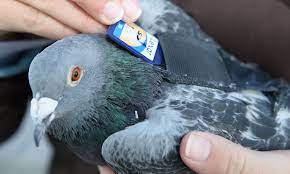
Officials believe an inmate at a jail in Costa Rica trained a feathered friend to smuggle cocaine and cannabis in a pouch.
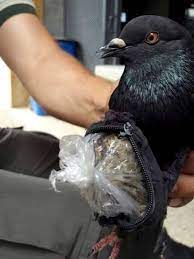
A pigeon smuggling cocaine and cannabis into a prison in Costa Rica has been caught by guards.
The bird was seen landing in the central concourse of the medium security La Reforma jail, in San Rafael de Alajuela, where it was taken into custody.
The drugs were contained in a small zipped up pouch strapped to the animals chest.
About 14g of cocaine and at least the same amount of cannabis were inside wrapped in plastic.
Costa Rica’s Ministry of Justice and Peace released the animal’s mugshot under the headline caption “narcopaloma”, meaning “drugs dove”, and listing the date of the animals detention.
Realidad7 reported the drugs had a street value of around £180 ($281).
Prison officials said they believe the drugs were destined for use by an inmate who may have trained the pigeon to act as a courier.
Director of the Penitentiary Police, Paul Bertozzi, told Spanish news agency Efe that it showed the need to be vigilant.
“Drug traffickers are using unimaginable ways to achieve their macabre atrocities,” he said.
“This (use of a pigeon) is nothing new. In the past (the traffickers) have used cats and dogs to pass drugs to prisoners. Now it seems they are using pigeons to carry in their wares from the outside.”
Although it is the first time the Costa Rican authorities said they had come across the practice, it has previously been reported in Argentina in 2013 and Colombia in 2011.
The pigeon was later taken to a zoo where it was expected to remain behind the bars of a cage.
Biologist Oscar Ramirez told Realidad7 that pigeons can be trained to travel several miles with small loads.
During the Second World War, more than 250,000 homing pigeons were used to transport messages between front line Allied troops and top brass, according to the Royal Pigeon Racing Association.
Pigeon Patrol Products & Services is the leading manufacturer and distributor of bird deterrent (control) products in Canada. Pigeon Patrol products have solved pest bird problems in industrial, commercial, and residential settings since 2000, by using safe and humane bird deterrents with only bird and animal friendly solutions. At Pigeon Patrol, we manufacture and offer a variety of bird deterrents, ranging from Ultra-flex Bird Spikes with UV protection, Bird Netting, 4-S Bird Gel and the best Ultrasonic and audible sound devices on the market today.
Voted Best Canadian wholesaler for Bird Deterrent products ten years in a row.
Contact us at 1- 877– 4– NO-BIRD, (604) 585-9279 or visit our website at www.pigeonpatrol.ca
Pigeon/Pigeon Patrol / Pigeons Roosting / Vancouver Pigeon Control /Bird Spikes / Bird Control / Bird Deterrent / Pigeon Deterrent? Surrey Pigeon Control / Pest /Seagull deterrent / Vancouver Pigeon Blog / Birds Inside Home / Pigeons in the cities / Ice Pigeons/ What to do about pigeons/ sparrows , Damage by Sparrows, How To Keep Raccoons Away, Why Are Raccoons Considered Pests/ De-fence / Pigeon Nesting/ Bird Droppings / Pigeon Dropping/ woodpecker control/ Professional Bird Control Company/ Keep The Birds Away/ Birds/rats/ seagull/pigeon/woodpecker/ dove/sparrow/pidgeon control/pidgeon problem/ pidgeon control/flying rats/ pigeon Problems/ bird netting/bird gel/bird spray/bird nails/ bird guard
by Pigeon Patrol | Apr 26, 2021 | Bird Law, Pigeon Control, Pigeon Patrol's Services, Pigeon Predators
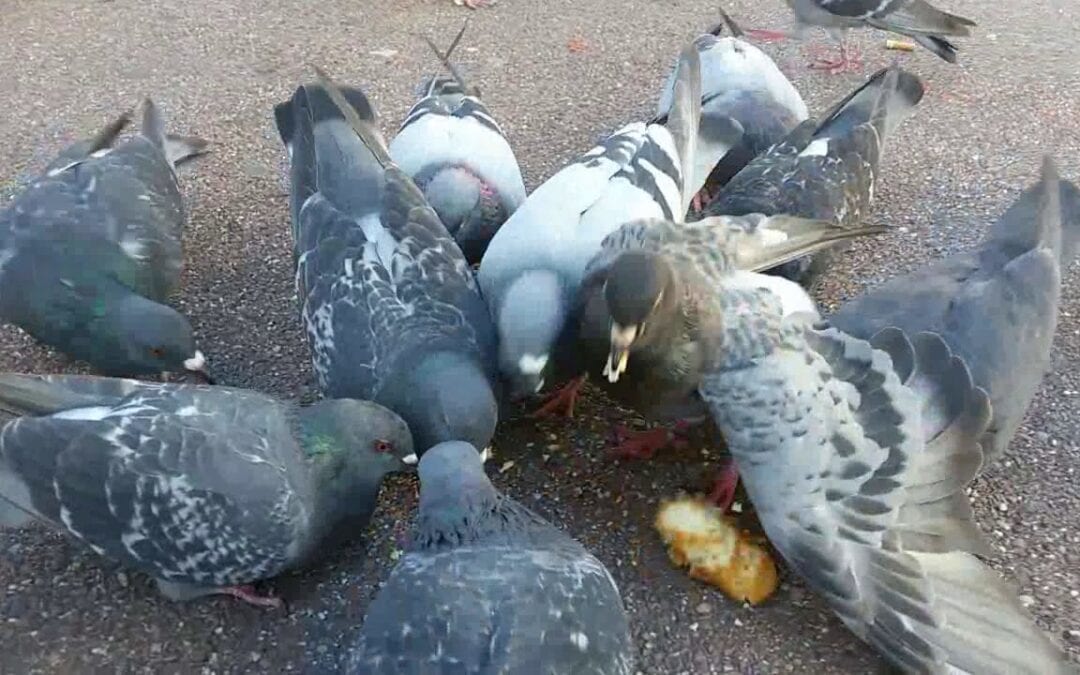
Commonly known as Pigeons, Rock Pigeons are often considered a nuisance by some city officials and some farm businesses.
In cities they congregate in large flocks and can create messes with their droppings.
On farms, eating grains and possible harm to livestock through bacteria and viruses are concerns about these birds.
Many pigeon deterents are available online to prevent nesting in areas they’re not wanted.
Introduced into North America from Europe in the 1600’s, these birds have been associated with humans for thousands of years.
Rock Doves are thought to have been the first domesticated bird, raised for meat as far back as the time of the ancient Egyptians.
Description
Pigeons have different colors due to breeding by humans. They are the descendants of the wild Rock Dove of Europe.
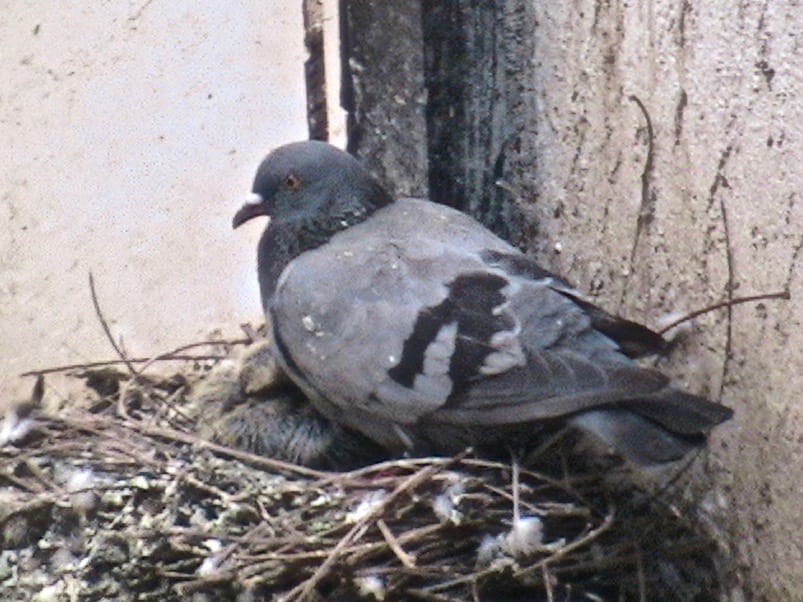
About 13 inches in length with a dark gray head, iridescent neck, with a light gray back and 2 dark wing bars.
Mating – Breeding Habits
Like Mourning Doves, pairs are monogamous, often breeding in consecutive seasons for as long as both birds of a pair live.
Most will attempt to raise several broods each year. Sometimes as many as four or five broods will be raised in a single year.
The breeding season of these birds can be all year provided climate conditions allow. There seems to be some slowing down during the winter months.
Nesting Habits
The nesting habits of Pigeons are a bit unique. The male chooses a site in view of the female, selecting one stick and bringing it back, lays it in front of his mate.
The female who stays at the nesting site accepts the sticks the male brings to her and places them underneath her.
The nest of these birds can be found along building ledges, rafters, beams, under bridges or inside barns.
The nest is saucer-like in shape and made of stems and leaves.
The female may sit on the nest a day or two before the first egg is laid. Generally 2 white eggs are laid.
Both the male and female will incubate but the female will spend the most time on the eggs since she will be on the nest from mid-afternoon to mid-morning.
Incubation last for about 18 days. When the eggs hatch the young are covered in yellow down.
Young pigeons in the nest are referred to as “squabs”
Initially, the squabs are fed what is referred to as crop milk. This is a regurgitated thick liquid food that comes from the parents crops.
At about 10 days the squabs are fed increasing amounts of the food types that adults eat and are no longer dependent on crop milk.
The young will double in size in a day and a half. Making them one of the fastest growing vertebrate in the world.
Within 2 weeks the flight feathers begin to emerge and by week 3 the squabs are covered in feathers.
The tail and full feathering is completed by the 28th day and their weight is that of an adult.
The young will now leave the nest and the male will teach them what they need to know to survive.
This is 10 – 15 days longer than most of our backyard birds.
The female will begin a new clutch and this cycle will repeat about every 30 days when weather cooperates.
Do Pigeons Reuse the Same Nest
It’s more accurate to say that the same nest site is used as the second and subsequent nest are built on top of the previous nest.
Nest that are several years old can measure out to be as much as 7 inches high and 19 inches wide.
Feeding Habits – What Pigeons Eat
Rock Pigeons feed on the ground. To prevent seed spoilage and to keep the birds healthy a ground feeder is recommended for all ground feeding birds.
The best types of food to offer these birds are properly mixed seeds specifically made for doves and pigeons.
For more information on seeds and photos of each, please see our
Bird Seed Page.Predators
The primary preadators of pigeons include: man, peregrin falcon, and cats. Nest predators include oppossums, raccoons, crows and owls. Hawks will capture perching birds.
Are Pigeons Smart Birds?
According to Professor Richard J. Herrnstein at the Harvard Psychological Laboratories they are. Pigeons were smart enough to learn all the letters of the english alphabet.
In another study, Pigeons were able to recognize themselves in a mirror. This makes them one of six species and the only non-mammal to be able to do so.
So yes, Pigeons are a pretty smart bird.
What is the Lifespan of Pigeons?
Pigeons may live 3 – 6 years in the wild with the average being 3 – 4 years. In captivity they have lived as long as 15 years depending on the care given to the bird.
Pigeons in History
During the world wars, Homing Pigeons were trained to return to a loft in the UK.
Troops then took the pigeons with them and used them to send messages when radio and written communication were being intercepted.
Pigeon Fun Facts
Pigeons have the ability to see about 26 miles.
When fully feather, adult pigeons have around 10,000 feathers.
There are approximately 400 million pigeons in the world.
Pigeon Patrol Products & Services is the leading manufacturer and distributor of bird deterrent (control) products in Canada. Pigeon Patrol products have solved pest bird problems in industrial, commercial, and residential settings since 2000, by using safe and humane bird deterrents with only bird and animal friendly solutions. At Pigeon Patrol, we manufacture and offer a variety of bird deterrents, ranging from Ultra-flex Bird Spikes with UV protection, Bird Netting, 4-S Bird Gel and the best Ultrasonic and audible sound devices on the market today.
Voted Best Canadian wholesaler for Bird Deterrent products ten years in a row.
Contact us at 1- 877– 4– NO-BIRD, (604) 585-9279 or visit our website at www.pigeonpatrol.ca
Pigeon/Pigeon Patrol / Pigeons Roosting / Vancouver Pigeon Control /Bird Spikes / Bird Control / Bird Deterrent / Pigeon Deterrent? Surrey Pigeon Control / Pest /Seagull deterrent / Vancouver Pigeon Blog / Birds Inside Home / Pigeons in the cities / Ice Pigeons/ What to do about pigeons/ sparrows , Damage by Sparrows, How To Keep Raccoons Away, Why Are Raccoons Considered Pests/ De-fence / Pigeon Nesting/ Bird Droppings / Pigeon Dropping/ woodpecker control/ Professional Bird Control Company/ Keep The Birds Away/ Birds/rats/ seagull/pigeon/woodpecker/ dove/sparrow/pidgeon control/pidgeon problem/ pidgeon control/flying rats/ pigeon Problems/ bird netting/bird gel/bird spray/bird nails/ bird guard
by Pigeon Patrol | Apr 26, 2021 | Bird Law, Pigeon Control, Pigeon Predators, Pigeon Spikes
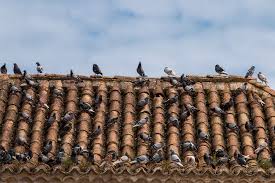
Probably the second-worst thing that ever happened to pigeons was Woody Allen calling them “rats with wings” in 1980, prompting a bad reputation that the birds just haven’t been able to get rid of. (The worst thing that ever happened to pigeons was the extinction of the carrier pigeon in the late 1800s/early 1900s. These pigeons once existed in such multitudes, they would darken the sky for hours as they flew overhead; sadly, their sheer numbers led to a carefree attitude in hunting them, and they went from a population of millions to zero in a short time span.)
Contrary to popular belief, pigeons are quite interesting, useful animals. They were domesticated thousands of years ago (Darwin, in fact, was a little obsessed with pigeons), can be trained as athletes (called “racing pigeons”), mate for life (aww!), and have evolved to be able to digest a much wider variety of food than their ancestors. More recently, scientists in the U.S. and England have utilized pigeons to help collect data on air quality by strapping tiny, pigeon-sized backpacks onto the pigeons’ backs and tracking the data as the birds fly around.
They’re more reliable than your car’s GPS
Probably one of the most famous cool things about pigeons is their ability to always find their way home. You’ve probably heard of “homing pigeons” before, right? But how do they do it? Past studies have investigated the roles of olfactory cues, sun and magnetic compasses, and the use of long, linear landmarks such as roads, railway lines, and rivers. Interestingly enough, despite hundreds of years of research on the matter, there still doesn’t appear to be a consensus on how exactly pigeons have such an uncanny sense of direction.
In 2013, a study in the Journal of Experimental Biology found that homing pigeons use low-frequency sound waves, called infrasound waves, to make an acoustic mental map of their location. The researcher examined 14 years’ worth of data from 45,000 pigeons to determine that the only times the birds got lost were when these infrasound waves, due to wind or difficult terrain, were unable to reach the pigeons’ home loft. This sound block appears to have inhibited the birds’ ability to figure out their orientation relative to home, indicating that sound plays an important role in their ability to find their way home.
But in a 2015 study in Proceedings of the Royal Society B, scientists found that vision, too, plays a major role in homing pigeons’ abilities. The left and right halves of bird brains are thought to act more autonomously than ours, because they don’t have a corpus callosum, the part of the brain that passes information between brain hemispheres. So for this study, the researchers placed eye patches on first one, then the other, of the birds’ eyes to see how limited vision might affect their sense of direction. Two groups of birds were trained to return home, first with the left eye covered or first with the right eye covered. The pigeons formed new routes after switching eyes, meaning that their brain hemispheres do indeed learn and act independently.
It’s worth nothing that, despite having full use of both eyes and ears, plus the ability to read a map, I can recount multiple instances wherein I panicked because I was “lost,” only to find out I was within two or three blocks of home. Multiple instances, you guys. I would be a terrible pigeon.
They can detect cancer
So, pigeons have built-in GPSs. You still seem unimpressed. Well, did you know that pigeons can also detect cancer? Aha, now I’ve got your attention!
It’s true: a 2015 study in PLOS ONE found that pigeons, with a little training, can distinguish breast tissue from tumors on biopsy slides. The researchers showed 16 pigeons touchscreen images of microscope slides of either benign or malignant breast tissue, and within two weeks, the pigeons had achieved 85% accuracy in identifying malignancies. Interestingly, if the assessments of multiple pigeons on each slide were added together (the researchers called this “flock-sourcing,” which may be the cutest adaption of crowdsourcing I’ve ever seen), accuracy reached 99%. The pigeons had a harder time identifying suspicious masses in mammogram images, which, to be fair, is something doctors have trouble with too, even after of years of training.
Nonetheless, this suggests that pigeons could be used as trained medical image observers and could help researchers figure out better ways to train pathologists and computer systems by determining the impact of color, contrast, brightness, and image compression artifacts on diagnostic performance.
They’re highly intelligent
Which brings me back to my original point: pigeons are actually highly intelligent creatures. A 1995 study in the Journal of the Experimental Analysis of Behavior found that pigeons could distinguish between paintings by Monet and Picasso (though the study didn’t determine which artist the pigeons preferred, so we may never know if they’re more into cubism or impressionism). A 2008 study in Animal Cognition found that pigeons, like large-brained primates, recognize themselves in mirrors and videos.
In a study presented at the 2011 Society for Experimental Biology Annual Conference, researchers determined that feral, untrained pigeons can recognize individual people and are not fooled by a change of clothes. Two researchers, of similar build and skin color, wearing different-colored lab coats that covered most of their bodies, fed pigeons in a park. One of the researchers ignored the pigeons, whereas the other researcher shooed the pigeons away; in subsequent sessions, even when the “hostile” researcher acted neutrally toward the pigeons or switched lab coats with the other researcher, the pigeons recognized and avoided the “hostile” researcher.
Lest you think this is a one-off occurrence, a 2012 study in Avian Biology Research confirmed that pigeons can recognize a person they have encountered before, based strictly on facial characteristics. The researchers trained a group of pigeons to distinguish between photographs of familiar and unfamiliar objects. These pigeons, along with a control group that had not been trained, were then shown photographs of pairs of human faces, one familiar and one the pigeons had not previously seen. The trained birds were able to recognize and classify the familiar people using only their faces, whereas the birds without prior training failed.
So, to recap, pigeons can identify cancer, recognize human faces, and find their way home. Which leaves me with one burning question: do they also play fetch?
Pigeon Patrol Products & Services is the leading manufacturer and distributor of bird deterrent (control) products in Canada. Pigeon Patrol products have solved pest bird problems in industrial, commercial, and residential settings since 2000, by using safe and humane bird deterrents with only bird and animal friendly solutions. At Pigeon Patrol, we manufacture and offer a variety of bird deterrents, ranging from Ultra-flex Bird Spikes with UV protection, Bird Netting, 4-S Bird Gel and the best Ultrasonic and audible sound devices on the market today.
Voted Best Canadian wholesaler for Bird Deterrent products ten years in a row.
Pigeon/Pigeon Patrol / Pigeons Roosting / Vancouver Pigeon Control /Bird Spikes / Bird Control / Bird Deterrent / Pigeon Deterrent? Surrey Pigeon Control / Pest /Seagull deterrent / Vancouver Pigeon Blog / Birds Inside Home / Pigeons in the cities / Ice Pigeons/ What to do about pigeons/ sparrows , Damage by Sparrows, How To Keep Raccoons Away, Why Are Raccoons Considered Pests/ De-fence / Pigeon Nesting/ Bird Droppings / Pigeon Dropping/ woodpecker control/ Professional Bird Control Company/ Keep The Birds Away/ Birds/rats/ seagull/pigeon/woodpecker/ dove/sparrow/pidgeon control/pidgeon problem/ pidgeon control/flying rats/ pigeon Problems/ bird netting/bird gel/bird spray/bird nails/ bird guardContact us at 1- 877– 4– NO-BIRD, (604) 585-9279 or visit our website at www.pigeonpatrol.ca
by Pigeon Patrol | Apr 26, 2021 | Bird Law, Pigeons
Pigeons can categorize and name both natural and human-made objects—and not just a few. The birds in a new study categorized 128 photographs into 16 categories.
The finding suggests a similarity between how pigeons learn the equivalent of words and the way children do, according to Ed Wasserman, professor of psychology at the University of Iowa and corresponding author of the study.
“Unlike prior attempts to teach words to primates, dogs, and parrots, we used neither elaborate shaping methods nor social cues,” Wasserman says of the study, which appears online in the journal Cognition. “And our pigeons were trained on all 16 categories simultaneously, a much closer analog of how children learn words and categories.”
For researchers like Wasserman, who has been studying animal intelligence for decades, this latest experiment is further proof that animals—whether primates, birds, or dogs—are smarter than once presumed and have more to teach scientists.
“It is certainly no simple task to investigate animal cognition; But, as our methods have improved, so too have our understanding and appreciation of animal intelligence,” he says.
“Differences between humans and animals must indeed exist: many are already known. But, they may be outnumbered by similarities. Our research on categorization in pigeons suggests that those similarities may even extend to how children learn words.”
PECK THE SYMBOL
Wasserman says the pigeon experiment comes from a project published in 1988 and featured in the New York Times in which University of Iowa researchers discovered pigeons could distinguish among four categories of objects.
This time, the researchers used a computerized version of the “name game” in which three pigeons were shown 128 black-and-white photos of objects from 16 basic categories: baby, bottle, cake, car, cracker, dog, duck, fish, flower, hat, key, pen, phone, plane, shoe, tree.
The birds then had to peck on one of two different symbols: the correct one for that photo and an incorrect one that was randomly chosen from one of the remaining 15 categories. The pigeons not only succeeded in learning the task, but they also reliably transferred the learning to four new photos from each of the 16 categories.
SMARTER THAN YOUR AVERAGE BIRD
Pigeons have long been known to be smarter than your average bird—or many other animals, for that matter. Among their many talents, pigeons have a “homing instinct” that helps them find their way home from hundreds of miles away, even when blindfolded.
They have better eyesight than humans do and have been trained by the US Coast Guard to spot orange life jackets of people lost at sea. They carried messages for the US Army during World Wars I and II, saving lives and providing vital strategic information.
The researchers say their expanded experiment represents the first purely associative animal model that captures an essential ingredient of word learning—the many-to-many mapping between stimuli and responses.
“Ours is a computerized task that can be provided to any animal, it doesn’t have to be pigeons,” says psychologist Bob McMurray, a coauthor of the study. “These methods can be used with any type of animal that can interact with a computer screen.”
HOW CHILDREN LEARN
McMurray says the research shows the mechanisms by which children learn words might not be unique to humans.
“Children are confronted with an immense task of learning thousands of words without a lot of background knowledge to go on,” he says. “For a long time, people thought that such learning is special to humans. What this research shows is that the mechanisms by which children solve this huge problem may be mechanisms that are shared with many species.”
Wasserman acknowledges the recent pigeon study is not a direct analogue of word-learning in children and more work needs to be done. Nonetheless, the model used in the study could lead to a better understanding of the associative
principles involved in children’s word learning.
“That’s the parallel that we’re pursuing,” he says, “but a single project—however innovative it may be—will not suffice to answer such a provocative question.”
National Institute of Mental Health, National Eye Institute, and National Institute of Deafness and Other Communication Disorders supported the research.
Pigeon Patrol Products & Services is the leading manufacturer and distributor of bird deterrent (control) products in Canada. Pigeon Patrol products have solved pest bird problems in industrial, commercial, and residential settings since 2000, by using safe and humane bird deterrents with only bird and animal friendly solutions. At Pigeon Patrol, we manufacture and offer a variety of bird deterrents, ranging from Ultra-flex Bird Spikes with UV protection, Bird Netting, 4-S Bird Gel and the best Ultrasonic and audible sound devices on the market today.
Voted Best Canadian wholesaler for Bird Deterrent products ten years in a row.
Contact us at 1- 877– 4– NO-BIRD, (604) 585-9279 or visit our website at www.pigeonpatrol.ca
Pigeon/Pigeon Patrol / Pigeons Roosting / Vancouver Pigeon Control /Bird Spikes / Bird Control / Bird Deterrent / Pigeon Deterrent? Surrey Pigeon Control / Pest /Seagull deterrent / Vancouver Pigeon Blog / Birds Inside Home / Pigeons in the cities / Ice Pigeons/ What to do about pigeons/ sparrows , Damage by Sparrows, How To Keep Raccoons Away, Why Are Raccoons Considered Pests/ De-fence / Pigeon Nesting/ Bird Droppings / Pigeon Dropping/ woodpecker control/ Professional Bird Control Company/ Keep The Birds Away/ Birds/rats/ seagull/pigeon/woodpecker/ dove/sparrow/pidgeon control/pidgeon problem/ pidgeon control/flying rats/ pigeon Problems/ bird netting/bird gel/bird spray/bird nails/ bird guard
by Pigeon Patrol | Apr 18, 2021 | Bird Law, Pigeons in the News
The CIA assassinated John F. Kennedy after he refused to kill and replace billions of birds with drones. The U.S. government is sequestering a team of Boeing engineers in Area 51 for a secret military mission. Our tax dollars have been funneled into building the “Turkey X500,” a robot used to hunt large birds.
Combine all these conspiracies and you get Birds Aren’t Real, a nearly two-year-old movement that claims the CIA took out 12 billion feathered fugitives because directors within the organization were “annoyed that birds had been dropping fecal matter on their car windows.” The targets were eradicated between 1959 and 1971 with specially altered B-52 bombers stocked with poison. They were then supplanted with avian-like robots that could be used to surveil Americans.
Sounds extreme but also somewhat fitting, given the landscape of today’s social discourse. By surfacing murky bits of history and the ubiquity of Aves, Birds Aren’t Real feeds into this era of post-truth politics. The campaign relies on internet-fueled guerilla marketing to spread its message, manifesting through real-world posters and Photoshopped propaganda tagged with the “Birds Aren’t Real” slogan.
For much of its devoted fanbase, Birds Aren’t Real is a respite from America’s political divide—a joke so preposterous both conservatives and liberals can laugh at it. But for a few followers, this movement is no more unbelievable than QAnon, a right-wing conspiracy theory turned marketing ploy that holds that someone with high-level government clearance is planting coded tips in the news. Therein lies the genius of Birds Aren’t Real: It’s a digital breadcrumb trail that leads to a website that leads to a shop full of ready-to-buy merchandise.
The creative muscle behind the avian-inspired conspiracy (and thinly disguised marketing scheme) is 20-year-old Peter McIndoe, an English and philosophy major at the University of Memphis in Tennessee. McIndoe first went live with Birds Aren’t Real in January 2017 at his city’s Women’s March. A video from the event shows McIndoe with a crudely drawn sign, heckling protesters with lines like, “Birds are a myth; they’re an illusion; they’re a lie. Wake up America! Wake up!” The idea of selling Birds Aren’t Real goods, he says, came after the stunt gained traction over Instagram.
McIndoe didn’t break character once during a 30-minute-long phone interview with Audubon. He defended the movement’s legitimacy, mainly by proselytizing about what Birds Aren’t Real isn’t. “The thought that this could be used to make a satire of a dark and tense time in American culture—I find those things to be baloney,” McIndoe says.
What isn’t baloney is the attention Birds Aren’t Real has drawn on social media, thanks to an Instagram account with more than 50,000 followers, a YouTube page with more than 45,000 views, and a Twitter profile with nearly 8,500 followers. McIndoe handles all these accounts and fulfills every order for the Birds Aren’t Real goods he sells online. He declined to comment on how much money he’s made off the T-shirts, hats, and stickers, many of which are out of stock.
Exploiting conspiracists for profit is nothing new, says Mike Metzler, a social media influencer and viral-content creator on Instagram. Amazon sells dozens of styles of QAnon T-shirts that have become a fixture at Make America Great Again rallies around the country. What’s different is that while many QAnon believers wear their shirts in earnest, most Birds Aren’t Real fans seem to wear theirs to be ironic and on trend.
“Birds Aren’t Real is taking advantage of the meme-ification of previous conspiracy theories,” Metzler says. “People really want to believe in conspiracies—but more than that, people want to make fun of people who believe in conspiracies even more. Starting a conspiracy theory and selling Birds Aren’t Real merchandise allows them to sell to both sides,” Metzler says.
McIndoe’s movement got a free jolt of publicity on October 30 after Chicago-based journalist Robert Loerzel tweeted a photo of a Birds Aren’t Real flier he found on the street. The same flier also popped up on Reddit numerous times over the past month. The hectic and cryptic nature of the website makes it an incubator for conspiracy theories like QAnon. The Reddit forum r/conspiracy has 721,000 anonymous subscribers alone.
While some people will draw parallels between QAnon and Birds Aren’t Real (they were both launched in 2017, after all), their popularity on Reddit is the only true similarity, says Brooke Binkowski, managing editor of the myth-busting website TruthOrFiction.com and the former managing editor of Snopes. “Birds Aren’t Real is a good one, but it in no way ranks up there with the incredible complexity of whatever QAnon is,” she says over email. “QAnon has caught on because it’s interactive, it’s always evolving, and it’s completely vague—so vague that anything they say could be ‘true’ if you interpret it the right way.”
How could Birds Aren’t Real gain more dark-web cred then? “Conspiracy theories offer a way for the world to make sense, and they offer a sense of purpose to the purposeless,” Binkowski writes. “If Birds Aren’t Real hinted at some larger, dark pattern, it would really take flight.”
For now, though, this shallow conspiracy seems harmless and may even be a net gain for birds. Jordan Rutter, the director of public relations at the American Bird Conservancy, thinks the intricate history behind McIndoe’s movement is hilarious and thus, something positive. “Anything that gets people talking about birds is a good thing,” she says. “It’s definitely a way we can start a conversation.”
The filmmaker Oliver Stone once wrote that Kennedy’s assassination is “a mystery wrapped in a riddle inside an enigma.” Birds Aren’t Real, on the other hand, is a chimera of conspiracies that wraps satire, modern insecurities, and internet culture into a successful marketing scheme.
Source
Pigeon Patrol Products & Services is the leading manufacturer and distributor of bird deterrent (control) products in Canada. Pigeon Patrol products have solved pest bird problems in industrial, commercial, and residential settings since 2000, by using safe and humane bird deterrents with only bird and animal friendly solutions. At Pigeon Patrol, we manufacture and offer a variety of bird deterrents, ranging from Ultra-flex Bird Spikes with UV protection, Bird Netting, 4-S Bird Gel and the best Ultrasonic and audible sound devices on the market today.
Voted Best Canadian wholesaler for Bird Deterrent products ten years in a row.
Contact us at 1- 877– 4– NO-BIRD, (604) 585-9279 or visit our website at www.pigeonpatrol.ca
Pigeon/Pigeon Patrol / Pigeons Roosting / Vancouver Pigeon Control /Bird Spikes / Bird Control / Bird Deterrent / Pigeon Deterrent? Surrey Pigeon Control / Pest /Seagull deterrent / Vancouver Pigeon Blog / Birds Inside Home / Pigeons in the cities / Ice Pigeons/ What to do about pigeons/ sparrows , Damage by Sparrows, How To Keep Raccoons Away, Why Are Raccoons Considered Pests/ De-fence / Pigeon Nesting/ Bird Droppings / Pigeon Dropping/ woodpecker control/ Professional Bird Control Company/ Keep The Birds Away/ Birds/rats/ seagull/pigeon/woodpecker/ dove/sparrow/pidgeon control/pidgeon problem/ pidgeon control/flying rats/ pigeon Problems/ bird netting/bird gel/bird spray/bird nails/ bird guard
by Pigeon Patrol | Feb 9, 2021 | Animal Deterrent Products, Bird Deterrent Products, Bird Law, Bird Netting, Bird Spike, Bird Spikes, Pigeons, Raccoons
What Bird Are Considered To Be A Pest?
Pest Bird
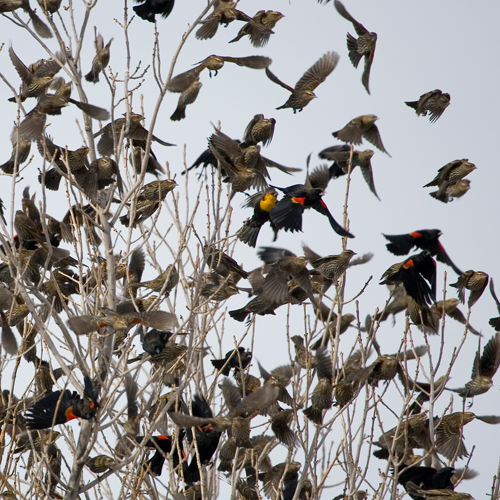
The Canada goose, pigeons, starlings, seagulls and house sparrows are the most common pest birds in our area. Pest birds are responsible for millions of dollars of damage every year. Bird droppings are highly caustic and eat away at roofing and other structural material. They contaminate food, water, and anything they touch. They release airborne spores that can be inhaled by customers, workers and family members. They also carry disease-causing parasites, fleas, ticks, mites, lice and other biting insects.
Are They Dangerous
Pigeon’s droppings and nests are of medical concern because they have over 50 diseases associated with them. Some of these include histoplasmosis, chlamyiosis, and salmonella. Their droppings are also acidic and may mar many different surfaces. The Canada goose is aggressive at protecting its territory and airport safety is jeopardized as many airport bird strike collisions result from geese roosting in open areas near airports. House sparrows and starlings can be a major nuisance in urban areas due to their nesting, eating, and living habits. Gutters and drainage pipes clogged with sparrow or starling nests can back up and cause extensive water damage. Furthermore, numerous fires have been attributed to electrical shorts from machinery housing sparrow or starling nests.
How To Get Rid Of Them
Controlling these birds can be difficult. That’s why our services may include a combination of products and techniques. Corrective landscaping, barriers, and exclusion methods may all be used to rid your home or business of these nuisance birds. source
Can You DIY?
Due to the complexity of treatment and the time required, pigeons, Canada geese, and house sparrows are generally not a pest many people have success in eradicating on their own. Beware when purchasing products online, as many are not effective. Pesticides are not typically effective against birds and can be harmful to people and pets if they are misused or mixed improperly.
How Soon Can We Come?
Our customers are our top priority. The Pigeon Patrol team will help you as soon as we can
Are These Treatments Safe?
Pigeon Patrol uses the least amount of materials possible while still resolving the problem. We utilize natural products, baits, and mechanical means as a form of treatment whenever possible keeping you, your family, employees, and customers safe.
How To Prevent For The Future
Pest bird problems can be difficult to prevent. Many of our clients choose year-round service against pest birds for the protection of their home or business.
Pigeon Patrol Products & Services is the leading manufacturer and distributor of bird deterrent (control) products in Canada. Pigeon Patrol products have solved pest bird problems in industrial, commercial, and residential settings since 2000, by using safe and humane bird deterrents with only bird and animal friendly solutions. At Pigeon Patrol, we manufacture and offer a variety of bird deterrents, ranging from Ultra-flex Bird Spikes with UV protection, Bird Netting, 4-S Gel and the best Ultrasonic and audible sound devices on the market today.
Contact us at 1- 877– 4– NO-BIRD, (604) 585-9279 or visit our website at www.pigeonpatrol.ca
Pigeon / Pigeon Patrol / Pigeons Roosting / Vancouver Pigeon Patrol / Bird Control / Surrey Pigeon Control / Pest / Vancouver Pigeon Blog / Birds Inside Home / Pigeons in the cities / Ice Pigeons/ What to do about pigeons/ most common types of sparrows , Damages Caused by Sparrows, How To Keep Raccoons Away, Why Are Raccoons Considered Pests?de-fence, Pigeon Nesting and Breeding Patterns and Behavior What Do I Do With a Bird Trapped in My Wall? Professional Bird Control Company Keep The Birds Away From Your Business Why Are Raccoons Considered Pests?