by Pigeon Patrol | Dec 16, 2021 | Bird Spike, Pigeon Predators, Pigeon Spikes, Pigeons, Pigeons in the News, Raccoons
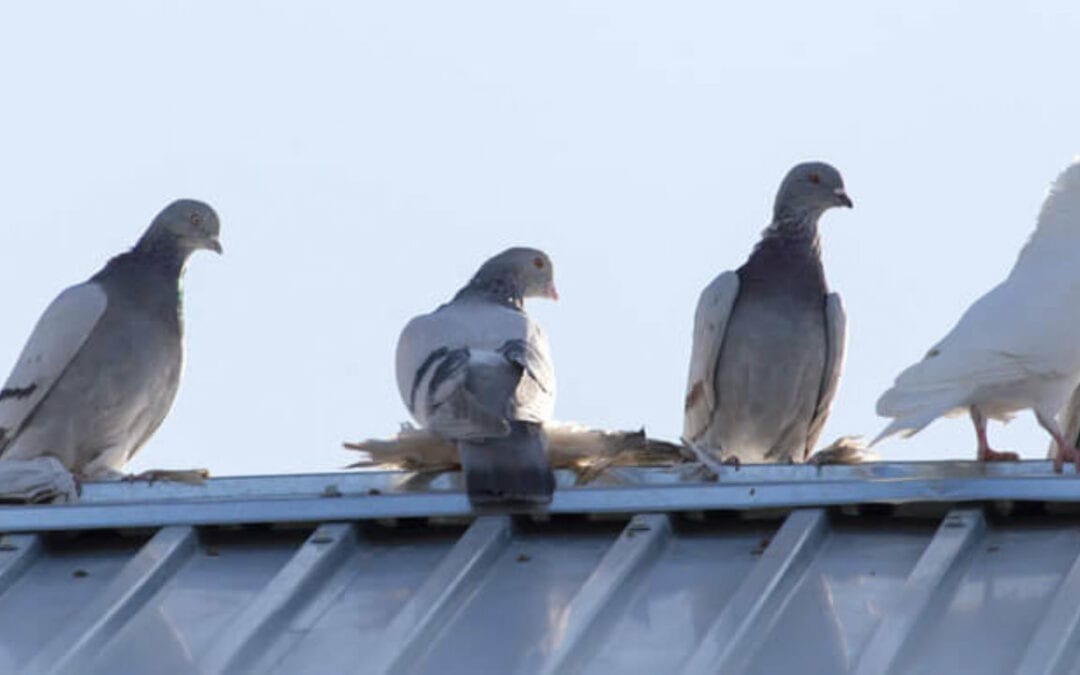
How does a lone pigeon get back home? Does it choose the fastest, the easiest or the safest route?
As flying takes a lot of energy, birds generally adapt their flight speed and trajectory to reduce how much they use.
Now researchers at Swansea University have been using high-tech tags to study homing pigeons and to discover if these crucial decisions could be linked to helping them avoid attack by predators.
When the team monitored pigeons as they flew back to their loft at the Max Planck Institute of Animal Behaviour in Germany, they observed that the birds did sometimes adopt energy-efficient flight styles such as starting their climbs ahead of hills to reduce their climb angle. But they also saw pigeons using up energy by flying at high speeds.
Baptiste Garde, of the University’s Swansea Lab for Animal Movement (SLAM) led the new research which has just been published by the journal Royal Society Open Science
He said: “This might suggest that pigeons are just trying to get home as fast a possible, but by comparing the variation in their flight speed and altitude to those of an ultralight aircraft following the same path, we found that pigeon altitude and speed was, in fact, very variable.
“Flying this way is neither efficient in terms of time nor energy, but it might have an unexpected advantage. Indeed, if we look at the trajectory of a rabbit on the run, or a snipe flying away, we can see that they make unpredictable sharp turns to confuse their predators.
“That is what we call a protean behaviour. Pigeons might be using the same strategy to increase their chances of avoiding an attack.
“Protean flight has only been described in a handful of birds up until now but we think that it might be a relatively common behaviour, with birds flying in a more unpredictable way when they fly solo.”
Source
Pigeon Patrol Products & Services is the leading manufacturer and distributor of bird deterrent (control) products in Canada. Pigeon Patrol products have solved pest bird problems in industrial, commercial, and residential settings since 2000, by using safe and humane bird deterrents with only bird and animal friendly solutions. At Pigeon Patrol, we manufacture and offer a variety of bird deterrents, ranging from Ultra-flex Bird Spikes with UV protection, Bird Netting, 4-S Bird Gel and the best Ultrasonic and audible sound devices on the market today.
Voted Best Canadian wholesaler for Bird Deterrent products ten years in a row.
Contact us at 1- 877– 4– NO-BIRD, (604) 585-9279 or visit our website at www.pigeonpatrol.ca
Pigeon/Pigeon Patrol / Pigeons Roosting / Vancouver Pigeon Control /Bird Spikes / Bird Control / Bird Deterrent / Pigeon Deterrent? Surrey Pigeon Control / Pest /Seagull deterrent / Vancouver Pigeon Blog / Birds Inside Home / Pigeons in the cities / Ice Pigeons/ What to do about pigeons/ sparrows , Damage by Sparrows, How To Keep Raccoons Away, Why Are Raccoons Considered Pests/ De-fence / Pigeon Nesting/ Bird Droppings / Pigeon Dropping/ woodpecker control/ Professional Bird Control Company/ Keep The Birds Away/ Birds/rats/ seagull/pigeon/woodpecker/ dove/sparrow/pidgeon control/pidgeon problem/ pidgeon control/flying rats/ pigeon Problems/ bird netting/bird gel/bird spray/bird nails/ bird guard
by Pigeon Patrol | Dec 16, 2021 | 4-S Gel Bird repellent, Animal Deterrent Products, Bird Deterrent Products, Bird Law, Bird Netting, Pigeon Droppings, Pigeon Patrol's Services, Pigeon Predators, Pigeon Spikes
All birds should be hatched wild and live and fly free but unfortunately many don’t. Whether they are our pets because they are domestic or because they are rescued from the wild, they can’t free fly safely. We would break your heart with all the stories of pet birds lost. And how they suffer.
The biggest risk to a pet pigeon or dove is getting outside and being killed by a predator before he can get back in to safety. Wild pigeons derive all their security from being part of a flock that stays alert watching out for predators and knows what to do (and has the education and physiology to do) what is needed when under attack. A pigeon alone is extremely vulnerable. A domestic pigeon outside alone is in imminent danger. It is unsafe to take a pet pigeon outside unprotected. They need to be in an aviary or in the house.
Your pet pigeon or dove doesn’t want to get lost but many do, especially when allowed to hang around outside in the backyard or ride along unprotected on their person’s shoulder. And clipped wings do not protect birds outside. Birds are by their very nature aerodynamic and being outside unprotected with clipped wings is no safer. One little startle and, with the air currents outdoors, they are airborne. And in danger. Wild pigeons and doves derive all of their security from their survival of the fittest DNA, their education growing up in the wild and from being a part of a flock. Your pet pigeon, even if hatched wild, is at terrible risk if permitted to free fly. You (and your dogs and your patio cover, etc. etc.) offer no protection to pet birds, only an illusion of safety. We too wish your pet could fly free but the odds of tragedy are very high. It is just too great a risk.
Reprinted from the Palomacy Help Group, written by Ashley Dietrich
We’re discussing free-flying pet pigeons, and why not to do it.
It sounds great, right? These fantastic fliers, out in the fresh air, doing what nature intended? It sounds wonderful, and I wish I could give my birds the whole sky to enjoy. While pigeons and doves DO need exercise and sunlight, these needs can be met with a predator-proof aviary, out-of-cage time indoors, secure leashes, etc. Here are the reasons Palomacy advocates against allowing domestic birds outdoors un-caged/un-tethered:
1. Predators
— Hawks – they’re everywhere. I’ve read a report about a hawk grabbing a parrot off of an owner’s shoulder. Raptors focus tightly on their intended prey, swoop in, and won’t always notice or care if a human is nearby. Two years ago, a small hawk tried to get my dove Cecily as she sat inside the screen of my open window, sunning after a bath – I was sitting less than 3 feet away. My windows are now covered in hardware cloth in addition to the basic window screens, so it is safe to open the glass. I live in the woods, but hawks are city birds too.
— Cats and Dogs. Even with the benefit of wild instincts, countless birds fall victim to outdoor cats and dogs. Cat attacks are the #1 human-related cause of bird mortality. I’ve seen this first-hand too many times as a wildlife rehabber, and I’ll spare you the gory details.
2. Birds can get lost
Birds are more difficult to retrieve than 4-legged pets. It’s easy for something to spook a bird – if they go too high or too far, it can be even harder to get them back. They can cover more distance, quickly – and a bit of wind exacerbates this problem. The tamest of birds could bolt if startled, and not all pigeons have a homing instinct. Adding to the complications, many people do not realize they are pets, so birds are less likely to get help from strangers. The pigeons and doves I have retrieved after they were found outdoors have all been suffering from dehydration or hunger to some degree. They cannot find food and water in the wild.
Source
Pigeon Patrol Products & Services is the leading manufacturer and distributor of bird deterrent (control) products in Canada. Pigeon Patrol products have solved pest bird problems in industrial, commercial, and residential settings since 2000, by using safe and humane bird deterrents with only bird and animal friendly solutions. At Pigeon Patrol, we manufacture and offer a variety of bird deterrents, ranging from Ultra-flex Bird Spikes with UV protection, Bird Netting, 4-S Bird Gel and the best Ultrasonic and audible sound devices on the market today.
Voted Best Canadian wholesaler for Bird Deterrent products ten years in a row.
Contact us at 1- 877– 4– NO-BIRD, (604) 585-9279 or visit our website at www.pigeonpatrol.ca
Pigeon/Pigeon Patrol / Pigeons Roosting / Vancouver Pigeon Control /Bird Spikes / Bird Control / Bird Deterrent / Pigeon Deterrent? Surrey Pigeon Control / Pest /Seagull deterrent / Vancouver Pigeon Blog / Birds Inside Home / Pigeons in the cities / Ice Pigeons/ What to do about pigeons/ sparrows , Damage by Sparrows, How To Keep Raccoons Away, Why Are Raccoons Considered Pests/ De-fence / Pigeon Nesting/ Bird Droppings / Pigeon Dropping/ woodpecker control/ Professional Bird Control Company/ Keep The Birds Away/ Birds/rats/ seagull/pigeon/woodpecker/ dove/sparrow/pidgeon control/pidgeon problem/ pidgeon control/flying rats/ pigeon Problems/ bird netting/bird gel/bird spray/bird nails/ bird guard
by Pigeon Patrol | Dec 16, 2021 | history of pigeons, MBCA, pet bird, Pigeon Control, Pigeon Droppings, Pigeon Patrol's Services, Pigeon Predators
When the leader of a flock goes the wrong way, what will the flock do?
With human beings, nobody can be sure. But with homing pigeons, the answer is that they find their way home anyway.
Either the lead pigeon recognizes that it has no clue and falls back into the flock, letting birds that know where they are going take over, or the flock collectively decides that the direction that it is taking just doesn’t feel right, and it doesn’t follow.
Several European scientists report these findings in a stirring report in Biology Letters titled, “Misinformed Leaders Lose Influence Over Pigeon Flocks.”
Isobel Watts, a doctoral student in zoology at Oxford, conducted the study with her advisers, Theresa Burt de Perera and Dora Biro, and with the participation of Mate Nagy, a statistical physicist from Hungary, who is affiliated with several institutions, including Oxford and the Hungarian Academy of Sciences.
Dr. Biro, who studies social behavior in primates as well as pigeons, said that the common questions that ran through her work were “about group living and what types of challenges and opportunities it brings.”
She and her colleagues at Oxford have pioneered a method of studying flock behavior that uses very-fine-resolution GPS units, which the birds wear in pigeon-size backpacks.
The devices record a detailed position for each bird a number of times a second. Researchers in Budapest and Oxford developed software to analyze small movements and responses of every bird in a flock.
With this method, the scientists can identify which pigeons are leading the way. They can build a picture of how each bird responds to changes in the flight of other birds.
The consistent leaders were often fast fliers and occupied the first position in the group of flying birds. Other birds followed them.
But what if one day, a leader flew in the wrong direction?
The researchers arranged to feed the leaders misinformation by putting them in lofts with artificial light for a few days. By shifting when the lights went on and off, compared with the actual external schedule of light and dark, the researchers could shift the pigeons’ internal clocks a few hours forward or back.
Pigeons navigate by using the position of the sun and an internal clock, so the change in the clock threw off their sense of direction and they didn’t fly toward home at all.
But the pigeon flock corrected its flight path, and went the right way.
Dr. Biro doesn’t know exactly how they corrected. The followers all had the right information, so they might have collectively said, “this guy’s wrong, let’s not follow him,” Dr. Biro said.
“Or, the leader said, ‘Something’s wrong here,’” and fell back into the flock, “effectively choosing not to lead,” Dr. Biro said, and another pigeon, that knew the time of day, led the way.
Sadly, these kinds of decisions by pigeon flocks offer no reassurance to humans who think political leaders are misinformed or misdirected.
The pigeons don’t communicate directly about where they are flying. The flock changes its flight path because of split-second reactions to position changes by other birds. There’s no decision-making process remotely similar to, say, an election.
But knowledge of how the pigeons work might be useful in creating swarms of small robots for activities like search and rescue. If researchers can reduce the decision-making process of a flock to a few simple rules about who follows whom, and when, those rules might be applied to robot groups.
Then the group of robots might be able to make some of its own decisions, at least about where to go or how to get there.
Source
Pigeon Patrol Products & Services is the leading manufacturer and distributor of bird deterrent (control) products in Canada. Pigeon Patrol products have solved pest bird problems in industrial, commercial, and residential settings since 2000, by using safe and humane bird deterrents with only bird and animal friendly solutions. At Pigeon Patrol, we manufacture and offer a variety of bird deterrents, ranging from Ultra-flex Bird Spikes with UV protection, Bird Netting, 4-S Bird Gel and the best Ultrasonic and audible sound devices on the market today.
Voted Best Canadian wholesaler for Bird Deterrent products ten years in a row.
Contact us at 1- 877– 4– NO-BIRD, (604) 585-9279 or visit our website at www.pigeonpatrol.ca
Pigeon/Pigeon Patrol / Pigeons Roosting / Vancouver Pigeon Control /Bird Spikes / Bird Control / Bird Deterrent / Pigeon Deterrent? Surrey Pigeon Control / Pest /Seagull deterrent / Vancouver Pigeon Blog / Birds Inside Home / Pigeons in the cities / Ice Pigeons/ What to do about pigeons/ sparrows , Damage by Sparrows, How To Keep Raccoons Away, Why Are Raccoons Considered Pests/ De-fence / Pigeon Nesting/ Bird Droppings / Pigeon Dropping/ woodpecker control/ Professional Bird Control Company/ Keep The Birds Away/ Birds/rats/ seagull/pigeon/woodpecker/ dove/sparrow/pidgeon control/pidgeon problem/ pidgeon control/flying rats/ pigeon Problems/ bird netting/bird gel/bird spray/bird nails/ bird guard
by Pigeon Patrol | Nov 30, 2021 | Bird Spike, Pigeon Droppings, Pigeon Patrol's Services, Pigeon Predators, Pigeon Spikes, Pigeons, Pigeons in the News
Pigeons predominantly feed on grains and cereals, thus they can consume quickly any grainy foods lift in the open. Aside from grains and cereals, Pigeons are known to feed on small insects as well as earthworms . Pigeons can feed on small Kentucky rats , lizards and many other reptiles, they can also carry these small animals in their claws or feet through hundreds of miles during flights until they reach their destination and without losing grip of such animals.
The question of feeding pigeon or not will largely depends on whether the bird is domesticated or not. While domesticated Louisville pigeons can be fed at a restricted area of a property, free-roaming pigeons must never be fed. Domesticated pigeons must only be fed if they are very few (between 1 and 5), however, feeding domesticated Kentucky pigeons may attract the attention of other pigeons , thus the population of pigeons around your property may soar within a short period of time.
Feeding of Louisville pigeons are widely discourage because of the possibility of such birds causing damages to different compartments of a property during flight. When you feed pigeons, they will end up defecating on your roof, similarly, they will end up roosting and building nests close to you property because they have a ready source of food. Feeding Kentucky pigeons around your property also means that they will eventually gain access to other places such as the patio, deck, and garage.
When you feed pigeons close to your Louisville property, they will get used to migrating there in search of food, and when you are not around, they may decide to fly through your door or window. Feeding pigeons within your Kentucky property will increase the chances of the birds gaining access to the attic or the chimney at the top , where they can easily roost and establish their nests. Even when your pigeons are domesticated, you must only feed them in their cages and not outside of their abode, this will reduce their chances of accessing your roof, since they are used to eating in their bowls or troughs , inside their cages.
Feeding Kentucky pigeons is discouraged in every way because of the enormous damages they tend to cause in and outside of properties. The birds are aggressive in nature, and their droppings can get too much to the extent of making roofs to cave in. Pigeon damages reduce the value of homes and can cause thousands of dollars in damages.
Source
Pigeon Patrol Products & Services is the leading manufacturer and distributor of bird deterrent (control) products in Canada. Pigeon Patrol products have solved pest bird problems in industrial, commercial, and residential settings since 2000, by using safe and humane bird deterrents with only bird and animal friendly solutions. At Pigeon Patrol, we manufacture and offer a variety of bird deterrents, ranging from Ultra-flex Bird Spikes with UV protection, Bird Netting, 4-S Bird Gel and the best Ultrasonic and audible sound devices on the market today.
Voted Best Canadian wholesaler for Bird Deterrent products ten years in a row.
Contact us at 1- 877– 4– NO-BIRD, (604) 585-9279 or visit our website at www.pigeonpatrol.ca
Pigeon/Pigeon Patrol / Pigeons Roosting / Vancouver Pigeon Control /Bird Spikes / Bird Control / Bird Deterrent / Pigeon Deterrent? Surrey Pigeon Control / Pest /Seagull deterrent / Vancouver Pigeon Blog / Birds Inside Home / Pigeons in the cities / Ice Pigeons/ What to do about pigeons/ sparrows , Damage by Sparrows, How To Keep Raccoons Away, Why Are Raccoons Considered Pests/ De-fence / Pigeon Nesting/ Bird Droppings / Pigeon Dropping/ woodpecker control/ Professional Bird Control Company/ Keep The Birds Away/ Birds/rats/ seagull/pigeon/woodpecker/ dove/sparrow/pidgeon control/pidgeon problem/ pidgeon control/flying rats/ pigeon Problems/ bird netting/bird gel/bird spray/bird nails/ bird guard
by Pigeon Patrol | Nov 23, 2021 | Bird Spike, Pigeon Predators, Pigeon Spikes, Pigeons, Pigeons in the News
That flock of pigeons flying overhead may look like a chaotic cloud of birds, but it’s more like an airborne hierarchy. By strapping tiny global positioning system (GPS) backpacks onto the birds, researchers have found that a flock follows several leaders at any given time in flight. But the flock’s leadership can change so that even low-ranking birds sometimes get a chance to command. The findings could shed light on how other groups of animals behave en masse, such as herds of wildebeest, schools of fish, and even crowds of humans.
Flocks of birds are one of the most common sights in everyday life, but many aspects of the animals’ behavior remain poorly understood. Why, for example, do flocks suddenly change directions and then change directions again within a few seconds? Why do birds in flight suddenly stop to rest on a certain stretch of telephone wire? And lacking any threat or sudden disturbance, why do flocks on the ground spontaneously take to the air?
To find some of the answers, researchers exploited a bit of 21st century technology. A team lead by statistical physicist Tamás Vicsek of Eötvös University in Hungary outfitted a trained flock of 13 homing pigeons with tiny GPS receivers that could determine each individual bird’s position every 0.2 seconds. Then they sent as many as 10 members of the flock out on 15 test flights. The journeys included four flights of about 15 kilometers back to the birds’ roost and 11 flights roaming freely around their home base outside Budapest. The researchers tracked each bird’s directional changes and how often those changes either followed or were copied by its flockmates.
In today’s issue of Nature, the team reports that the flight patterns showed a definite hierarchy, with most or all of the birds consistently copying changes in direction by the flock’s leaders, which almost always flew in front. If, for example, a leading bird suddenly swerved to the right, its followers copied its move within about 0.4 seconds—an amount of time considered too long to be reflexive.
However, the data also revealed that the leaders weren’t always the same, even within a single flight. And sometimes, even the birds at the bottom of the pecking order would lead the flock for brief periods. The arrangement made each flight more egalitarian, but the researchers think the reason might be more evolutionarily than politically driven. It’s possible that this type of group decision-making is more accurate or beneficial than others, says zoologist and co-author Dora Biro of the University of Oxford in the United Kingdom. Perhaps the individuals in the flocks stand a better chance of survival if they sometimes participate in guiding the group rather than constantly submitting to a single leader, she says.
Another curiosity was that the lower-ranking birds most often flew behind and to the right of the leaders. The researchers think this relates to the structure of the birds’ brains, in which the left side handles spatial tasks and the right side governs social recognition. Therefore, anything the birds see with their left eye (which is processed by the right side of the brain) tends to yield a quicker social response.
“The degree of coordination that flocks achieve is really impressive,” Biro says. “We identified a clear hierarchical structure within the decision-making process.” She says the team next plans to study flock members in greater depth, including their genders, ages, navigational experiences, to determine “what airborne leaders are made of.”
The findings could help explain group behavior of other animals, such as schooling fish, says evolutionary biologist Iain Couzin of Princeton University. There’s a “fascinating balance” between democratic and hierarchical control in the pigeon flocks, he says. And this sophisticated study reveals the link between the birds’ brain hemispheres and how they gather information during their flights. It achieves “a deeper understanding of coordinated control in animal groups,” he says.
Source
Pigeon Patrol Products & Services is the leading manufacturer and distributor of bird deterrent (control) products in Canada. Pigeon Patrol products have solved pest bird problems in industrial, commercial, and residential settings since 2000, by using safe and humane bird deterrents with only bird and animal friendly solutions. At Pigeon Patrol, we manufacture and offer a variety of bird deterrents, ranging from Ultra-flex Bird Spikes with UV protection, Bird Netting, 4-S Bird Gel and the best Ultrasonic and audible sound devices on the market today.
Voted Best Canadian wholesaler for Bird Deterrent products ten years in a row.
Contact us at 1- 877– 4– NO-BIRD, (604) 585-9279 or visit our website at www.pigeonpatrol.ca
Pigeon/Pigeon Patrol / Pigeons Roosting / Vancouver Pigeon Control /Bird Spikes / Bird Control / Bird Deterrent / Pigeon Deterrent? Surrey Pigeon Control / Pest /Seagull deterrent / Vancouver Pigeon Blog / Birds Inside Home / Pigeons in the cities / Ice Pigeons/ What to do about pigeons/ sparrows , Damage by Sparrows, How To Keep Raccoons Away, Why Are Raccoons Considered Pests/ De-fence / Pigeon Nesting/ Bird Droppings / Pigeon Dropping/ woodpecker control/ Professional Bird Control Company/ Keep The Birds Away/ Birds/rats/ seagull/pigeon/woodpecker/ dove/sparrow/pidgeon control/pidgeon problem/ pidgeon control/flying rats/ pigeon Problems/ bird netting/bird gel/bird spray/bird nails/ bird guard
by Pigeon Patrol | Nov 16, 2021 | Pigeon Droppings, Pigeon Patrol's Services, Pigeon Predators, Pigeon Spikes, Pigeons, Pigeons in the News
The feral pigeon (Columba livia) carries with it a reputation that runs counter to conservation: it is feral, exotic and invasive and even considered down right filthy. But upon closer inspection, the pigeon could be a subject worthy of study for both ecological and social science purposes and highlight the importance of urban species in ecology. This insight on pigeons occurred during an urban ecology study that focused on habitat and population dynamics of the birds and is also supported through an extensive literature review. As a nearly ubiquitous species, we discuss how important pigeons are as a prey-base for numerous raptors and underscore our position by highlighting several studies on the biological uptake of environmental contaminants that may have benefited from including the pigeon as part of the research. We further our stance on the importance of pigeons in urban ecology by highlighting additional concerns such as zoonotic disease and climate change. We expand our case by turning to the social construction of nature, the importance of public participation in conservation. Once again, the ubiquitous presence of pigeons lends itself well to citizen science in ecology and conservation, especially to show trends across a range of geographic locations. In short, this commentary strives to reconceptualize the feral pigeon, promoting the bird as a valuable asset to ecological and social research in ways that raise awareness for conservation concerns and advance our scientific thinking.
Source
Pigeon Patrol Products & Services is the leading manufacturer and distributor of bird deterrent (control) products in Canada. Pigeon Patrol products have solved pest bird problems in industrial, commercial, and residential settings since 2000, by using safe and humane bird deterrents with only bird and animal friendly solutions. At Pigeon Patrol, we manufacture and offer a variety of bird deterrents, ranging from Ultra-flex Bird Spikes with UV protection, Bird Netting, 4-S Bird Gel and the best Ultrasonic and audible sound devices on the market today.
Voted Best Canadian wholesaler for Bird Deterrent products ten years in a row.
Contact us at 1- 877– 4– NO-BIRD, (604) 585-9279 or visit our website at www.pigeonpatrol.ca
Pigeon/Pigeon Patrol / Pigeons Roosting / Vancouver Pigeon Control /Bird Spikes / Bird Control / Bird Deterrent / Pigeon Deterrent? Surrey Pigeon Control / Pest /Seagull deterrent / Vancouver Pigeon Blog / Birds Inside Home / Pigeons in the cities / Ice Pigeons/ What to do about pigeons/ sparrows , Damage by Sparrows, How To Keep Raccoons Away, Why Are Raccoons Considered Pests/ De-fence / Pigeon Nesting/ Bird Droppings / Pigeon Dropping/ woodpecker control/ Professional Bird Control Company/ Keep The Birds Away/ Birds/rats/ seagull/pigeon/woodpecker/ dove/sparrow/pidgeon control/pidgeon problem/ pidgeon control/flying rats/ pigeon Problems/ bird netting/bird gel/bird spray/bird nails/ bird guard