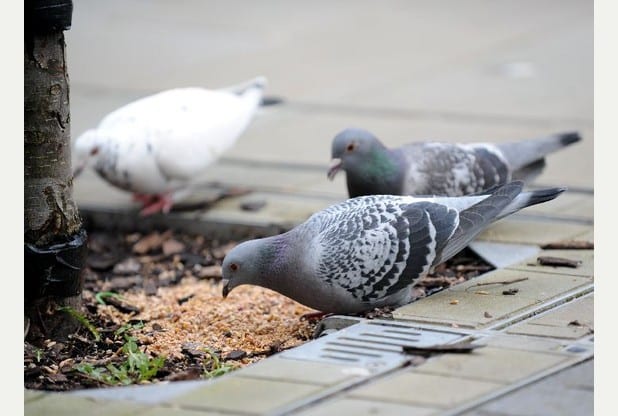
More than 60 diseases are associated with pigeons

More than 60 diseases are associated with pigeons
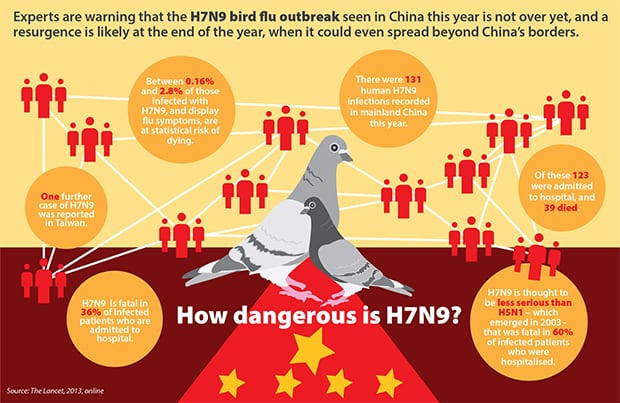
Pigeon PatrolMore than 60 transmissible diseases (some of which are fatal) are associated with geese, pigeons, starlings and house sparrows. For example:

Histoplasmosis is a respiratory disease that may be fatal. It results from a fungus growing in dried bird droppings.

Candidiasis is a yeast or fungus infection spread by pigeons. The disease affects the skin, the mouth, the respiratory system, the intestines and the urogenital tract, especially the vagina. It is a growing problem for women, causing itching, pain and discharge.

Cryptococcosis is caused by yeast found in the intestinal tract of pigeons and starlings. The illness often begins as a pulmonary disease and may later affect the central nervous system. Since attics, cupolas, ledges, schools, offices, warehouses, mills, barns, park buildings, signs, etc. are typical roosting and nesting sites, the fungus is apt to found in these areas.

St. Louis Encephalitis, an inflammation of the nervous system, usually causes drowsiness, headache and fever. It may even result in paralysis, coma or death. St. Louis encephalitis occurs in all age groups, but is especially fatal to persons over age 60. The disease is spread by mosquitoes which have fed on infected house sparrow, pigeons and house finches carrying the Group B virus responsible for St. Louis encephalitis.

Salmonellosis often occurs as “food poisoning” and can be traced to pigeons, starlings and sparrows. The disease bacteria are found in bird droppings; dust from droppings can be sucked through ventilators and air conditioners, contaminating food and cooking surfaces in restaurants, homes and food processing plants.

Besides being direct carriers of disease, nuisance birds are frequently associated with over 50 kinds of ectoparasites, which can work their way throughout structures to infest and bite humans. About two-thirds of these pests may be detrimental to the general health and well-being of humans and domestic animals. The rest are considered nuisance or incidental pests. A few examples of ectoparasites include:

Chicken mites (Dermanyssus gallinae) are known carriers of encephalitis and may also cause fowl mite dermatitis and acariasis. While they subsist on blood drawn from a variety of birds, they may also attack humans. They have been found on pigeons, starlings and house sparrows.

Yellow mealworms (Tenebrio molitor), perhaps the most common beetle parasites of people in the United States, live in pigeon nests. It is found in grain or grain products, often winding up in breakfast cereals, and may cause intestinal canthariasis and hymenolespiasis.

West Nile Virus while West Nile is technically not transmitted to humans from birds, humans can get infected by the bite of a mosquito who has bitten an infected bird. The obvious lesson is that the fewer birds there are in any given area, the better. This translates into a smaller chance of an infected bird in that area, a smaller chance of a mosquito biting an infected bird and then biting a human.

About Pigeon Patrol:

Pigeon Patrol Products & Services is the leading manufacturer and distributor of bird deterrent (control) products in Canada. Pigeon Patrol products have solved pest bird problems in industrial, commercial, and residential settings since 2000, by using safe and humane bird deterrents with only bird and animal friendly solutions. At Pigeon Patrol, we manufacture and offer a variety of bird deterrents, ranging from Ultra-flex Bird Spikes with UV protection, Bird Netting, 4-S Gel and the best Ultrasonic and audible sound devices on the market today.
Voted Best Canadian wholesaler for Bird Deterrent products four years in a row.

Contact Info: 1- 877– 4– NO-BIRD (www.pigeonpatrol.ca)
Pigeons can be controlled !

Pigeons can be controlled !

Pigeon PatrolThe need to control feral pigeon populations in urban areas has been the subject of intense debate for decades with town and city councils making little impact on the problem due to lack of investment and, in many cases, a reluctance to think laterally. Although the feral pigeon has been a common feature of urban life for the last 100 years there is no doubt that urban flocks are now growing faster than their numbers can be controlled. The reason for this unprecedented rise in feral pigeon numbers is due, almost exclusively, to the availability of food and the methods used to control the birds. Other factors such as the availability of good roosting and breeding facilities also play their part.

Today the feral pigeon can be seen in virtually every area of the globe other than the two polar icecaps, exploiting man for food and his buildings for the purposes of roosting and breeding. Man has attempted to control the feral pigeon by using a variety of lethal controls, includingpoisonsnarcoticscage traps and shooting, and yet the pigeon has shrugged off all these attempts at population control and continued to live and breed in close association with man undeterred. Lethal controls have been complemented by an arsenal of deterrents, provided in an effort to deny or restrict roosting and perching opportunities (thereby reducing guano-related problems). Anti-roosting systems such as anti-roosting spikes have proved extremely effective at displacing pigeons from areas that pigeons roost and nest; but may not be a total solution as pigeons may simply move to other areas nearby.

So what other options are available to control and contain the problem?

The use of lethal control as a means of controlling and reducing pigeon populations has been found to have no effect in terms of reducing pigeon flock size.

Breeding Control

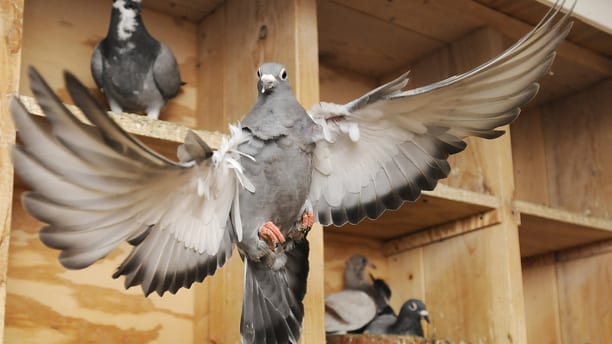
The principle of a scheme using artificial breeding facilities is to provide a pigeon loft ordovecote in which feral pigeons can be encouraged to roost and breed and from which their eggs can be removed as laid and replaced with dummy eggs. This method of breeding control has been found to be extremely effective in reducing flock size and maintaining that reduction indefinitely.

If public feeding is identified to be the cause of the problem a system of controls must be provided that take the impact of persistent feeding into consideration at the same time as identifying large-scale pigeon roosts and closing them down. 

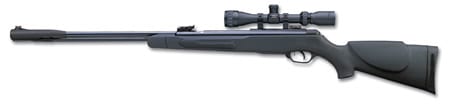
Pigeon Patrol Gun

About Pigeon Patrol:

Pigeon Patrol Products & Services is the leading manufacturer and distributor of bird deterrent (control) products in Canada. Pigeon Patrol products have solved pest bird problems in industrial, commercial, and residential settings since 2000, by using safe and humane bird deterrents with only bird and animal friendly solutions. At Pigeon Patrol, we manufacture and offer a variety of bird deterrents, ranging from Ultra-flex Bird Spikes with UV protection, Bird Netting, 4-S Gel and the best Ultrasonic and audible sound devices on the market today.
Voted Best Canadian wholesaler for Bird Deterrent products four years in a row.

Contact Info: 1- 877– 4– NO-BIRD (www.pigeonpatrol.ca)
The information on this blog is for personal use only. Content for this blog obtained from other websites is not being used for any commercial reasons whatsoever as per the copyright statement on the Pigeon Control Resource Centre’swebsite. http://www.pigeoncontrolresourcecentre.org/ Special thanks for the people and companies that helped gather this information. This information is to be used for reference only.


Removing bird netting at Echo Park Lake

Removing bird netting at Echo Park Lake

Pigeon PatrolThe anti-bird netting covering the lotus bed at Echo Park Lake was being removed today a few weeks after a resident complained that the nets had trapped and separated ducklings from their mothers, leading some chicks to die.  It’s not clear if the removal of the nets was prompted by the complaint or was already in the works. But one member of the crew removing the nets today said the fabric would also be taken down from the lake’s other wetland areas.

The netting was installed about a year ago after ducks and other birds began feasting on the approximately 20,000 aquatic plants that were installed as part of the lake’s clean up. The idea of the nets was to give the plants time to grow and establish themselves before getting picked off by birds. But no one ever said when those nets would be removed.

Thomas DeBoe, who focused attention on the problems caused by the nets, alerted The Eastsider this morning when he saw the nets being removed over the lotus bed.  “Today the lotuses are being freed,” he said.

It’s not clear how the aquatic plants will hold up without the nets but the lifting of the black shroud restores the classic vista of the lotus plants floating on the lake and downtown skyscrapers rising in the distance.

About Pigeon Patrol:

Pigeon Patrol Products & Services is the leading manufacturer and distributor of bird deterrent (control) products in Canada. Pigeon Patrol products have solved pest bird problems in industrial, commercial, and residential settings since 2000, by using safe and humane bird deterrents with only bird and animal friendly solutions. At Pigeon Patrol, we manufacture and offer a variety of bird deterrents, ranging from Ultra-flex Bird Spikes with UV protection, Bird Netting, 4-S Gel and the best Ultrasonic and audible sound devices on the market today.
Voted Best Canadian wholesaler for Bird Deterrent products four years in a row.

Contact Info: 1- 877– 4– NO-BIRD (www.pigeonpatrol.ca)
Expert help sought to handle pigeon issue at LaPorte City Hall

Expert help sought to handle pigeon issue at LaPorte City Hall

  pigeon Patrol birdsHelp is being sought from experts at Purdue University to help chase away pigeons that seem at times to be overtaking the newly renovated LaPorte City Hall.

Their numbers are so high that some people coming in and out of the building are relieved not to be hit by droppings.

“Don’t walk out there without your hat on,” said LaPorte City Councilman Ron McAtee.

It’s a problem a busy Mayor Blair Milo would rather not have to tackle, but her office is persevering, contacting Purdue University and other cities that have had success in combating pigeons for possible solutions.

“We are still working on that,” said Milo.

The $1 million renovation of the historic 1913 structure was virtually completed in February at the time complaints started being voiced about large numbers of pigeons roosting close to the edge of the roof and on the ornamental metal trim.

Spikes were put on the ledges near the roof but that didn’t drive them away.

Instead, the pigeons found room behind the spikes to nest or moved to window sills and other ledges to perch lower on the building.

“We’ve got a little more work to do on that,” said McAtee.

Not only is there a risk of being pelted with droppings, but the waste littering the concrete steps leading up to the front entrance and other spots on the ground has to be cleaned.

Jason Flores, an employee of Larson Danielson Construction, said his crew has had to wipe the mess off the limestone ledges at times during the renovation and has seen nests in the soffit close to the roof’s edge whenever he goes up on a lift to perform restoration work.

After the winter, there were droppings caked on parts of the exterior.

“See how it’s starting to build back up again,” said Flores, 39, of LaPorte.

Milo said trapping the birds is among the ideas also being explored but that would mean an organization having to come in regularly to release the pigeons.

“We want to do it in the most humane way possible,” said Milo.

Gene Matzat, an educator with the Purdue extension office in LaPorte, said besides tarnishing a building, pigeons also carry disease that could spread to humans.

Matzat said possible solutions include running a thin porcupine wire with sharp metal prongs along roosting places on the building to inflict pain so the pigeons fly elsewhere.

Attaching sheet metal or wood on the stone ledges at an angle so pigeons won’t feel comfortable roosting is among the other options.

Depending on what the city decides to try, there likely will be some expense.

“The results may justify the cost,” said Matzat, who added farmers sometimes turn to pesticides absorbed by the feet on pigeons to kill the birds roosting inside barns and pole type structures.

In extreme cases, he said some communities have brought in birds that prey upon pigeons to reduce their numbers.

Once they’re gone, though, Matzat said there is a chance the same or some other flock of pigeons will wind up back there.

“They’re adaptable. They’ll look for the best place for their area that they would enjoy roosting on and they’ll probably find it,” said Matzat.

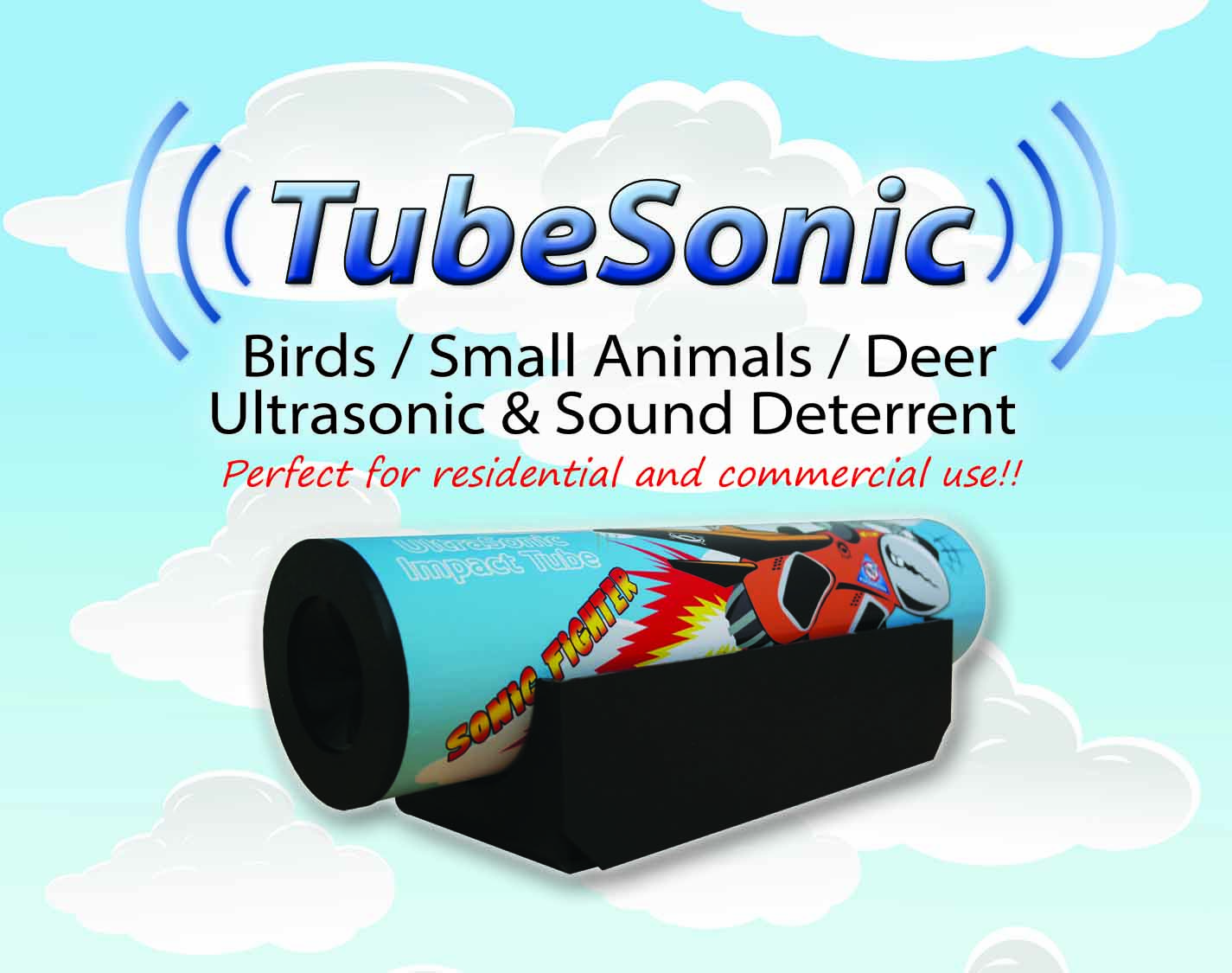
Seems that these people should be investing in a TubeSonic!!

About Pigeon Patrol:

Pigeon Patrol Products & Services is the leading manufacturer and distributor of bird deterrent (control) products in Canada. Pigeon Patrol products have solved pest bird problems in industrial, commercial, and residential settings since 2000, by using safe and humane bird deterrents with only bird and animal friendly solutions. At Pigeon Patrol, we manufacture and offer a variety of bird deterrents, ranging from Ultra-flex Bird Spikes with UV protection, Bird Netting, 4-S Gel and the best Ultrasonic and audible sound devices on the market today.
Voted Best Canadian wholesaler for Bird Deterrent products four years in a row.

Contact Info: 1- 877– 4– NO-BIRD (www.pigeonpatrol.ca)

Tube sonic pigeon patrol

Man jailed five days for killing gull that stole pigeon feed

Man jailed five days for killing gull that stole pigeon feed

Pigeon PatrolOTTAWA — An Ottawa man will serve five days in jail for bashing a gull to death because it was stealing the seed he meant for pigeons in the ByWard Market last summer.

Keith Watt, 59, was sentenced Thursday in an Ottawa courtroom on a charge of causing distress to an animal.

Watt beat the bird on Aug. 27, 2013. It died of its injuries two days later.

“Violence against animals is not acceptable, no matter what the animal,” Bruce Roney, executive director of the Ottawa Humane Society, said in a statement. “This bird really suffered before dying from its injuries. We’re pleased the justice system has acknowledged that this act of animal cruelty is unacceptable to our community.”

According the Humane Society report of the case, Watt was feeding pigeons in the Market and got mad when gulls arrived and began to eat the food, too. One gull got close enough that Watt was able to grab it. The gull bit him.

Watt “responded by swinging the gull with what appeared to be full force against a brick wall.” He then tossed the badly injured bird over a nearby fence.

A witness reported the incident and the gull was taken to the Wild Bird Care Centre, where it died.

Watt was charged under the Ontario SPCA Act.

He was also put on probation for two years and is banned from owning an animal for five years. He must also pay the Humane Society’s court costs.

About Pigeon Patrol:

Pigeon Patrol Products & Services is the leading manufacturer and distributor of bird deterrent (control) products in Canada. Pigeon Patrol products have solved pest bird problems in industrial, commercial, and residential settings since 2000, by using safe and humane bird deterrents with only bird and animal friendly solutions. At Pigeon Patrol, we manufacture and offer a variety of bird deterrents, ranging from Ultra-flex Bird Spikes with UV protection, Bird Netting, 4-S Gel and the best Ultrasonic and audible sound devices on the market today.
Voted Best Canadian wholesaler for Bird Deterrent products four years in a row.

Contact Info: 1- 877– 4– NO-BIRD (www.pigeonpatrol.ca)  Now shipping World Wide.