Many types of birds are attracted to swimming pools. As a result, swimmers might come in contact with bird droppings (poop) while in the pool. If you find bird droppings in the pool, there are a few simple steps you can take to disinfect the water and keep birds away from the pool.
Can bird droppings in the pool spread germs to swimmers?
Many germs that might be found in bird droppings can infect humans. Duck and goose droppings, in particular, might contain germs such as E. coli, Salmonella, Campylobacter, or Cryptosporidium (“Crypto” for short).
Most germs in bird droppings are killed by chlorine within minutes in a well-maintained pool.
The germ Crypto, however, has a tough outer shell that allows it to survive for a long time in the environment. Crypto can survive for days even in properly chlorinated pools. Currently, CDC is not aware of any evidence of Crypto being spread directly from birds to humans.
What should I do if I find bird droppings in the pool?
Pool operators and owners should respond to finding bird droppings in the pool the same way they would respond to finding formed human feces (poop) in the pool. The Healthy Swimming Program’s Fecal Incident Response Recommendations Cdc-pdf[PDF – 4 pages] provide step-by-step guidance on how to properly decontaminate the water in these situations.
Follow these steps to remove bird droppings and disinfect the water:
Close the pool to swimmers.
Put on disposable gloves.
Remove the bird droppings using a net or bucket. Do not vacuum the droppings from the pool.
Clean off any debris or dirt from the item used to remove the bird droppings.
Disinfect the item used to remove the droppings by immersing it in the pool during the 30-minute disinfection time described below.
Remove and dispose of gloves.
Wash your hands thoroughly with soap and water immediately.
Raise the free chlorine concentration to, or maintain it at, 2 parts per million (ppm); maintain the pH level at 7.5 or less; keep the temperature at 77°F (25°C) or higher. The free chlorine and pH should remain at these levels for 30 minutes.
Confirm that the filtration system is operating properly.
How can I keep birds away from the pool area?
The following steps can help encourage birds, other than ducks and geese (more information on ducks and geese is provided below), to leave the swimming pool area:
Remove plants that produce edible nuts, fruits, and berries.
Remove bird feeders.
Trim or remove trees and shrubs to limit branches hanging around or over the pool that can be used by roosting birds.
How can I keep ducks and geese away from the pool area?
Do not feed ducks or geese; providing food attracts them and encourages them to return. Many types of ducks and geese eat grass, so reducing the area of grass lawns around the swimming pool or putting up barriers that prohibit movement between swimming pools and grass lawns, such as fences and hedges, might also help. Removing domestic ducks and geese from the pool area can also help decrease the likelihood that wild ducks and geese will be attracted to the area.
The U.S. Department of Agriculture has additional information on how to manage ducks and geese (also known as waterfowl) in their document Assistance with Waterfowl Damage. Cdc-pdf[PDF – 3 pages]External
What can I do to get rid of ducks and geese already in the pool area?
In the United States, most birds, including ducks and geese, are protected by the Federal Migratory Bird Treaty Act and state laws. Local laws might also apply. Therefore, legal options for dealing with birds are limited and may require a permit. Consult the U.S. Fish and Wildlife ServicesExternal and your state wildlife agencyExternal for more information.
Pigeon Patrol Products & Services is the leading manufacturer and distributor of bird deterrent (control) products in Canada. Pigeon Patrol products have solved pest bird problems in industrial, commercial, and residential settings since 2000, by using safe and humane bird deterrents with only bird and animal friendly solutions. At Pigeon Patrol, we manufacture and offer a variety of bird deterrents, ranging from Ultra-flex Bird Spikes with UV protection, Bird Netting, 4-S Bird Gel and the best Ultrasonic and audible sound devices on the market today.
Voted Best Canadian wholesaler for Bird Deterrent products ten years in a row.
Contact us at 1- 877– 4– NO-BIRD, (604) 585-9279 or visit our website at www.pigeonpatrol.ca
Pigeon/Pigeon Patrol / Pigeons Roosting / Vancouver Pigeon Control /Bird Spikes / Bird Control / Bird Deterrent / Pigeon Deterrent? Surrey Pigeon Control / Pest /Seagull deterrent / Vancouver Pigeon Blog / Birds Inside Home / Pigeons in the cities / Ice Pigeons/ What to do about pigeons/ sparrows , Damage by Sparrows, How To Keep Raccoons Away, Why Are Raccoons Considered Pests/ De-fence / Pigeon Nesting/ Bird Droppings / Pigeon Dropping/ woodpecker control/ Professional Bird Control Company/ Keep The Birds Away/ Birds/rats/ seagull/pigeon/woodpecker/ dove/sparrow/pidgeon control/pidgeon problem/ pidgeon control/flying rats/ pigeon Problems/ bird netting/bird gel/bird spray/bird nails/ bird guard
Nobody could possibly be happy cleaning pigeon droppings. Yet Arno Penzias and Robert Wilson were being forced to do it. As good scientists they simply could not avoid it, since they had to discount the role of this “white dielectric substance” in the noise that was plaguing their equipment. When they finished with the cleaning and dispatched the pigeons by mail to a faraway place, the noise still did not disappear. And it seemed to come from all directions. The implications of this annoying constant background hum, corresponding to a temperature of only 3 degrees above absolute zero, signified one of the most momentous discoveries in twentieth-century physics, notable even among Nobel Prize-winning discoveries.
Arno Penzias, the German-born physicist who fled from the Nazis with his family in 1939, is at Lindau this year along with his co-recipient Robert Wilson. There are two other physics Nobel laureates this year at Lindau- George Smoot and John Mather. The four men whose work is separated by forty years share a very close connection. Smoot and Mather’s work put the capstone on that of Penzias and Wilson’s. In a way the work of these gentlemen eclipses the work of all Nobel laureates since it deals with something that happened long before any of the others made their discoveries. In fact, it was so long before that it dealt with the beginning of time itself…or so we think. Penzias and Wilson discovered what is called the”cosmic microwave background radiation”, which is nothing less than the notes from the harp that the universe played when it fired up. Just like you can guess the identity of the great conductor Herbert von Karajan from listening to the thundering notes of his performance of Beethoven’s 9th symphony, so can you discern the violent birth throes of the universe from the noise this cosmic cataclysm left behind.
It was noise, quite literally. And it was bothering Penzias and Wilson when they were working on a radio antenna inthe fall of 1964 in a small town called Holmdel in New Jersey. There, Bell Laboratories which owned the instrument had turned it over to Penzias and Wilson for pure science. That was a different age, when companies like BellLabs gave free rein to researchers to pursue their own ideas; in the ensuing decades the institution would produce a steady stream of Nobel laureates,an astonishing feat for an industrial laboratory. But at that point the lab was just getting warmed up.
The antenna was about twenty feet wide and shaped like a horn to minimize reception from the sides. It was originally designed to detect transmitted signals from Echo, the first communications satellite. But now Penzias and Wilson were using it to detect radio waves from celestial bodies. The receiver was tuned to detect only frequencies in the microwave region of the spectrum.
But there it was, that darned noise again. No matter what they did to the antenna, it was steadily humming in the background, like one of those overenthusiastic teenagers deliberately trying to annoy you. Like good scientists, Penzias and Wilson started to eliminate all possible sources of noise they could find. Radio noise could arise from any number of sources. It could come from the ground which was warmed up by the sun. It could arise from the earth’s atmosphere, or from the gas between the stars, or from the emission of molecules in outer space. Noise could be generated by waves bouncing off some of the sharp edges in their antenna. Oneby one the scientists investigated and discounted all these sources. They covered up the sharp edges with aluminum tape. They turned the antenna towards and away from major cities like New York. And of course, finally in desperation, they cleaned up waste from a family of pigeons that was roosting in a small part of the antenna horn. They dispatched these pigeons to the main offices of Bell Labs (like good homing pigeons the birds promptly showed up two days later). The noise still would not disappear. Like constant mumbling from disgruntled voters at a campaign speech, it simply would not die.
The two men were accomplished scientists and they did not doubt their own skills. Penzias had worked with Isidor Rabi (whom we met earlier) and Charles Townes, the inventor of the maser, at Columbia University. Wilson had gotten his PhD. at Caltech a few years ago. Their temperaments also complemented each other. Penzias was a big picture man, trying to tie together facts in an overarching thread. Wilson was much more detail-oriented and could patiently tinker with equipment until he got it right. Together the scientists were confident in their analysis and believed they had discarded all sources of noise. Yet it remained. For the moment they decided to take a break.
It was December of that year, and Penzias was coming back on an airplane from a conference. The “noise problem” was on his mind and he mentioned it to a fellow astronomer named Bernie Burke. A short time later, Burke called Penzias back with some interesting news. He had just seen a manuscript written by a physicist named Jim Peebles at Princeton University along with his supervisor Robert Dicke. The manuscript predicted that because of the intense heat during the birth of the universe, there should exist today a remnant of the Big Bang, which would manifest itself uniformly as steady background radiation. Because of the time elapsed since the Big Bang, the temperature of this radiation should be no more than afew degrees kelvin above absolute zero.
Oh yes, and it should be detectable as constant hiss in a good radio telescope.
I leave it to the students at this year’s Lindau meeting to personally ask Penzias what he must have felt when he heard about the Peebles-Dicke paper from Burke. But it surely must have sent his heart racing. Intrigued, Penzias called Dicke. Dicke’s heart must have raced even more because just then he had been trying to construct his own antenna to detect the cosmic noise that his paper predicted. Dicke promptly got into his car and drove the thirty miles or so from Princeton to check out Penzias and Wilson’s data. When he confirmed its authenticity, he must have felt an intense mix of excitement, amazement and chagrin. He had narrowly missed making the discovery that won Penzias and Wilson the Nobel Prize for physics in 1978.
Penzias and Wilson in front of the Holmdel radio antenna
Sounds from a faraway time
The evolution of the idea of the cosmic microwave background is almost a textbook study of ignorance and triumph, and how experimentalists and theoreticians can sometimes unintentionally delay progress by failing to communicate with one another. The Big Bang theory was proposed by Georges Lemaître, a Belgian Roman Catholic priest, although interestingly the term ‘Big Bang’ was pejoratively coined by a detractor of the theory, Fred Hoyle. Later the theory was developed by the brilliant and colorful Russian physicist, scotch lover and popular science writer George Gamow and his colleagues, Ralph Alpher and Robert Herman. After World War 2, Gamow’s colleagues Alpher and Herman predicted the cosmic microwave background. This was based on their ideas about nucleosynthesis- the formation of elements in the universe.
Robert Herman (left) and Ralph Alpher. In the middle is George Gamow, materializing out of a bottle of ‘Ylem’, the primordial soup from which our universe originated.
Big Bang Theory cosmology is based on Einstein’s theory of gravitation. In 1929 Edwin Hubble had already made the groundbreaking discovery that the universe seemed to be expanding. This meant that at some point back in time it must have been infinitely compressed. Compression means high temperature, in this case, a very high temperature of 10 billion degrees when the universe was only one second old. At this temperature matter as we know it ceases to exist, and the universe consists of a thick boiling broth of subatomic particles and electromagnetic radiation in the form of very high frequency gamma rays. Electromagnetic radiation is emitted and absorbed by all electrically charged particles. When there are a sufficient number of particles, this radiation manifests itself as black-body radiation. Black-body radiation can be defined by a certain value of energy at a given frequency range and thus can be completely fixed by the temperature. At ten billion degrees, there would be massive creation of electrons and positrons from the energy of other moving particles. But after one second, Big Bang theory physics predicts that if the number of photons is larger than the number of matter particles, then the initial black-body radiation will continue to be black-body radiation. The only change in this radiation is that it cools with the expansion of the universe. About 400,000 years after the beginning, an epochal event happened. Stable atoms of hydrogen began to form, and the radiation was ‘decoupled’ from the matter and was left free to wander on its own. Thus, even today, almost fifteen billion years later, space should be filled with black-body radiation left over from the Big Bang. Its temperature should be roughly 3 K.
This at least was what Alpher and Gamow conjectured. But they were not the first ones to think about it. In fact the microwave background had been indirectly observed in the late 1930s and early 40s by American astronomers. These astronomers saw faint signs of light absorption by certain molecules in outer space and concluded that the molecules were somehow being ‘pumped up’ with energy that came from a temperature of 2.3 K. Unfortunately, there was yet no theoretical framework in which this observation could fit, and it became part of the countless number of other details in astronomy. Now, when Gamow, Alpher and Herman formed their ideas, they did not know about this experimental work. Most incredibly, a couple of years later, two Russian physicists published a paper saying that not only should this background exist, but that the best detecting instrument for it would be the radio antenna in Holmdel, New Jersey! As if to cap this circus of ignorance and lack of communication, Penzias, Wilson and Dicke had all not heard of these earlier predictions; somehow unlike the cosmic background, the signal had been lost in the noise. One can only wonder how things would be if this drama were to be enacted today, in the era of the Internet and Email.
Dicke in fact thought he was the first one proposing the cosmic microwave background. His reasoning was fascinating and harkened back to analogies in Hindu and Buddhist philosophies about the creation of the universe. Dicke was a proponent of the ‘oscillating universe’ which posits that the universe has no end or beginning but cycles through time. According to his logic, if the heavy elements had been created through nucleosynthesis, they could not keep on increasing in proportion indefinitely; after all, the observed universe is largely contained of hydrogen and helium and not heavy elements. Thus, at some point the heavy elements would have to be annihilated to make room for the next batch of matter. This annihilation would produce radiation, and it’s this radiation that would manifest itself as the cosmic background. Dicke’s oscillating universe tome is a perfect example of a scientific ‘model’, a conceptual construction that retains some simple aspects of the universe but which can neatly explain a key observation. As with models, Dicke’s prediction of the microwave background does not uniquely depend on the oscillating universe model. In fact it arises perfectly from the modern day theory of the Big Bang.
Dicke was supremely competent for this kind of theorizing. Today he is the underappreciated man in the cosmic microwave background story. Dicke was a genius at electronic devices, working on important radar components at the famous Radiation Laboratory at MIT during the war. In the early 60s, he did a highly accurate measurement proving the equivalence of inertial mass and gravitational mass, a foundational concept of Einstein’s relativity. Dicke’s thirst was not slaked just by doing experiments. He also provided the first quantum theory of the laser. By the mid 60s Dicke was a legend, the Enrico Fermi of his time, highly accomplished in both theory and experiment. As it turned out though, even Dicke could not escape the vagaries of space and time. Robert Henry Dicke died in 1997.
Robert Henry Dicke (1916-1997)
In 1989, a satellite called COBE was launched by NASA that would measure Penzias and Wilson’s microwave background to unprecedented accuracy. Two of the principal scientists in this endeavor were George Smoot and John Mather who are at Lindau this year. The satellite’s measurements of the black body radiation curve were so remarkably accurate that the error bars in the curve which typically extend on top and bottom were almost lost in the signal.
The COBE satellite black-body radiation curve with the data points (red) plotted on the theoretical spectrum (black). The two match up almost perfectly
The COBE satellite followed by the Wilkinson Probe satellite launched in 2001 put the icing on the microwave background cake. The Big Bang theory has attained the status of one of our most highly refined and validated theories, thanks to the work of Smoot, Penzias, Wilson, Mather and many others. It seems only wonderfully fitting that Penzias, Wilson, Smoot and Mather are all attending this year’s meeting, coming full circle and neatly tying together the ends of a story spread over 40 years, which in turn tells the story of moments in time billions of years ago.
George Smoot and John Mather (Physics, 2006)
The story of the microwave background is an exercise in scientific history, demonstrating how ideas can, and sometimes do not, build on top of each other. It would have been interesting to see how the same story would have played out in today’s age, when the barriers to communication have been all but shattered by the availability of hundreds of years of research that can be accessed through the click of a mouse. Scientific ideas are hostage to the same qualities of human fallibility, determination, creativity, and of course, the uncertainties of space and time, as are other aspects of the human experiment. All we can do is persevere.
Pigeon Patrol Products & Services is the leading manufacturer and distributor of bird deterrent (control) products in Canada. Pigeon Patrol products have solved pest bird problems in industrial, commercial, and residential settings since 2000, by using safe and humane bird deterrents with only bird and animal friendly solutions. At Pigeon Patrol, we manufacture and offer a variety of bird deterrents, ranging from Ultra-flex Bird Spikes with UV protection, Bird Netting, 4-S Bird Gel and the best Ultrasonic and audible sound devices on the market today.
Voted Best Canadian wholesaler for Bird Deterrent products ten years in a row.
Contact us at 1- 877– 4– NO-BIRD, (604) 585-9279 or visit our website at www.pigeonpatrol.ca
Pigeon/Pigeon Patrol / Pigeons Roosting / Vancouver Pigeon Control /Bird Spikes / Bird Control / Bird Deterrent / Pigeon Deterrent? Surrey Pigeon Control / Pest /Seagull deterrent / Vancouver Pigeon Blog / Birds Inside Home / Pigeons in the cities / Ice Pigeons/ What to do about pigeons/ sparrows , Damage by Sparrows, How To Keep Raccoons Away, Why Are Raccoons Considered Pests/ De-fence / Pigeon Nesting/ Bird Droppings / Pigeon Dropping/ woodpecker control/ Professional Bird Control Company/ Keep The Birds Away/ Birds/rats/ seagull/pigeon/woodpecker/ dove/sparrow/pidgeon control/pidgeon problem/ pidgeon control/flying rats/ pigeon Problems/ bird netting/bird gel/bird spray/bird nails/ bird guard
Study Shows Why Each Parasite Species Often Infests a Favorite Host Species
University of Utah biologists twirled louse-infested bird feathers on an electric fan and flew pigeons and doves like kites on strings in a study that found small lice stick to small birds and big lice prefer big birds.
The study also showed why size matters to parasites: Lice infest bird species with feather
s that are just the right size so the insects can hide between individual “barbs” – the hair-like branches that extend from the shaft of each feather. When lice can hide in the feathers, the birds cannot preen them off with their beaks.
Why should anyone care? More than half of all species on Earth are parasites, or bacteria and viruses that act like parasites. The great diversity of parasites is tied to the fact that many parasite species evolved so each usually infests only one species of host organism.
The study “is one of the best demonstrations to date of why parasites are often specific to a single species of host and under what conditions they jump hosts,” said evolutionary ecologist Dale H. Clayton, the study’s first author and an associate professor of biology at the University of Utah. “This is of strong interest to the public, particularly when it concerns parasites such as SARS and the West Nile virus.”
“Sometimes parasites from domestic animals switch to h
umans and sometimes they don’t,” says biology doctoral student Sarah E. Bush, a co-author of the study. “So looking at how parasites on birds switch to other species of birds may help us understand how parasites from mammals switch to humans.”
The study is being published online the week of Dec. 8, 2003, by the journal Proceedings of the National Academy of Sciences. It was conducted by Clayton; Bush; former biology undergraduate Brad Goates, now a University of Utah medical student; and former postdoctoral researcher Kevin Johnson, now at the Illinois Natural History Survey.
SARS (severe acute respiratory syndrome), which killed 916 people worldwide in a 2003 outbreak, is caused by a coronavirus that is believed to have jumped to humans from civets, which are nocturnal, cat-shaped creatures. The West Nile virus is spread from birds and mosquitoes to humans.
While the new study is not immediately relevant to SARS and West Nile, “if we know why parasites use some hosts and not other hosts, then we can begin to predict what hosts may get hit in the future by a given parasite,” Clayton says.
Genealogy for lice and birds
In one part of the study, the researchers analyzed genetic material from 19 species of lice and 24 species of pigeons and doves. That allowed them to construct evolutionary family trees for the lice and the birds, showing how each species was related to or descended from other species during the last 30 million years.
Those evolutionary trees revealed that louse species evolved in concert with various species of pigeons and doves they infest. As a result, “big birds have big lice, small birds have small lice,” says Bush.
“We have shown that something as simple as the changing size of a parasite’s environment – the bird feather – can cause new species of lice to form,” Clayton says.
“Our research suggests that humans don’t pick up lice from chimps and baboons because those lice evolved to hang onto to coarser hair. On an even broader level, the study suggests size matters in terms of what parasites infest a host. Size is one of the most fundamental properties of all living organisms. Something as simple as size even may be dictating what cells can be invaded by parasites like those that cause malaria.”
Experiments to learn why bird size matters to lice
After making measurements to confirm bigger birds have bigger feathers and smaller birds have smaller feathers, the researchers conducted three sets of experiments to learn why big lice could only survive on birds with big feathers.
Five species of birds were captured in Arizona, Utah, Oregon and Texas in accordance with federal and state permits: rock pigeons (average weight 21 ounces), which are the common pigeons seen in city streets worldwide; band-tailed pigeons (21 ounces); white-tipped doves (6 ounces); mourning doves (4 ounces); and common ground doves (1 ounce).
One louse species was used: the slender wing louse that normally infests rock pigeons.
— The first experiment disproved the hypothesis that lice couldn’t eat feathers of incompatibly sized birds.
Some abdominal feathers were plucked from all five species, weighed, and incubated for a month in test tubes with 10 lice per tube. Then the feathers were removed and weighed, revealing that the lice ate the same, no matter what size bird the feathers came from.
— A second set of experiments disproved the hypothesis that large lice would have trouble clinging to the small feathers of a small bird. The hypothesis is basically that “if you have evolved to shimmy up telephone poles, then you might have trouble climbing redwood trees or a clothesline pole,” Clayton explains.
Bush tested that idea by cutting a small, square piece of feather from each wing of several rock pigeons. On one wing, she used fabric glue to transplant a piece of feather from another rock pigeon. This was the control. On the other wing, she grafted a piece of feather from one of the other four pigeon and dove species. Then she placed two live lice on each feather graft.
“The idea was to see if rock pigeon lice can hang onto feathers from different species of birds,” Bush says.
Bush placed each bird on a tether made of fishing line and, one at a time, let them fly above a University of Utah football field until they landed. In a related experiment, she painlessly removed feathers with the transplanted feather piece and taped them to an electric fan rotating at 50 mph for 20 minutes.
Both parts of the experiment showed most of the rock pigeon lice stuck to feathers, no matter what species of bird was the source of the feather transplant.
“I had one louse on the fan for seven hours,” Bush says. “I gave up before it did.”
— The third and conclusive experiment revealed why a bird’s size matters to the lice that infest it. The experiment showed that lice of just the right size were able to hide in the feathers and escape being picked off when the bird used its beak to preen its feathers.
The researchers started with louse-free birds. Then they transferred 25 lice that normally infest rock pigeons onto each bird of four other species of pigeons and doves.
Some birds were allowed to keep their normal preening ability. Preening was blocked in other birds by placing a harmless C-shaped plastic bit – somewhat like a horse’s bit – between the upper and lower parts of the beak. Those birds couldn’t completely close their beaks. They could eat, but were unable to use the overhang of the upper beak to remove lice.
Normally, a bird’s beak “is like a guillotine,” Bush says. “It chops off parts of the lice and crushes or slices them to remove them.”
After two months, the scientists counted the number of lice on each bird, and found big lice couldn’t survive on small birds because they couldn’t hide in the feathers.
“This study suggests that birds and lice co-evolve in an arms race over time, with lice changing size as birds, their beaks and feathers also change size,” Clayton says.
Pigeon Patrol Products & Services is the leading manufacturer and distributor of bird deterrent (control) products in Canada. Pigeon Patrol products have solved pest bird problems in industrial, commercial, and residential settings since 2000, by using safe and humane bird deterrents with only bird and animal friendly solutions. At Pigeon Patrol, we manufacture and offer a variety of bird deterrents, ranging from Ultra-flex Bird Spikes with UV protection, Bird Netting, 4-S Bird Gel and the best Ultrasonic and audible sound devices on the market today.
Voted Best Canadian wholesaler for Bird Deterrent products ten years in a row.
Contact us at 1- 877– 4– NO-BIRD, (604) 585-9279 or visit our website at www.pigeonpatrol.ca
Pigeon/Pigeon Patrol / Pigeons Roosting / Vancouver Pigeon Control /Bird Spikes / Bird Control / Bird Deterrent / Pigeon Deterrent? Surrey Pigeon Control / Pest /Seagull deterrent / Vancouver Pigeon Blog / Birds Inside Home / Pigeons in the cities / Ice Pigeons/ What to do about pigeons/ sparrows , Damage by Sparrows, How To Keep Raccoons Away, Why Are Raccoons Considered Pests/ De-fence / Pigeon Nesting/ Bird Droppings / Pigeon Dropping/ woodpecker control/ Professional Bird Control Company/ Keep The Birds Away/ Birds/rats/ seagull/pigeon/woodpecker/ dove/sparrow/pidgeon control/pidgeon problem/ pidgeon control/flying rats/ pigeon Problems/ bird netting/bird gel/bird spray/bird nails/ bird guard
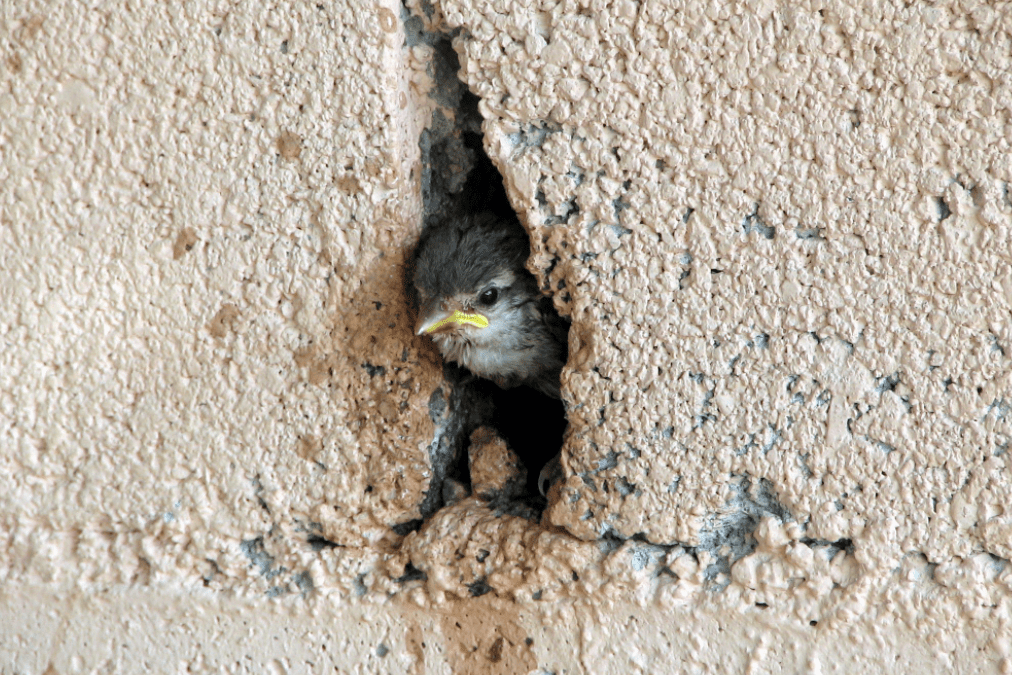
It starts as a slight scratching. You suspect mice or rats at first until you hear the faint tweeting that means only one thing: A bird has become trapped behind your wall. Unfortunately, getting the bird out is a lot harder for you than it was for it to get in. Accept that it will probably mean cutting a hole in your wall. You also need to figure out where the bird got in and cover the hole with a metal screen to prevent it from happening again.
Lure It Out
Luring a bird out of a wall sounds logical. The bird got itself in, therefore it should be able to get itself out. This can work in some cases, but usually the bird becomes trapped between two walls and doesn’t have enough room to fly. If it sounds like the bird is moving up and down in the walls and you know where it entered, you can try luring it out. Place a bright light near the entrance to the wall since birds often fly toward light. Open any windows in the room and close it off to other areas of your house. Playing recorded birdsong near the entrance can help assure the bird that it is safe to come out; otherwise keep it very quiet in that room. Placing birdseed near the hole won’t work because birds have a poor sense of smell. If the bird is not out within a few hours, it probably can’t get out on its own.
Cut It Out
If you have the right tools and some construction experience, you can try to free the bird yourself by cutting a large hole in the wall above the bird. Cut shallowly into the drywall to avoid cutting into the electrical wires. Make the cut neat to make patching the wall easier. Once the piece of the wall is removed, the bird may fly out suddenly. Open any windows and doors to the outside to allow it to escape. If it doesn’t fly out, reach in with a gloved hand and carefully pick it up. Don’t release it until you are outside.
Call In an Expert
The safest, simplest method of dealing with a trapped bird is to call in a professional wildlife control expert. Look in the phone book under “pest control” or “animal removal services” to find one. Although they will charge a fee, they will get the animal out with the least amount of damage to your wall and home. In some cases, the cost of paying for animal control is less than paying a contractor to repair the damage done to your home.
Pigeon Patrol Products & Services is the leading manufacturer and distributor of bird deterrent (control) products in Canada. Pigeon Patrol products have solved pest bird problems in industrial, commercial, and residential settings since 2000, by using safe and humane bird deterrents with only bird and animal friendly solutions. At Pigeon Patrol, we manufacture and offer a variety of bird deterrents, ranging from Ultra-flex Bird Spikes with UV protection, Bird Netting, 4-S Gel and the best Ultrasonic and audible sound devices on the market today. source
Contact us at 1- 877– 4– NO-BIRD, (604) 585-9279 or visit our website at www.pigeonpatrol.ca
Pigeon / Pigeon Patrol / Pigeons Roosting / Vancouver Pigeon Patrol / Bird Control / Surrey Pigeon Control / Pest / Vancouver Pigeon Blog / Birds Inside Home / Pigeons in the cities / Ice Pigeons/ What to do about pigeons/ most common types of sparrows , Damages Caused by Sparrows, How To Keep Raccoons Away, de-fence, Pigeon Nesting and Breeding Patterns and Behavior What Do I Do With a Bird Trapped in My Wall?
Avians aren’t the source of COVID-19, but some do harbor pathogens that can infect humans. Here’s what you need to know and how to stay safe.
COVID-19, the viral disease gripping the globe, is not bird-related. Researchers believe it likely came from bats. Still, this pandemic understandably provokes fear about wildlife diseases and so provides an opportunity to clear up confusion surrounding the question, “can birds get you sick?”
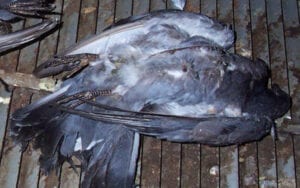
Karel Schat, professor emeritus of avian virology at Cornell University, says that birds generally pose a “very limited threat to humans,” at least not directly. If you want to admire the birds from afar in your backyard or your local park, you don’t have to worry about contagion. But if you are in contact with a bird with its excretions such as feces or saliva (that includes filling bird feeders), he advises observing common hygiene practices, including not touching your face and washing your hands right after. That’s because birds can carry some viral, bacterial, or fungal pathogens that cause human illness—think Salmonella or West Nile Virus. And if you see a dead bird, stay away from it and don’t touch it, he says (though you may consider reporting it to your state or local wildlife agency, which can come to remove it and may be tracking dead animal clusters).
Wild birds do also pass diseases to farm animals and vice versa, and that can pose the more indirect threat to human health. One of the most well-known examples of this is with avian influenza. A recent outbreak of a bird flu on a quail farm in the Philippines, for example, resulted in the culling of 17,000 quail to stop the spread.
Bird flu strains live in a bird’s gut and become exposed in fecal matter. Birds being birds, they may peck at their droppings and become infected that way. In more confined settings, like on an industrial farm or in a dense colony, airborne fecal particles can find their way into a bird’s eyes or respiratory tract, offering another avenue for infection. That is how bird flu spreads among birds.
Few strains of bird flu can cause serious harm to humans, and none are currently active in the United States, says Schat. “Fortunately, the transmission of those avian influenza virus strains from human to human has been fairly limited,” Schat says. “But it is a continuous problem that is in the chickens, it is in the ducks, and maybe in some wild birds, and it can always get to humans.”
The particularly deadly avian flu H5N1 strain, however, has occurred intermittently across Asia since 2004. It has led to 455 human deaths from about 861 recorded cases, mostly across the Middle East and East Asia, according to the World Health Organization (there have been no cases in the United States). These sporadic cases are largely in people who have close contact with infected live or dead birds, often before home slaughter— and spread from person-to-person is unusual, the health agency says. Still, health officials closely monitor for outbreaks and mutations of H5N1.
In general, it is contact with other animals, including humans, that gives any wildlife viruses— including coronaviruses and avian influenza— the best chance to mutate and shift into new strains. These types of interactions, however, mostly occur in settings that include many different species of animals in close proximity, like a live animal market. Habitat loss may also increase the amount of interaction between wild animals, farm animals, and humans. Even with these ample opportunities to interact with other species and mutate, avian influenza viruses seldom change into anything that poses significant risk for humans, says Schat. Still, given that deadly influenza outbreaks have occurred, the risk is always there, though it is lessened when birds are not kept with other species.
Birds, of course, do carry other diseases they spread amongst themselves (this is why it’s important to keep your bird feeders clean). For example, Newcastle disease, a virus common in chickens but also found in more than 200 bird species, is a well-known scourge that inflicts flu-like symptoms along with severe eye irritation in birds. Though it is mostly found in poultry, Newcastle was hampering Toronto’s Cormorant population as recently as 2018. While Newcastle is a nasty bug for birds, it does not pose a significant threat to humans. Birds also carry coronaviruses, but not the one that causes COVID-19. For example, the coronavirus that causes avian infectious bronchitis is a well-known scourge in the poultry industry, and many chickens are vaccinated against it, according to Schat.
Beyond influenza, the biggest virological threat birds can pose to humans is from the West Nile Virus, which has been in the United States since 1999. It is likely that an infected mosquito, surviving a flight from somewhere in the Middle East, brought the disease to the U.S., says Schat. Over time, this mosquito must have infected at least one bird by feeding on it, thereby making it a carrier for more mosquitoes to feed on and become infected as well. As the virus moved from this “mosquito zero” to birds, and to other mosquitoes feeding on those birds, particularly crows and jays, it eventually spread to humans. In 1999, hundreds of birds and seven people around the New York-New Jersey area died from the virus, but it continues to kill today. In the past year, per the CDC, 51 people died of West Nile in the United States.
So, while close contact with bird poop may not be a part of the everyday experience of most people, mosquitoes are a constant threat during the summer in many parts of the world, and they can serve as a conduit between birds and humans.
Overall, the lesson is: Whether you handle wild birds, or you admire them for afar, getting infected by one is something you probably don’t have to worry about, just as long as you maintain the same hygienic habits you’re probably already sticking to in this time of COVID-19. In other words, wash your hands and don’t touch your face. And please, unless you’re a scientist or trained worker with a purpose, leave the bird poop or any dead birds alone.
Pigeon Patrol Products & Services is the leading manufacturer and distributor of bird deterrent (control) products in Canada. Pigeon Patrol products have solved pest bird problems in industrial, commercial, and residential settings since 2000, by using safe and humane bird deterrents with only bird and animal friendly solutions. At Pigeon Patrol, we manufacture and offer a variety of bird deterrents, ranging from Ultra-flex Bird Spikes with UV protection, Bird Netting, 4-S Gel and the best Ultrasonic and audible sound devices on the market today.
Contact us at 1- 877– 4– NO-BIRD, (604) 585-9279 or visit our website at www.pigeonpatrol.ca
Pigeon / Pigeon Patrol / Pigeons Roosting / Vancouver Pigeon Patrol / Bird Control / Surrey Pigeon Control / Pest / Vancouver Pigeon Blog / Birds Inside Home / Pigeons in the cities / Ice Pigeons/ What to do about pigeons/ most common types of sparrows , Damages Caused by Sparrows, How To Keep Raccoons Away, de-fence,
Ever heard of ice pigeons? No? keep on reading to find out what they are!
Ice Pigeons
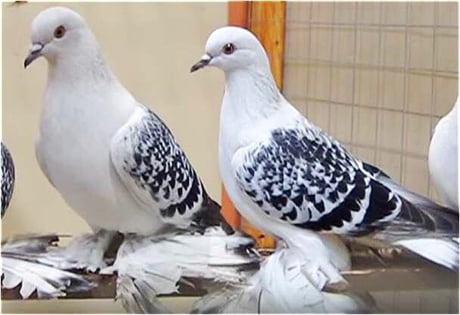
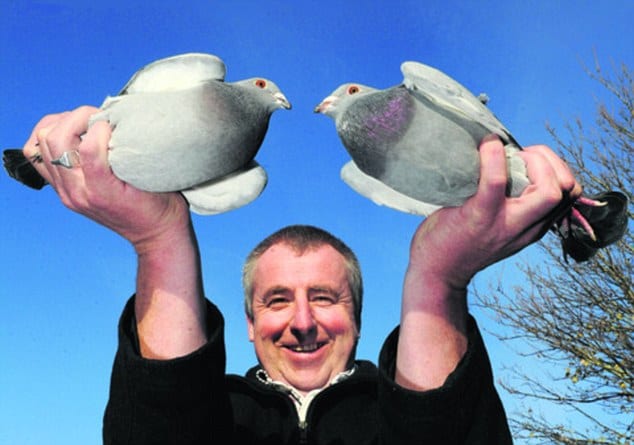
The Ice pigeon is a breed of fancy pigeon developed over many years of selective breeding. Ice pigeons, along with other varieties of domesticated pigeons, are all descendants from the rock pigeon. In 1846, Charles Darwin is known to have crossbred the Ice pigeon in order to ascertain colour patterns.
it is one of the oldest of the German color pigeon breeds and was developed over many years of selective breeding.The breed is actually from the South Germany. And it was first developed in the region from eastern Germany to western Poland, with most early breeding in Saxony and Silesia.
Where Do They Live?
And it was first developed in the region from eastern Germany to western Poland, with most early breeding in Saxony and Silesia. The Ice pigeon and other varieties of domesticated pigeons, all are descendants from the wild or feral rock pigeon.
Appearance
This pigeon is an average sized bird which is named and known for it’s ‘ice-blue’ coloration. It’s head is slightly oblong, and have smooth head.
It has several varieties, which are differing in the type and color of their wing pattern. But the basic color of these birds is a pale grey.
Eyes of these birds are of different color depending on the variety. The black barred and checked version has orange to yellow orange colored eyes. And all other varieties have black eyes.
Ice Pigeon | Breed Profile
Breed Name
Ice
Other Name
Polish: Lazurek; German: Eistaube
Breed Purpose
Exhibition, ornamental, pets
Special Notes
Beautiful, calm and gentle in nature, good for ornamental purpose, good for exhibition, good for raising as pets
Breed Class
Small to medium
Climate Tolerance
All climates
Flying Ability
Average
As Pets
Good
Color
Many
Rarity
Common
About Pigeon Patrol:
Pigeon Patrol Products & Services is the leading manufacturer and distributor of bird deterrent (control) products in Canada. Pigeon Patrol products have solved pest bird problems in industrial, commercial, and residential settings since 2000, by using safe and humane bird deterrents with only bird and animal friendly solutions. At Pigeon Patrol, we manufacture and offer a variety of bird deterrents, ranging from Ultra-flex Bird Spikes with UV protection, Bird Netting, 4-S Gel and the best Ultrasonic and audible sound devices on the market today.
Contact us at 1- 877– 4– NO-BIRD, (604) 585-9279 or visit our website at www.pigeonpatrol.ca
Pigeon / Pigeon Patrol / Pigeons Roosting / Vancouver Pigeon Patrol / Bird Control / Surrey Pigeon Control / Pest / Vancouver Pigeon Blog / Birds Inside Home / Pigeons in the cities / Ice Pigeons



:max_bytes(150000):strip_icc()/121776101-56a709ba5f9b58b7d0e63328.jpg)