by Pigeon Patrol | May 31, 2021 | Bird Netting, Bird Spikes, Columbidae, history of pigeons, MBCA, Pigeons, Pigeons in the News
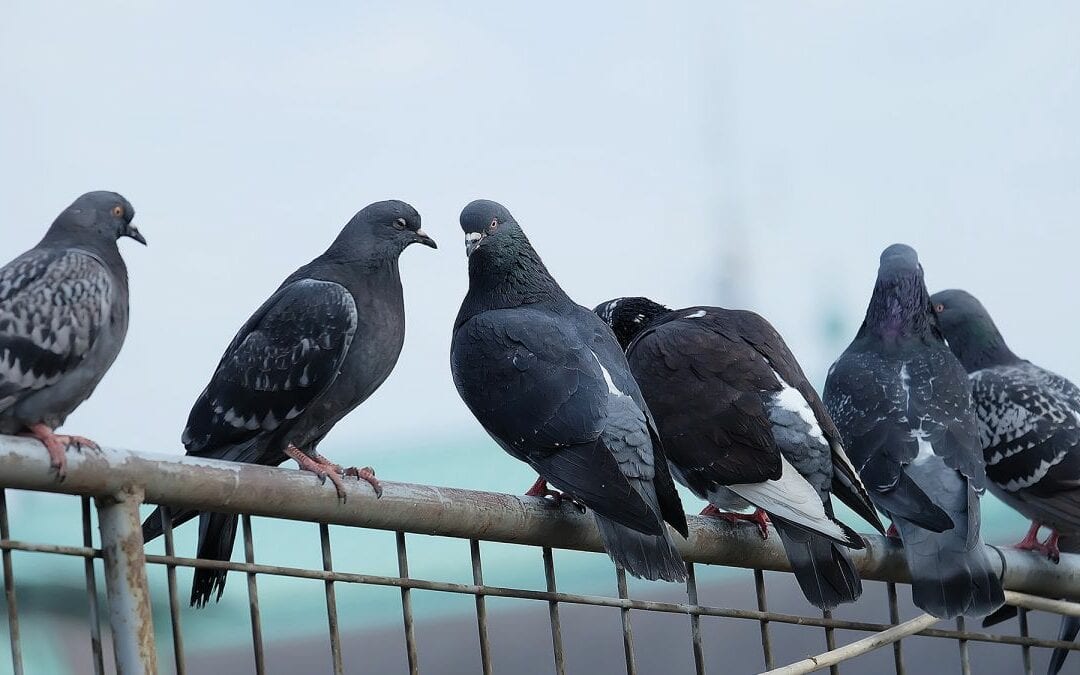
CHICAGO – A pigeon apparently didn’t think much of a lawmaker’s ideas to address a messy situation at a Chicago Transit Authority stop known by some as “pigeon poop station.”
WBBM-TV reports that one of the birds did its business on the head of Democratic state Rep. Jaime Andrade as he was discussing the problem with a reporter outside of the Irving Park Blue Line station.
During the interview, Andrade rubbed the top of his head and said, “I think they just got me.” They did.
The sidewalks outside of the station are covered in bird waste and feathers.
Andrade has been trying to fix the problem. One of his ideas is to ask the CTA to install a hose line for power washing when it constructs new escalators at the stop.
Pigeon Patrol Products & Services is the leading manufacturer and distributor of bird deterrent (control) products in Canada. Pigeon Patrol products have solved pest bird problems in industrial, commercial, and residential settings since 2000, by using safe and humane bird deterrents with only bird and animal friendly solutions. At Pigeon Patrol, we manufacture and offer a variety of bird deterrents, ranging from Ultra-flex Bird Spikes with UV protection, Bird Netting, 4-S Bird Gel and the best Ultrasonic and audible sound devices on the market today.
Voted Best Canadian wholesaler for Bird Deterrent products ten years in a row.
Contact us at 1- 877– 4– NO-BIRD, (604) 585-9279 or visit our website at www.pigeonpatrol.ca
Pigeon/Pigeon Patrol / Pigeons Roosting / Vancouver Pigeon Control /Bird Spikes / Bird Control / Bird Deterrent / Pigeon Deterrent? Surrey Pigeon Control / Pest /Seagull deterrent / Vancouver Pigeon Blog / Birds Inside Home / Pigeons in the cities / Ice Pigeons/ What to do about pigeons/ sparrows , Damage by Sparrows, How To Keep Raccoons Away, Why Are Raccoons Considered Pests/ De-fence / Pigeon Nesting/ Bird Droppings / Pigeon Dropping/ woodpecker control/ Professional Bird Control Company/ Keep The Birds Away/ Birds/rats/ seagull/pigeon/woodpecker/ dove/sparrow/pidgeon control/pidgeon problem/ pidgeon control/flying rats/ pigeon Problems/ bird netting/bird gel/bird spray/bird nails/ bird guard
by Pigeon Patrol | May 25, 2021 | history of pigeons, pet bird, Pigeon Control, Pigeon Droppings, Pigeon Patrol's Services
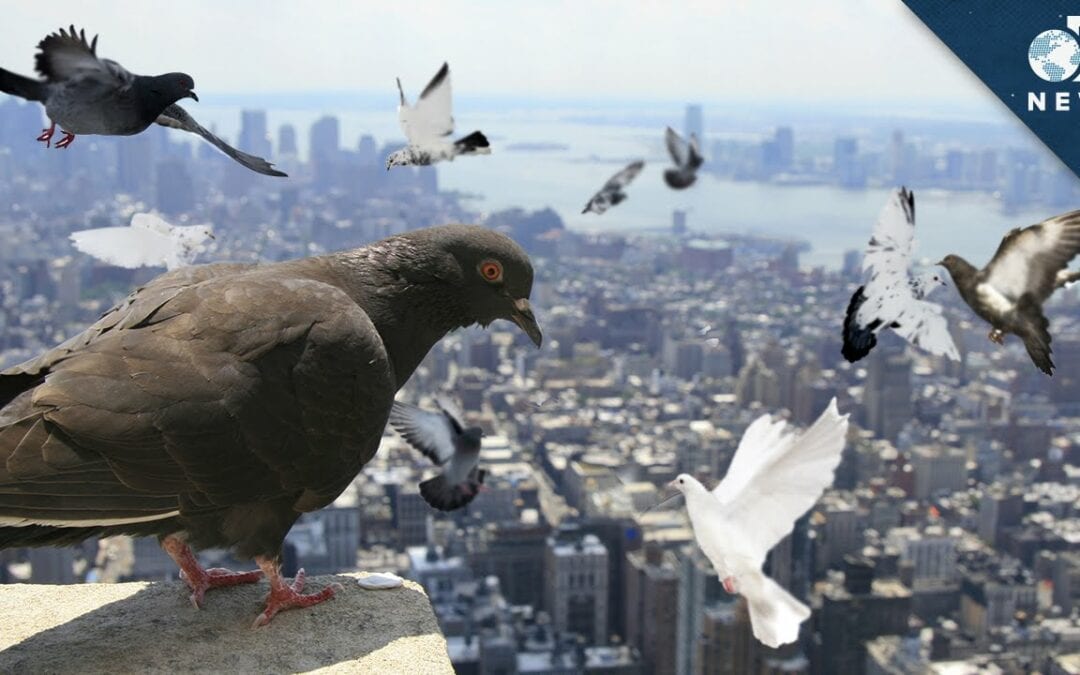
Though they’re often described as “rats with wings” (a phrase popularized by the movie Stardust Memories), pigeons are actually pretty cool. From homing instincts to misleading rump feathers, here are 15 things you might not know about these avian adventurers.
1. THEY MIGHT BE THE FIRST DOMESTICATED BIRD.
The common city pigeon (Columba livia), also known as the rock pigeon, might be the first bird humankind ever domesticated. You can see them in art dating back as far as 4500 BCE in modern Iraq, and they’ve been a valuable source of food for thousands of years.
2. THEY WON OVER CHARLES DARWIN—AND NIKOLA TESLA.
Pigeon-breeding was a common hobby in Victorian England for everyone from well-off businessmen to average Joes, leading to some fantastically weird birds. Few hobbyists had more enthusiasm for the breeding process than Charles Darwin, who owned a diverse flock, joined London pigeon clubs, and hobnobbed with famous breeders. Darwin’s passion for the birds influenced his 1868 book The Variation of Animals and Plants Under Domestication, which has not one but two chapters about pigeons (dogs and cats share a single chapter).
Nikola Tesla was another great mind who enjoyed pigeons. He used to care for injured wild pigeons in his New York City hotel room. Hands down, Tesla’s favorite was a white female—about whom he once said, “I loved that pigeon, I loved her as a man loves a woman and she loved me. When she was ill, I knew and understood; she came to my room and I stayed beside her for days. I nursed her back to health. That pigeon was the joy of my life. If she needed me, nothing else mattered. As long as I had her, there was a purpose in my life.” Reportedly, he was inconsolable after she died.
3. THEY UNDERSTAND SPACE AND TIME.
In a 2017 Current Biology study, researchers showed captive pigeons a series of digital lines on a computer screen for either two or eight seconds. Some lines were short, measuring about 2.3 inches across; others were four times longer. The pigeons were trained to evaluate either the length of the line or how long it was displayed. They found that the more time a line was displayed, the longer in length the pigeon judged it to be. The reverse was true too: If the pigeons encountered a longer line, they thought it existed in time for a greater duration. Pigeons, the scientists concluded, understand the concepts of both time and space; the researchers noted “similar results have been found with humans and other primates.”
It’s thought that humans process those concepts with a brain region called the parietal cortex; pigeon brains lack that cortex, so they must have a different way of judging space and time.
4. THEY CAN FIND THEIR WAY BACK TO THE NEST FROM 1300 MILES AWAY.
The birds can do this even if they’ve been transported in isolation—with no visual, olfactory, or magnetic clues—while scientists rotate their cages so they don’t know what direction they’re traveling in. How they do this is a mystery, but people have been exploiting the pigeon’s navigational skills since at least 3000 BCE, when ancient peoples would set caged pigeons free and follow them to nearby land.
Their navigational skills also make pigeons great long-distance messengers. Sports fans in ancient Greece are said to have used trained pigeons to carry the results of the Ancient Olympics. Further east, Genghis Khan stayed in touch with his allies and enemies alike through a pigeon-based postal network.
5. THEY SAVED THOUSANDS OF HUMAN LIVES DURING WORLD WARS I AND II.
Pigeons’ homing talents continued to shape history during the 20th century. In both World Wars, rival nations had huge flocks of pigeon messengers. (America alone had 200,000 at its disposal in WWII.) By delivering critical updates, the avians saved thousands of human lives. One racing bird named Cher Ami completed a mission that led to the rescue of 194 stranded U.S. soldiers on October 4, 1918.
6. TWO PIGEONS ALMOST DISTRACTED FROM THE DISCOVERY OF EVIDENCE OF THE BIG BANG.
In 1964, scientists in Holmdel, New Jersey, heard hissing noises from their antenna that would later prove to be signals from the Big Bang. But when they first heard the sound, they thought it might be, among other things, the poop of two pigeons that were living in the antenna. “We took the pigeons, put them in a box, and mailed them as far away as we could in the company mail to a guy who fancied pigeons,” one of the scientists later recalled. “He looked at them and said these are junk pigeons and let them go and before long they were right back.” But the scientists were able to clean out the antenna and determine that they had not been the cause of the noise. The trap used to catch the birds (before they had to later be, uh, permanently removed) is on view at the Smithsonian Air & Space Museum.
7. YOU CAN TRAIN THEM TO BE ART SNOBS …
Japanese psychologist Shigeru Watanabe and two colleagues earned an Ig Nobel Prize in 1995 for training pigeons, in a lab setting, to recognize the paintings of Claude Monet and Pablo Picasso and to distinguish between the painters. The pigeons were even able to use their knowledge of impressionism and cubism to identify paintings of other artists in those movements. Later, Watanabe taught other pigeons to distinguish watercolor images from pastels. And in a 2009 experiment, captive pigeons he’d borrowed were shown almost two dozen paintings made by students at a Tokyo elementary school, and were taught which ones were considered “good” and which ones were considered “bad.” He then presented them with 10 new paintings and the avian critics managed to correctly guess which ones had earned bad grades from the school’s teacher and a panel of adults. Watanabe’s findings indicate that wild pigeons naturally categorize things on the basis of color, texture, and general appearance.
8. … AND TO DISTINGUISH WRITTEN WORDS.
In a 2016 study, scientists showed that pigeons can differentiate between strings of letters and actual words. Four of the birds built up a vocabulary of between 26 and 58 written English words, and though the birds couldn’t actually read them, they could identify visual patterns and therefore tell them apart. The birds could even identify words they hadn’t seen before.
9. FLUFFY PIGEON FEET MIGHT ACTUALLY BE PARTIAL WINGS.
A few pigeon breeds have fuzzy legs—which hobbyists call “muffs”—rather than scaly ones. According to a 2016 study, the DNA of these fluffy-footed pigeons leads their hind legs to take on some forelimb characteristics, making muffed pigeon legs look distinctly wing-like; they’re also big-boned. Not only do they have feathers, but the hindlimbs are somewhat big-boned, too. According to biologist Mike Shapiro, who led the study, “pigeons’ fancy feathered feet are partially wings.”
10. SOME PIGEONS DISTRACT FALCONS WITH WHITE RUMP FEATHERS.
In a life-or-death situation, a pigeon’s survival could depend upon its color pattern: Research has shown that wild falcons rarely go after pigeons that have a white patch of feathers just above the tail, and when the predators do target these birds, the attacks are rarely successful.
To figure out why this is, Ph.D. student Alberto Palleroni and a team tagged 5235 pigeons in the vicinity of Davis, California. Then, they monitored 1485 falcon-on-pigeon attacks over a seven-year span. The researchers found that although white-rumped pigeons comprised 20 to 25 percent of the area’s pigeon population, they represented less than 2 percent of all the observed pigeons that were killed by falcons; the vast majority of the victims had blue rumps. Palleroni and his team rounded up 756 white- and blue-rumped pigeons and swapped their rump feathers by clipping and pasting white feathers on blue rumps, and vice versa. The falcons had a much easier time spotting and catching the newly blue-rumped pigeons, while the pigeons that received the white feathers saw predation rates plummet.
Close observation revealed that the white patches distract birds of prey. In the wild, falcons dive-bomb other winged animals from above at high speeds. Some pigeons respond by rolling away in midair, and on a spiraling bird, white rump feathers can be eye-catching, which means that a patch of them may divert a hungry raptor’s focus long enough to make the carnivore miscalculate and zip right past its intended victim.
11. DODOS WERE RELATED TO TODAY’S PIGEONS.
Though most of this list focuses on the rock pigeon, there are 308 living species of pigeons and doves. Together, they make up an order of birds known as the columbiformes. The extinct dodo belonged to this group as well.
Flightless and (somewhat) docile, dodos once inhabited Mauritius, an island near Madagascar. The species had no natural predators, but when human sailors arrived with rats, dogs, cats, and pigs, it began to die out, and before the 17th century came to a close, the dodo had vanished altogether. DNA testing has confirmed that pigeons are closely related to the dodo, and the vibrant Nicobar pigeon (above) is its nearest genetic relative. A multi-colored bird with iridescent feathers, this near-threatened creature is found on small islands in the South Pacific and off Asia. Unlike the dodo, it can fly.
12. AT ONE POINT, MORE THAN ONE-QUARTER OF ALL THE BIRDS LIVING IN THE U.S. MAY HAVE BEEN PASSENGER PIGEONS.
Wild/feral rock pigeons reside in all 50 states, which makes it easy to forget that they’re invasive birds. Originally native to Eurasia and northern Africa, the species was (most likely) introduced to North America by French settlers in 1606. At the time, a different kind of columbiform—this one indigenous—was already thriving there: the passenger pigeon (Ectopistes migratorius). As many as 5 billion of them were living in America when England, Spain, and France first started colonizing, and they may have once represented anywhere from 25 to 40 percent of the total U.S. bird population. But by the early 20th century, they had become a rare sight, thanks to overhunting, habitat loss, and a possible genetic diversity issue. The last known passenger pigeon—a captive female named Martha—died on September 1, 1914.
13. THEY’RE REALLY GOOD AT MULTITASKING.
According to one study, they’re more efficient multitaskers than people are. Scientists at Ruhr-Universitat Bochum put together a test group of 15 humans and 12 pigeons and trained all of them to complete two simple jobs (like pressing a keyboard once a light bulb came on). They were also put in situations wherein they’d need to stop working on one job and switch over to another. In some trials, the participants had to make the change immediately. During these test runs, humans and pigeons switched between jobs at the same speed.
But in other trials, the test subjects were allowed to complete one assignment and then had to wait 300 milliseconds before moving on to the next job. Interestingly, in these runs, the pigeons were quicker to get started on that second task after the period ended. In the avian brain, nerve cells are more densely packed, which might enable our feathered friends to process information faster than we can under the right circumstances.
14. PIGEONS PRODUCE FAKE “MILK.”
Only mammals produce genuine milk, but pigeons and doves (along with some other species of birds) feed their young with something similar—a whitish liquid filled with nutrients, fats, antioxidants, and healthy proteins called “crop milk.” Both male and female pigeons create the milk in the crop, a section of the esophagus designed to store food temporarily. As is the case with mammal milk, the creation of crop milk is regulated by the hormone prolactin. Newly-hatched pigeons drink crop milk until they’re weaned off it after four weeks or so. (And if you’ve ever asked yourself, “Where are all the baby pigeons?” we have the answer for you right here.)
15. ONE STUDY SUGGESTS THAT, GIVEN THE RIGHT CONDITIONS, THEY’RE AS GOOD AT IDENTIFYING CANCER AS DOCTORS.
We’ve already established that pigeons are excellent at differentiating between artists and words, but a 2015 study revealed they can also distinguish between malignant and benign growths in the right conditions. Researchers at University of California Davis Medical Center put 16 pigeons in a room with magnified biopsies of potential breast cancers. If the pigeons correctly identified them as either benign or malignant, they got a treat, According to Scientific American.
“Once trained, the pigeons’ average diagnostic accuracy reached an impressive 85 percent. But when a “flock sourcing” approach was taken, in which the most common answer among all subjects was used, group accuracy climbed to a staggering 99 percent, or what would be expected from a pathologist. The pigeons were also able to apply their knowledge to novel images, showing the findings weren’t simply a result of rote memorization.”
Mammograms proved to be more of a challenge, however; the birds could memorize signs of cancer in the images they were trained on but could not identify the signs in new images.
No matter how impressive their results, “I don’t anticipate that pigeons, no matter how good they become at pathology or radiology, will be playing a role in actual patient care—certainly for the foreseeable future,” study co-author Richard M. Levenson told Scientific American. “There are just too many regulatory barriers—at least in the West.”
Source
Pigeon Patrol Products & Services is the leading manufacturer and distributor of bird deterrent (control) products in Canada. Pigeon Patrol products have solved pest bird problems in industrial, commercial, and residential settings since 2000, by using safe and humane bird deterrents with only bird and animal friendly solutions. At Pigeon Patrol, we manufacture and offer a variety of bird deterrents, ranging from Ultra-flex Bird Spikes with UV protection, Bird Netting, 4-S Bird Gel and the best Ultrasonic and audible sound devices on the market today.
Voted Best Canadian wholesaler for Bird Deterrent products ten years in a row.
Contact us at 1- 877– 4– NO-BIRD, (604) 585-9279 or visit our website at www.pigeonpatrol.ca
Pigeon/Pigeon Patrol / Pigeons Roosting / Vancouver Pigeon Control /Bird Spikes / Bird Control / Bird Deterrent / Pigeon Deterrent? Surrey Pigeon Control / Pest /Seagull deterrent / Vancouver Pigeon Blog / Birds Inside Home / Pigeons in the cities / Ice Pigeons/ What to do about pigeons/ sparrows , Damage by Sparrows, How To Keep Raccoons Away, Why Are Raccoons Considered Pests/ De-fence / Pigeon Nesting/ Bird Droppings / Pigeon Dropping/ woodpecker control/ Professional Bird Control Company/ Keep The Birds Away/ Birds/rats/ seagull/pigeon/woodpecker/ dove/sparrow/pidgeon control/pidgeon problem/ pidgeon control/flying rats/ pigeon Problems/ bird netting/bird gel/bird spray/bird nails/ bird guard
by Pigeon Patrol | May 17, 2021 | Bird Law, Doves, history of pigeons, pet bird, Pigeon Control
Earth’s magnetic field plays a vital role in everything from animal migration to protecting the Earth from the Sun’s harsh solar wind. Now, a recent study finally sheds light on how some birds visually see Earth’s magnetic field. Birds use Earth’s magnetic field as sort of a heads-up display to help them navigate the globe.
The Earth’s magnetic field is a result of the movement or convection of liquid iron in the outer core. As the liquid metal in the outer core moves, it generates electric currents, which lead to a magnetic field. The continual movement of liquid metal through this magnetic field creates stronger electrical currents and thus a stronger magnetic field. This positive feedback loop is called the geomagnetic dynamo.
While scientists have known for quite some time that birds can see Earth’s magnetic field, it was unclear exactly how birds are able to visualize the magnetic field. Two recent studies from researchers at Lund University in Sweden and Carl von Ossietzky University Oldenburg in Germany discovered that the ability is a result of a special protein in bird’s eyes. The two papers studied European robins and zebra finches and found evidence for an unusual eye protein called Cry4.
The Cry4 protein is part of a class of protein called a cryptochrome that is sensitive to blue light. Cryptochromes are found in both plants and animals and are responsible for circadian rhythms in various species. In the two bird species above, it appears that the presence of cryptochromes, specifically the Cry4 protein, is responsible for the ability of birds to visually detect Earth’s magnetic field.
The ability to see Earth’s magnetic field, known as magnetoreception, relies on the presence of specifically the blue wavelength of light. The complex process involves “radical” intermediate molecules which are sensitive to Earth’s magnetic field. The Earth’s magnetic field, as it relates to the direction the bird is facing, could alter the intermediate radical molecules differently, giving the bird a sense for where it is facing in relation to the Earth’s magnetic field.
The research team also found that the Cry4 protein was produced in much higher amounts in European robins during migration season. Perhaps this would give the robin a more precise picture of Earth’s magnetic field throughout its migration.
While the exact way birds visualize Earth’s magnetic field is part of further investigation, scientists believe the Cry4 protein acts as sort of a filter over the bird’s vision. This filter would allow birds to see a sort of compass of the Earth and direct their migratory flights accordingly.
Scientists at the University of Illinois at Urbana-Champaign believe birds see Earth’s magnetic field through a filter similar to the figure above. This would act to guide birds in the right direction through migration.
Source
Pigeon Patrol Products & Services is the leading manufacturer and distributor of bird deterrent (control) products in Canada. Pigeon Patrol products have solved pest bird problems in industrial, commercial, and residential settings since 2000, by using safe and humane bird deterrents with only bird and animal friendly solutions. At Pigeon Patrol, we manufacture and offer a variety of bird deterrents, ranging from Ultra-flex Bird Spikes with UV protection, Bird Netting, 4-S Bird Gel and the best Ultrasonic and audible sound devices on the market today.
Voted Best Canadian wholesaler for Bird Deterrent products ten years in a row.
Contact us at 1- 877– 4– NO-BIRD, (604) 585-9279 or visit our website at www.pigeonpatrol.ca
Pigeon/Pigeon Patrol / Pigeons Roosting / Vancouver Pigeon Control /Bird Spikes / Bird Control / Bird Deterrent / Pigeon Deterrent? Surrey Pigeon Control / Pest /Seagull deterrent / Vancouver Pigeon Blog / Birds Inside Home / Pigeons in the cities / Ice Pigeons/ What to do about pigeons/ sparrows , Damage by Sparrows, How To Keep Raccoons Away, Why Are Raccoons Considered Pests/ De-fence / Pigeon Nesting/ Bird Droppings / Pigeon Dropping/ woodpecker control/ Professional Bird Control Company/ Keep The Birds Away/ Birds/rats/ seagull/pigeon/woodpecker/ dove/sparrow/pidgeon control/pidgeon problem/ pidgeon control/flying rats/ pigeon Problems/ bird netting/bird gel/bird spray/bird nails/ bird guard
by Pigeon Patrol | May 10, 2021 | Bird Law, Columbidae, history of pigeons, MBCA, pet bird
In any pigeon race there will be a number of competitors which lose their way and are unable to find their way back home and these are refered to as strays. There can be a number of reasons for this occuring with the most common being injury, fatigue, and adverse weather conditions. Sometimes strong winds can blow a race bird off its normal flight path and add considerably to the time and distance needed to make the trip home. This can lead to fatigue and with pigeon races in Australia generally being between 100 and 1000 kilometres it is understandable that they sometimes need to stop for a rest. Unfortunately a tired racing pigeon makes easy prey for many animals, those stopping in a backyard can encounter pet cats and dogs while those stopping in rural areas can encounter foxes. Birds of prey are the major cause of injury to racing pigeons, although collisions with unseen power lines can also cause serious injuries.
So what should you do if you find a lost race bird?
1/ Firstly give it a drink of water.
2/ Something to eat. Racing pigeons (unlike feral pigeons) only eat grain. A bird seed mixture of any type available from supermarkets will be quite suitable. Racing Pigeons generally will not eat bread or other scraps.
3/ Check the pigeon for injuries. Often physical injuries will be quite obvious but be sure to check under the wings as these can often hide serious wounds.
4/ Rest. After food, water, and a couple of days rest, a racing pigeon can be released and will in many cases have recovered sufficiently to complete its journey home.
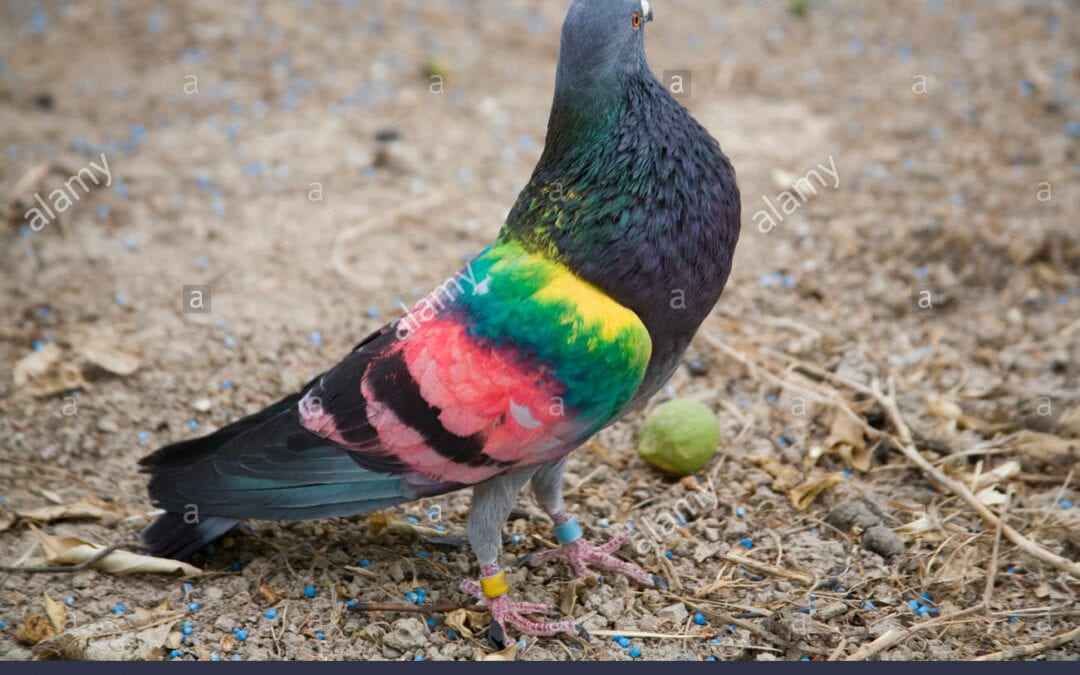
5/ My pigeon keeps coming back, what should I do? Even after rest and food, there can be internal injuries that can prevent a bird from continuing its way home. If this happens check the birds legs. If it is a racing pigeon it will have at least one band or ring on its leg. One of these rings will be hard and plastic coated and will carry information which will allow you to find the birds owner. Quite often the ring will have the name of the town the pigeon has originated from and the phone number of someone in that area for you to contact. Before phoning the contact number on the ring make sure you make a note of the other information on the ring. This other information will include a series of letters, a year, and a number for example VHA 2010 1234. In this case the VHA would stand for Victorian Homing Association, 2010 is the year the pigeon was born, and 1234 is the pigeons identification number.
6/ If your ring does not have a phone number on it then check this list of contacts for someone in your area
http://www.anpa.com.au/found-a-lost-pigeon/
7/ If your pigeon does not have a ring on its leg then it is not a racing pigeon. It may be someones pet or a feral pigeon.
Pigeon Patrol Products & Services is the leading manufacturer and distributor of bird deterrent (control) products in Canada. Pigeon Patrol products have solved pest bird problems in industrial, commercial, and residential settings since 2000, by using safe and humane bird deterrents with only bird and animal friendly solutions. At Pigeon Patrol, we manufacture and offer a variety of bird deterrents, ranging from Ultra-flex Bird Spikes with UV protection, Bird Netting, 4-S Bird Gel and the best Ultrasonic and audible sound devices on the market today.
Voted Best Canadian wholesaler for Bird Deterrent products ten years in a row.
Contact us at 1- 877– 4– NO-BIRD, (604) 585-9279 or visit our website at www.pigeonpatrol.ca
Pigeon/Pigeon Patrol / Pigeons Roosting / Vancouver Pigeon Control /Bird Spikes / Bird Control / Bird Deterrent / Pigeon Deterrent? Surrey Pigeon Control / Pest /Seagull deterrent / Vancouver Pigeon Blog / Birds Inside Home / Pigeons in the cities / Ice Pigeons/ What to do about pigeons/ sparrows , Damage by Sparrows, How To Keep Raccoons Away, Why Are Raccoons Considered Pests/ De-fence / Pigeon Nesting/ Bird Droppings / Pigeon Dropping/ woodpecker control/ Professional Bird Control Company/ Keep The Birds Away/ Birds/rats/ seagull/pigeon/woodpecker/ dove/sparrow/pidgeon control/pidgeon problem/ pidgeon control/flying rats/ pigeon Problems/ bird netting/bird gel/bird spray/bird nails/ bird guard
by Pigeon Patrol | May 10, 2021 | history of pigeons, pet bird, Pigeon Predators, Pigeons
What Is Squab?
squab are young pigeons that have never flown. For thousands of years, they have been a favorite meal for every stratum of society throughout the world. They were unequivocally the first domesticated poultry, even preceding chicken.
This may surprise twenty-first-century Americans. More often we think of pigeons as annoying denizens of city monuments and buildings. In fact, these are rock doves, a relative of pigeons, and far less edible. Yet squab is considered a most exquisite ingredient in cuisines as distinct as Cantonese, Moroccan, and French. The simple reason for squab’s universal appeal is the delicate, succulent flesh, truly unlike that of any other bird. Squab is a dark-meat bird, like duck and goose, yet the meat is not nearly as fibrous, rendering it far more tender. Its flavor, when properly cooked, is a lush, rich essence, reminiscent of sautéed foie gras, albeit with more texture.
History of Eating Squab
Historically, squab was a reliable and inexpensive source of animal protein. Documents detailing aristocratic banquets frequently show squab used in one or several important courses. B’stilla, a splendid Moroccan phyllo-crusted pie that is sweet, salty, crispy, and juicy at the same time, is traditionally made with squab. It dates from around the 15th century when the Moors were kicked out of Andalusia and migrated to North Africa. Huge molded timbales of pasta, and molded domes of rice made with squab and rich accompaniments, were fashionable 16th and 17th-century Italian culinary showpieces.
Early on, wide circular structures with tapered tops, or dovecotes, were built in fields to attract wild pigeons to roost. Numerous cubbyholes lined the interior, accommodating several breeding pairs. Adult birds forage independently and, being monogamous, return every evening to the same roost throughout their adult life. Other than constructing the residence facility, the squab farmer was required to do little or no maintenance except to harvest the young squab. Using a ladder, one simply plucked them from the nest.
Farming Squab
In the United States, squab are raised primarily in central California and South Carolina. The birds weigh about 1 pound each. Large covered pens are used for up to a dozen breeding pairs. They are capable of producing up to 24 offspring a year. Parents share in all activities required to raise the squab. They build their nest together, incubate the eggs, and feed the young. The male participates willingly as long as the female accommodates him sexually on demand. When she refuses, he pecks her in the middle of the head. As a result, farmers can separate the sexes far more easily than might otherwise be the case.
They just look for the bald birds, which are females.
Sorting young squab from mature pigeons is also an easy activity. The farmer gathers his squab in a crate. When the crate is opened and shaken vigorously, any birds that fly away are not squab but adult pigeons.
No one farms squab to make a fortune. The birds’ notorious sensitivity prevents using modern poultry techniques, like those employed in the factory farming of chickens, to produce enormous flocks at minimal costs. They respond poorly to artificial insemination and inferior-quality feeds laced with animal by-products.
Farm-raised pigeons must have the same food year-round. Their nesting cubbies must never be disturbed. For this reason, the cost of squab, which has remained constant for decades, is expensive relative to mass-marketed chickens. It’s a whole lot of bother to raise good squab. But these succulent birds make a feast fit for a king.
Pigeon Patrol Products & Services is the leading manufacturer and distributor of bird deterrent (control) products in Canada. Pigeon Patrol products have solved pest bird problems in industrial, commercial, and residential settings since 2000, by using safe and humane bird deterrents with only bird and animal friendly solutions. At Pigeon Patrol, we manufacture and offer a variety of bird deterrents, ranging from Ultra-flex Bird Spikes with UV protection, Bird Netting, 4-S Bird Gel and the best Ultrasonic and audible sound devices on the market today.
Voted Best Canadian wholesaler for Bird Deterrent products ten years in a row.
Contact us at 1- 877– 4– NO-BIRD, (604) 585-9279 or visit our website at www.pigeonpatrol.ca
Pigeon/Pigeon Patrol / Pigeons Roosting / Vancouver Pigeon Control /Bird Spikes / Bird Control / Bird Deterrent / Pigeon Deterrent? Surrey Pigeon Control / Pest /Seagull deterrent / Vancouver Pigeon Blog / Birds Inside Home / Pigeons in the cities / Ice Pigeons/ What to do about pigeons/ sparrows , Damage by Sparrows, How To Keep Raccoons Away, Why Are Raccoons Considered Pests/ De-fence / Pigeon Nesting/ Bird Droppings / Pigeon Dropping/ woodpecker control/ Professional Bird Control Company/ Keep The Birds Away/ Birds/rats/ seagull/pigeon/woodpecker/ dove/sparrow/pidgeon control/pidgeon problem/ pidgeon control/flying rats/ pigeon Problems/ bird netting/bird gel/bird spray/bird nails/ bird guard
by Pigeon Patrol | May 3, 2021 | Animal Deterrent Products, Bird Deterrent Products, Bird Netting, Bird Spikes, history of pigeons, Pigeon Control, Pigeon Patrol's Services, Pigeon Spikes
Need pigeon removal in your hometown?
Pigeons are a determined bird, doggedly living near humans because of the ample food supply. These birds are indiscriminate eliminators of waste, leaving liquid splatters of dropping anywhere they travel. Their lack of concern for cleanliness extends into their everyday activities, and water contamination has been traced back to pigeon carcasses and feces in water towers near roosting sites. The waste from these birds, which are most commonly seen in urban areas, is very corrosive. Concrete, limestone and metal all suffer from the ill-effects of pigeon droppings. In cities, constant cleanup alone costs thousands of dollars.
Because of the homing ability of pigeons, there are difficulties with relocation. This species of bird was once used as a messenger between civilizations, finding their way over hundreds and thousands of miles. The only way to get rid of pigeons is to discourage them and prevent them from frequenting undesired locations. There are a number of ways to accomplish this, some proven to show more success than others. Information about pigeon trapping – analysis and methods for how to trap.
Unsuccessful methods of pigeon control deal mostly with predator fear. Plastic owls are a favorite of the public when, in reality, the fake predator appears as just that—fake. A pigeon will not be any more leery of an unmoving owl than it would an unmoving human. Pigeons are largely unaffected by unpleasant smells, though it has recently been proven that their homing ability is based on scent mapping and not electromagnetic fields. Sounds are another flop when it comes to pigeon control. Ultrasonic sound emitters may very well produce noises humans can’t hear, but rarely are those sounds ‘annoying’ to birds. If a pigeon can put up with all the noise congestion in a busy city, some random sounds from an ultrasonic radio aren’t going to bother it.
The most practical ways to get rid of pigeons is to convince them that they do not or cannot stay near your home or business. Any ledge can be a roosting site. By installing pigeon nets, bird spikes or electric shockers, pigeons will be less inclined to settle on those surfaces. Nets and spikes prevent roosting all together. Electric strips may be difficult to install at higher locations, but many brands offer solar power and require little maintenance. Electric strips do require more attention than netting and are often more expensive. If your building has smaller sections of roof, bird “spiders” are useful instruments. The wire device resembles a sprinkler in design with thin lines of arced metal extending outward from a central location. These wires are loose and are not strong enough to support the weight of a bird.
Information about how to keep pigeons away – prevention techniques.
There is something to be said for determination, too. Even though most scare tactics do not work on pigeons, harassment techniques can prove beneficial if done frequently and without fail. If pigeons have taken over your yard, letting your dog out will chase them away. Yes, they will come back when the dog is gone, but if this scenario is repeated often enough the pigeons will learn that your yard is not the easiest place to visit. When it comes to opportunistic birds, life is all about easy.
Some towns and cities have experimented with employing the use of falcons to control pigeon populations. The benefit to using birds of prey is that they often keep the pigeons moving, preventing any one roosting area to become long-term. Unfortunately, falcons cannot eliminate a large enough number of the nuisance birds to make a noticeable difference without becoming a nuisance bird themselves.
Pigeons are products of their environment. If they were not deliberately fed in parks and on streets a decline in their nuisance behaviors would be seen. These birds can live on naturally occurring food sources. Unfortunately, it is the poor sanitation habits of people that keep these animals desiring our leftovers. If pigeons have overrun your home, be sure that all garbage and compost is carefully disposed of. You may not be able to control the habits of the neighbors on your block, but you can make your house that much more uninviting by following good hygiene habits.
Pigeon Information & Facts
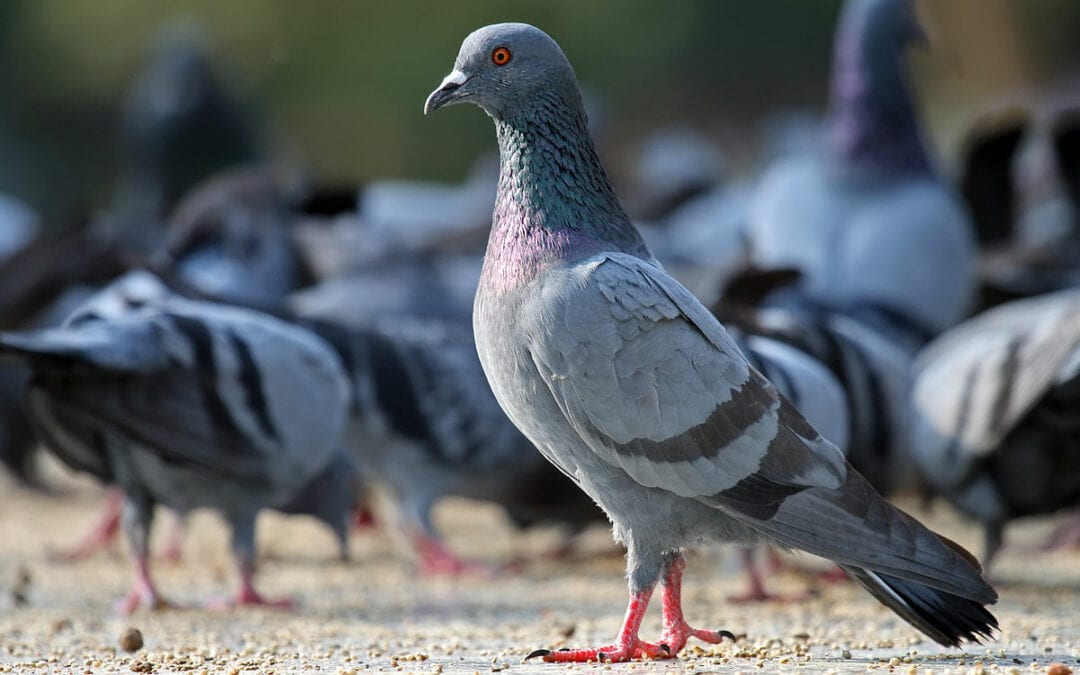
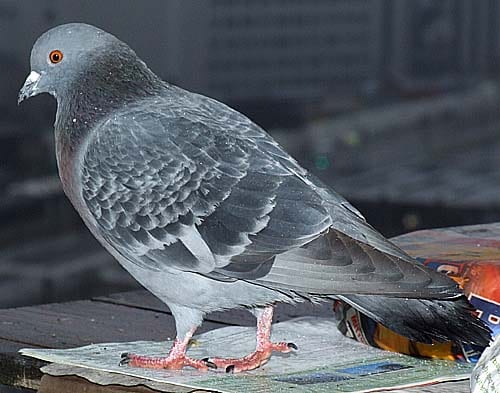
Pigeon Appearance: Pigeons are robust birds with short necks, usually gray in color with a faint iridescence to their feathers. They have a characteristic back and forth rhythm to their head. This bobbing is a mechanism that allows the birds to focus their vision and perceive depth. Pigeons have duplicate black bands on each wing, but the coloration on the main part of the body can vary. Their feet are suited for perching on ledges and high peaks. The beak of the pigeon is medium in both length and width, ideal for pulling apart bread, picking up small food pieces, or fishing spiders out of cracks.
Pigeon Habitat and Behavior: Pigeons are most often seen in cities. This habitat preference is largely due to the surplus of food available and the high roosting opportunities. Pigeons are fond of the water towers on tall buildings, often building messy nests on the rim. For this reason, most cities require water towers be completely sealed to prevent the birds or their waste from contaminating the water supply. A pigeon will nest almost anywhere and will often do so with many others of its kind. A roost can be made atop any vertical surface. Pigeons are known in invade gutters, ducts, air conditioners, attics, warehouses, and drains. They are not overly concerned with sanitary conditions and will utilize any vertical object in any location for their purposes.
Pigeons are also very food-driven. This problem has been made serious by the continued, deliberate feeding of the birds in urban areas. The birds have little fear of humans and will often converge around people in parks and near restaurants. Pigeon feeding is a common hobby of many city-goers, yet another reason for the lack of caution around humans.
Egg laying can take place as often as every other month. Courtship between the male and the female is brief, and the resulting egg clutch usually only contains two eggs. An abundance of pigeons will result in quick overpopulation, regardless of how many eggs are laid per pair. Some cites have sought population control by replacing viable eggs with fake or unfertilized eggs. This tactic may be effective short-term, but pigeons will lay another clutch once the original appears unproductive.
Pigeon Diet: Pigeons will scavenge for almost any type of grain-based food source. The habit of city restaurants discarding stale bread into parks increases the role this type of food plays in the pigeon diet. In nature, the birds eat insects, berries, seeds, grains, and spiders.
Pigeon Nuisance Concerns: Pigeons are not as bold as some species of birds adapted to living off human leftovers. The major concern when it comes to this species centers on its roosting habits. Pigeons most often roost in number. They are not a sanitary bird, often eliminating waste in their own nests, and living on top of the bodies of their own kind. Pigeon waste is caustic and will do permanent damage to stone and concrete. In many cities, water contamination due to pigeons and their droppings has been a major concern. Because these birds pool around areas with a high opportunity for food (such as restaurants), there is a logical concern for public health.
Pigeon Diseases: The most common zoonotic disease associated with pigeons is called histoplasmosis. This disease is caused by a fungal infection facilitated by the dried powder of pigeon feces. People with compromised immune systems should also be wary of cryptococcosis, another fungal infection affecting only those without healthy defenses. Psittacosis, more commonly transmitted by exotic birds, has been reported in larger cities. These illnesses present with flu-like symptoms, making diagnosis and treatment difficult unless the disease is well underway.
This site is intended to provide pigeon education and information, so that you can make an informed decision if you need to deal with a pigeon problem. This site provides many pigeon control articles and strategies, if you wish to attempt to solve the problem yourself. If you are unable to do so, which is likely with many cases of pigeon removal, please go to the home page and click the USA map, where I have wildlife removal experts listed in over 500 cites and towns, who can properly help you with your nuisance pigeon.
Pigeon Patrol Products & Services is the leading manufacturer and distributor of bird deterrent (control) products in Canada. Pigeon Patrol products have solved pest bird problems in industrial, commercial, and residential settings since 2000, by using safe and humane bird deterrents with only bird and animal friendly solutions. At Pigeon Patrol, we manufacture and offer a variety of bird deterrents, ranging from Ultra-flex Bird Spikes with UV protection, Bird Netting, 4-S Bird Gel and the best Ultrasonic and audible sound devices on the market today.
Voted Best Canadian wholesaler for Bird Deterrent products ten years in a row.
Contact us at 1- 877– 4– NO-BIRD, (604) 585-9279 or visit our website at www.pigeonpatrol.ca
Pigeon/Pigeon Patrol / Pigeons Roosting / Vancouver Pigeon Control /Bird Spikes / Bird Control / Bird Deterrent / Pigeon Deterrent? Surrey Pigeon Control / Pest /Seagull deterrent / Vancouver Pigeon Blog / Birds Inside Home / Pigeons in the cities / Ice Pigeons/ What to do about pigeons/ sparrows , Damage by Sparrows, How To Keep Raccoons Away, Why Are Raccoons Considered Pests/ De-fence / Pigeon Nesting/ Bird Droppings / Pigeon Dropping/ woodpecker control/ Professional Bird Control Company/ Keep The Birds Away/ Birds/rats/ seagull/pigeon/woodpecker/ dove/sparrow/pidgeon control/pidgeon problem/ pidgeon control/flying rats/ pigeon Problems/ bird netting/bird gel/bird spray/bird nails/ bird guard