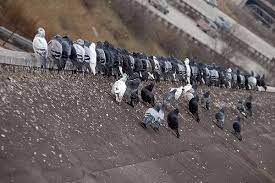
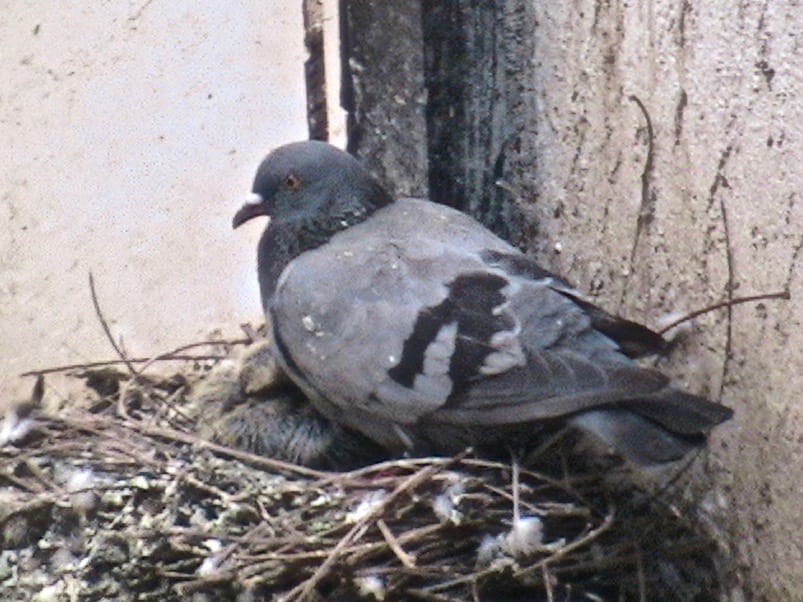
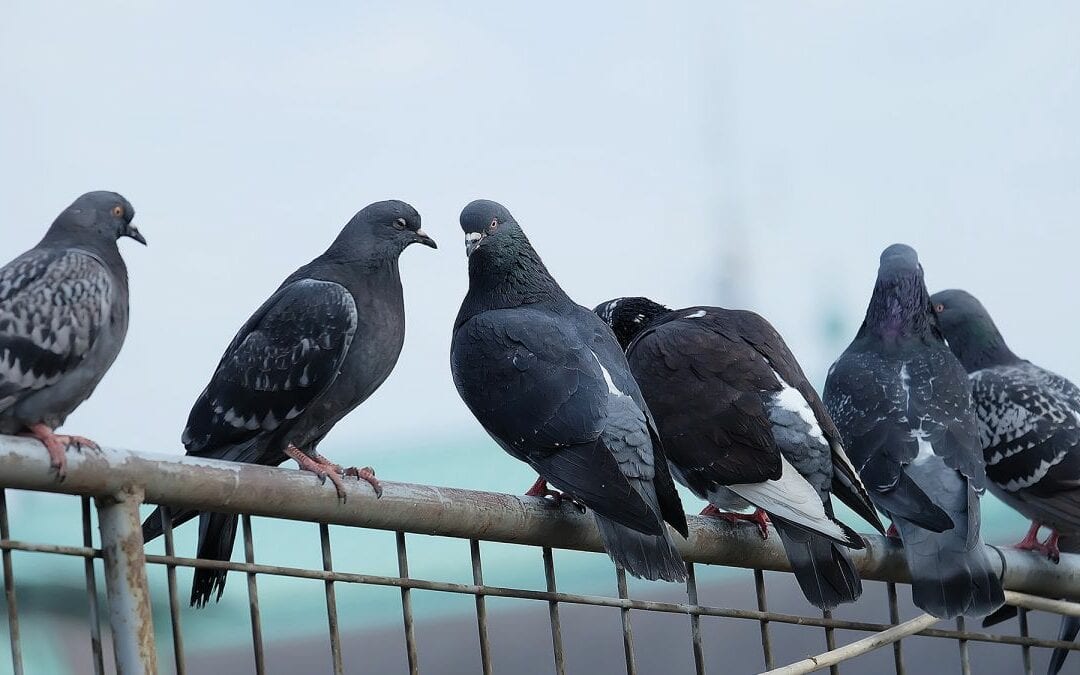
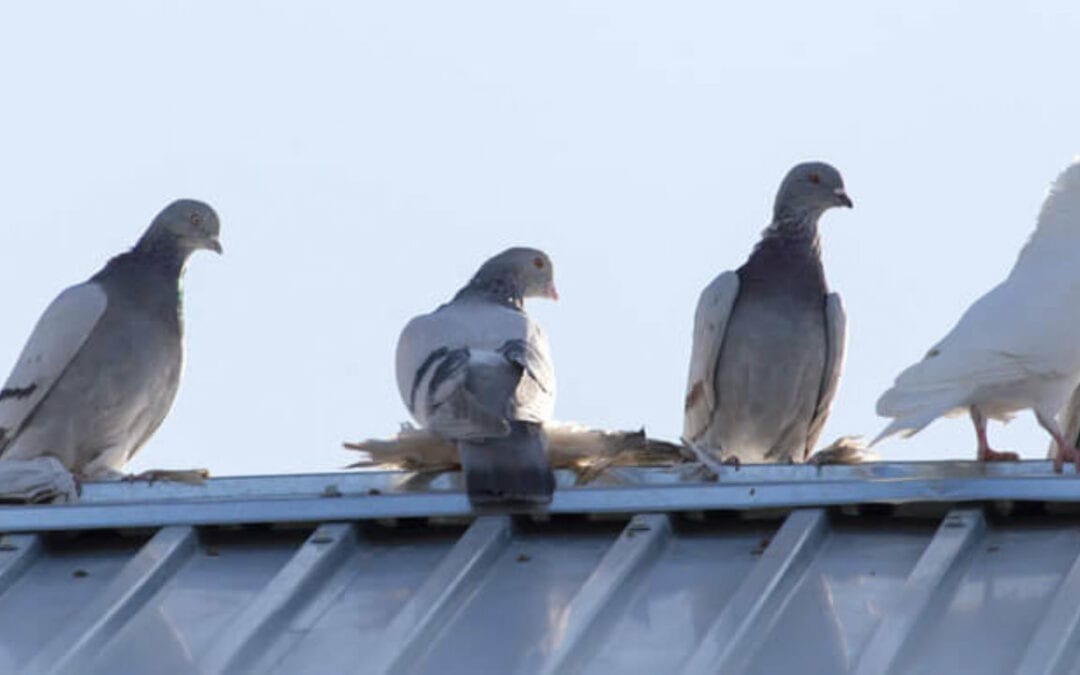
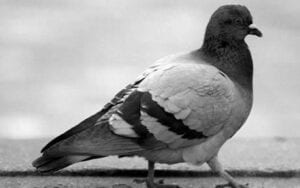
Hanging on roof and window ledges throughout the Bay Area, pigeon spikes serve as one of the many deterrents that protect local buildings from the oft-maligned birds.
Pets Gone Wild
San Francisco’s pigeons are feral “rock doves.” Ornithologists believe the pigeon was the first domesticated bird, originally prized in the Middle East 6,000 years ago for the delicious meat of its squabs and the fertilizing prowess of its waste. Pigeons are highly adaptable; they nest in a wide variety of locations and will eat almost anything.
Flying Rodent?
An estimated 3.5 million feral pigeons live in the Bay Area. Large populations also live in New York City; London; Seville, Spain; Venice; and New Delhi. The characterization “rats with wings” became popular after it was used in Woody Allen’s 1980 film, “Stardust Memories.”
Edgy Critters
Pigeons are edge-landing birds. When landing above ground, they land only on peaks or at perimeters, where they can use their claws to grip for stability. To deter pigeons from a building, only those areas need to be blocked.
No Stabbing
Many pigeon spikes are not pointed. Birds Away/Pigeons Away, a 25-year-old company based in Concord, uses only blunt-ended prongs. It decided spikes were inferior to prongs because they injured birds and snagged flying debris like large leaves, newspapers and plastic bags.
Feathered Hero
Domestic carrier pigeons have been used for centuries to transmit messages during wartime. An American bird, G.I. Joe, received a medal for his courageous flight in World War II, traveling 20 miles to safeguard the lives of British soldiers.
Winged Plague
Pigeons can transmit heart and kidney diseases to humans, as well as salmonella and encephalitis. They also carry parasites like ticks, mites, fleas and lice.
Artistic Decision
The de Young Museum is protected from pigeons by an invisible “shock track” on its edges that is charged with a low voltage.
Bird Brains
At the Balboa Park BART station, pigeons tried to nest between the spikes, but they got stuck and eventually starved. BART has also tried to deter pigeons with fake owls and rubber snakes.
Ugly and Injurious
Highly acidic pigeon feces can corrode paint and most metals. The droppings on sidewalks can also lead to liability issues, like slip-and-fall lawsuits.
Pigeon Patrol Products & Services is the leading manufacturer and distributor of bird deterrent (control) products in Canada. Pigeon Patrol products have solved pest bird problems in industrial, commercial, and residential settings since 2000, by using safe and humane bird deterrents with only bird and animal friendly solutions. At Pigeon Patrol, we manufacture and offer a variety of bird deterrents, ranging from Ultra-flex Bird Spikes with UV protection, Bird Netting, 4-S Bird Gel and the best Ultrasonic and audible sound devices on the market today.
Voted Best Canadian wholesaler for Bird Deterrent products ten years in a row.
Contact us at 1- 877– 4– NO-BIRD, (604) 585-9279 or visit our website at www.pigeonpatrol.ca
Pigeon/Pigeon Patrol / Pigeons Roosting / Vancouver Pigeon Control /Bird Spikes / Bird Control / Bird Deterrent / Pigeon Deterrent? Surrey Pigeon Control / Pest /Seagull deterrent / Vancouver Pigeon Blog / Birds Inside Home / Pigeons in the cities / Ice Pigeons/ What to do about pigeons/ sparrows , Damage by Sparrows, How To Keep Raccoons Away, Why Are Raccoons Considered Pests/ De-fence / Pigeon Nesting/ Bird Droppings / Pigeon Dropping/ woodpecker control/ Professional Bird Control Company/ Keep The Birds Away/ Birds/rats/ seagull/pigeon/woodpecker/ dove/sparrow/pidgeon control/pidgeon problem/ pidgeon control/flying rats/ pigeon Problems/ bird netting/bird gel/bird spray/bird nails/ bird guard
New research has shown that feral, untrained pigeons can recognise individual people and are not fooled by a change of clothes.
Researchers, who presented their work at the Society for Experimental Biology Annual Conference in Glasgow on the 3rd of July, have shown that urban pigeons that have never been caught or handled can recognise individuals, probably by using facial characteristics.
Although pigeons have shown remarkable feats of perception when given training in the lab this is the first research showing similar abilities in untrained feral pigeons.
In a park in Paris city centre, pigeons were fed by two researchers, of similar build and skin colour, wearing different coloured lab coats. One individual simply ignored the pigeons, allowing them to feed while the other was hostile, and chased them away. This was followed by a second session when neither chased away the pigeons.
The experiment, which was repeated several times, showed that pigeons were able to recognise the individuals and continued to avoid the researcher who had chased them away even when they no longer did so. Swapping lab coats during the experiments did not confuse the pigeons and they continued shun the researcher who had been initially hostile.
“It is very likely that the pigeons recognised the researchers by their faces, since the individuals were both female and of a similar age, build and skin colour,” says Dr. Dalila Bovet a co-author of this work from the University of Paris Ouest Nanterre La Défense. “Interestingly, the pigeons, without training, spontaneously used the most relevant characteristics of the individuals (probably facial traits), instead of the lab coats that covered 90% of the body.”
The fact that the pigeons appeared to know that clothing colour was not a good way of telling humans apart suggests that the birds have developed abilities to discriminate between humans in particular. This specialised ability may have come about over the long period of association with humans, from early domestication to many years of living in cities.
Future work will focus on identifying whether pigeons learn that humans often change clothes and so use more stable characteristics for recognition, or if there is a genetic basis for this ability, linked to domestication or to having evolved in an urban environment.
Pigeon Patrol Products & Services is the leading manufacturer and distributor of bird deterrent (control) products in Canada. Pigeon Patrol products have solved pest bird problems in industrial, commercial, and residential settings since 2000, by using safe and humane bird deterrents with only bird and animal friendly solutions. At Pigeon Patrol, we manufacture and offer a variety of bird deterrents, ranging from Ultra-flex Bird Spikes with UV protection, Bird Netting, 4-S Bird Gel and the best Ultrasonic and audible sound devices on the market today.
Voted Best Canadian wholesaler for Bird Deterrent products ten years in a row.
Contact us at 1- 877– 4– NO-BIRD, (604) 585-9279 or visit our website at www.pigeonpatrol.ca
Pigeon/Pigeon Patrol / Pigeons Roosting / Vancouver Pigeon Control /Bird Spikes / Bird Control / Bird Deterrent / Pigeon Deterrent? Surrey Pigeon Control / Pest /Seagull deterrent / Vancouver Pigeon Blog / Birds Inside Home / Pigeons in the cities / Ice Pigeons/ What to do about pigeons/ sparrows , Damage by Sparrows, How To Keep Raccoons Away, Why Are Raccoons Considered Pests/ De-fence / Pigeon Nesting/ Bird Droppings / Pigeon Dropping/ woodpecker control/ Professional Bird Control Company/ Keep The Birds Away/ Birds/rats/ seagull/pigeon/woodpecker/ dove/sparrow/pidgeon control/pidgeon problem/ pidgeon control/flying rats/ pigeon Problems/ bird netting/bird gel/bird spray/bird nails/ bird guard
Odors are known to be essential for navigation during homeward orientation and migration of some bird species. Yet little was known about their chemical composition. An international team has now identified volatile organic compounds that can be used for olfactory navigation by homing pigeons and proved the existence of suitable regional chemical gradients in the air on a landscape-scale in Tuscany.
Many bird species can find their way home even after being brought to remote or unfamiliar locations. Over 40 years of research on homing pigeons have shown that environmental odors play a crucial role in this process. Yet the chemical identity of these odors has remained a mystery. An international team of scientists from the Max Planck Institutes for Chemistry (Mainz) and of Animal Behavior (Radolfzell), and the Universities of Konstanz, Pisa and Mainzhas now identified potential chemical navigational cues that could be used by homing pigeons. Based on the collected data, the researchers were also able to create regional olfactory maps for marine emissions, biogenic compounds, and anthropogenic mixed air and to establish the existence of regional navigable chemical gradients in the air.
During the scientific mission, which took place in 2017 and 2018 in the Italian region of Tuscany, the researchers measured a suite of airborne volatile organic compounds (VOCs) over a period of months at the pigeon’s home aviary. Some of these compounds are emitted by trees, the pine fragrance one smells during a walk in the forest. Other pungent natural emissions come from the sea, while still further VOCs can be emitted from industry. The measurements enabled regional maps to be constructed connecting chemicals with wind direction and speed. Additional measurements were taken in selected regional forest environments and by air using an ultralight plane flying at 180 meters – the average altitude of flying pigeon. The scientists merged the information they had gathered during the field campaigns with GPS tracks obtained from released birds. Thus, they generated multiple regional, horizontal and vertical spatial chemical gradients that can form the basis of an olfactory map.
Olfactory maps based on environmental odors
“Ornithologists from Germany and Italy have shown in more than 40 years of experiments, that pigeons use airborne odors to navigate home,” explains Nora Zannoni, post-doctoral researcher at Max Planck Institute for Chemistry and the study’s first author. Those results have shown that pigeons construct an olfactory map based on the distribution of environmental odors they have perceived over several months at the home aviary. This knowledge is then used as a compass at the point of release to return back home from unfamiliar sites. “By proving the existence of regional chemical gradients in the air around the experimental site we provide support for the olfactory navigation hypothesis and with atmospheric measurements we have found which chemicals can be used for navigation,” adds Zannoni. Some compounds come from forested areas (monoterpenes) or the sea (DMS) while others are emitted from cities and industrial complexes (trimethylbenzene), spots that act like chemical lighthouses.
One of the biggest challenges during this research campaign was its multidisciplinary character. “We had to combine the different approaches of several scientific disciplines – atmospheric and analytical chemistry, ornithology and animal behavior, computer science and statistics,” says Martin Wikelski, managing director at the Max Planck Institute of Animal Behavior.
“It’s amazing really,” adds Jonathan Williams the project leader at the MPIC’s Atmospheric Chemistry Department in Mainz. “We uncovered these chemical gradients using several tones of ultrasensitive scientific equipment, but the same complex odor information can be analyzed and converted to a regional map by a 400-gram pigeon.”
Pigeon Patrol Products & Services is the leading manufacturer and distributor of bird deterrent (control) products in Canada. Pigeon Patrol products have solved pest bird problems in industrial, commercial, and residential settings since 2000, by using safe and humane bird deterrents with only bird and animal friendly solutions. At Pigeon Patrol, we manufacture and offer a variety of bird deterrents, ranging from Ultra-flex Bird Spikes with UV protection, Bird Netting, 4-S Bird Gel and the best Ultrasonic and audible sound devices on the market today.
Voted Best Canadian wholesaler for Bird Deterrent products ten years in a row.
Contact us at 1- 877– 4– NO-BIRD, (604) 585-9279 or visit our website at www.pigeonpatrol.ca
Pigeon/Pigeon Patrol / Pigeons Roosting / Vancouver Pigeon Control /Bird Spikes / Bird Control / Bird Deterrent / Pigeon Deterrent? Surrey Pigeon Control / Pest /Seagull deterrent / Vancouver Pigeon Blog / Birds Inside Home / Pigeons in the cities / Ice Pigeons/ What to do about pigeons/ sparrows , Damage by Sparrows, How To Keep Raccoons Away, Why Are Raccoons Considered Pests/ De-fence / Pigeon Nesting/ Bird Droppings / Pigeon Dropping/ woodpecker control/ Professional Bird Control Company/ Keep The Birds Away/ Birds/rats/ seagull/pigeon/woodpecker/ dove/sparrow/pidgeon control/pidgeon problem/ pidgeon control/flying rats/ pigeon Problems/ bird netting/bird gel/bird spray/bird nails/ bird guard
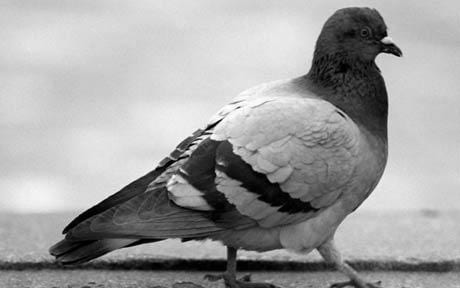
Most evidence suggests that the head bobbing serves a visual function.
Chickens bob their heads while walking. So do cranes, magpies and quails. In fact, head bobbing is a unique feature in birds and occurs in at least 8 of the 27 families of birds.
There are a few theories why some birds bob their heads when they walk:
Assists with balance
Provides depth perception
Sharpens their vision
However, most studies suggest that birds in motion bob their heads to stabilize their visual surroundings. In comparison, we rely more on our eye movements, not our head movements, to catch and hold images while in motion.
Picture a pigeon on a moving treadmill. What do you think would happen as the pigeon walks with the speed of the treadmill and its environment remains relatively the same? Dr. Barrie J Frost (1978) did this experiment and the pigeon’s head did not bob.
Dr. Mark Friedman (1975) also conducted a series of experiments to test the head bobbing actions of birds, using doves. His research demonstrated that the head movement is controlled more by visual stimulation than movement of the body.
Scientists continue to research head bobbing in birds. For example, scientists are currently investigating question such as “Why do some birds exhibit head bobbing, while other do not?” For more information on this topic see the related Web sites section.
Pigeon Patrol Products & Services is the leading manufacturer and distributor of bird deterrent (control) products in Canada. Pigeon Patrol products have solved pest bird problems in industrial, commercial, and residential settings since 2000, by using safe and humane bird deterrents with only bird and animal friendly solutions. At Pigeon Patrol, we manufacture and offer a variety of bird deterrents, ranging from Ultra-flex Bird Spikes with UV protection, Bird Netting, 4-S Bird Gel and the best Ultrasonic and audible sound devices on the market today.
Voted Best Canadian wholesaler for Bird Deterrent products ten years in a row.
Contact us at 1- 877– 4– NO-BIRD, (604) 585-9279 or visit our website at www.pigeonpatrol.ca
Pigeon/Pigeon Patrol / Pigeons Roosting / Vancouver Pigeon Control /Bird Spikes / Bird Control / Bird Deterrent / Pigeon Deterrent? Surrey Pigeon Control / Pest /Seagull deterrent / Vancouver Pigeon Blog / Birds Inside Home / Pigeons in the cities / Ice Pigeons/ What to do about pigeons/ sparrows , Damage by Sparrows, How To Keep Raccoons Away, Why Are Raccoons Considered Pests/ De-fence / Pigeon Nesting/ Bird Droppings / Pigeon Dropping/ woodpecker control/ Professional Bird Control Company/ Keep The Birds Away/ Birds/rats/ seagull/pigeon/woodpecker/ dove/sparrow/pidgeon control/pidgeon problem/ pidgeon control/flying rats/ pigeon Problems/ bird netting/bird gel/bird spray/bird nails/ bird guard
If you could ask any animal ‘A penny for your thoughts’, which would you choose? When the question occurred to Fumihiro Kano from Kyoto University, Japan, he decided to focus on the great apes. ‘Eye movement is a good indicator of attention, cognition and emotion’, he says, explaining how he uses an infrared eye tracker to monitor ape eye movements to understand their thought processes. However, after a decade, Kano decided to switch from working with apes to investigating the minds of homing pigeons through their eyes. Bird eyes are almost fixed in their sockets, allowing Kano to infer where they are gazing from the movements of their heads alone. Teaming up with fellow primate biologist – Dora Biro from the University of Oxford, UK, who also has a passion for researching pigeon navigation – Kano set about designing a head sensor that would allow him to measure the birds’ head movements to test how they use their eyes while homing through the Oxfordshire countryside.
Combining a GPS tracker, microcomputer and battery in a pigeon-sized backpack, Kano added an inertial measurement unit, which could track the bird’s head movements using a gyroscope and accelerometers, mounted on a custom-built mask. ‘Constructing the mask was actually the most challenging, but most fun, part of this study’, smiles Kano, who frequently visited the local craft store in Oxford to try out different materials until he had perfected the wire, felt and elastic band design. ‘The most important thing was to design the mask so that it did not interfere with the bird’s breathing when flying’, he recalls, adding, ‘Most of them were okay to wear it, but some of them didn’t seem to like it and immediately took it off, so we continued to modify the design until they were comfortable’. Once Kano, James Walker, Takao Sasaki and Biro were confident that the pigeons were content to fly wearing their new accessories, the team drove the birds 4 km up the road and then released them individually for the 10 min flight home.
Downloading the data after each bird returned, the team was delighted to see every detail of the head manoeuvres, in addition to the GPS plot of the return flight path. The first thing that they noticed was how stable the birds’ heads were; ‘it is like a high spec gimbal’, says Kano, describing how the heads of the animals barely wobbled. It was also clear that the pigeons were actively glancing from side to side, scanning the landscape, during their solo flights; ‘[They] moved their heads far more than necessary for manoeuvring flight’, says Kano. In addition, the birds reduced their head movements when approaching landmarks, including a main road and a railway line, ‘which indicates that they indeed “see” them to navigate’, says Kano. Finally, the scientists dispatched the birds in pairs to learn more about how they use their eyes when flocking, and noticed that the birds reined in their head movements when flying with a partner, ‘indicating that the flock-mate is a key visual cue that they need to pay attention to’, he says.
It seems that pigeons keenly observe their surroundings, especially when flying solo, and the team is eager to incorporate a tiny camera into the sensor to get a true bird’s-eye view of the world, with the hope of eventually taking a glimpse into the minds of other bird species.
Pigeon Patrol Products & Services is the leading manufacturer and distributor of bird deterrent (control) products in Canada. Pigeon Patrol products have solved pest bird problems in industrial, commercial, and residential settings since 2000, by using safe and humane bird deterrents with only bird and animal friendly solutions. At Pigeon Patrol, we manufacture and offer a variety of bird deterrents, ranging from Ultra-flex Bird Spikes with UV protection, Bird Netting, 4-S Bird Gel and the best Ultrasonic and audible sound devices on the market today.
Voted Best Canadian wholesaler for Bird Deterrent products ten years in a row.
Contact us at 1- 877– 4– NO-BIRD, (604) 585-9279 or visit our website at www.pigeonpatrol.ca
Pigeon/Pigeon Patrol / Pigeons Roosting / Vancouver Pigeon Control /Bird Spikes / Bird Control / Bird Deterrent / Pigeon Deterrent? Surrey Pigeon Control / Pest /Seagull deterrent / Vancouver Pigeon Blog / Birds Inside Home / Pigeons in the cities / Ice Pigeons/ What to do about pigeons/ sparrows , Damage by Sparrows, How To Keep Raccoons Away, Why Are Raccoons Considered Pests/ De-fence / Pigeon Nesting/ Bird Droppings / Pigeon Dropping/ woodpecker control/ Professional Bird Control Company/ Keep The Birds Away/ Birds/rats/ seagull/pigeon/woodpecker/ dove/sparrow/pidgeon control/pidgeon problem/ pidgeon control/flying rats/ pigeon Problems/ bird netting/bird gel/bird spray/bird nails/ bird guard