by Pigeon Patrol | Feb 26, 2015 | Animal Deterrent Products, Bird Deterrent Products, Bird Netting, Pigeon Patrol's Services, Pigeon Spikes, Pigeons in the News, UltraSonic Bird Control
Scarecrows have never worked, and history shows that advancements in technology haven’t worked much better when it comes to shooing birds away from ripening crops.
“You set out propane cannons, they’ll habituate. You broadcast predator calls, they’ll learn to ignore them. They’ll even get used to packs of angry wiener dogs,” said Mark Hinders. “About the only things that work to exclude birds are nets, guns and poison. But those are expensive and/or bad manners.”
Hinders, professor of applied science, and John Swaddle, professor of biology, are the core members of the Sonic Nets collaboration at William & Mary. The idea is to produce an effective, non-lethal bird deterrent, a solution to an age-old problem that is affordable, polite and does not rely on a steady supply of irritable dachshunds.
Instead of scaring or even alarming the birds, Sonic Nets works on the annoyance principle. As they dine in a farmer’s field, birds keep up a constant chatter. A device called a parametric array projects a narrow beam of sound to disrupt the birds’ field chatter, which seems to be mainly about the quality of the hors d’oeuvres and the immediate predator situation.
Like a noisy cocktail party
“It’s like the cocktail party problem,” Hinders explained. “You’re in a room and a lot of people are talking and it can be difficult to follow an individual conversation. It doesn’t even have to be especially loud. It’s just that all those other people’s words fill in the empty spaces. And so you go to a quiet room so that you can hear.”
The Sonic Nets collaboration has attracted considerable interest over the years, beginning in 2012, when the Bill and Melinda Gates Foundation named the project a Grand Challenges Explorations winner. Additional support from the Andrew W. Mellon Foundation allowed birdsong expert Dana Moseley to join the collaboration in fall, 2014 as a Mellon postdoctoral fellow.
There also has been considerable movement toward eventual commercialization of Sonic Nets, as well. The collaborators have been discussing options with a group of M.B.A. students at William & Mary’s Raymond A. Mason School of Business under the leadership of Richard Ash, executive director of the Mason School’s Alan B. Miller Center for Entrepreneurship. A patent application for the parametric array system is under consideration, and Sonic Nets has entered into a partnership with Midstream Technology, a Williamsburg firm, to pursue commercial opportunities.
The technology was first tested with starlings in William & Mary’s aviary. Those encouraging results led to a summer of field tests at Fort Eustis. Swaddle explained that the Fort Eustis tests included an examination of a completely different use for the parametric array—minimizing bird-aircraft collisions by chasing birds away from runways. The airfield work is funded by the Virginia Center for Innovative Technology.
“We surveyed bird activity at three places at the airfield four times a week for eight weeks,” Swaddle said. “The first four weeks gave us a baseline of bird activity. During the second four weeks, we deployed our Sonic Net at one of the sites—and recorded an approximate 85 percent reduction in the presence of birds in that area.”
Testing in an open field
The instrumentation shack (left) holds the white rectangular parametric array aimed at the elevated food tray.
They also field-tested the devices in an open field, with the action recorded on video. The video footage from the open-field tests is still being processed, but Swaddle said the airfield data exceeded their expectations. The aviary tests showed that the Sonic Nets reduced the presence of starlings at food by 50 percent. He suggested that the higher success rate at the airfield is probably due to the difference between wariness of wild birds versus captive starlings.
“After our aviary testing, we thought that we would see a stronger effect in the field, but not as strong as we recorded,” Swaddle said. “We think the Sonic Net works because birds can’t hear alarm calls or predators. In the aviary, there isn’t much threat. In the wild, there are plenty of threats and so there is greater need for birds to hear these calls.”
Bird vocalization is much more rich and diverse than calls to alert the flock to the presence of predators or food. Moseley’s Ph.D. research centered on how males use songs to attract potential mates as well as ward off rivals. The breeding-related vocalizations are yet another aspect of the deep aural avian experience.
“It’s interesting to think about how the world of birds is such an acoustic world,” Moseley said. “It can be hard for us to see some little brown bird in a bush. And it’s hard for them to see each other too in a bush or in a forest, or even in a field. The way that they are able to interact with their environment is especially through sound.”
‘Soundscape’ theory
The wide-frequency capabilities of the apparatus open up the potential for “tuning” the Sonic Nets sound to target particular species. Nonlinear acoustics principles incorporated into design of the speakers also allow the operator to “focus” the sound right at the birds, and only the birds.She explained that there is some evidence that “soundscape” is a factor in habitat choice—that birds show a preference for a place where their songs and calls will best resonate. Moseley noted that the Sonic Nets apparatus could be used as research tool to test the soundscape-preference hypothesis, using its wide-frequency range to select sound that would alter the acoustic landscape of a test plot to observe if sound changes the bird’s perception of a habitat.
“If you do it just right you can get that narrow beam of sound to cancel itself out after it propagates a certain distance,” Hinders explained. “This control over where the sound goes allows us to cover a particular region with a blanket of sound. Inside that area the birds can’t communicate, so they leave. Outside that area, nothing—so we don’t generate any noise pollution.”
Graduate student Elizabeth Skinner sets up speakers at an airfield.
Elizabeth Skinner, a Ph.D. student in applied science, is working on simulations of how the sound beams interact with air. Her aim is to fine-tune the controls of the sound, setting the stage for Sonic Nets arrays tailored for specific situations.
“There are some applications where we’re going to want to cover a huge area, and there are others, like on the edge of a golf course, where you’re going to want to cut the sound off before you get to the course itself, so that you don’t bother the golfers,” she said. “My simulations allow us to see where the sounds are going to go before we build the speaker.”
Speakers, described as light sources
The team likes to compare different speaker designs to light sources. A regular speaker, Skinner explained, can be compared to a normal incandescent light bulb, illuminating a room, although diminishing with distance.
“Whereas, a parametric array would be like a flashlight. You can point it, direct it,” she said. “And then the limited parametric array that we’re working on is more like a light saber, where it will just cut off at a certain distance, but up to that distance, you’ll still have that defined beam.”
Sonic Nets is versatile in concept, but one size does not fit all applications. Scaling up—spreading out the sound—is easier than confining the sound to a defined space, Hinders said.
The team is working on variations in speaker design, sound and power source to engineer a Sonic Nets solution to any number of site-specific bird-pest problems. There is an almost limitless variety of bird issues, with consequences ranging from life-and-death to the most trivial of First-World Problems, Hinders said. Each problem poses a different set of engineering challenges.“If we need to cover a sunflower field in North Dakota, we would simply repurpose a stripped-down version of an emergency-alert kind of siren or maybe the PA system for a stadium,” he said. Other agricultural applications might be as small as a portion of an acre or a couple rows of fruit trees, Swaddle added.
“There are particular birds in sub-Saharan Africa that come and eat your rice and make your kids starve, so you want to encourage them to go somewhere else. The new football stadium in Minneapolis happens to be right in the major flyway for lots and lots of birds and apparently they are building this with lots of glass and they have to do something to head off a plague of bird deaths. A technology like this might be just what the NFL needs to avoid yet another run of bad press,” he said. “It could be pigeons pooping on the cars in your parking lot. It could be gulls pooping on your yacht. ”
Next: More testing, more speaker design, more research
Next steps for the project include more extensive field testing, speaker design, various technology-transfer options and getting a better understanding of aspects of both the avian and the human condition. The collaborators stress that they want to be careful to work with people who would use Sonic Nets applications, to understand the bird and the problem it’s causing.
Hinders said the group hopes to introduce use of the technology in resource-poor areas such as sub-Saharan Africa. He has begun leveraging existing contacts, starting with consultations with a young Tanzanian who is about to get a degree in wildlife management, thanks to the support from St. Stephen’s Lutheran Church in Williamsburg.
“The world is in fact that small,” Hinders said. “As we develop this technology, partnering with a small company who intends to make money, we also have in mind the social entrepreneurship angle where we’re solving the actual problem in a place like Tanzania. The engineering challenge is to engineer enough cost and complexity out of it that can actually solve the problem.”
About Pigeon Patrol:
Pigeon Patrol Products & Services is the leading manufacturer and distributor of bird deterrent (control) products in Canada. Pigeon Patrol products have solved pest bird problems in industrial, commercial, and residential settings since 2000, by using safe and humane bird deterrents with only bird and animal friendly solutions. At Pigeon Patrol, we manufacture and offer a variety of bird deterrents, ranging from Ultra-flex Bird Spikes with UV protection, Bird Netting, 4-S Gel and the best Ultrasonic and audible sound devices on the market today.
Voted Best Canadian wholesaler for Bird Deterrent products four years in a row.
Contact Info: 1- 877– 4– NO-BIRD (www.pigeonpatrol.ca)
by Pigeon Patrol | Feb 11, 2015 | Bird Deterrent Products, Bird Netting, Pigeon Patrol's Services, Pigeons in the News
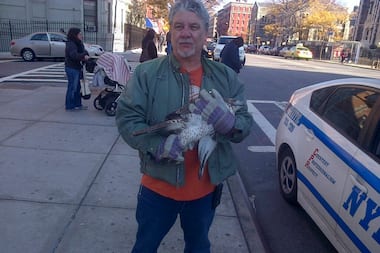
 A PEREGRINE falcon has been rescued by firefighters after becoming trapped.
The bird of prey got stuck in anti-pigeon netting on the roof of a building shortly after 9.30am yesterday morning.
A specialist rescue team from Camels Head set about helping the bird.
They used specialist animal rescue equipment, and requested the mobilisation of the aerial platform to help get to the bird.
Ben Wheedon, from Camels Head, said: “The netting was wrapped around its wing and leg. We used animal rescue equipment to free the bird, and put it in an animal rescue bag to be handed over to the SPCA. It has been taken to the vet for a check-up and we think it’s going to be OK.
“We have a lot of protective equipment to help protect the animals.”
The bird was rescued using specialist equipment and was passed into the care of the SPCA.
ONE lane was blocked as emergency services dealt with an incident.
About Pigeon Patrol:
Pigeon Patrol Products & Services is the leading manufacturer and distributor of bird deterrent (control) products in Canada. Pigeon Patrol products have solved pest bird problems in industrial, commercial, and residential settings since 2000, by using safe and humane bird deterrents with only bird and animal friendly solutions. At Pigeon Patrol, we manufacture and offer a variety of bird deterrents, ranging from Ultra-flex Bird Spikes with UV protection, Bird Netting, 4-S Gel and the best Ultrasonic and audible sound devices on the market today.
Voted Best Canadian wholesaler for Bird Deterrent products four years in a row.
Contact Info: 1- 877– 4– NO-BIRD (www.pigeonpatrol.ca)

by Pigeon Patrol | Feb 5, 2015 | 4-S Gel Bird repellent, Animal Deterrent Products, Bird Deterrent Products, Pigeon Spikes, Pigeons in the News
 For Mathis Brothers Furniture in Indio, it’s time to go solar. With a two-story showroom, a large warehouse and a lot of light fixtures, televisions and adjustable mattress bases, “The amount of power being used is pretty huge,” said sales manager, James Dorris.
On the rooftop, Solar Forward, an Los Angeles based company, is already hard at work installing nearly 2,500 solar panels.
“We’re really excited to be working with Mathis Brothers to install the largest solar system here in Indio. Basically this system is so large it could power 125 homes,” said Mark Smith, CEO of Solar Forward.
The installation’s expected to take two months and cost $2.5 million. The panels will lighten up Mathis Brothers’ electric bill 95 percent and could trim your bill too.
“We’re making the energy on site. It’s going to go from the roof into the main panel and be used right here. Any excess energy just gets distributed right in the area, consumed in the local community,” said Smith.
“We want to be able to cut down as much as we can, not just for our own benefit, but for our community,” said Dorris.
The workers are facing several challenges including the Coachella Valley heat and pigeons! They’re using everything under the sun to keep the birds away such as reflective tape and sound decoys.
“There were swamp coolers and the pigeons made it their home. Now we’re trying to teach the pigeons to go somewhere else,” said Smith.
Solar Forward said it’ll need more hands on deck to get the job done.
“Solar Forward is LA based. We want to hire local people to facilitate this installation. We need local help. This is a huge job,” Smith said.
“Overall it’s the step in the right direction for everybody,” said Dorris.
About Pigeon Patrol:
Pigeon Patrol Products & Services is the leading manufacturer and distributor of bird deterrent (control) products in Canada. Pigeon Patrol products have solved pest bird problems in industrial, commercial, and residential settings since 2000, by using safe and humane bird deterrents with only bird and animal friendly solutions. At Pigeon Patrol, we manufacture and offer a variety of bird deterrents, ranging from Ultra-flex Bird Spikes with UV protection, Bird Netting, 4-S Gel and the best Ultrasonic and audible sound devices on the market today.
Voted Best Canadian wholesaler for Bird Deterrent products four years in a row.
Contact Info: 1- 877– 4– NO-BIRD (www.pigeonpatrol.ca)
by Pigeon Patrol | Jan 20, 2015 | 4-S Gel Bird repellent, Animal Deterrent Products, Bird Deterrent Products, Pigeon Spikes, Pigeons in the News
 NIPTON, Calif. — The Mojave Desert’s gleaming Ivanpah solar plant is bright enough to make Las Vegas-bound air travelers and pilots squint from a distance of 60 or more miles.
The 45-story “power towers” shine with sunlight reflected by 350,000 heliostat mirrors spread across an area four times the size of New York’s Central Park. Receivers atop the towers heat to nearly 1,000 degrees Fahrenheit, boiling water to turn turbines that crank out 392 megawatts — power for more than 100,000 houses.
But that intense heat is incinerating birds that fly into the “flux field” between the mirrors and the towers.
Bird mortality is a problem for Ivanpah developer BrightSource Energy Inc., operator NRG Energy Inc. and other companies that covet the power tower technology. Killing or maiming most bird species — even by accident — is illegal under the Migratory Bird Treaty Act.
Ivanpah, which opened a year ago, is testing new ways to prevent bird deaths, trying everything from anti-perching devices to spraying a bubble gum extract that birds hate. Its efforts could be key to the technology’s future.
“We take this issue very seriously, and Ivanpah’s project owners have gone to great lengths to investigate and minimize wildlife impacts,” NRG spokesman Jeff Holland said. “We are evaluating the use of humane avian deterrent systems, similar to those employed by airports and in food industry, and implementing other practices that go beyond conventional operational procedures to reduce avian activity near the towers.”
While bird kills happen at all energy projects, Ivanpah has had an outsize amount of press attention — possibly because it’s the largest power tower project in the world and because it got a $1.6 billion loan guarantee from the Department of Energy.
Trouble began last April with the release of a Fish and Wildlife Service forensics report documenting debris, birds and insects — all known as “streamers” — going up in smoke at Ivanpah. Vivid pictures of charred birds spawned headlines.
According to the report, Fish and Wildlife enforcement officers reported seeing an average of one streamer every two minutes.
One falconlike bird was seen with a plume of smoke rising from its tail as it flew through the field. It lost stability and altitude but was able to clear the plant’s perimeter and land, the officers said. It was never found.
One hundred forty-one bird carcasses were found at Ivanpah from June 2012 to December 2013, one-third of which likely died from the solar flux, with telltale signs including feather curling, charring, melting and breakage. Most were house finches and yellow-rumped warblers whose diets consist mostly of insects.
Federal investigators warned Ivanpah may act as a “mega-trap” where abundant insects attract small birds that are killed or incapacitated by the solar flux. Those birds in turn attract larger predators, “creating an entire food chain vulnerable to injury and death.”
Critics and media seized on the report.
An Associated Press story in August suggested a bird was being toasted every two minutes at Ivanpah, even though investigators did not know what percentage of the streamers were birds. The AP also quoted Shawn Smallwood, an ecologist at the Center for Biological Diversity, estimating that 28,000 birds were dying each year at Ivanpah, an estimate the environmentalist admitted was “back-of-the-napkin.”
Ivanpah consultants said they believe no more than 1,469 birds a year are being directly killed, 898 of which could be attributed to solar flux.
FWS conceded that “we currently have a very incomplete knowledge of the scope of avian mortality at these solar facilities.”
The agency late last summer said it is conducting a “systematic study” at Ivanpah “to determine its true impact on birds.”
Impacts on other projects
Ivanpah officials say the plant’s impacts pale in comparison to larger human threats.
They include building collisions that kill an estimated 365 million to 988 million birds annually in the U.S., according to a 2014 study by federal scientists in the journal The Condor: Ornithological Applications.
Stray and outdoor pet cats each year kill a median of 2.4 billion birds and 12.3 billion mammals, mostly native mammals like shrews, chipmunks and voles, according to a 2013 report from scientists from the Smithsonian Conservation Biology Institute and FWS.
American wind farms kill upward of half a million birds annually, according to peer-reviewed research, and power lines kill hundreds of thousands to 175 million birds annually, according to another study.
But the lurid images of burned birds at Ivanpah seem to resonate with the public. And uncertainty over the towers’ impacts could bring headaches to new projects.
Whether bird deaths at Ivanpah will crimp the technology’s development remains to be seen.
Environmentalists are unlikely to endorse the technology until its environmental footprint is better understood.
“We’re cautious and somewhat alarmed until we find out the truth,” said Garry George, renewable energy project director for Audubon California. “Everything you build is going to have some impact on birds. The question is, how big? Is it affecting populations?”
Ivanpah ramps up monitoring
Ivanpah’s owners hope to answer that through better monitoring and the use of bird deterrents.
In mid-October, Ivanpah installed a “BirdBuffer” at the top of one of its towers. The moving box-size machine sprays a concentrated grape juice extract into the air at regular intervals, 45 minutes of every hour. The vapor extract, which is used in food products including bubble gum, causes a “safe yet irritating response” in birds, according to the manufacturer, BirdBuffer LLC of Everett, Wash., which sells the units for $8,995 each.
BirdBuffer CEO Gary Crawford said the plant has since seen a reduction in bird activity.
Ivanpah is also exploring anti-perching devices, fogging and sonic deterrents, and waste and water containment to keep birds from scavenging the area for food, NRG’s Holland said. It is turning off facility lights at night to attract fewer insects and repositioning heliostats to cut down on glare.
Birds continue to fall from the sky — 115 carcasses were located last year between May 23 and Aug. 17, about one-third of which showed signed of dying in the solar flux, according to Ivanpah’s latest filing with the California Energy Commission.
A Greenwire reporter visited the site Dec. 7 but saw no streamers or bird carcasses.
Ivanpah mirror
Ivanpah’s nearly 350,000 mirrors track and reflect sunlight onto the boilers atop the three power towers. Photo by Phil Taylor.
The true number of dying birds is likely underrepresented by human surveys.
Large facilities like Ivanpah are difficult to efficiently search; carcasses are often hidden by vegetation or solar panels, dead birds disappear to scavengers and others degrade too fast to determine cause of death, according to the FWS forensics report.
Ivanpah is also seeking to better monitor its airspace.
Last May, the plant’s owners commissioned the U.S. Geological Survey to study the effectiveness of video cameras, radar, acoustic detectors and other tracking devices to quantify the presence, diversity, movement and behaviors of birds, bats and insects flying near the facility. The results, expected to be published this year in a scientific journal, could spur new research into best management practices.
Birds are not the first major wildlife problem Ivanpah has faced.
In addition to invading avian airspace, the plant took over about 3,500 acres of native desert scrubland with a resident population of federally threatened desert tortoise.
Developers spent $22 million to care for tortoises, moving several dozen from the construction site and building a “head start” nursery where juvenile tortoises and hatchlings are reared until big enough to resist predation from kit foxes, ravens or coyotes.
The company plans to spend $34 million more to meet federal and state mitigation obligations.
“BrightSource was a very good partner for making that work for desert tortoise,” said FWS Director Dan Ashe.
Bird mortality will be an ongoing challenge, he said.
“Are we concerned? Um, yes,” Ashe said during a Western Governors’ Association winter meeting last month in Las Vegas. “Except … are birds killed at that facility? They are, clearly. Are birds killed by running into this building? They are, and every building. I’ve had birds run into the glass window of my house. Everybody has. Every time we put a facility on the landscape, it’s going to take birds. The question is, is it going to have a population-level impact? We need to figure that out.”
‘Prosecutorial discretion’
Legal experts do not expect bird deaths to thwart solar development, even as the Justice Department cracks down on wind farms that kill significant numbers of birds and extracts major penalties under the Migratory Bird Treaty Act.
“Enforcement of the Migratory Bird Treaty Act and Bald and Golden Eagle Protection Act essentially boils down to prosecutorial discretion,” said Andrew Bell, an energy attorney for Marten Law in San Francisco. “Prosecutorial discretion is in turn founded largely on a demonstration of good-faith efforts by companies to address phenomena like avian impacts.”
Solar developers typically meet that burden by agreeing to mitigation and bird and bat conservation strategies as a condition of federal permits, Bell said.
Solar farms, particularly future power towers, may need to do more if they want to maintain their green credentials.
George, of Audubon California, said he’s reserving judgment on Ivanpah until more studies are completed.
“Right now, we’re cautious and not willing to support the permitting of another power tower,” he said.
George visited the Ivanpah plant last fall and said the operator had roughly two dozen biologists that day fanning the property looking for dead birds with the help of scent dogs. Through binoculars, he saw plenty of streamers in the sky, though he said it was not clear whether any of them were birds.
“It was a great mystery,” he said. “It wasn’t the nightmare Wes Craven movie I had in my mind.”
About Pigeon Patrol:
Pigeon Patrol Products & Services is the leading manufacturer and distributor of bird deterrent (control) products in Canada. Pigeon Patrol products have solved pest bird problems in industrial, commercial, and residential settings since 2000, by using safe and humane bird deterrents with only bird and animal friendly solutions. At Pigeon Patrol, we manufacture and offer a variety of bird deterrents, ranging from Ultra-flex Bird Spikes with UV protection, Bird Netting, 4-S Gel and the best Ultrasonic and audible sound devices on the market today.
Voted Best Canadian wholesaler for Bird Deterrent products four years in a row.
Contact Info: 1- 877– 4– NO-BIRD (www.pigeonpatrol.ca)
by Pigeon Patrol | Jan 18, 2015 | Animal Deterrent Products, Bird Deterrent Products, Bird Netting, Pigeon Spikes, Pigeons in the News
 Pigeons have plagued the parliament for years. When the building first opened, muck and feathers were blown through vents on to researchers’ desks and some birds even got into MSPs’ offices. Nets, wires and spikes were installed in a bid to keep the birds away.
Birds of prey were introduced in 2009 with a strict “no kill” policy. Last year, the Evening News revealed laser pens were also being used to frighten the birds away, prompting warnings by experts that birds could be blinded by such measures.
Today, pigeon experts said the parliament was wasting money by paying for any more action against the birds.
Monthly reports to Holyrood by contractors NBC Bird and Pest Solutions say they find an average of 14 birds present each time they arrive for their early-morning visits.
And the reports claim they successfully disperse about two-thirds each time.
But Emma Haskell, who until recently ran the Pigeon Control Advisory Service, said there was little chance of getting the numbers any lower.
She said: “These will undoubtedly be the same birds each time. They will return to base once the hawk has gone. You would need to fly the hawks 24/7 to deter the pigeons permanently.
“They are never going to be pigeon-free. That’s just unrealistic.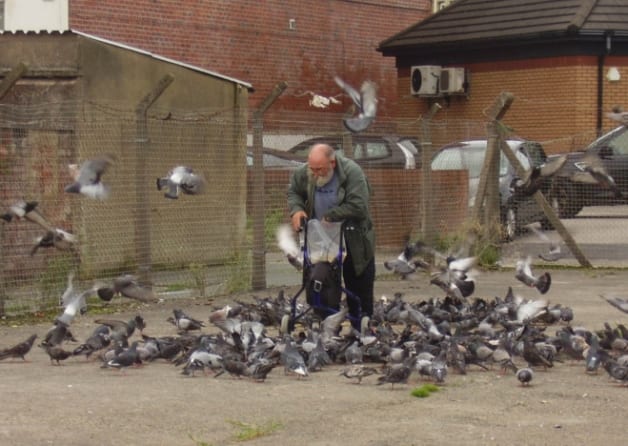
“Fourteen is a very small number of birds for an area the size of the parliament. Why are they spending any money on that number of pigeons? It’s a complete waste of money.”
Ms Haskell said the only time the pigeons would be absent from the building was when a hawk was flying and there was no reason to suppose scrapping such flights would lead to an increase in numbers.
Edinburgh Southern SNP MSP Jim Eadie said: “Given the size and importance of the building, it is appropriate there should be proper pest control measures in place.
“The public is entitled to expect that any expenditure is constantly reviewed and evaluated to ensure the taxpayer is receiving value for money.”
It is understood the parliament will consider cutting back hawk visits when the contract runs out in May next year.
A spokesman said: “While we are pleased measures have reduced the number of issues in recent times, we are aware the problem can never be fully eradicated. A decision on whether to continue with the existing approach will be taken early next year.”
About Pigeon Patrol:
Pigeon Patrol Products & Services is the leading manufacturer and distributor of bird deterrent (control) products in Canada. Pigeon Patrol products have solved pest bird problems in industrial, commercial, and residential settings since 2000, by using safe and humane bird deterrents with only bird and animal friendly solutions. At Pigeon Patrol, we manufacture and offer a variety of bird deterrents, ranging from Ultra-flex Bird Spikes with UV protection, Bird Netting, 4-S Gel and the best Ultrasonic and audible sound devices on the market today.
Voted Best Canadian wholesaler for Bird Deterrent products four years in a row.
Contact Info: 1- 877– 4– NO-BIRD (www.pigeonpatrol.ca)