by Pigeon Patrol | Jan 25, 2022 | Columbidae, Doves, history of pigeons, MBCA, pet bird
Turning is crucial for animals, particularly during predator–prey interactions and to avoid obstacles. For flying animals, turning consists of changes in (i) flight trajectory, or path of travel, and (ii) body orientation, or 3D angular position. Changes in flight trajectory can only be achieved by modulating aerodynamic forces relative to gravity. How birds coordinate aerodynamic force production relative to changes in body orientation during turns is key to understanding the control strategies used in avian maneuvering flight. We hypothesized that pigeons produce aerodynamic forces in a uniform direction relative to their bodies, requiring changes in body orientation to redirect those forces to turn. Using detailed 3D kinematics and body mass distributions, we examined net aerodynamic forces and body orientations in slowly flying pigeons (Columba livia) executing level 90° turns. The net aerodynamic force averaged over the downstroke was maintained in a fixed direction relative to the body throughout the turn, even though the body orientation of the birds varied substantially. Early in the turn, changes in body orientation primarily redirected the downstroke aerodynamic force, affecting the bird’s flight trajectory. Subsequently, the pigeon mainly reacquired the body orientation used in forward flight without affecting its flight trajectory. Surprisingly, the pigeon’s upstroke generated aerodynamic forces that were approximately 50% of those generated during the downstroke, nearly matching the relative upstroke forces produced by hummingbirds. Thus, pigeons achieve low speed turns much like helicopters, by using whole-body rotations to alter the direction of aerodynamic force production to change their flight trajectory.
Source
Pigeon Patrol Products & Services is the leading manufacturer and distributor of bird deterrent (control) products in Canada. Pigeon Patrol products have solved pest bird problems in industrial, commercial, and residential settings since 2000, by using safe and humane bird deterrents with only bird and animal friendly solutions. At Pigeon Patrol, we manufacture and offer a variety of bird deterrents, ranging from Ultra-flex Bird Spikes with UV protection, Bird Netting, 4-S Bird Gel and the best Ultrasonic and audible sound devices on the market today.
Voted Best Canadian wholesaler for Bird Deterrent products ten years in a row.
Contact us at 1- 877– 4– NO-BIRD, (604) 585-9279 or visit our website at www.pigeonpatrol.ca
Pigeon/Pigeon Patrol / Pigeons Roosting / Vancouver Pigeon Control /Bird Spikes / Bird Control / Bird Deterrent / Pigeon Deterrent? Surrey Pigeon Control / Pest /Seagull deterrent / Vancouver Pigeon Blog / Birds Inside Home / Pigeons in the cities / Ice Pigeons/ What to do about pigeons/ sparrows , Damage by Sparrows, How To Keep Raccoons Away, Why Are Raccoons Considered Pests/ De-fence / Pigeon Nesting/ Bird Droppings / Pigeon Dropping/ woodpecker control/ Professional Bird Control Company/ Keep The Birds Away/ Birds/rats/ seagull/pigeon/woodpecker/ dove/sparrow/pidgeon control/pidgeon problem/ pidgeon control/flying rats/ pigeon Problems/ bird netting/bird gel/bird spray/bird nails/ bird guard
by Pigeon Patrol | Jan 4, 2022 | Columbidae, Doves, history of pigeons, MBCA, pet bird, Pigeon Control
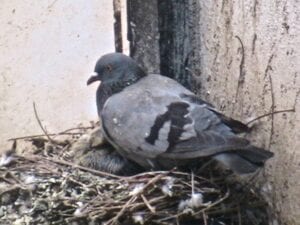
Spotting a bird’s nest can fill families with delight – but what about when the inhabitants of a nest on your property are notorious pest birds?
More specifically: should you be worried about nesting pigeons on your property?
Pigeons have a reputation – and not entirely unfairly – as flying rats. As this is down to their propensity to spread disease, which, in itself, justifies any concerns you may have over finding a pigeon nest in your garden.
Can I move a pigeon nest?
Like all wild birds, nesting pigeons are protected by the law and can only be moved in exceptional circumstances.
It is considered an offence to move a nest during nesting season, which usually runs from spring through the summer.
These same rules apply to pigeons, so if you have serious concerns it is essential to seek professional advice.
Any attempt to move a bird’s nest should only be made when you are sure that the fledglings have left and it is dormant.
With pigeons, however, this can be trickier as they can often lay eggs three times throughout the summer and do not as a rule nest and lay eggs seasonally. This means that a nest could theoretically be in use year-round.
Why should I be worried about nesting pigeons?
The main concern people usually have relating to pigeons is the spread of disease. They have been linked to the spread of diseases such as histoplasmosis, which can cause serious lung problems, and salmonella.
This is spread through contact with pigeon droppings – or breathing in airborne particles.
Obviously when a pigeon is nesting close to the living area of your home, or in an area used for preparing or eating food this is more of a risk.
Likewise, many homeowners will be unhappy to discover pigeons nesting in their roof due to concerns about the spread of disease.
However, this is less of a problem if a pigeon’s nest has been found in your garden.
Along with the risk of disease, pigeons’ pest bird status owes something to the noise and mess these birds bring with them. Pigeon droppings can cause a hazard on walkways, encourage weeds and moss to grow on roofs and look unsightly. They are also noisy birds, which, in numbers can cause a noise nuisance around your home.
What should I do if pigeons are nesting on my property?
If a nest is established in an area where there are no serious safety concerns you will need to allow the eggs to hatch and fledgling birds to leave before you take action.
It is always advisable to seek help from a pest bird control expert, such as Total Bird Control to ensure that you act within the law. The best way to prevent pigeons returning to the property is to put in place pigeon deterrents, such as spikes and netting
Source
Pigeon Patrol Products & Services is the leading manufacturer and distributor of bird deterrent (control) products in Canada. Pigeon Patrol products have solved pest bird problems in industrial, commercial, and residential settings since 2000, by using safe and humane bird deterrents with only bird and animal friendly solutions. At Pigeon Patrol, we manufacture and offer a variety of bird deterrents, ranging from Ultra-flex Bird Spikes with UV protection, Bird Netting, 4-S Bird Gel and the best Ultrasonic and audible sound devices on the market today.
Voted Best Canadian wholesaler for Bird Deterrent products ten years in a row.
Contact us at 1- 877– 4– NO-BIRD, (604) 585-9279 or visit our website at www.pigeonpatrol.ca
Pigeon/Pigeon Patrol / Pigeons Roosting / Vancouver Pigeon Control /Bird Spikes / Bird Control / Bird Deterrent / Pigeon Deterrent? Surrey Pigeon Control / Pest /Seagull deterrent / Vancouver Pigeon Blog / Birds Inside Home / Pigeons in the cities / Ice Pigeons/ What to do about pigeons/ sparrows , Damage by Sparrows, How To Keep Raccoons Away, Why Are Raccoons Considered Pests/ De-fence / Pigeon Nesting/ Bird Droppings / Pigeon Dropping/ woodpecker control/ Professional Bird Control Company/ Keep The Birds Away/ Birds/rats/ seagull/pigeon/woodpecker/ dove/sparrow/pidgeon control/pidgeon problem/ pidgeon control/flying rats/ pigeon Problems/ bird netting/bird gel/bird spray/bird nails/ bird guard
by Pigeon Patrol | Dec 24, 2021 | 4-S Gel Bird repellent, Animal Deterrent Products, Doves, history of pigeons, Pigeon Predators, Pigeon Spikes
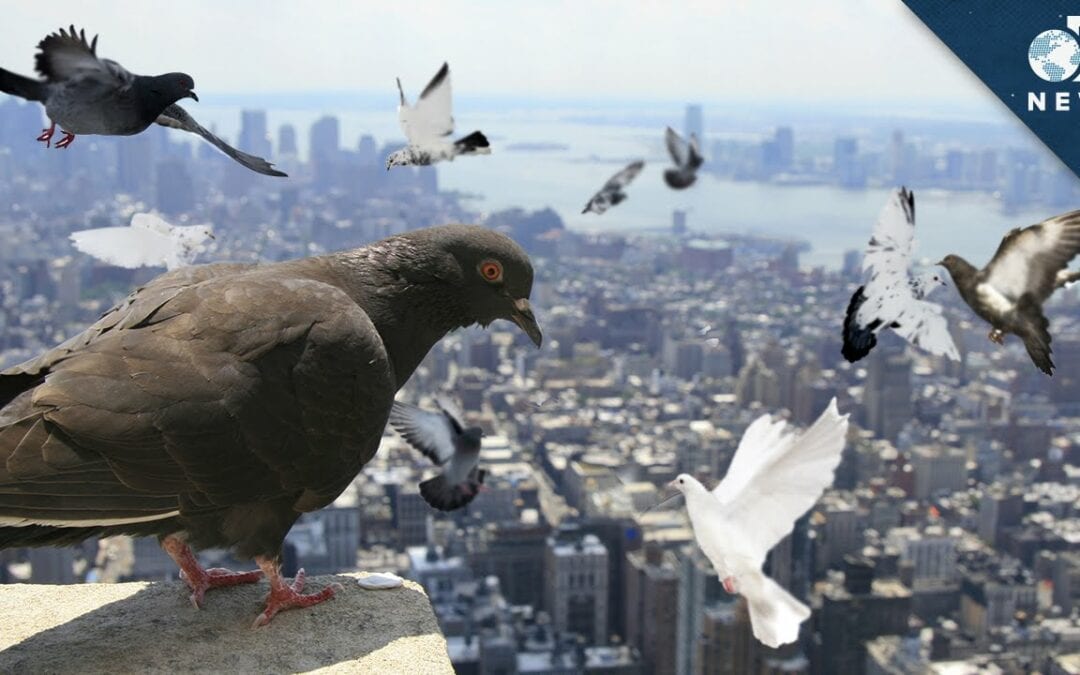
In urbanized areas, pigeons are part of the daily life of city dwellers. We see them strolling on the sidewalks without fear of passers-by and cooing under bridges over passing cars. As such, the pigeon is not really a problematic bird species, but when perched, it can release an impressive amount of droppings on anything below. If you are facing this problem, whether inside or outside your home and want to deal with it, here’s how to clean up pigeon droppings.
Preliminary measures before cleaning pigeon droppings
Cleaning pigeon droppings involves removing the guano from the outside or inside of a building after the animal has been removed. Pigeon droppings are generally not harmful to health, except in extreme cases. On the other hand, they can strongly affect the appearance of a building, cause odours and attract insects. Except in certain unusual situations, you can remove the pigeon droppings yourself, unless the extent of the problem is beyond your control or you are experiencing breathing problems. At such times, it may be appropriate to hire the services of a residential exterminator.
Working on an apartment or condo balcony? Our balcony pigeon-dropping cleanup guide covers concrete and other finishes, controlling runoff and preventing repeat buildup.
Whether the pigeon droppings to be cleaned are on the front of your building or in your attic, the same process can be used. But before you rush to buy products or start cleaning the area, a health and safety risk assessment is essential, especially if the work will be done at height.
It is also recommended to take certain preliminary measures. A face mask, disposable coveralls and rubber gloves must be worn at all times, as well as safety glasses and a good pair of boots.
Products used to kill bacteria in pigeon droppings
There are many cleaning products developed especially for bird droppings. First, there are disinfectants, designed to kill bacteria and organisms, and simple cleaning agents, which, as their name suggests, are simply designed to clean. In most cases, a bucket of hot soapy water containing a little household detergent is a simple but ideal cleaning solution.
Cleaning pigeon droppings is no different from any other thorough cleaning work. With the right equipment, the work will be done quickly. To remove the guano on window sills and the like, a scraper is all you need to remove it. Moisten overly dry guano to soften it before removing it and reduce the amount of dust thrown into the air. Once all pigeon droppings have been scraped and removed from the surface, simply wash the area with a brush and the cleaning solution mentioned above.
What should be done with the excrement next? Small quantities of pigeon guano can be safely disposed of in a domestic or commercial waste bin.
When pigeon droppings become too overwhelming
Urban life means living with a host of animal species, including pigeons. Although this bird is not a threat to human health, the droppings it produces are never desirable, either outside or inside a building. Fortunately, with the right equipment, it is quite easy to remove pigeon droppings.
Source
Pigeon Patrol Products & Services is the leading manufacturer and distributor of bird deterrent (control) products in Canada. Pigeon Patrol products have solved pest bird problems in industrial, commercial, and residential settings since 2000, by using safe and humane bird deterrents with only bird and animal friendly solutions. At Pigeon Patrol, we manufacture and offer a variety of bird deterrents, ranging from Ultra-flex Bird Spikes with UV protection, Bird Netting, 4-S Bird Gel and the best Ultrasonic and audible sound devices on the market today.
Voted Best Canadian wholesaler for Bird Deterrent products ten years in a row.
Contact us at 1- 877– 4– NO-BIRD, (604) 585-9279 or visit our website at www.pigeonpatrol.ca
Pigeon/Pigeon Patrol / Pigeons Roosting / Vancouver Pigeon Control /Bird Spikes / Bird Control / Bird Deterrent / Pigeon Deterrent? Surrey Pigeon Control / Pest /Seagull deterrent / Vancouver Pigeon Blog / Birds Inside Home / Pigeons in the cities / Ice Pigeons/ What to do about pigeons/ sparrows , Damage by Sparrows, How To Keep Raccoons Away, Why Are Raccoons Considered Pests/ De-fence / Pigeon Nesting/ Bird Droppings / Pigeon Dropping/ woodpecker control/ Professional Bird Control Company/ Keep The Birds Away/ Birds/rats/ seagull/pigeon/woodpecker/ dove/sparrow/pidgeon control/pidgeon problem/ pidgeon control/flying rats/ pigeon Problems/ bird netting/bird gel/bird spray/bird nails/ bird guard
by Pigeon Patrol | Dec 24, 2021 | history of pigeons, MBCA, pet bird, Pigeon Control, Pigeon Droppings, Pigeon Patrol's Services
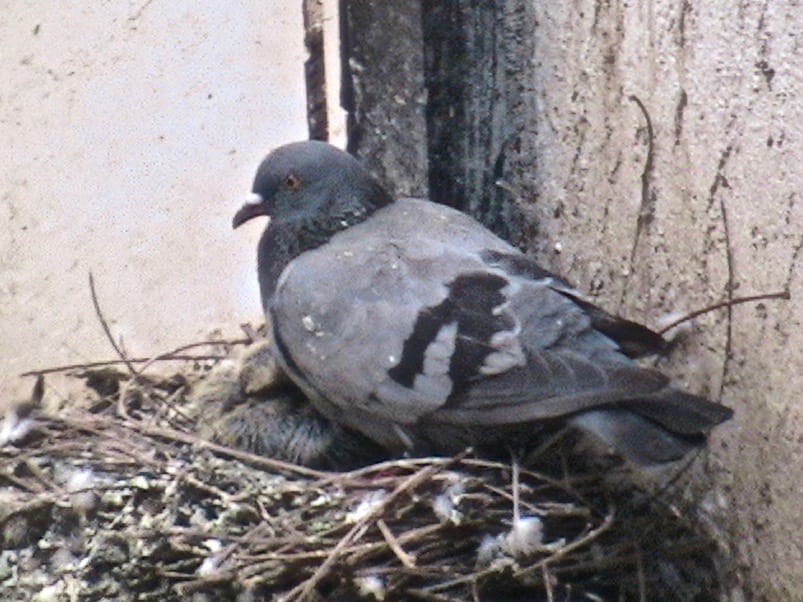
In January 2019, a child died in a Scottish hospital after developing a fungal infection caused by exposure to pigeon droppings. An elderly patient also died in the same hospital of another condition that was exacerbated by exposure to pigeon droppings. It was determined that both patients were exposed to the contaminants via the ventilation system, which was found to contain pigeon droppings. These deaths brought to the forefront a question that many people who are living with pigeon infestations have: in addition to being disruptive, are pigeons actually dangerous? Here are the facts you need to know.
Pigeon droppings contain bacteria and fungi that can cause disease.
Exposure to pigeon droppings can lead to a number of different diseases. Some of the most common infections associated with pigeons are:
· E. coli: E. coli infections are usually the result of pigeon droppings being present in water or in food that is later consumed. This infection causes nausea, abdominal cramps, fever, and vomiting.
· Histoplasmosis: This is a dangerous fungal infection that affects the lungs, or rarely, other parts of the body. It causes flu-like symptoms, including fever, shortness of breath, chest pain, fatigue, and loss of appetite. It can be fatal in severe cases.
· Cryptococcus: This is another fungal infection that affects the lungs and can spread to the brain. In its early stages, it can cause a cough, chest pain, fever, and shortness of breath. When it spreads to the lungs, it causes headaches, neck pain, changes in behavior, confusion, and sensitivity to light. It can also be fatal.
· Psittacosis: Psittacosis is a bacterial infection that causes fever, headaches, a rash, and can lead to pneumonia, if left untreated.
· Candidiasis: This fungal infection can affect multiple parts of the body, including the mouth, lungs, urogenital tract, and skin. This infection may require prolonged periods of antifungal medications to treat.
· Salmonellosis: Pigeon droppings may contain the bacteria salmonella, which can cause this infection. Typically, people are exposed to these bacteria when pigeon droppings come into contact with food or food preparation surfaces. This infection causes nausea, vomiting, and abdominal cramps.
Pigeons also carry other potential health risks.
It is not just the droppings of pigeons that are dangerous. Pigeons themselves can carry mites and fleas, which can then attach to your pets or enter your home, causing skin irritation and itchiness. They can also spread infections through bites that are dangerous to both people and pets.
Pigeons can also carry West Nile virus. Although people are unlikely to contract West Nile virus directly from pigeons, it is still important to avoid removing any dead pigeons from your property without the help of a professional for this reason.
People with weakened immune systems are most at risk.
The infections that pigeons are likely to transmit do not affect everyone at the same rate. Many healthy adults are able to fight off infections caused by exposure to bacteria and fungi from pigeon droppings. If they do become ill, then they are likely to have very mild infections.
However, although it is always possible for someone who is healthy to become very ill from these conditions, other people are more at risk. Infants and children are more likely to experience severe symptoms when they are exposed to a disease via pigeon droppings. People who are immuno-compromised, such as people with HIV or who are undergoing chemotherapy, also have a higher risk of developing severe symptoms and complications. Lastly, the elderly are prone to severe symptoms from pigeon-related diseases.
Even without exposure to a disease, some people may have allergy symptoms, including respiratory problems, rashes, and itchiness, as a result of a pigeon infestation near their home or business.
For safety reasons, only professionals should handle pigeon control.
If you have a pigeon infestation, it’s important to deal with the issue as soon as possible. However, trying to get rid of pigeons and clean up their droppings on your own is not safe. Pigeon control professionals are trained in safe management techniques and have the proper equipment required to clean up after a pigeon infestation safely.
One of the biggest risks of cleaning up pigeon droppings on your own is that you could release dust into the air that contains bacteria and fungi that cause infection. Not only would you be at risk from inhaling the bacteria and fungi yourself, but you could also inadvertently introduce the contaminants into the HVAC system in your home, allowing them to spread into your indoor air and putting your family at risk.
Source
Pigeon Patrol Products & Services is the leading manufacturer and distributor of bird deterrent (control) products in Canada. Pigeon Patrol products have solved pest bird problems in industrial, commercial, and residential settings since 2000, by using safe and humane bird deterrents with only bird and animal friendly solutions. At Pigeon Patrol, we manufacture and offer a variety of bird deterrents, ranging from Ultra-flex Bird Spikes with UV protection, Bird Netting, 4-S Bird Gel and the best Ultrasonic and audible sound devices on the market today.
Voted Best Canadian wholesaler for Bird Deterrent products ten years in a row.
Contact us at 1- 877– 4– NO-BIRD, (604) 585-9279 or visit our website at www.pigeonpatrol.ca
Pigeon/Pigeon Patrol / Pigeons Roosting / Vancouver Pigeon Control /Bird Spikes / Bird Control / Bird Deterrent / Pigeon Deterrent? Surrey Pigeon Control / Pest /Seagull deterrent / Vancouver Pigeon Blog / Birds Inside Home / Pigeons in the cities / Ice Pigeons/ What to do about pigeons/ sparrows , Damage by Sparrows, How To Keep Raccoons Away, Why Are Raccoons Considered Pests/ De-fence / Pigeon Nesting/ Bird Droppings / Pigeon Dropping/ woodpecker control/ Professional Bird Control Company/ Keep The Birds Away/ Birds/rats/ seagull/pigeon/woodpecker/ dove/sparrow/pidgeon control/pidgeon problem/ pidgeon control/flying rats/ pigeon Problems/ bird netting/bird gel/bird spray/bird nails/ bird guard
by Pigeon Patrol | Dec 16, 2021 | history of pigeons, MBCA, pet bird, Pigeon Control, Pigeon Droppings, Pigeon Patrol's Services, Pigeon Predators
When the leader of a flock goes the wrong way, what will the flock do?
With human beings, nobody can be sure. But with homing pigeons, the answer is that they find their way home anyway.
Either the lead pigeon recognizes that it has no clue and falls back into the flock, letting birds that know where they are going take over, or the flock collectively decides that the direction that it is taking just doesn’t feel right, and it doesn’t follow.
Several European scientists report these findings in a stirring report in Biology Letters titled, “Misinformed Leaders Lose Influence Over Pigeon Flocks.”
Isobel Watts, a doctoral student in zoology at Oxford, conducted the study with her advisers, Theresa Burt de Perera and Dora Biro, and with the participation of Mate Nagy, a statistical physicist from Hungary, who is affiliated with several institutions, including Oxford and the Hungarian Academy of Sciences.
Dr. Biro, who studies social behavior in primates as well as pigeons, said that the common questions that ran through her work were “about group living and what types of challenges and opportunities it brings.”
She and her colleagues at Oxford have pioneered a method of studying flock behavior that uses very-fine-resolution GPS units, which the birds wear in pigeon-size backpacks.
The devices record a detailed position for each bird a number of times a second. Researchers in Budapest and Oxford developed software to analyze small movements and responses of every bird in a flock.
With this method, the scientists can identify which pigeons are leading the way. They can build a picture of how each bird responds to changes in the flight of other birds.
The consistent leaders were often fast fliers and occupied the first position in the group of flying birds. Other birds followed them.
But what if one day, a leader flew in the wrong direction?
The researchers arranged to feed the leaders misinformation by putting them in lofts with artificial light for a few days. By shifting when the lights went on and off, compared with the actual external schedule of light and dark, the researchers could shift the pigeons’ internal clocks a few hours forward or back.
Pigeons navigate by using the position of the sun and an internal clock, so the change in the clock threw off their sense of direction and they didn’t fly toward home at all.
But the pigeon flock corrected its flight path, and went the right way.
Dr. Biro doesn’t know exactly how they corrected. The followers all had the right information, so they might have collectively said, “this guy’s wrong, let’s not follow him,” Dr. Biro said.
“Or, the leader said, ‘Something’s wrong here,’” and fell back into the flock, “effectively choosing not to lead,” Dr. Biro said, and another pigeon, that knew the time of day, led the way.
Sadly, these kinds of decisions by pigeon flocks offer no reassurance to humans who think political leaders are misinformed or misdirected.
The pigeons don’t communicate directly about where they are flying. The flock changes its flight path because of split-second reactions to position changes by other birds. There’s no decision-making process remotely similar to, say, an election.
But knowledge of how the pigeons work might be useful in creating swarms of small robots for activities like search and rescue. If researchers can reduce the decision-making process of a flock to a few simple rules about who follows whom, and when, those rules might be applied to robot groups.
Then the group of robots might be able to make some of its own decisions, at least about where to go or how to get there.
Source
Pigeon Patrol Products & Services is the leading manufacturer and distributor of bird deterrent (control) products in Canada. Pigeon Patrol products have solved pest bird problems in industrial, commercial, and residential settings since 2000, by using safe and humane bird deterrents with only bird and animal friendly solutions. At Pigeon Patrol, we manufacture and offer a variety of bird deterrents, ranging from Ultra-flex Bird Spikes with UV protection, Bird Netting, 4-S Bird Gel and the best Ultrasonic and audible sound devices on the market today.
Voted Best Canadian wholesaler for Bird Deterrent products ten years in a row.
Contact us at 1- 877– 4– NO-BIRD, (604) 585-9279 or visit our website at www.pigeonpatrol.ca
Pigeon/Pigeon Patrol / Pigeons Roosting / Vancouver Pigeon Control /Bird Spikes / Bird Control / Bird Deterrent / Pigeon Deterrent? Surrey Pigeon Control / Pest /Seagull deterrent / Vancouver Pigeon Blog / Birds Inside Home / Pigeons in the cities / Ice Pigeons/ What to do about pigeons/ sparrows , Damage by Sparrows, How To Keep Raccoons Away, Why Are Raccoons Considered Pests/ De-fence / Pigeon Nesting/ Bird Droppings / Pigeon Dropping/ woodpecker control/ Professional Bird Control Company/ Keep The Birds Away/ Birds/rats/ seagull/pigeon/woodpecker/ dove/sparrow/pidgeon control/pidgeon problem/ pidgeon control/flying rats/ pigeon Problems/ bird netting/bird gel/bird spray/bird nails/ bird guard
by Pigeon Patrol | Dec 16, 2021 | 4-S Gel Bird repellent, Animal Deterrent Products, Bird Deterrent Products, Bird Law, Bird Netting, Bird Spikes, Columbidae, Doves, history of pigeons
Many birds travel in flocks, sometimes migrating over thousands of miles. But how do the birds decide who will lead the way? Researchers reporting in the Cell Press journal Current Biology on November 25 now have some new insight based on studies in homing pigeons. For pigeons, it seems, leadership is largely a question of speed.
“This changes our understanding of how the flocks are structured and why flocks of this species have consistent leadership hierarchies,” says Dora Biro of the University of Oxford.
Previous studies had shown that flock leadership is unrelated to social dominance. Giving followers extra training flights doesn’t promote them to a position of leadership, either. The new findings offer an elegantly simple explanation for the phenomenon of leadership in birds, with important implications for how spatial knowledge is generated and retained in navigating flocks.
While many birds travel in flocks, homing pigeons are domestic and more easily studied than most. “We can control the composition of the flocks and the starting points for their homeward journeys,” says Benjamin Pettit, the first author of the new study. “We also have a good understanding of their individual spatial cognition, in particular how their homing routes develop over repeated flights in the same area.”
Recent developments in sensor technology also make it possible to explore with exquisite precision how pigeon flocks are coordinated. The latest GPS loggers allow the researchers to track not only the birds’ overall routes, but also the sub-second time delays with which they react to each other while flying as a flock.
In the new study, the researchers compared pigeons’ relative influence over flock direction to their solo flight characteristics. Their studies showed that a pigeon’s degree of leadership could be predicted by its speed in earlier flights.
In solo flights, leaders were no better than followers in forging a straight path. In other words, they didn’t excel in navigation ability, at least not at first. When the researchers tested the birds individually after a series of flock flights, however, they found that leaders had learned straighter homing routes than followers.
“Some birds are naturally faster and consistently get to the front, where they end up doing more of the navigation, which means on future flights they know the way better,” Biro says. “You can compare this to a ‘passenger-driver’-like effect: drivers in a car have to pay attention while passengers are often unable to recall the route they were driven along, especially if they remained passive in the navigation process.”
While it’s often tempting to take an anthropocentric view of leadership, the findings come as a reminder that leadership can arise as an unavoidable consequence of individual differences within a population. A very simple, self-organizing mechanism–such as that based on variation in speed–is sufficient for leadership to arise. In addition, the new findings offer a mechanism through which leaders can improve in their roles over time, making increasingly better decisions that others can follow.
“Our findings broaden the range of species and situations in which we would expect to see leadership and explain how leadership and competence can naturally come to correlate,” Pettit says.
Source
Pigeon Patrol Products & Services is the leading manufacturer and distributor of bird deterrent (control) products in Canada. Pigeon Patrol products have solved pest bird problems in industrial, commercial, and residential settings since 2000, by using safe and humane bird deterrents with only bird and animal friendly solutions. At Pigeon Patrol, we manufacture and offer a variety of bird deterrents, ranging from Ultra-flex Bird Spikes with UV protection, Bird Netting, 4-S Bird Gel and the best Ultrasonic and audible sound devices on the market today.
Voted Best Canadian wholesaler for Bird Deterrent products ten years in a row.
Contact us at 1- 877– 4– NO-BIRD, (604) 585-9279 or visit our website at www.pigeonpatrol.ca
Pigeon/Pigeon Patrol / Pigeons Roosting / Vancouver Pigeon Control /Bird Spikes / Bird Control / Bird Deterrent / Pigeon Deterrent? Surrey Pigeon Control / Pest /Seagull deterrent / Vancouver Pigeon Blog / Birds Inside Home / Pigeons in the cities / Ice Pigeons/ What to do about pigeons/ sparrows , Damage by Sparrows, How To Keep Raccoons Away, Why Are Raccoons Considered Pests/ De-fence / Pigeon Nesting/ Bird Droppings / Pigeon Dropping/ woodpecker control/ Professional Bird Control Company/ Keep The Birds Away/ Birds/rats/ seagull/pigeon/woodpecker/ dove/sparrow/pidgeon control/pidgeon problem/ pidgeon control/flying rats/ pigeon Problems/ bird netting/bird gel/bird spray/bird nails/ bird guard