Dear Porky,
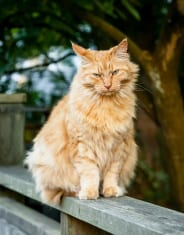
My two cats, George, age 7, and Elaine, age 2, mostly get along great.
I adopted Elaine a year ago to keep George company.
But every once in a while, for reasons that are not at all obvious to me, they will start hissing at each other, sometimes swatting, and then stalk away in a huff.
They haven’t hurt each other yet, but it worries me. What should I do?
Sally
Dear Sally,
Just maybe they’re getting cranky because you ignore them while you watch endless reruns on the TV.
Just sayin’.
No seriously, cats have occasional disagreements.
They can be, you know, “catty.”
Their behavior may include hissing, spitting, swatting or chasing. If cats occasionally hiss and swat and don’t cause injury, or if they take turns doing the chasing, not to worry.
Play aggression is not a cause for alarm.
But major altercations can become serious and should not be tolerated.
Howling, yowling, flattened ears, dilated pupils, raised hackles, arched back and puffy hair are indications that a battle is on the horizon; so, you need to intervene before they get to that stage.
Staring at each other with a twitching tail is an early warning sign.
Cat-to-cat aggression is one of the major behavior problems experienced by cat owners.
If cats have unresolved issues with one another, they may injure each other, spray your house to mark territory, become lethargic, hide, refuse to eat and subsequently lose weight, experience stress and fear and even become sick.
It doesn’t sound like you have a serious problem yet, but there are steps you can take to minimize the chances that it will become serious.
Basically, you can create an environment that promotes harmony between George and Elaine rather than one in which they have to compete for resources.
Provide more than one litter box in more than one location, and let them decide for themselves which to use.
Providing a food dish for each cat or feeding stations at multiple locations can help reduce competition for food.
Multi-level cat trees or shelves make use of vertical space within the home and give cats optional places to hang out.
The more opportunity for cats to have their own spots, the better.
And it goes without saying that your cats should be neutered.
They have enough things to argue with each other about without adding sex to the mix.
If George and Elaine begin what appears to be a serious fight, interrupt them.
Make an obnoxious loud noise by shaking a jar of pennies, snapping your fingers, or clapping your hands.
If that doesn’t work, blast them with a stream of water or throw a blanket over them.
Once they stop fighting, separate them and reintroduce them gradually, even if they have lived together for some time.
Make sure they are settled before putting them together again.
Never ever try to separate fighting cats with your hands! It could result in injury to your hands, face or other parts of your body.
If you are bitten by a cat seek medical attention right away as cat bites are unusually infectious.
The Oswego County Humane Society provides spay/neuter services and assistance, fostering and adoption of animals in urgent need, humane education programs, and information and referrals to animal lovers throughout Oswego County.
About Pigeon Patrol:
Pigeon Patrol Products & Services is the leading manufacturer and distributor of bird deterrent (control) products in Canada. Pigeon Patrol products have solved pest bird problems in industrial, commercial, and residential settings since 2000, by using safe and humane bird deterrents with only bird and animal friendly solutions. At Pigeon Patrol, we manufacture and offer a variety of bird deterrents, ranging from Ultra-flex Bird Spikes with UV protection, Bird Netting, 4-S Gel and the best Ultrasonic and audible sound devices on the market today.
Voted Best Canadian wholesaler for Bird Deterrent products four years in a row.
A PLYMOUTH man says his day was ruined when an army of more than 100 seagulls and pigeons suddenly swarmed on his car and started pooing all over it.
Arnold Barnes said he was enjoying a visit to Devils Point with his wife when the incident happened.
Mr Barnes, from Crownhill, blames two women who brought carrier bags full of food to feed the hungry birds.
He said “at least 100 seagulls and pigeons” immediately flocked to the shoreline and pooed on cars so badly that some motorists sped off to avoid them.
About Pigeon Patrol:
Pigeon Patrol Products & Services is the leading manufacturer and distributor of bird deterrent (control) products in Canada. Pigeon Patrol products have solved pest bird problems in industrial, commercial, and residential settings since 2000, by using safe and humane bird deterrents with only bird and animal friendly solutions. At Pigeon Patrol, we manufacture and offer a variety of bird deterrents, ranging from Ultra-flex Bird Spikes with UV protection, Bird Netting, 4-S Gel and the best Ultrasonic and audible sound devices on the market today.
Voted Best Canadian wholesaler for Bird Deterrent products four years in a row.
Downtown Chicago, where I spend most of my time, has beggars on nearly every corner.
Many of them have regular perches, like fishermen with favorite spots. Others, more creative – and usually more crafty – seem to wander around instead. But except for the licensed sellers of Streetwise and a truly unfortunate few, most of them are hustlers.
The legless Viet Nam veteran whose bare stumps stick out beneath his shorts as he sits, head hung in discouragement, at the corner of Adams and LaSalle Streets is truly unfortunate, a man who gave his legs for a country that turned its back on him when he came home from an unpopular war.
So is the rather lively but elderly fellow who stands outside the Walgreen’s at 200 West Adams Street cheerily chirping “have a nice day’ to all who pass, hoping without asking that someone will slip him a few bucks to help him through the day. It seems likely he is mentally challenged.
But most of the rest I encounter are frauds and tricksters.
Take, for example (please!) the ubiquitous white college-age beggars who prop themselves against lampposts with hand-lettered “homeless” signs while drinking their morning Starbuck’s coffees and reading their Kierkegaard and Karl Marx. If they’re not college students raising beer money or leftovers from the last Lollapalooza, Grateful Dead concert, or “Occupy” protest then I’ll eat the “School of the Art Institute” T-shirts right off their backs.
Some panhandlers are quite creative, even entertaining. A roving trickster most often seen in the vicinity of South Michigan Avenue does quite a good Shakespeare rendition while greeting potential victims with a flourish and a “Greetings, kind sir! Prithee, may I have word with you?”
Perhaps my favorite, for their brazenness and gall, are those who approach with the desperate plea: “I don’t want your money; may I please just ask you a question?” “Sure, what’s your question?” “May I please have some money?” No, you may not.
I’ve been taken in more than a few times, though, because I’m what you might deride as a “compassionate” conservative. Although I truly believe that it’s better to teach someone how to fish than simply to give him one, I’ll sometimes give a hungry person a fish nonetheless. Almost always I regret it later. For the more elaborate the story, the more likely it isn’t true.
A young, tall African-American clad in red and white basketball warm-ups and size sixteen shoes approached me one cold, dark Christmas Eve, tears streaming down his obviously distressed face. “What’s wrong with people in this town?” he lamented. “Everybody sees a seven foot tall black man approaching them and they run away.” I didn’t.
His spiel was that he’d missed the University of Oklahoma basketball team bus back to Norman after a game in Chicago and needed $85.00 to get home for the holidays. Of course, he would repay me once he got there. He was tall enough and wearing the right colors, but when I tried to flag down a passing police cruiser to help out, he bolted. According to that evening’s sports roundup, the Oklahoma Sooners were playing in the Chaminade Classic in Honolulu , 4246 miles away from Chicago.
Another supposed college student, an agitated young white man, insisted one Labor Day weekend evening that his wallet had been stolen when he fell asleep on the CTA. He, too, needed cash to get home, in this case for a train to South Bend to meet his father who would drive him back to Indiana University. He even had a police report documenting the supposed robbery.
I left him with the doorman in my building lobby while I called the local precinct, which verified that a person by that name had indeed filed such a report. A quick Internet search revealed an IU student by that name. Still, I knew almost immediately that I’d been taken from the look in his eyes and the speed with which he fled when he grabbed the $70.00 from my hands. A week or so later a Chicago Tribune columnist wrote about having been taken in by the exact same scam.
I could tell you about the pregnant woman and her husband who’d been burned out of their home (he had scorch marks on his had to prove it) for whom I bought $60.00 worth of groceries, the fellow with the scar on his forearm just out of prison who took me for $40.00 for the magazine subscriptions that never arrived, or the kid with the fake UNICEF ID who scowled when I gave him a check (which never cleared) instead of cash when he came collecting door-to-door. I could even tell you about the construction worker who needed fifty or sixty bucks to get home because his truck had blown its starter – three nights in a row – but I won’t.
Just don’t feed the pigeons when you come to Chicago, especially if they’ve got a story to sell. You might just turn out to be one.
About Pigeon Patrol:
Pigeon Patrol Products & Services is the leading manufacturer and distributor of bird deterrent (control) products in Canada. Pigeon Patrol products have solved pest bird problems in industrial, commercial, and residential settings since 2000, by using safe and humane bird deterrents with only bird and animal friendly solutions. At Pigeon Patrol, we manufacture and offer a variety of bird deterrents, ranging from Ultra-flex Bird Spikes with UV protection, Bird Netting, 4-S Gel and the best Ultrasonic and audible sound devices on the market today.
Voted Best Canadian wholesaler for Bird Deterrent products four years in a row.
It may sound like something from a 1960s B-film, but a project in North Yorkshire that uses lasers to deter pigeons is proving remarkably successful.
Gavin Milson, project technical assistant at Stockbridge Technology Centre, Cranfield University and high-tech GPS company Manterra reckon that using laser-based bird deterrents could be a cost-effective answer to dealing with the feathered fiends.
The equipment emits a strobing laser – akin to what you might find at a disco – which serves to scare off troublesome birds.
See also: Suffolk farmer battles pigeons with drones
In a Tru-Nject project – a high-tech study designed to investigate soil mapping and fertiliser application – had been set up to in late July this year, 165,000 pointed cabbage were transplanted at a North Yorkshire farm.
Normally the crop would be netted after transplanting, but the project team used a Dutch Agrilaser Autonomic laser, powered by a solar panel and deep-cycle gel battery.
Mr Milson is delighted with the outcome.
“This novel piece of technology appears to have effectively protected the cabbages.
“Its potential for bird control in field vegetables has generated significant interest and is threatening to emerge as a major, albeit unexpected, output from the project.
“Whilst light bird damage has been noted on selected plants in some isolated areas of the crop, complete loss of any individual plant to birds has not” Gavin Milson, Stockbridge Technology Centre
“Whilst light bird damage has been noted on selected plants in some isolated areas of the crop, complete loss of any individual plant to birds has not.
“Indeed, the vast majority of plants have received no unwanted attention from pigeons at all.”
The Tru-Nject team are now discussing plans to fully test the system in an oilseed rape crop later this year, comparing laser-protected crops to unprotected control crops.
It is hoped that this will provide even stronger evidence that the Agrilaser can function as a stand-alone option to manage bird damage in field crops.
About Pigeon Patrol:
Pigeon Patrol Products & Services is the leading manufacturer and distributor of bird deterrent (control) products in Canada. Pigeon Patrol products have solved pest bird problems in industrial, commercial, and residential settings since 2000, by using safe and humane bird deterrents with only bird and animal friendly solutions. At Pigeon Patrol, we manufacture and offer a variety of bird deterrents, ranging from Ultra-flex Bird Spikes with UV protection, Bird Netting, 4-S Gel and the best Ultrasonic and audible sound devices on the market today.
Voted Best Canadian wholesaler for Bird Deterrent products four years in a row.
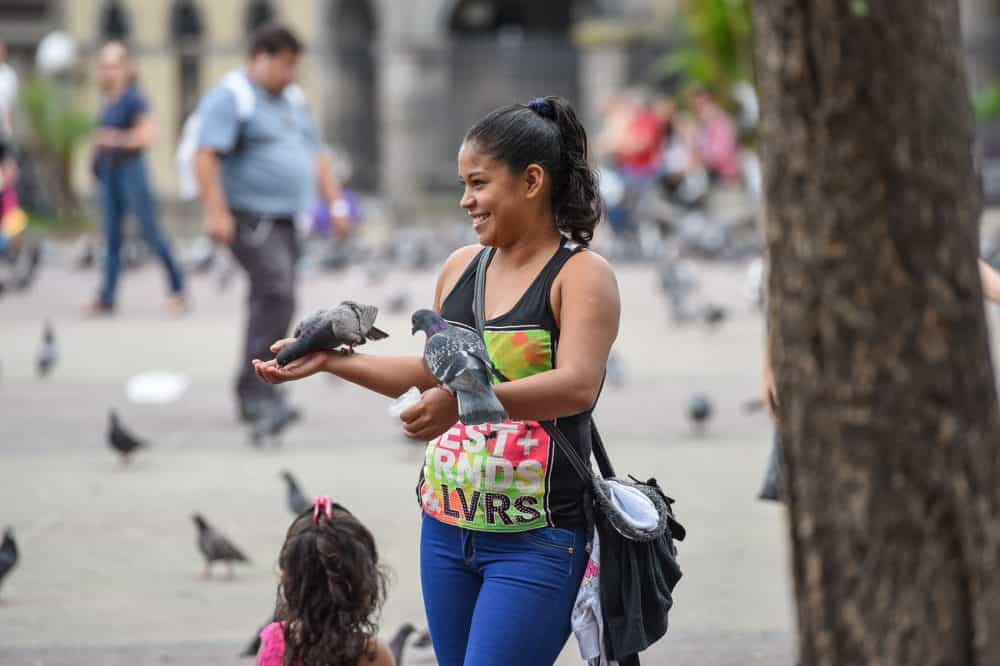
Large flocks of pigeons are part of San José’s daily landscape, and while pedestrians are mostly used to the scene, health officials say the local winged population is getting out of control. The Health Ministry recently ordered city officials to outline and implement plans to control the number of pigeons in public spaces, mostly in the capital’s downtown.
The feathers of common or feral pigeons (Columba livia) usually carry chlamydia as well as parasites that can be carriers of several other diseases. A 2012 study from the University of Basel, Switzerland, found pigeons can carry some 60 types of microorganisms associated with respiratory infections, as well as lung and brain damage.
Earlier this year, ministry experts conducted an inspection prompted by citizen complaints regarding a perceived increase in the number of pigeons in the capital’s parks, boulevards and other open spaces.
Inspections concluded that the high concentration of pigeons in those spaces is related to the large amount of waste from businesses in the area, and because people constantly feed them.
In April the Health Ministry ordered the Municipality of San José to take specific action to curb the increase in pigeon populations downtown. The ministry’s sanitary order called for an immediate ban on pigeon feed sold by street vendors. It requested that Municipal Police confiscate feed when found.
The ministry also asked the city to draft a plan for removing pigeon droppings from sidewalks and parks, and one for improving waste management in the area.
Public health problem
An investigation by the National University’s entomology lab concluded that people who spend time in San José’s public places with large pigeons populations are at risk.
Between 2012 and 2013, UNA experts collected samples of pigeon droppings at four of the capital’s locations where the largest populations are found: Plaza de la Cultura, Plaza de las Garantías Sociales, Parque Morazán and Parque Guadalupe, in northeast San José.
Among their findings UNA researchers found organisms that can be passed to humans, mostly salmonella, usually known as a food poisoning, and chlamydia, mostly known as a sexually-transmitted disease. In fact, chlamydia can be spread from bird to human through particles on the bird, in the bird’s poop or in the air.
The Health Minister at the time, María Luisa Avila Agüero, said that pigeons in these public places also carry two other diseases that can affect humans: toxoplasmosis andhistoplasmosis. According to the U.S. Centers for Disease Control and Prevention, toxoplasmosis is particularly dangerous for pregnant women, as an infection during the early months of pregnancy may result in serious consequences, including abortion, congenital malformations, hydrocephalus, blindness, deafness and intellectual disability. An infection in late pregnancy may result in a child born apparently in health conditions, but years later the child can develop visual disorders that can produce total blindness.
The National Theater, a San José arquitectural landmark, is one of the pigeons’ favorite buildings.
Alberto Font/The Tico Times
Damage to architectural heritage
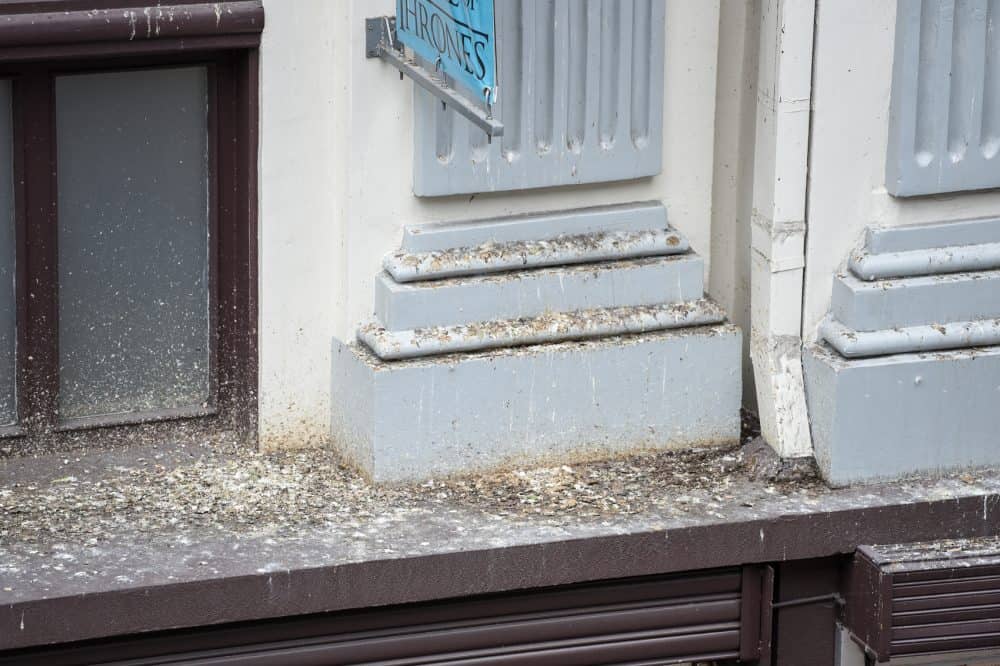
Besides serious health concerns, citizens have requested the removal of pigeons from downtown San José because of the damage pigeon poop causes to buildings, including historic structures such as the National Theater, Melico Salazar Theater, Knor building (on Central Avenue), the Metropolitan Cathedral and La Merced Church, among others.
William Monge Quesada, director of the Culture Ministry’s Center for Conservation of Cultural Heritage, said that in recent years several strategies to address the problem have been unsuccessful.
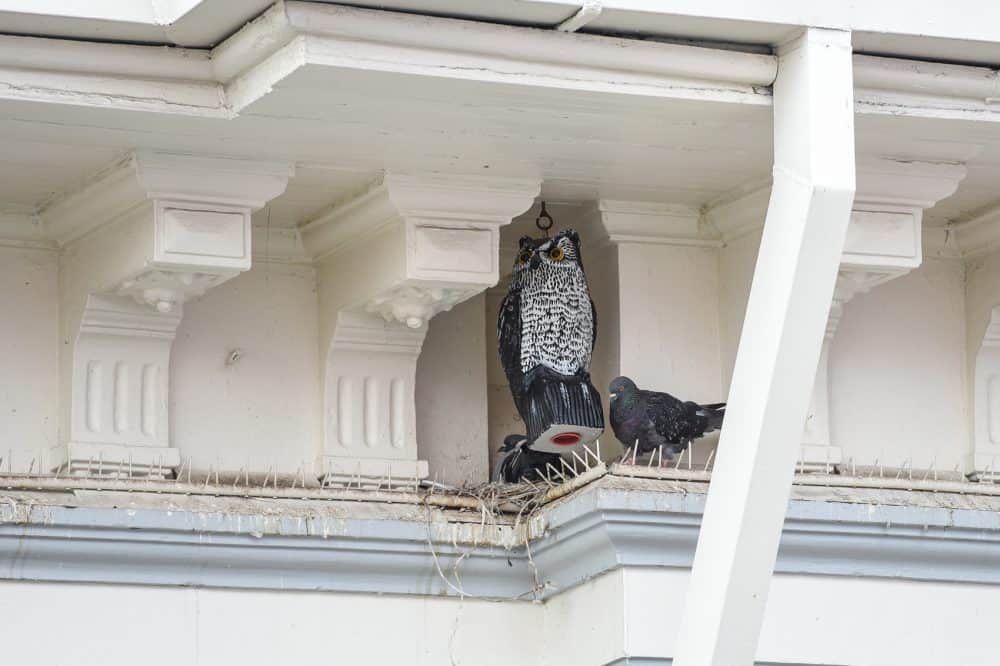
He said city officials had tried many things, from placing metal mesh on cornices, fake owls to scare pigeons, and even ultrasonic systems that imitate pigeon predators. “Scare tactics worked at first but pigeons got used to them pretty soon,” he said.
Monge, an architect who previously worked at the National Theater, said metal mesh worked well but was an expensive solution. Also, at certain times of the year parakeets make holes that pigeons use to enter the ceilings and nest there.
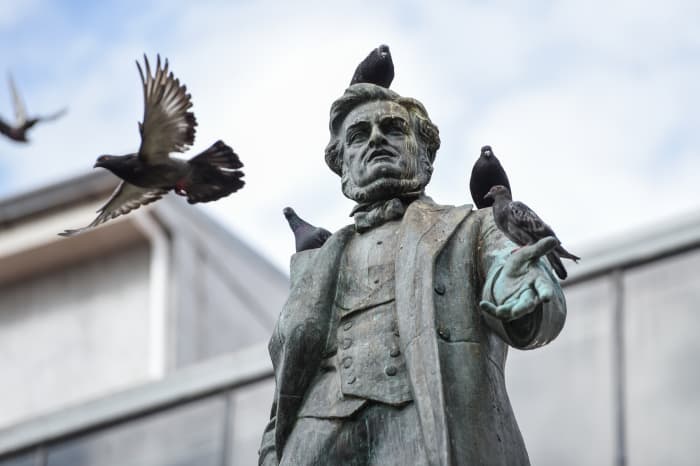
Pigeon droppings corrode rooftops and, as rain washes them, they also corrode cornices and walls. Monuments and statues around San José are also suffering damage, including that of four-time president Juan Mora Porras, located next to the Post Office building.
The statue of ex president Juan Mora Porras is covered in pigeon droppings.
Alberto Font/The Tico Times
Who’s in charge?
The city’s director of tourism Carmen Azofeifa Vindas said authorities have a plan involving relocating the pigeons outside of the capital and implementing a birth control program to reduce the population. The latter could involve adding contraceptives to the pigeons’ food, Azofeifa said.
The relocation plan currently doesn’t have a timetable. Municipal officials are carrying out an investigation to determine an appropriate location for relocating the birds.
City officials are also consulting with counterparts in other countries, mainly in Europe, where authorities have successfully controlled pigeon populations that also were damaging historic buildings and affecting public health, she said.
Municipal officials hope a timetable for the relocation and birth control plan might be ready as soon as next month. Azofeifa, however, believes the municipality likely will need specialized help to carry out the plan. Officials have asked for assistance — at the suggestion of the Health Ministry — from the National System of Conservation Areas (SINAC) and the National Animal Health Service (SENASA) but both agencies say the pigeon relocation problem is not within their responsibilities.
Coordinating with these and other agencies could prove difficult for the city.
SENASA told The Tico Times through its press office that wildlife is out of the agency’s jurisdiction.
SINAC’s wildlife manager Joaquín Calvo Domingo said the city should take the first steps to deal with the problem. He thinks municipal officials first need to improve waste collection and prevent people from feeding the pigeons.
“Once these situations are under control, SINAC might get involved in the next stage of the plan to control overpopulation,” Calvo said.
On the cultural side, officials at the Center for Conservation of Cultural Heritage have yet to draft plans to protect the capital’s historic buildings. William Monge took office a month ago following the dismissal of most of the Culture Ministry’s top officials as a result of thefailed organization of this year’s International Arts Festival.
“I’ve said we need to appoint a person who will be responsible for coordinating efforts with other agencies on this issue,” Monge said last week. He said that person would likely be chosen within a few months.
Pigeons are not scared of fake owls anymore. Metal devices placed to keep them away now support their nests.
Alberto Font/The Tico Times
People touch pigeons unaware that they can be carriers of diseases.
Alberto Font/The Tico Times
Pigeon droppings are damaging several historic buildings in San José.
Alberto Font/The Tico Times
Street vendors sell corn for feeding pigeons, in spite of a prohibition from the Health Ministry.
About Pigeon Patrol:
Pigeon Patrol Products & Services is the leading manufacturer and distributor of bird deterrent (control) products in Canada. Pigeon Patrol products have solved pest bird problems in industrial, commercial, and residential settings since 2000, by using safe and humane bird deterrents with only bird and animal friendly solutions. At Pigeon Patrol, we manufacture and offer a variety of bird deterrents, ranging from Ultra-flex Bird Spikes with UV protection, Bird Netting, 4-S Gel and the best Ultrasonic and audible sound devices on the market today.
Voted Best Canadian wholesaler for Bird Deterrent products four years in a row.
I was sitting in the High Street, outside M & S, waiting for Sue to finish buying up the whole store.
A chap came up and had a carrier bag of tit-bits for the pigeons.
They seemed to know him and flew down for a bit of lunch.
How healthy they looked with most of them still having their legs and toes.
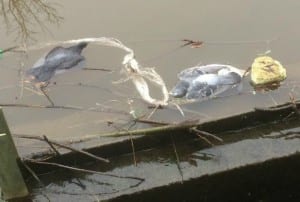
In London practically all the pigeons look tatty, have no feet or are dragging a leg because it was entwined with cotton, wire or some other form of ligature.
Previously I had been sitting, waiting for the train, on Marylebone Station.
A couple of pigeons were gleaning what they could on the concourse.
There it was.
One had a definite limp with cotton wrapped around its leg, a ligature almost severing the foot.
How could I ignore it?
I couldn’t.
I went into M & S and bought some biscuits.
The plan was to entice our pigeon to come within distance then I could pounce and grab.
Did this without any trouble. Then to untangle the cotton from its leg.
Bad mistake.
As I started to unwind it the leg started to bleed profusely.
From being a hero I had become a villain who made pigeons bleed.
I stemmed the bleeding with tissues and getting a box, once more in M & S, I took my bemused pigeon back to Tiggys where, once the cotton had been removed, the leg could be sutured back together.
The true endorsement of the pigeon that I witnessed was in St Mark’s Square in Venice.
The local council had banned the sale of pigeon food. I was in Venice where a group of tourists in wheelchairs were having a fabulous time feeding the pigeons. They were loving every minute of it.
Leave the pigeons be.
Somebody loves them.
About Pigeon Patrol:
Pigeon Patrol Products & Services is the leading manufacturer and distributor of bird deterrent (control) products in Canada. Pigeon Patrol products have solved pest bird problems in industrial, commercial, and residential settings since 2000, by using safe and humane bird deterrents with only bird and animal friendly solutions. At Pigeon Patrol, we manufacture and offer a variety of bird deterrents, ranging from Ultra-flex Bird Spikes with UV protection, Bird Netting, 4-S Gel and the best Ultrasonic and audible sound devices on the market today.
Voted Best Canadian wholesaler for Bird Deterrent products four years in a row.


 Dear Porky,
 Downtown Chicago, where I spend most of my time, has beggars on nearly every corner.
 It may sound like something from a 1960s B-film, but a project in North Yorkshire that uses lasers to deter pigeons is proving remarkably successful.
 Large flocks of pigeons are part of San José’s daily landscape, and while pedestrians are mostly used to the scene, health officials say the local winged population is getting out of control. The Health Ministry recently ordered city officials to outline and implement plans to control the number of pigeons in public spaces, mostly in the capital’s downtown.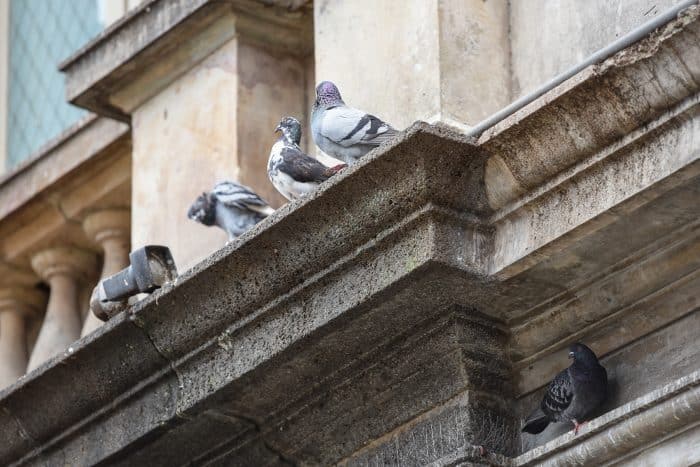

 I was sitting in the High Street, outside M & S, waiting for Sue to finish buying up the whole store.