by Pigeon Patrol | May 3, 2021 | history of pigeons, Pigeon Control, Pigeon Droppings, Pigeon Patrol's Services, Pigeons
There it was, that darned noise again.
Nobody could possibly be happy cleaning pigeon droppings. Yet Arno Penzias and Robert Wilson were being forced to do it. As good scientists they simply could not avoid it, since they had to discount the role of this “white dielectric substance” in the noise that was plaguing their equipment. When they finished with the cleaning and dispatched the pigeons by mail to a faraway place, the noise still did not disappear. And it seemed to come from all directions. The implications of this annoying constant background hum, corresponding to a temperature of only 3 degrees above absolute zero, signified one of the most momentous discoveries in twentieth-century physics, notable even among Nobel Prize-winning discoveries.

Arno Penzias, the German-born physicist who fled from the Nazis with his family in 1939, is at Lindau this year along with his co-recipient Robert Wilson. There are two other physics Nobel laureates this year at Lindau- George Smoot and John Mather. The four men whose work is separated by forty years share a very close connection. Smoot and Mather’s work put the capstone on that of Penzias and Wilson’s. In a way the work of these gentlemen eclipses the work of all Nobel laureates since it deals with something that happened long before any of the others made their discoveries. In fact, it was so long before that it dealt with the beginning of time itself…or so we think. Penzias and Wilson discovered what is called the”cosmic microwave background radiation”, which is nothing less than the notes from the harp that the universe played when it fired up. Just like you can guess the identity of the great conductor Herbert von Karajan from listening to the thundering notes of his performance of Beethoven’s 9th symphony, so can you discern the violent birth throes of the universe from the noise this cosmic cataclysm left behind.
It was noise, quite literally. And it was bothering Penzias and Wilson when they were working on a radio antenna inthe fall of 1964 in a small town called Holmdel in New Jersey. There, Bell Laboratories which owned the instrument had turned it over to Penzias and Wilson for pure science. That was a different age, when companies like BellLabs gave free rein to researchers to pursue their own ideas; in the ensuing decades the institution would produce a steady stream of Nobel laureates,an astonishing feat for an industrial laboratory. But at that point the lab was just getting warmed up.
The antenna was about twenty feet wide and shaped like a horn to minimize reception from the sides. It was originally designed to detect transmitted signals from Echo, the first communications satellite. But now Penzias and Wilson were using it to detect radio waves from celestial bodies. The receiver was tuned to detect only frequencies in the microwave region of the spectrum.
But there it was, that darned noise again. No matter what they did to the antenna, it was steadily humming in the background, like one of those overenthusiastic teenagers deliberately trying to annoy you. Like good scientists, Penzias and Wilson started to eliminate all possible sources of noise they could find. Radio noise could arise from any number of sources. It could come from the ground which was warmed up by the sun. It could arise from the earth’s atmosphere, or from the gas between the stars, or from the emission of molecules in outer space. Noise could be generated by waves bouncing off some of the sharp edges in their antenna. Oneby one the scientists investigated and discounted all these sources. They covered up the sharp edges with aluminum tape. They turned the antenna towards and away from major cities like New York. And of course, finally in desperation, they cleaned up waste from a family of pigeons that was roosting in a small part of the antenna horn. They dispatched these pigeons to the main offices of Bell Labs (like good homing pigeons the birds promptly showed up two days later). The noise still would not disappear. Like constant mumbling from disgruntled voters at a campaign speech, it simply would not die.
The two men were accomplished scientists and they did not doubt their own skills. Penzias had worked with Isidor Rabi (whom we met earlier) and Charles Townes, the inventor of the maser, at Columbia University. Wilson had gotten his PhD. at Caltech a few years ago. Their temperaments also complemented each other. Penzias was a big picture man, trying to tie together facts in an overarching thread. Wilson was much more detail-oriented and could patiently tinker with equipment until he got it right. Together the scientists were confident in their analysis and believed they had discarded all sources of noise. Yet it remained. For the moment they decided to take a break.
It was December of that year, and Penzias was coming back on an airplane from a conference. The “noise problem” was on his mind and he mentioned it to a fellow astronomer named Bernie Burke. A short time later, Burke called Penzias back with some interesting news. He had just seen a manuscript written by a physicist named Jim Peebles at Princeton University along with his supervisor Robert Dicke. The manuscript predicted that because of the intense heat during the birth of the universe, there should exist today a remnant of the Big Bang, which would manifest itself uniformly as steady background radiation. Because of the time elapsed since the Big Bang, the temperature of this radiation should be no more than afew degrees kelvin above absolute zero.
Oh yes, and it should be detectable as constant hiss in a good radio telescope.
I leave it to the students at this year’s Lindau meeting to personally ask Penzias what he must have felt when he heard about the Peebles-Dicke paper from Burke. But it surely must have sent his heart racing. Intrigued, Penzias called Dicke. Dicke’s heart must have raced even more because just then he had been trying to construct his own antenna to detect the cosmic noise that his paper predicted. Dicke promptly got into his car and drove the thirty miles or so from Princeton to check out Penzias and Wilson’s data. When he confirmed its authenticity, he must have felt an intense mix of excitement, amazement and chagrin. He had narrowly missed making the discovery that won Penzias and Wilson the Nobel Prize for physics in 1978.
Penzias and Wilson in front of the Holmdel radio antenna
Sounds from a faraway time
The evolution of the idea of the cosmic microwave background is almost a textbook study of ignorance and triumph, and how experimentalists and theoreticians can sometimes unintentionally delay progress by failing to communicate with one another. The Big Bang theory was proposed by Georges Lemaître, a Belgian Roman Catholic priest, although interestingly the term ‘Big Bang’ was pejoratively coined by a detractor of the theory, Fred Hoyle. Later the theory was developed by the brilliant and colorful Russian physicist, scotch lover and popular science writer George Gamow and his colleagues, Ralph Alpher and Robert Herman. After World War 2, Gamow’s colleagues Alpher and Herman predicted the cosmic microwave background. This was based on their ideas about nucleosynthesis- the formation of elements in the universe.
Robert Herman (left) and Ralph Alpher. In the middle is George Gamow, materializing out of a bottle of ‘Ylem’, the primordial soup from which our universe originated.
Big Bang Theory cosmology is based on Einstein’s theory of gravitation. In 1929 Edwin Hubble had already made the groundbreaking discovery that the universe seemed to be expanding. This meant that at some point back in time it must have been infinitely compressed. Compression means high temperature, in this case, a very high temperature of 10 billion degrees when the universe was only one second old. At this temperature matter as we know it ceases to exist, and the universe consists of a thick boiling broth of subatomic particles and electromagnetic radiation in the form of very high frequency gamma rays. Electromagnetic radiation is emitted and absorbed by all electrically charged particles. When there are a sufficient number of particles, this radiation manifests itself as black-body radiation. Black-body radiation can be defined by a certain value of energy at a given frequency range and thus can be completely fixed by the temperature. At ten billion degrees, there would be massive creation of electrons and positrons from the energy of other moving particles. But after one second, Big Bang theory physics predicts that if the number of photons is larger than the number of matter particles, then the initial black-body radiation will continue to be black-body radiation. The only change in this radiation is that it cools with the expansion of the universe. About 400,000 years after the beginning, an epochal event happened. Stable atoms of hydrogen began to form, and the radiation was ‘decoupled’ from the matter and was left free to wander on its own. Thus, even today, almost fifteen billion years later, space should be filled with black-body radiation left over from the Big Bang. Its temperature should be roughly 3 K.
This at least was what Alpher and Gamow conjectured. But they were not the first ones to think about it. In fact the microwave background had been indirectly observed in the late 1930s and early 40s by American astronomers. These astronomers saw faint signs of light absorption by certain molecules in outer space and concluded that the molecules were somehow being ‘pumped up’ with energy that came from a temperature of 2.3 K. Unfortunately, there was yet no theoretical framework in which this observation could fit, and it became part of the countless number of other details in astronomy. Now, when Gamow, Alpher and Herman formed their ideas, they did not know about this experimental work. Most incredibly, a couple of years later, two Russian physicists published a paper saying that not only should this background exist, but that the best detecting instrument for it would be the radio antenna in Holmdel, New Jersey! As if to cap this circus of ignorance and lack of communication, Penzias, Wilson and Dicke had all not heard of these earlier predictions; somehow unlike the cosmic background, the signal had been lost in the noise. One can only wonder how things would be if this drama were to be enacted today, in the era of the Internet and Email.
Dicke in fact thought he was the first one proposing the cosmic microwave background. His reasoning was fascinating and harkened back to analogies in Hindu and Buddhist philosophies about the creation of the universe. Dicke was a proponent of the ‘oscillating universe’ which posits that the universe has no end or beginning but cycles through time. According to his logic, if the heavy elements had been created through nucleosynthesis, they could not keep on increasing in proportion indefinitely; after all, the observed universe is largely contained of hydrogen and helium and not heavy elements. Thus, at some point the heavy elements would have to be annihilated to make room for the next batch of matter. This annihilation would produce radiation, and it’s this radiation that would manifest itself as the cosmic background. Dicke’s oscillating universe tome is a perfect example of a scientific ‘model’, a conceptual construction that retains some simple aspects of the universe but which can neatly explain a key observation. As with models, Dicke’s prediction of the microwave background does not uniquely depend on the oscillating universe model. In fact it arises perfectly from the modern day theory of the Big Bang.
Dicke was supremely competent for this kind of theorizing. Today he is the underappreciated man in the cosmic microwave background story. Dicke was a genius at electronic devices, working on important radar components at the famous Radiation Laboratory at MIT during the war. In the early 60s, he did a highly accurate measurement proving the equivalence of inertial mass and gravitational mass, a foundational concept of Einstein’s relativity. Dicke’s thirst was not slaked just by doing experiments. He also provided the first quantum theory of the laser. By the mid 60s Dicke was a legend, the Enrico Fermi of his time, highly accomplished in both theory and experiment. As it turned out though, even Dicke could not escape the vagaries of space and time. Robert Henry Dicke died in 1997.
Robert Henry Dicke (1916-1997)
In 1989, a satellite called COBE was launched by NASA that would measure Penzias and Wilson’s microwave background to unprecedented accuracy. Two of the principal scientists in this endeavor were George Smoot and John Mather who are at Lindau this year. The satellite’s measurements of the black body radiation curve were so remarkably accurate that the error bars in the curve which typically extend on top and bottom were almost lost in the signal.
The COBE satellite black-body radiation curve with the data points (red) plotted on the theoretical spectrum (black). The two match up almost perfectly
The COBE satellite followed by the Wilkinson Probe satellite launched in 2001 put the icing on the microwave background cake. The Big Bang theory has attained the status of one of our most highly refined and validated theories, thanks to the work of Smoot, Penzias, Wilson, Mather and many others. It seems only wonderfully fitting that Penzias, Wilson, Smoot and Mather are all attending this year’s meeting, coming full circle and neatly tying together the ends of a story spread over 40 years, which in turn tells the story of moments in time billions of years ago.
George Smoot and John Mather (Physics, 2006)
The story of the microwave background is an exercise in scientific history, demonstrating how ideas can, and sometimes do not, build on top of each other. It would have been interesting to see how the same story would have played out in today’s age, when the barriers to communication have been all but shattered by the availability of hundreds of years of research that can be accessed through the click of a mouse. Scientific ideas are hostage to the same qualities of human fallibility, determination, creativity, and of course, the uncertainties of space and time, as are other aspects of the human experiment. All we can do is persevere.
Pigeon Patrol Products & Services is the leading manufacturer and distributor of bird deterrent (control) products in Canada. Pigeon Patrol products have solved pest bird problems in industrial, commercial, and residential settings since 2000, by using safe and humane bird deterrents with only bird and animal friendly solutions. At Pigeon Patrol, we manufacture and offer a variety of bird deterrents, ranging from Ultra-flex Bird Spikes with UV protection, Bird Netting, 4-S Bird Gel and the best Ultrasonic and audible sound devices on the market today.
Voted Best Canadian wholesaler for Bird Deterrent products ten years in a row.
Contact us at 1- 877– 4– NO-BIRD, (604) 585-9279 or visit our website at www.pigeonpatrol.ca
Pigeon/Pigeon Patrol / Pigeons Roosting / Vancouver Pigeon Control /Bird Spikes / Bird Control / Bird Deterrent / Pigeon Deterrent? Surrey Pigeon Control / Pest /Seagull deterrent / Vancouver Pigeon Blog / Birds Inside Home / Pigeons in the cities / Ice Pigeons/ What to do about pigeons/ sparrows , Damage by Sparrows, How To Keep Raccoons Away, Why Are Raccoons Considered Pests/ De-fence / Pigeon Nesting/ Bird Droppings / Pigeon Dropping/ woodpecker control/ Professional Bird Control Company/ Keep The Birds Away/ Birds/rats/ seagull/pigeon/woodpecker/ dove/sparrow/pidgeon control/pidgeon problem/ pidgeon control/flying rats/ pigeon Problems/ bird netting/bird gel/bird spray/bird nails/ bird guard
by Pigeon Patrol | May 3, 2021 | Bird Law, Bird Spikes, history of pigeons, Pigeons, Pigeons in the News
I admit that topic is a bit off my usual
Brain Sense
beat, but occasionally a piece of research comes along that is just too intriguing to pass by. Such is the case with a new report out of the University of Kentucky, published this week in the
Proceedings of the Royal Society
(UK). The study’s lead author, psychology professor Thomas Zentall, studied some pigeon gamblers and came up with some intriguing insights into human gamblers.
Zentall and collaborator Jessica Stagner set pigeons up in cages and let the birds peck at lights to obtain rewards of food pellets. If the pigeons pecked on the left, they received a green or a red light; after 10 seconds, the red light yielded 10 pellets but the green light yielded nothing. Because the odds were stacked at 20 percent–which is much more generous than your average casino–the pigeons averaged 2 pellets per peck if they pecked on the left.
If they pecked to the right, however, they saw yellow or blue lights, which both yielded 3 pellets of food per trial. Same every time. Sure thing.
So which would you choose: a guaranteed 3 or the remote possibility of a 10 (with the odds stacked against you)? Seems most pigeons behave like human gamblers. They don’t go for the sure thing. Most of Zentall’s experimental birds consistently chose the left side, apparently motivated by some bird-brained hope that they would receive the 10 pellets, even though 0 was a 4:1 favorite. “It’s more efficient not to gamble, and the likelihood of winning is low, but pigeons do it anyway,” Zentall says. “And so do people.”
“There’s a basic behavioral, biological process involved that probably affects many different species, and it doesn’t require the excitement of a casino, the misunderstanding of the likelihood of winning, social reinforcement or the publicity of winners,” Zentall says. “These factors may help, but that’s not it. Look at the pigeons.”
Zentall is also looking at the pigeons to try to find out why some pigeons, like some people, eschew gambling. (Yes, a few, wise pigeons peck to the right.) “Most of the time, people who aren’t terribly happy with what they’re doing choose to gamble because it’s exciting to them and other things generally aren’t,” says Zentall, and pigeons may be no different. Zentall thinks boredom may be an important motivator for gambling. His pigeons are less likely to gamble after spending time in a room playing with toys and other pigeons.
“We can understand the basis for gambling,” Zentall says, “but why has this evolved in people and in animals?” The answer may lie in the animal’s sense of control. “In nature, probability isn’t constant,” he said. “Animals are attracted to stimuli that make it easy to predict the availability of food and approaching these stimuli often makes their occurrence more likely. In lab conditions, this isn’t the case. . . . In addition, humans remember the wins and not the losses, which has functional value in nature. . . . Animals too, don’t remember where they didn’t find food, but do remember where they did.”
Thus, gambling may have survival value in nature, but not in the casino.
Pigeon Patrol Products & Services is the leading manufacturer and distributor of bird deterrent (control) products in Canada. Pigeon Patrol products have solved pest bird problems in industrial, commercial, and residential settings since 2000, by using safe and humane bird deterrents with only bird and animal friendly solutions. At Pigeon Patrol, we manufacture and offer a variety of bird deterrents, ranging from Ultra-flex Bird Spikes with UV protection, Bird Netting, 4-S Bird Gel and the best Ultrasonic and audible sound devices on the market today.
Voted Best Canadian wholesaler for Bird Deterrent products ten years in a row.
Contact us at 1- 877– 4– NO-BIRD, (604) 585-9279 or visit our website at www.pigeonpatrol.ca
Pigeon/Pigeon Patrol / Pigeons Roosting / Vancouver Pigeon Control /Bird Spikes / Bird Control / Bird Deterrent / Pigeon Deterrent? Surrey Pigeon Control / Pest /Seagull deterrent / Vancouver Pigeon Blog / Birds Inside Home / Pigeons in the cities / Ice Pigeons/ What to do about pigeons/ sparrows , Damage by Sparrows, How To Keep Raccoons Away, Why Are Raccoons Considered Pests/ De-fence / Pigeon Nesting/ Bird Droppings / Pigeon Dropping/ woodpecker control/ Professional Bird Control Company/ Keep The Birds Away/ Birds/rats/ seagull/pigeon/woodpecker/ dove/sparrow/pidgeon control/pidgeon problem/ pidgeon control/flying rats/ pigeon Problems/ bird netting/bird gel/bird spray/bird nails/ bird guard
by Pigeon Patrol | May 3, 2021 | Bird Law, Bird Spikes, Doves, Pigeon Control, Pigeon Patrol's Services
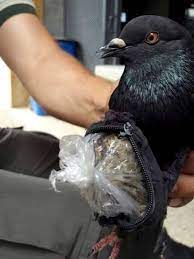
Officials believe an inmate at a jail in Costa Rica trained a feathered friend to smuggle cocaine and cannabis in a pouch.
A pigeon smuggling cocaine and cannabis into a prison in Costa Rica has been caught by guards.
The bird was seen landing in the central concourse of the medium security La Reforma jail, in San Rafael de Alajuela, where it was taken into custody.
The drugs were contained in a small zipped up pouch strapped to the animals chest.
About 14g of cocaine and at least the same amount of cannabis were inside wrapped in plastic.
Costa Rica’s Ministry of Justice and Peace released the animal’s mugshot under the headline caption “narcopaloma”, meaning “drugs dove”, and listing the date of the animals detention.
Realidad7 reported the drugs had a street value of around £180 ($281).
Prison officials said they believe the drugs were destined for use by an inmate who may have trained the pigeon to act as a courier.
Director of the Penitentiary Police, Paul Bertozzi, told Spanish news agency Efe that it showed the need to be vigilant.
“Drug traffickers are using unimaginable ways to achieve their macabre atrocities,” he said.
“This (use of a pigeon) is nothing new. In the past (the traffickers) have used cats and dogs to pass drugs to prisoners. Now it seems they are using pigeons to carry in their wares from the outside.”
Although it is the first time the Costa Rican authorities said they had come across the practice, it has previously been reported in Argentina in 2013 and Colombia in 2011.
The pigeon was later taken to a zoo where it was expected to remain behind the bars of a cage.
Biologist Oscar Ramirez told Realidad7 that pigeons can be trained to travel several miles with small loads.
During the Second World War, more than 250,000 homing pigeons were used to transport messages between front line Allied troops and top brass, according to the Royal Pigeon Racing Association.
Pigeon Patrol Products & Services is the leading manufacturer and distributor of bird deterrent (control) products in Canada. Pigeon Patrol products have solved pest bird problems in industrial, commercial, and residential settings since 2000, by using safe and humane bird deterrents with only bird and animal friendly solutions. At Pigeon Patrol, we manufacture and offer a variety of bird deterrents, ranging from Ultra-flex Bird Spikes with UV protection, Bird Netting, 4-S Bird Gel and the best Ultrasonic and audible sound devices on the market today.
Voted Best Canadian wholesaler for Bird Deterrent products ten years in a row.
Contact us at 1- 877– 4– NO-BIRD, (604) 585-9279 or visit our website at www.pigeonpatrol.ca
Pigeon/Pigeon Patrol / Pigeons Roosting / Vancouver Pigeon Control /Bird Spikes / Bird Control / Bird Deterrent / Pigeon Deterrent? Surrey Pigeon Control / Pest /Seagull deterrent / Vancouver Pigeon Blog / Birds Inside Home / Pigeons in the cities / Ice Pigeons/ What to do about pigeons/ sparrows , Damage by Sparrows, How To Keep Raccoons Away, Why Are Raccoons Considered Pests/ De-fence / Pigeon Nesting/ Bird Droppings / Pigeon Dropping/ woodpecker control/ Professional Bird Control Company/ Keep The Birds Away/ Birds/rats/ seagull/pigeon/woodpecker/ dove/sparrow/pidgeon control/pidgeon problem/ pidgeon control/flying rats/ pigeon Problems/ bird netting/bird gel/bird spray/bird nails/ bird guard
by Pigeon Patrol | Apr 26, 2021 | Columbidae, Pigeon Spikes, Pigeons in the News, UltraSonic Bird Control
Many of us have heard of the Lost Battalion, and know some of the story. What is not commonly known is the role of a remarkable pigeon, named Cher Ami. That little bird became one of the greatest heroes of World War I.
Cher Ami at the Smithsonian Institution. (Photo by Armed Forces History, Division of History of Technology, National Museum of American History)
Cher Ami was one of almost 600 carrier pigeons employed by the US Army Signal Corps during the First World War. Carrier pigeons were invaluable , in spite of the advances in communications technology during the war. Radios were not as reliable since they were large and still bound by delicate wires. It also was not always possible to lay new wires quickly, and often could be extremely dangerous. While not necessarily a popular form of communication, pigeons did prove a reliable one. The average homing pigeon can fly approximately fifty miles per hour, making them a quick method of communication. Still, these pigeons often proved popular targets to enemy gunfire despite their speed. In fact, German machine gunners trained diligently to both spot and kill these birds with their deadly MG 08s, which could fire over 500 rounds per minute. Pigeons could also be a very risky way to communicate, because if a pigeon was shot down, the message could easily be intercepted by enemy forces.
The US Army Signal Corps used some 600 pigeons in WW1.
It was during the Meuse-Argonne Offensive of 1918 where the carrier pigeon was finally recognized for its valiant efforts. On October 2nd, 1918, American soldiers from the 77th Division pushed too far into the Argonne Forest and became trapped behind German lines on the slopes of a hill. Cut off from reinforcements and supplies, roughly 550 men from the 306th, 307th, and 308th regiments under Major Charles Whittlesey held their ground against a far larger German force for several days. Far beyond radio range, the only way the Americans could communicate with their own lines was via carrier pigeon. However, it did not take long to realize that the skies were as dangerous as the ground. Trapped in a horrible meatgrinder of machine guns and rain, the Lost Battalion held their ground against vicious German attacks.
On October 4th, American heavy artillery started to bombard the Lost Battalion’s position on accident, killing thirty men as they held the line. Major Whittlesey and his men watched as bird after bird fell out of a sky torn apart by German fire. With supplies running out and casualties mounting rapidly, Major Whittlesey desperately sent out his last pigeon, Cher Ami, to the American lines with a note that simply read, “We are along the road parallel to 276.4. Our own artillery is dropping a barrage directly on us. For heaven’s sake, stop it.” With fire raining down on them from all sides, Cher Ami was now the last chance for the Lost Battalion to walk off that hill alive.
Capt John Carney, Cher Ami’s trainer, holds the feathered hero.
The brave bird flew straight into the German fire, dodging bullets as he went. However, his luck did not last for long. Cher Ami was hit in the chest soon after takeoff, as American soldiers watched in horror as their last hope hit the ground. Against all odds though, Cher Ami got up again! Wounded but still alive, the little bird took flight again, charging head-on into wave after wave of gunfire. By the end of the trip, he covered 25 miles in roughly half an hour. He arrived at base heavily wounded, but alive.
The Croix de Guerre with Palm military decoration of France, awarded to Cher Ami.
Army medics were able to save Cher Ami’s life, but his right leg was barely attached to his body and he was blind in one eye. However, because of Cher Ami’s delivery, the artillery stopped and took up new firing coordinates away from American lines. The next day, shells started to fall on German positions, relieving pressure on the bloodied 77th and the battle turned in America’s favor. On October 8th, one hundred and ninety-four men made it back to the American lines thanks to Cher Ami’s sacrifice.
For his part in saving the 77th Division, Cher Ami was awarded the Croix de Guerre, one of France’s highest military honors for his gallantry in the field. General John Pershing, commander of the American Expeditionary Force, said “There isn’t anything the United States can do too much for this bird.”
Cher Ami made it back to the United States in the care of its trainer, Capt John Carney. On June 13th, 1919, Cher Ami died at Fort Monmouth, New Jersey. However, Cher Ami’s body was preserved and presented to the American Government with honor. It is difficult to say how many families owe their existence to the sheer courage and self-sacrifice of one brave bird. Today, Cher Ami is on display at the Smithsonian Museum of American History to preserve his memory. Since then, his story has lived on in the hearts and minds of Americans across the decades, and his bravery will never be forgotten.
Pigeon Patrol Products & Services is the leading manufacturer and distributor of bird deterrent (control) products in Canada. Pigeon Patrol products have solved pest bird problems in industrial, commercial, and residential settings since 2000, by using safe and humane bird deterrents with only bird and animal friendly solutions. At Pigeon Patrol, we manufacture and offer a variety of bird deterrents, ranging from Ultra-flex Bird Spikes with UV protection, Bird Netting, 4-S Bird Gel and the best Ultrasonic and audible sound devices on the market today.
Voted Best Canadian wholesaler for Bird Deterrent products ten years in a row.
Contact us at 1- 877– 4– NO-BIRD, (604) 585-9279 or visit our website at www.pigeonpatrol.ca
Pigeon/Pigeon Patrol / Pigeons Roosting / Vancouver Pigeon Control /Bird Spikes / Bird Control / Bird Deterrent / Pigeon Deterrent? Surrey Pigeon Control / Pest /Seagull deterrent / Vancouver Pigeon Blog / Birds Inside Home / Pigeons in the cities / Ice Pigeons/ What to do about pigeons/ sparrows , Damage by Sparrows, How To Keep Raccoons Away, Why Are Raccoons Considered Pests/ De-fence / Pigeon Nesting/ Bird Droppings / Pigeon Dropping/ woodpecker control/ Professional Bird Control Company/ Keep The Birds Away/ Birds/rats/ seagull/pigeon/woodpecker/ dove/sparrow/pidgeon control/pidgeon problem/ pidgeon control/flying rats/ pigeon Problems/ bird netting/bird gel/bird spray/bird nails/ bird guard
by Pigeon Patrol | Apr 26, 2021 | Bird Law, Pigeon Control, Pigeon Patrol's Services, Pigeon Predators
Commonly known as Pigeons, Rock Pigeons are often considered a nuisance by some city officials and some farm businesses.
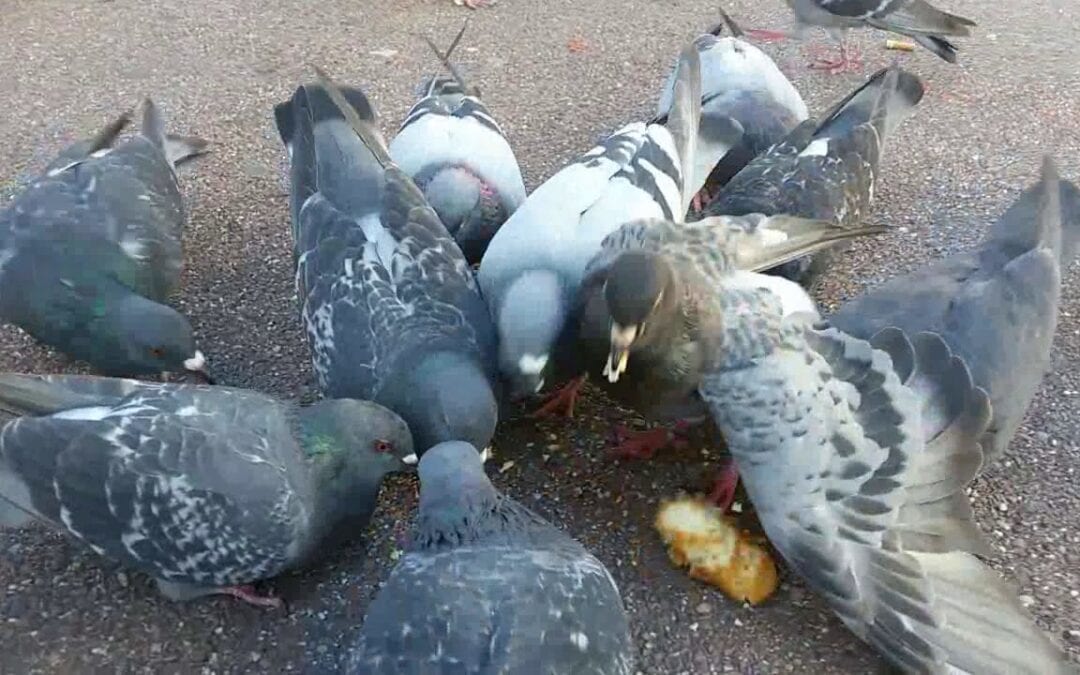
In cities they congregate in large flocks and can create messes with their droppings.
On farms, eating grains and possible harm to livestock through bacteria and viruses are concerns about these birds.
Many pigeon deterents are available online to prevent nesting in areas they’re not wanted.
Introduced into North America from Europe in the 1600’s, these birds have been associated with humans for thousands of years.
Rock Doves are thought to have been the first domesticated bird, raised for meat as far back as the time of the ancient Egyptians.
Description
Pigeons have different colors due to breeding by humans. They are the descendants of the wild Rock Dove of Europe.
About 13 inches in length with a dark gray head, iridescent neck, with a light gray back and 2 dark wing bars.
Mating – Breeding Habits
Like Mourning Doves, pairs are monogamous, often breeding in consecutive seasons for as long as both birds of a pair live.
Most will attempt to raise several broods each year. Sometimes as many as four or five broods will be raised in a single year.
The breeding season of these birds can be all year provided climate conditions allow. There seems to be some slowing down during the winter months.
Nesting Habits
The nesting habits of Pigeons are a bit unique. The male chooses a site in view of the female, selecting one stick and bringing it back, lays it in front of his mate.
The female who stays at the nesting site accepts the sticks the male brings to her and places them underneath her.
The nest of these birds can be found along building ledges, rafters, beams, under bridges or inside barns.
The nest is saucer-like in shape and made of stems and leaves.
The female may sit on the nest a day or two before the first egg is laid. Generally 2 white eggs are laid.
Both the male and female will incubate but the female will spend the most time on the eggs since she will be on the nest from mid-afternoon to mid-morning.
Incubation last for about 18 days. When the eggs hatch the young are covered in yellow down.
Young pigeons in the nest are referred to as “squabs”
Initially, the squabs are fed what is referred to as crop milk. This is a regurgitated thick liquid food that comes from the parents crops.
At about 10 days the squabs are fed increasing amounts of the food types that adults eat and are no longer dependent on crop milk.
The young will double in size in a day and a half. Making them one of the fastest growing vertebrate in the world.
Within 2 weeks the flight feathers begin to emerge and by week 3 the squabs are covered in feathers.
The tail and full feathering is completed by the 28th day and their weight is that of an adult.
The young will now leave the nest and the male will teach them what they need to know to survive.
This is 10 – 15 days longer than most of our backyard birds.
The female will begin a new clutch and this cycle will repeat about every 30 days when weather cooperates.
Do Pigeons Reuse the Same Nest
It’s more accurate to say that the same nest site is used as the second and subsequent nest are built on top of the previous nest.
Nest that are several years old can measure out to be as much as 7 inches high and 19 inches wide.
Feeding Habits – What Pigeons Eat
Rock Pigeons feed on the ground. To prevent seed spoilage and to keep the birds healthy a ground feeder is recommended for all ground feeding birds.
The best types of food to offer these birds are properly mixed seeds specifically made for doves and pigeons.
For more information on seeds and photos of each, please see our
Bird Seed Page.Predators
The primary preadators of pigeons include: man, peregrin falcon, and cats. Nest predators include oppossums, raccoons, crows and owls. Hawks will capture perching birds.
Are Pigeons Smart Birds?
According to Professor Richard J. Herrnstein at the Harvard Psychological Laboratories they are. Pigeons were smart enough to learn all the letters of the english alphabet.
In another study, Pigeons were able to recognize themselves in a mirror. This makes them one of six species and the only non-mammal to be able to do so.
So yes, Pigeons are a pretty smart bird.
What is the Lifespan of Pigeons?
Pigeons may live 3 – 6 years in the wild with the average being 3 – 4 years. In captivity they have lived as long as 15 years depending on the care given to the bird.
Pigeons in History
During the world wars, Homing Pigeons were trained to return to a loft in the UK.
Troops then took the pigeons with them and used them to send messages when radio and written communication were being intercepted.
Pigeon Fun Facts
Pigeons have the ability to see about 26 miles.
When fully feather, adult pigeons have around 10,000 feathers.
There are approximately 400 million pigeons in the world.
Pigeon Patrol Products & Services is the leading manufacturer and distributor of bird deterrent (control) products in Canada. Pigeon Patrol products have solved pest bird problems in industrial, commercial, and residential settings since 2000, by using safe and humane bird deterrents with only bird and animal friendly solutions. At Pigeon Patrol, we manufacture and offer a variety of bird deterrents, ranging from Ultra-flex Bird Spikes with UV protection, Bird Netting, 4-S Bird Gel and the best Ultrasonic and audible sound devices on the market today.
Voted Best Canadian wholesaler for Bird Deterrent products ten years in a row.
Contact us at 1- 877– 4– NO-BIRD, (604) 585-9279 or visit our website at www.pigeonpatrol.ca
Pigeon/Pigeon Patrol / Pigeons Roosting / Vancouver Pigeon Control /Bird Spikes / Bird Control / Bird Deterrent / Pigeon Deterrent? Surrey Pigeon Control / Pest /Seagull deterrent / Vancouver Pigeon Blog / Birds Inside Home / Pigeons in the cities / Ice Pigeons/ What to do about pigeons/ sparrows , Damage by Sparrows, How To Keep Raccoons Away, Why Are Raccoons Considered Pests/ De-fence / Pigeon Nesting/ Bird Droppings / Pigeon Dropping/ woodpecker control/ Professional Bird Control Company/ Keep The Birds Away/ Birds/rats/ seagull/pigeon/woodpecker/ dove/sparrow/pidgeon control/pidgeon problem/ pidgeon control/flying rats/ pigeon Problems/ bird netting/bird gel/bird spray/bird nails/ bird guard