by Pigeon Patrol | Sep 11, 2023 | Bird Spike, Pigeon Predators, Pigeon Spikes, Pigeons, Pigeons in the News, Raccoons, Sparrows, UltraSonic Bird Control
Chicago ranks as the deadliest city in the United States for birds, according to a recent study by the Cornell Lab of Ornithology.
People might think that a larger city like New York would be guilty of more bird-window collisions than Chicago, but an unfortunate combination of building structures and geographical placement proves to be deadlier than size.
“It’s not just the size of the city, it also has to do with how bright the city is and also where the birds are flying themselves.” said Kyle Horton, the lead researcher on the study which evaluated 125 cities for their bird-killing potential.
Every fall, billions of birds will fly from the northern United States and Canada to the tropics and in the spring those birds return from their tropical vacation, according to the Cornell Chronicle.
Chicago is positioned on one of the primary flight paths, Horton said. It is the nation’s deadliest city for birds during both the spring and fall migrations. Other Great Lakes regional cities in the study’s top 20: Minneapolis (sixth spring, seventh fall), Detroit (13th spring, 15th fall), Indianapolis (16th spring, 13th fall).
Annette Prince witnesses this flight and its casualties firsthand. She is the director of the Chicago Bird Collision Monitors, a volunteer-based conservation project that has been protecting and recovering birds that are killed and injured in downtown Chicago during these mass migrations since 2003.
“They’re birds that certainly cannot afford to be having collisions as an additional reason to have their species reduced,” Prince said.
The decline of these species doesn’t only affect local populations and ecosystems. Migratory bird populations are an important part of a global environment, she said.
“Chicago is in the fortunate position to enjoy a huge migration of birds every spring and fall,” Prince said. “They’re following a pathway that they’ve used for thousands of years, before there was ever a city here.”
What was once a lakefront that travel-weary migrating birds could easily navigate and find pitstops offering food and rest is now a maze of lights, reflections and invisible yet deadly obstacles. This results in 5,000 dead birds per square-mile in Chicago, Prince said.
And that’s a low estimate. The volunteers at Chicago Bird Collision Monitors can’t find every crime scene when there are so many, and there are plenty that could be tampered with by passing pedestrians, cars, or a wandering cat or dog, Prince said.
Windows are often the perpetrator of these deaths, but lights act as a productive accomplice.
“It’s not necessarily that the lights are killing birds,” Horton said. “It’s that the lights seem to attract birds, it disorients them and elevates their risk of colliding with structures.”
To reduce the risk of bird-window collisions, Horton encourages those who live in or work in buildings to turn off or dim unneeded lights. This is especially relevant at 7 p.m. to 8 p.m. for three to four weeks of spring and fall, which is when the majority of birds would be moving through the city, said Horton.
Reducing lights can decrease bird-window collisions, but building-designers and homeowners can also make changes to the windows themselves without living in a building devoid of natural light.
“The glass has to have some sort of visual noise, something that alerts the birds to the presence of a surface instead of an opening,” Prince said.
This visual noise could be decorations such as hanging banners, cords, ribbons, or sunshades in front of the window. It could also be modifications to the window itself like window films, decals, etchings, or use of glass that isn’t as reflective or transparent. Further information on measures and products that can be used to make windows less susceptible to bird-window collisions can be found on the websites of the Chicago Bird Collision Monitors and the American Bird Conservancy.
“We have the tools to make things safer for birds,” said Prince. “It’s just a question of people saying that it matters enough that we will do it.”
Migratory birds have been declining for decades and the lack of awareness of the importance of these options is a major setback in their use, said Pamela Rasmussen, an assistant professor in Michigan State University’s College of Natural Science.
“Everyone just wants nice shiny skyscrapers,” she said. “They have no idea what they’re doing to the bird population.”
Researchers are developing a glass with nanotechnology that birds can see but people can’t, she said.
Local ordinances could increase awareness. To make downtown Chicago safer for birds, Alderman Brian Hopkins introduced the Chicago Bird-Friendly Building Ordinance earlier this year.
It would limit the amount of transparent or reflective glass on the exterior of buildings and specify glass that provides visual noise in situations that are proven hazardous for birds. It would also limit the amount, location and timing of exterior lighting and reduce the interior lighting visible from outside for all newly constructed buildings and any buildings that undertake a major renovation. More information can be found at the bird-friendly Chicago website.
Representatives of the Illinois Environmental Council, American Bird Conservancy and the Lincoln Park Zoo recently testified in support of the measure, according to the Office of the City Clerk.
But high-rise buildings within large urban centers aren’t the only bird hazards out there.
“A skyscraper certainly will on average kill more birds than a single residential home,” Horton said. “But…if you sum up all of the mortality that happens at low-rise buildings it’s substantially more than what would happen at a city level.”
So consider turning that porch light out or making your security lights motion-activated. It might save more than just electricity costs.
Source
Pigeon Patrol
Pigeon Patrol Products & Services is the leading manufacturer and distributor of bird deterrent (control) products in Canada. Pigeon Patrol products have solved pest bird problems in industrial, commercial, and residential settings since 2000, by using safe and humane bird deterrents with only bird and animal -friendly solutions. At Pigeon Patrol, we manufacture and offer a variety of bird deterrents, ranging from Ultra-flex Bird Spikes with UV protection, Bird Netting, 4-S Bird Gel and the best Ultrasonic and audible sound devices on the market today.
Canada’s top wholesaler for bird deterrent products for twelve consecutive years.
Contact us at 1- 877– 4– NO-BIRD, (604) 585-9279 or visit our website at https://www.pigeonpatrol.ca/
Bird Gone, Pigeon Gone, Pigeon problems, pigeon spikes, 1-877-4NO-BIRD, 4-S Gel, Bird Control, Pigeon Control, bird repellent, Bird Spikes, sonic bird repellent, stainless steel bird spikes, bird spikes Vancouver, Ultra Sonic Bird Control, Bird Netting, Plastic Bird Spikes, Canada bird spike deterrents, Pigeon Pests, B Gone Pigeon, Pigeon Patrol, pest controller, pest control operator, pest control technician, Pigeon Control Products, humane pigeon spikes, pigeon deterrents, pigeon traps, Pigeon repellents, Sound & Laser Deterrents, wildlife control, raccoon, skunk, squirrel deterrent, De-Fence Spikes, Dragons Den, Pigeon, Pigeon Patrol, Pigeons Roosting, Vancouver Pigeon Control, Bird Spikes, Bird Control, Bird Deterrent, Pigeon Deterrent, Surrey Pigeon Control, Pest, Seagull deterrent Vancouver Pigeon Blog, Birds Inside Home De-fence, Pigeon Nesting, Bird Droppings, Pigeon Dropping, woodpecker control, Keep The Birds Away, Birds/rats, seagull, pigeon, woodpecker, dove, sparrow, pidgeon control, pidgeon problem, pidgeon control, flying rats, pigeon Problems, bird netting, bird gel, bird spray, bird nails, bird guard, Pigeon control, Bird deterrents, Pigeon deterrents, Bird control, solutions, Pigeon prevention, Pigeon repellent, Bird proofing, Pest bird management, Pigeon spikes, Bird netting, Humane bird control, Bird exclusion, Urban bird control, Anti-roosting devices, Pigeon removal, Bird barriers
by Pigeon Patrol | Sep 11, 2023 | Bird Netting, Bird Spikes, Doves, history of pigeons, MBCA, pet bird, Pigeon Control
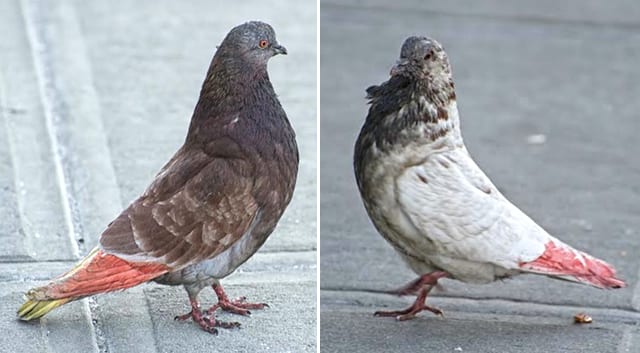
The pigeon problem in Kirkland Lake is so bad, police felt the need to issue a news release this morning warning residents to follow the law when dealing with them.
The town started renting out traps to residents today to capture pigeons, and police say that trappers will be responsible for the disposal of the birds, which includes a ban on throwing them in the garbage for curbside pickup. Successful trappers will instead have to take the pigeons for burial at the town dump.
“The OPP want to inform the residents that it is each individual’s responsibility to educate themselves on this topic and to ensure that they are acting within the laws, regulations and town by-laws,” says Constable Adam Gauthier.
The problem started, says Ashley Bilodeau, Kirkland Lake’s Manager of Planning and Land Development, when a few bird lovers started feeding the pigeons.
“We have a couple of residents that have been obnoxiously feeding pigeons to the point where we have some serious problem areas, so we passed a no-feeding bylaw back in the fall,” she told BayToday. “However, there is one individual who just continues to feed them despite the bylaw and has been charged. There’s been a few charges laid around town but there is one individual who is causing more headaches than normal.”
The fine for feeding is steep at $100, and that’s down from the $250 the town wanted to charge but the province wouldn’t allow it.
“So we’re trying to find different ways to combat the issue because it’s now causing problems to people’s properties and vehicles because there are so many of them.”
Bilodeau says the town has checked with the MNRF and it’s not illegal to kill pigeons although you are required to have a small game licence in order to trap and kill pigeons.
The town has not placed a limit on the number of pigeons people can capture, but police warn folks can’t use their guns to shoot the birds because discharging a firearm is prohibited within the Town of Kirkland Lake,
Bilodeau says poop is the problem.
“They’re also causing damage to buildings by trying to build nesting areas,” she adds. “We’ve got four traps here and people can come in and put in a deposit and take the trap for 10 days, and when they bring it back they get their money back.”
Pigeons were originally bred from the wild rock dove, which naturally inhabits sea-cliffs and mountains according to Wikipedia, so the bird finds the ledges of buildings to be a substitute for sea cliffs.
They have become abundant in towns and cities throughout the world. Due to their abilities to create large amounts of excrement and to carry disease, combined with crop and property damage, pigeons are largely considered a nuisance with steps being taken in many municipalities to lower their numbers or completely eradicate them.
Source
Pigeon Patrol
Pigeon Patrol Products & Services is the leading manufacturer and distributor of bird deterrent (control) products in Canada. Pigeon Patrol products have solved pest bird problems in industrial, commercial, and residential settings since 2000, by using safe and humane bird deterrents with only bird and animal -friendly solutions. At Pigeon Patrol, we manufacture and offer a variety of bird deterrents, ranging from Ultra-flex Bird Spikes with UV protection, Bird Netting, 4-S Bird Gel and the best Ultrasonic and audible sound devices on the market today.
Canada’s top wholesaler for bird deterrent products for twelve consecutive years.
Contact us at 1- 877– 4– NO-BIRD, (604) 585-9279 or visit our website at https://www.pigeonpatrol.ca/
Bird Gone, Pigeon Gone, Pigeon problems, pigeon spikes, 1-877-4NO-BIRD, 4-S Gel, Bird Control, Pigeon Control, bird repellent, Bird Spikes, sonic bird repellent, stainless steel bird spikes, bird spikes Vancouver, Ultra Sonic Bird Control, Bird Netting, Plastic Bird Spikes, Canada bird spike deterrents, Pigeon Pests, B Gone Pigeon, Pigeon Patrol, pest controller, pest control operator, pest control technician, Pigeon Control Products, humane pigeon spikes, pigeon deterrents, pigeon traps, Pigeon repellents, Sound & Laser Deterrents, wildlife control, raccoon, skunk, squirrel deterrent, De-Fence Spikes, Dragons Den, Pigeon, Pigeon Patrol, Pigeons Roosting, Vancouver Pigeon Control, Bird Spikes, Bird Control, Bird Deterrent, Pigeon Deterrent, Surrey Pigeon Control, Pest, Seagull deterrent Vancouver Pigeon Blog, Birds Inside Home De-fence, Pigeon Nesting, Bird Droppings, Pigeon Dropping, woodpecker control, Keep The Birds Away, Birds/rats, seagull, pigeon, woodpecker, dove, sparrow, pidgeon control, pidgeon problem, pidgeon control, flying rats, pigeon Problems, bird netting, bird gel, bird spray, bird nails, bird guard, Pigeon control, Bird deterrents, Pigeon deterrents, Bird control, solutions, Pigeon prevention, Pigeon repellent, Bird proofing, Pest bird management, Pigeon spikes, Bird netting, Humane bird control, Bird exclusion, Urban bird control, Anti-roosting devices, Pigeon removal, Bird barriers
y/bird nails/bird guard
by Pigeon Patrol | Mar 31, 2019 | 4-S Gel Bird repellent, Animal Deterrent Products, Bird Deterrent Products
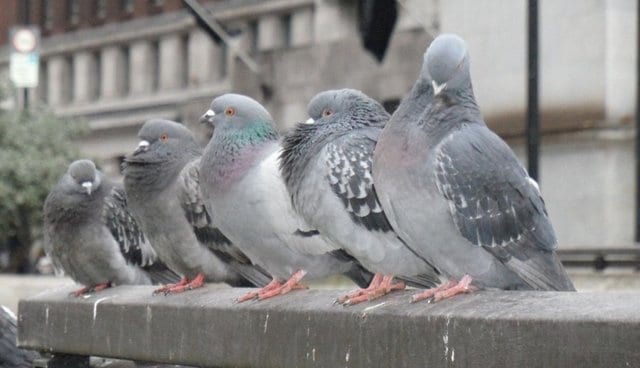
Occasionally, you see them munching on a pizza rind or some other recognizable discarded food, but most of the time they seem to be pecking at nothing at all.
I am not planning to start a pigeon Facebook enterprise, but unlike virtually all New Yorkers, I do not loathe pigeons and give them credit for living a tough life on the mean and unforgiving streets of Manhattan.
And if you actually stop and look at them, which no one does, their plumage can be quite striking. Yes they are plump and the neck-snapping walk is mind-boggling — what evolutionary rationale could that possibly have? — but they demonstrate an unrelenting pluck to survive in the city that I find admirable.
Just like seagulls, you never see a young or old pigeon, and never a sickly one. They are all the same size and seem in excellent health. I’ve never seen a dead pigeon or a squished one, which is remarkable for all their bicycle- and car-dodging. Not to overthink this, for all of their daily vicissitudes they seem pretty content with their lives, although their expressionless faces could be masking all kinds of nameless dreads.
One activity that seems to definitely give them great pleasure is communal flight. As I look east from our 16th floor apartment, I often see sizable flocks of pigeons soaring in synchronized movements that have no purpose, just banking, turning this way and that, diving and climbing.
They are clearly playing. They will, as a group, alight on a random rooftop, cogitate for a while and then set off on another flight maneuver, happy as clams.
If there is an afterlife, this playful flying would not make me elect to come back as a pigeon. I’m on record as choosing to come back as a chickadee. But if I have no choice and I’m forced to come back as a pigeon, I could handle it. The key, it seems, is a sufficient stream of pizza rinds.
Seagulls seem a lot like pigeons. They are always scamming for food and can fly beautifully. They seem smarter than pigeons and have a more sculpted shape. Gratefully, they have eliminated the disturbing neck-snapping walk, and they are artful at catching food thrown at them by the bored human denizens of Crescent Beach.
Which brings me to a seagull story. It is a third-hand story and its veracity cannot be verified. It was told to me by my nephew on Cape Cod, and he is a known embellisher. There is a thin line between embellishment and prevarication, and I am pretty sure he was sticking to the embellishment side. Not betting my life on that, however.
It starts with a surf-casting fisherman and a nearby observing seagull. The seagull watches as the surf-caster baits up his hook and heaves it into the waves. This is repeated several times with no success, fish-catching-wise. This is where it gets interesting.
This story wants you to believe that a light goes on in the observing seagull’s brain. The light says one, there is food being flung into the air and two, I can fly. Ergo, an intercept is entirely possible. But the light does not fully grasp the concept of “fish hook.”
You probably see where this is going. A perfectly timed intercept is made and the hook lodges in the seagull’s beak, surprising both human and bird actors in this story.
Embellishment alert: The fisherman starts reeling in the seagull and eventually gets it on the beach where a concerned woman assists the fisherman to calm the seagull while he fetches his needle-nose pliers to extract the hook. The seagull is not pleased, and it takes a while to wrestle the hook out.
A moment passes as the humans and seagull digest what just happened. Another light goes on in the seagull’s brain. With good intentions, the concerned woman is carefully holding the seagull but gets no credit for this act of kindness. The light says take a nip of the woman’s cheek and get the heck out of here. End of story.
True story? We cannot be sure.
But it sure beats any pigeon story I know.
Bird Gone, Pigeon Gone, Pigeon problems, pigeon spikes, 1-877-4NO-BIRD, 4-S Gel, Bird Control, Pigeon Control, bird repellent, Bird Spikes, sonic bird repellent, stainless steel bird spikes, bird spikes Vancouver, Ultra Sonic Bird Control, Bird Netting, Plastic Bird Spikes, Canada bird spike deterrents, Pigeon Pests, B Gone Pigeon, Pigeon Patrol, pest controller, pest control operator, pest control technician, Pigeon Control Products, humane pigeon spikes, pigeon deterrents, pigeon traps, Pigeon repellents, Sound & Laser Deterrents, wildlife control, raccoon, skunk, squirrel deterrent, De-Fence Spikes, Dragons Den.
by Pigeon Patrol | Mar 31, 2019 | Bird Netting, Pigeon Spikes, Pigeons in the News, UltraSonic Bird Control
WOLCOTT — Someone discarded 145 living pigeons this winter the way one throws out an empty disposable coffee cup — by tossing them into a trash dumpster.
The night caretaker at the northbound Interstate 65 rest area in White County found the first 57 birds in the middle of December as he took the trash out, said Kim Hoover of the Hoots to Howls Wildlife Rehabilitation Center in rural Pulaski County. Some of the birds trapped inside boxes died, she said.
She took the birds and found homes for most of them, keeping the blind and crippled birds at the rehabilitation center.
Then on Feb. 28, the caretaker found more boxes of birds in the same dumpster at the same rest area.
“Same mozzarella cheese boxes. Same person’s name and number on the leg ban,” she said.
The first group of birds found were standing in feces that were caked to their feet and matted in their feathers, Hoover said. It appeared they’d been in the dumpster for a while and were in poor health.
The second group was found in better condition and did not have trash piled on top of the boxes, indicating that they had not been in the dumpster that long, Hoover said.
That person’s name on the leg band is Bahman Ghassab from Dublin, Ohio, Hoover said. The bands also had a telephone number to reach Ghassab. The Journal & Courier called that number on Wednesday, but it is no longer a working number.
But after the find in December, Hoover said one of her associates did call the number, and Ghassab answered.
“He said he sold some birds to someone in Florida and in Illinois,” Hoover said, “and he would not give any more info than that.
“When asked why would you sell sick starving and injured pigeons and better yet why would someone buy them in this condition, the conversation ended,” Hoover said.
The Journal & Courier contacted John DeCarlo Jr., president of the National Pigeon Association. He checked the association’s membership list, and Ghassab is not a member.
“These birds don’t fly,” Hoover said.
The Journal & Courier texted photos of the birds to DeCarlo, who is in California.
“I don’t know why they don’t fly,” he said, noting this particular breed of pigeon is the Iranian high fliers.
The Iranian high fliers are capable of flight, unlike the one particular breed that Hoover mistakenly was told the rescued birds belonged to, DeCarlo said.
The birds might not fly because they are sick or are under fed or are under conditioned, DeCarlo said. Or they might have been altered so they can’t fly, he added.
Someone told Hoover the birds were likely part of an illegal gambling ring, but that doesn’t seem likely, according to DeCarlo.
The only gambling in the pigeon hobby is among racing pigeons, and these are not racing pigeons, he said.
The flightless pigeon breed is known as parlor rollers. They have been genetically bred not to fly, and when they are nervous or excited, they roll, Decarlo said. There is a competition among parlor rollers to see whose bird can roll the furthest, but it’s not cruel because this is the natural way these birds behave, according to several pigeon experts interviewed Wednesday by the Journal & Courier.
Everyone interviewed Wednesday was incensed by the way these birds were discarded.
Hoover said no one seems interested in investigating it as a criminal case.
“From what I’m told, they’re not pets; they’re not farm animals, so nobody does anything,” she said.
National Pigeon Association Secretary/Treasurer Tim Heidrich of Georgia doesn’t see why it couldn’t be prosecuted.
“To me, it’s like animal cruelty,” Heidrich said. “There are ways to get rid of them without being cruel about it.”
“There are quite a few small shows,” he said. “You can go to these things and sell them — give them away to the kids.”
DeCarlo suggested giving unwanted pigeons to 4Hers so they can learn the hobby and show them.
Finding so many birds thrown away begs the question of whether other birds met with a similar fate only went undiscovered at other locations.
“We don’t know if this is the first time,” Hoover said. “Is it happening at other rest parks? We don’t know.
“I just wish he’d stop. These birds don’t deserve to be thrown out.”
Bird Gone, Pigeon Gone, Pigeon problems, pigeon spikes, 1-877-4NO-BIRD, 4-S Gel, Bird Control, Pigeon Control, bird repellent, Bird Spikes, sonic bird repellent, stainless steel bird spikes, bird spikes Vancouver, Ultra Sonic Bird Control, Bird Netting, Plastic Bird Spikes, Canada bird spike deterrents, Pigeon Pests, B Gone Pigeon, Pigeon Patrol, pest controller, pest control operator, pest control technician, Pigeon Control Products, humane pigeon spikes, pigeon deterrents, pigeon traps, Pigeon repellents, Sound & Laser Deterrents, wildlife control, raccoon, skunk, squirrel deterrent, De-Fence Spikes, Dragons Den.
by Pigeon Patrol | Mar 31, 2019 | Bird Deterrent Products, Bird Netting, Pigeon Patrol's Services, Pigeon Spikes, Pigeons in the News
BOSTON — Along with all the usual declarations and deductions, Massachusetts residents have been asked to keep something else in mind this tax season: pigeon droppings.
In an unusual and at times stomach-turning appeal, the state agency MassWildlife proposed that one way to fight back against the sticky messes befouling cars and damaging bridges is for taxpayers to check a box on their tax forms to support the state’s endangered species program.
How so? Peregrine falcons are among the program’s beneficiaries, and they prey on pigeons.
“Hate pigeon poop? Save peregrine falcons,” begins the message on the agency’s website and in a recent newsletter. It goes on to picture a typical motorist driving home from work over one of the state’s major bridges.
“You’re thinking about dinner as you wait in traffic when — PLOP! — something white and black falls onto your windshield,” the post continues.
Next comes a scientific breakdown of the bird droppings that includes an explanation — for inquiring minds that need to know — of the precise difference between the dark and white portions.
Damage: And then, lest the reader believe it’s all no more than a yucky nuisance, this warning: “This paste-like substance is so acidic and corrosive, that it can damage your car’s paint job. And you guessed it, groups of birds all going to the bathroom in the same place can make man-made structures like bridges deteriorate faster.”
Enter the peregrine falcon, a magnificent predator that can attain speeds of 240 mph in high-elevation dives, no match for the slower and less agile pigeon, which just so happens to be one of the peregrine’s favorite feasts.
Peregrine falcons disappeared from Massachusetts in the mid-1950s and soon after in the entire eastern U.S., their demise largely blamed on the pesticide DDT, according to the state’s Natural Heritage and Endangered Species Program.
After the chemical was banned, efforts picked up to reintroduce the raptor, sometimes confused with more common varieties of hawk.
Pigeon-hunting perches: To the surprise of some ornithologists, many of the newcomers eschewed their former rural habitats and became city dwellers. Instead of on cliffs, they began nesting on tall building ledges and bridges in urban areas where food sources — pigeons, especially — were more plentiful.
To help the falcons along, state officials and volunteers placed nesting boxes in strategic locations such as the Custom House Tower in Boston, the 28-story W.E.B. Du Bois Library at the University of Massachusetts-Amherst and the heavily traveled Tobin Bridge spanning the Mystic River.
“Falcon cams” were even installed to offer a continuous livestream of peregrine comings and goings.
The restoration effort is partially funded by voluntary donations from taxpayers, who can choose to contribute to “endangered wildlife conservation” on their state returns. The money supports more than 400 threatened or endangered plants and animals, from bog turtles to timber rattlesnakes, but the peregrine falcon is easily among the most “charismatic,” said David Paulson, senior endangered species biologist for MassWildlife.
Donations: Contributions to the fund have been increasing but remain well below levels needed, according to state officials and wildlife experts. About 23,000 taxpayers gave $312,000 through the tax check-off in 2017, the last full year for which figures were available, compared with the $178,000 provided by approximately 18,000 taxpayers in 2013.
It’s not just bird lovers and conservationists embracing the slow but steady revival of the peregrine falcons.
State transportation engineers have noticed a reduction in the pigeon population on bridges with nesting falcons, officials said. Fewer pigeons means less waste building up on bridge surfaces, rusting the steel and increasing the costs for maintenance and bridge replacement.
“It’s almost like a symbiotic relationship,” Paulson said. “The structure provides the habitat, and the falcons kind of provide the pest management, for lack of a better term.”
Officials hope drivers when completing their tax forms will see the peregrine as a feathered friend that can make an unwanted splattering a bit less likely.
The falcons “are never going to eliminate (pigeons), but they can help to manage them,” Paulson said.
Bird Gone, Pigeon Gone, Pigeon problems, pigeon spikes, 1-877-4NO-BIRD, 4-S Gel, Bird Control, Pigeon Control, bird repellent, Bird Spikes, sonic bird repellent, stainless steel bird spikes, bird spikes Vancouver, Ultra Sonic Bird Control, Bird Netting, Plastic Bird Spikes, Canada bird spike deterrents, Pigeon Pests, B Gone Pigeon, Pigeon Patrol, pest controller, pest control operator, pest control technician, Pigeon Control Products, humane pigeon spikes, pigeon deterrents, pigeon traps, Pigeon repellents, Sound & Laser Deterrents, wildlife control, raccoon, skunk, squirrel deterrent, De-Fence Spikes, Dragons Den.