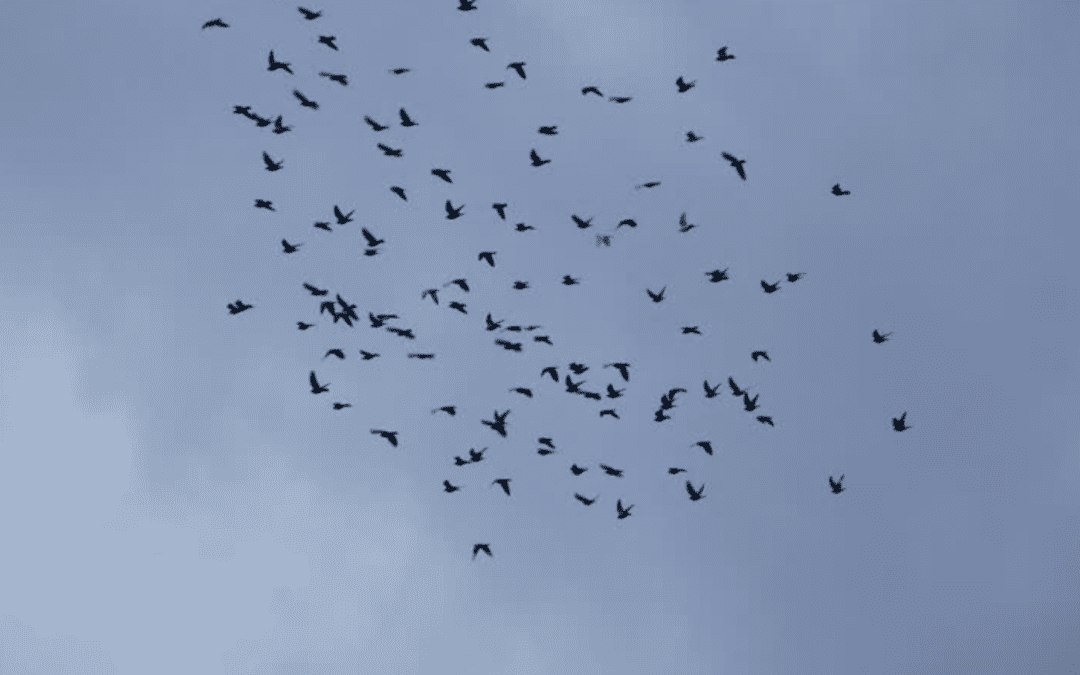
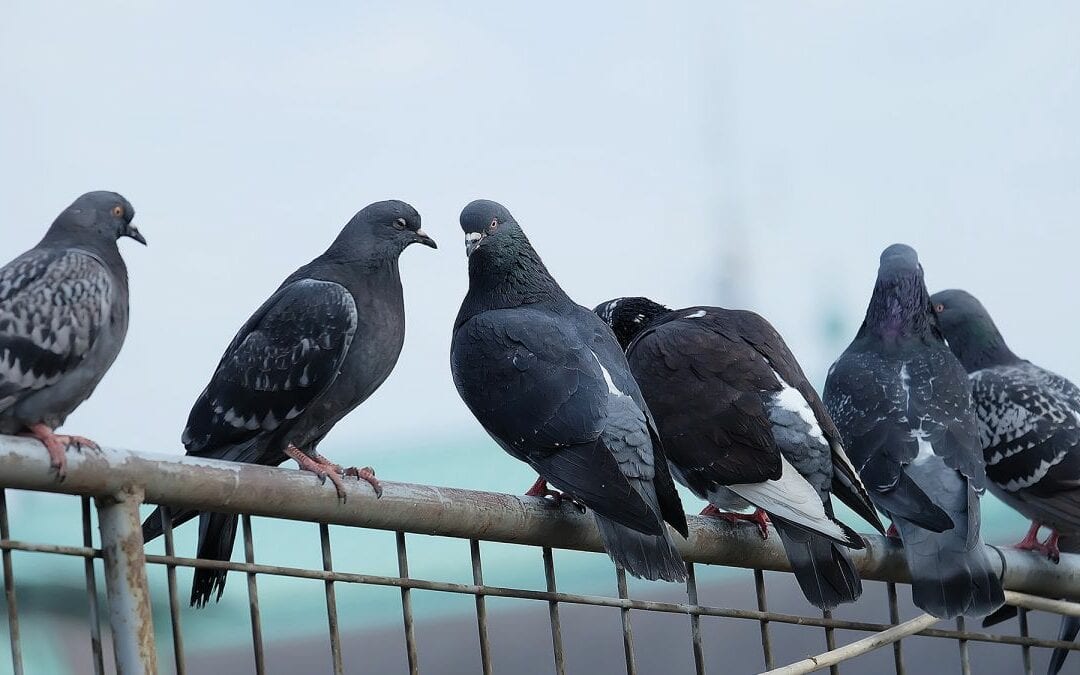
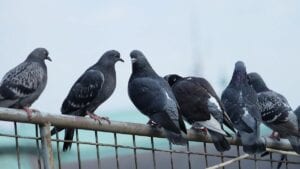
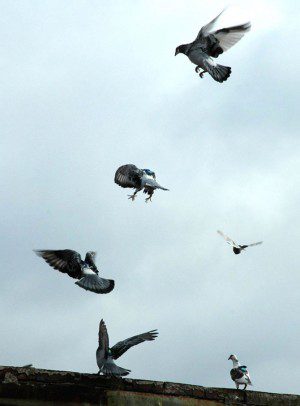
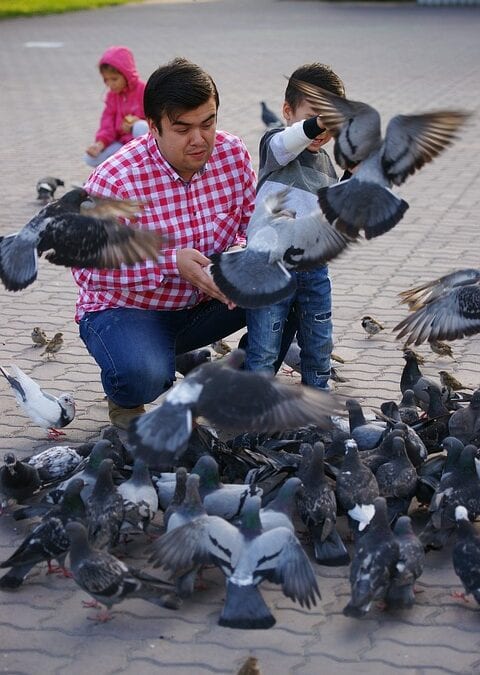
They peck at the pavement; they coo overhead; they swoop in hundreds across town squares: Pigeons have become such a permanent fixture in our urban landscapes that cities would seem oddly vacant without them.
But while many people harbor resentment for these ubiquitous creatures — labeling them “rats with wings” — few of us stop to ponder how pigeons became so numerous in the first place, and what our own role in their urban colonization might be.
Today, in fact, there are more than 400 million pigeons worldwide, most of which live in cities. But that wasn’t always the case. The city pigeons we know today are actually descended from a wild creature known as the rock dove (Columba livia): As its name suggests, this bird prefers a rocky coastal cliff habitat to the conveniences of city life. [Why Are Chickens So Bad at Flying?]
But going as far back as 10,000 years ago, written and fossil records show that people living in ancient Mesopotamia (modern-day Iraq) and Egypt began coaxing these doves with food into human-inhabited areas, encouraging them to roost and breed on their land. “Back then, we brought rock doves into cities to eat as livestock,” Steve Portugal, a comparative ecophysiologist who studies bird flight and behavior, told Live Science. The plump, young birds especially — known as “squabs” — became a prized source of protein and fat. People then began domesticating and breeding the birds for food, creating subspecies that led to the diversity of urban pigeons known today.
Along the way, humans began to realize that pigeons were useful for much more than their meat. As the birds grew more popular in the Middle East, North Africa and Western Europe in the ensuing centuries, people began to tap into their innate talent for navigation — the same skill that makes homing pigeons famous today. Ancient records show that Mediterranean sailors used the birds to point floundering ships toward land. In cities, they became increasingly valuable as airborne messengers that could deliver important information across large distances.
From there, humanity’s appreciation for the animals only grew: Although pigeons were initially domesticated as a food source, “as other poultry became more popular, pigeons fell out of favor for eating and people began breeding them as a hobby,” said Elizabeth Carlen, a doctoral student at Fordham University in New York City who studies the evolution of urban pigeons.
By the 1600s, rock doves — non-native to the United States — had reached North America, transported by ships in the thousands. Rather than being a food source, it’s most likely that the birds were brought across from Europe to satiate the growing pigeon-breeding trend among hobbyists, said Michael Habib, a paleontologist in the Dinosaur Institute at the Los Angeles County Museum of Natural History, and the University of Southern California.
Inevitably, birds escaped captivity, and began to breed freely in American cities. “We created this novel [urban] habitat and then we basically engineered an animal that does very well in that novel habitat,” Habib told Live Science. “They were successful in cities because we engineered them to be comfortable living around humans.” [Do Birds Really Abandon Their Chicks If Humans Touch Them?]
Cities became the perfect backdrop for the pioneering pigeons’ success. “Pigeons are naturally cliff-dwellers and tall buildings do a pretty great job at mimicking cliffs,” Carlen told Live Science. “Ornate facing, window sills and air-conditioning units provide fantastic perches for pigeons, similar to the crevices found on the side of a cliff.”
Another trait that makes pigeons more adaptable is their appetite. While other bird species have to rely on supplies of berries, seeds and insects, pigeons can eat just about anything that humans toss in the trash. “Other species are specialists and pigeons are the ultimate generalists,” Portugal said. “And the food is endless: I don’t think too many pigeons go to bed hungry!”
The pigeon’s unusual breeding biology seals the deal: Both parents rear their chicks on a diet of special protein- and fat-rich milk produced in a throat pouch called the crop. So, instead of having to rely on insects, worms and seeds to keep their young alive — resources that would be scarcer in cities — pigeons can provide for their offspring no matter what, Portugal says: “As long as the adults can eat, they can feed their babies, too.”
All these traits give pigeons a competitive edge compared with other species that might attempt survival in cities. Combined with the pigeon’s prolific breeding habits (parents can produce up to 10 chicks a year), it’s easy to see why these birds have become so populous around the world.
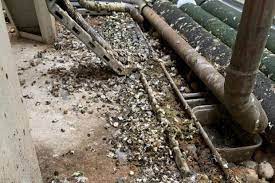
Not everyone appreciates the urban phenomenon that these birds have become — hence the “rat with wings” moniker. That’s understandable to some extent: Pigeons can spread diseases, and the mounds of guano they splatter across buildings can be cumbersome and costly to clean.
Despite this, Portugal sees a benefit to their presence in our urban environments. “They’re actually one of the few bits of wildlife that people get to interact with in cities now,” he said. What’s more, “they’re super-adaptable and super-successful; they’re the ultimate survivors. Actually, we can learn a lot from them.”
Pigeon Patrol Products & Services is the leading manufacturer and distributor of bird deterrent (control) products in Canada. Pigeon Patrol products have solved pest bird problems in industrial, commercial, and residential settings since 2000, by using safe and humane bird deterrents with only bird and animal friendly solutions. At Pigeon Patrol, we manufacture and offer a variety of bird deterrents, ranging from Ultra-flex Bird Spikes with UV protection, Bird Netting, 4-S Bird Gel and the best Ultrasonic and audible sound devices on the market today.
Voted Best Canadian wholesaler for Bird Deterrent products ten years in a row.
Contact us at 1- 877– 4– NO-BIRD, (604) 585-9279 or visit our website at www.pigeonpatrol.ca
Pigeon/Pigeon Patrol / Pigeons Roosting / Vancouver Pigeon Control /Bird Spikes / Bird Control / Bird Deterrent / Pigeon Deterrent? Surrey Pigeon Control / Pest /Seagull deterrent / Vancouver Pigeon Blog / Birds Inside Home / Pigeons in the cities / Ice Pigeons/ What to do about pigeons/ sparrows , Damage by Sparrows, How To Keep Raccoons Away, Why Are Raccoons Considered Pests/ De-fence / Pigeon Nesting/ Bird Droppings / Pigeon Dropping/ woodpecker control/ Professional Bird Control Company/ Keep The Birds Away/ Birds/rats/ seagull/pigeon/woodpecker/ dove/sparrow/pidgeon control/pidgeon problem/ pidgeon control/flying rats/ pigeon Problems/ bird netting/bird gel/bird spray/bird nails/ bird guard
The Blue Rock Pigeon lives in perfect freedom in ledges, fissures and holes of rocks, forts, old buildings and side walls of wells. It prefers to live in those places of towns and cities which have plenty of coarse grains. Thus, their favourite resorts include big buildings, godowns, grain markets, temples, mosques, churches, tombs, railway stations and office buildings. They never nest on trees.
Nature:
The pigeons are inoffensive, harmless, timid and gregarious birds. During breeding season solitary couples make a simple, flat and artless nest of small sticks and thin roots, etc., at all sorts of places where there is some shelter from rain and sun. The eggs are laid in these nests and further development also occurs there. During winter, the pigeons collect into flocks which may be composed of several hundred individuals.
Food and Feeding:
The pigeons are vegetarians, feeding on grains, pulses, seeds of fruits and grasses. Sometimes they feed on insects, snails and slugs probably mistaken for seeds. They regularly leave their places of retreats and settlings during mornings and evenings, and collect into flocks to plunder the nearby fields.
Locomotion:
The pigeons are provided with long powerful wings which are well adapted for swift and strong flight. They walk on their two legs and such kind of walking is called bipedal gait. They walk on ground in search of food with great rapidity. When startled, they rise suddenly by striking the ground with their wings producing a crackling sound.
Sound:
The pigeons do not sing, chirp or screech but produce a characteristic sound which resembles the syllables gootur-goon, gootur-goon.
Family Life:
They lead a monogamous life, i.e., one male lives and copulates with only one female throughout the life.
ADVERTISEMENTS:
Reproduction and Incubation:
The internal fertilisation is performed by copulation in which temporary union of male and female takes place at their cloacal ends, i.e., cloacae of the two oppose each other, and transfer of sperms occurs directly into the urodaeum of female. The pigeons are oviparous, the eggs are laid in the nest and are incubated by the warmth of the parent’s body and hatching occurs after a fortnight.
Parental Care:
The newly hatched youngs are immature, helpless and featherless and are nourished by both parents by a fatty, curdy secretion, the pigeon’s milk, which is secreted in their crop. The parental care and homing instinct are well developed in pigeons.
Distribution:
The Blue Rock Pigeons are widely distributed in Palaearctic (Europe) and Oriental regions (Asia) and North Africa. They are especially plentiful in Palestine city of Israel. In India, two subspecies of Columba livia are namely, Columba livia neglecta is found up to 13,000 feet on the Himalaya.
Another Columba livia intermedia is smaller and darker race, which occurs throughout India. The Indian wild pigeon differs from that of European in having the rump or lower part of the back ash-coloured, while Indian pigeon is white.
Pigeon Patrol Products & Services is the leading manufacturer and distributor of bird deterrent (control) products in Canada. Pigeon Patrol products have solved pest bird problems in industrial, commercial, and residential settings since 2000, by using safe and humane bird deterrents with only bird and animal friendly solutions. At Pigeon Patrol, we manufacture and offer a variety of bird deterrents, ranging from Ultra-flex Bird Spikes with UV protection, Bird Netting, 4-S Bird Gel and the best Ultrasonic and audible sound devices on the market today.
Voted Best Canadian wholesaler for Bird Deterrent products ten years in a row.
Contact us at 1- 877– 4– NO-BIRD, (604) 585-9279 or visit our website at www.pigeonpatrol.ca
Pigeon/Pigeon Patrol / Pigeons Roosting / Vancouver Pigeon Control /Bird Spikes / Bird Control / Bird Deterrent / Pigeon Deterrent? Surrey Pigeon Control / Pest /Seagull deterrent / Vancouver Pigeon Blog / Birds Inside Home / Pigeons in the cities / Ice Pigeons/ What to do about pigeons/ sparrows , Damage by Sparrows, How To Keep Raccoons Away, Why Are Raccoons Considered Pests/ De-fence / Pigeon Nesting/ Bird Droppings / Pigeon Dropping/ woodpecker control/ Professional Bird Control Company/ Keep The Birds Away/ Birds/rats/ seagull/pigeon/woodpecker/ dove/sparrow/pidgeon control/pidgeon problem/ pidgeon control/flying rats/ pigeon Problems/ bird netting/bird gel/bird spray/bird nails/ bird guard
With bits of DNA extracted from century-old museum specimens, researchers have found a place for the extinct passenger pigeon in the family tree of pigeons and doves, identifying for the first time this unique bird’s closest living avian relatives.
The new analysis, which appears this month in Molecular Phylogenetics and Evolution, reveals that the passenger pigeon was most closely related to other North and South American pigeons, and not to the mourning dove, as was once suspected.
Naturalists have long lamented that one of North America’s most spectacular birds was also one of the first to be driven to extinction. In the early 1800s it was the most abundant bird species on the planet, even though its range was limited to the eastern and central forests of the United States and parts of eastern Canada. Flocks of passenger pigeons were so vast they darkened the sky; it could take days for a flock to pass overhead.
“It must have been unbelievable to see one of these flocks,” said Kevin Johnson, an ornithologist with the Illinois Natural History Survey at the University of Illinois and lead author of the study. “There is nothing in modern times that we can compare it to. The passenger pigeon was very nomadic and it formed these huge flocks, in the millions, and breeding colonies in the millions.”
Passenger pigeons followed their food, settling down in forests that periodically produced a superabundance of acorns and chestnuts. The pigeons nested in dense colonies covering hundreds of acres. This made them easy targets for human predators.
Intensive hunting of the pigeons in the mid-to-late 19th century disrupted their ability to breed, Johnson said. That and habitat destruction led to the bird’s eventual extinction. (The last of her kind, a passenger pigeon named Martha, died in the Cincinnati Zoo in 1914.)
To find the passenger pigeon’s place in the evolutionary history of pigeons and doves, Johnson and his colleagues compared sequences from two of its mitochondrial genes with those of 78 species of pigeons and doves from around the world. (There are more than 300 species of pigeons and doves worldwide.)
“We had two sequences from the mitochondrial genome, which is a separate organelle in the cell that has its own genome,” Johnson said. Mitochondrial genes are plentiful and so are easier to sequence, he said. And the mitochondrial genome evolves more rapidly than the nuclear genome, making it a good target for evolutionary studies.
The researchers first analyzed the available sequence data for all (extant and extinct) pigeons and doves together. Then they focused only on the living species, for which much more genetic information is available. They built a family tree of all living pigeons and doves, and then compared the available gene sequences of the passenger pigeon to those of its relatives to find its place in that tree. Both approaches placed the passenger pigeon on the same place in the tree.
Prior to this study, some believed that the passenger pigeon was most closely related to the mourning dove, a smaller species that also has a relatively long tail, Johnson said.
“But it turns out, based on the DNA, that it’s actually related to the New World big pigeons in a totally different genus,” he said.
The band-tailed pigeon, Patagioenas fasciata, which lives in the western mountainous regions of North and South America, was the passenger pigeon’s geographically nearest relative. Other members of this genus are found in forests in parts of Mexico, Central and South America and the Caribbean.
The passenger pigeon was fairly distinct from its relatives, however, as it belonged to a separate genus, Ectopistes, Johnson said.
“The passenger pigeon is in a monotypic genus, which means there is only one species in that genus: Ectopistes migratorius,” he said. “This bird is pretty diverged from its nearest relatives, meaning it had a unique place in the world. It represented a unique lineage that’s now gone.”
The study team included Dale Clayton, of the University of Utah; John Dumbacher of the California Academy of Sciences and the Smithsonian Conservation Biology Institute; and Robert Fleischer, of the Smithsonian Conservation Biology Institute.
Pigeon Patrol Products & Services is the leading manufacturer and distributor of bird deterrent (control) products in Canada. Pigeon Patrol products have solved pest bird problems in industrial, commercial, and residential settings since 2000, by using safe and humane bird deterrents with only bird and animal friendly solutions. At Pigeon Patrol, we manufacture and offer a variety of bird deterrents, ranging from Ultra-flex Bird Spikes with UV protection, Bird Netting, 4-S Bird Gel and the best Ultrasonic and audible sound devices on the market today.
Voted Best Canadian wholesaler for Bird Deterrent products ten years in a row.
Contact us at 1- 877– 4– NO-BIRD, (604) 585-9279 or visit our website at www.pigeonpatrol.ca
Pigeon/Pigeon Patrol / Pigeons Roosting / Vancouver Pigeon Control /Bird Spikes / Bird Control / Bird Deterrent / Pigeon Deterrent? Surrey Pigeon Control / Pest /Seagull deterrent / Vancouver Pigeon Blog / Birds Inside Home / Pigeons in the cities / Ice Pigeons/ What to do about pigeons/ sparrows , Damage by Sparrows, How To Keep Raccoons Away, Why Are Raccoons Considered Pests/ De-fence / Pigeon Nesting/ Bird Droppings / Pigeon Dropping/ woodpecker control/ Professional Bird Control Company/ Keep The Birds Away/ Birds/rats/ seagull/pigeon/woodpecker/ dove/sparrow/pidgeon control/pidgeon problem/ pidgeon control/flying rats/ pigeon Problems/ bird netting/bird gel/bird spray/bird nails/ bird guard
One of Northern Ireland’s smallest World War II heroes has been honoured.
Paddy, a messenger pigeon who served with the RAF during the Normandy operations in June 1944, was remembered in his home town of Larne on Friday.
PDSA, Britain’s biggest veterinary charity, awarded Paddy the Dickin Medal, dubbed the animals’ “Victoria Cross”, 65 years ago this month.
He received it for being the fastest pigeon to reach England with a coded message from the battle-front beaches of Normandy.
The brave bird brought back vital information about the Allies’ progress, flying 230 miles in four hours 50 minutes – the fastest time of any of the messenger pigeons involved in the mission with an average speed of 56mph.
PDSA spokesman James Puxty said: “Paddy’s contribution to the D-Day operations was a credit to the thousands of messenger pigeons donated by the racing pigeon fraternity for service during World War II.
“He was one of 32 brave, feathered heroes that received the PDSA Dickin Medal for their life-saving flights during the war, and the only recipient from Northern Ireland.”
Local hero
Paddy was born and raised in Carnlough and joined thousands of other racing birds who were trained and drafted to RAF Hurn in Hampshire for military service.
Impressing military brass with his flying in the Air-Sea rescue units he was seconded to the United States First Army for undercover missions during the Normandy Landings.
In the face of poor weather conditions and the threat of German falcons, deployed to intercept Paddy and his comrades, he delivered his message to his home loft at RAF Hurn.
After the war Paddy returned to Carnlough and lived out his days with his owner Captain Andrew Hughes, until his death in 1954.
A memorial to the winged hero was erected in Carnlough harbour.
A feathered fly-past of pigeons formed part of the Paddy Memorial Day event held at Larne Museum and Arts Centre.
Larne Borough Council and the town’s historical society were joined by guests from PDSA and the owner of Paddy’s PDSA Dickin Medal, former Irish Army officer Kevin Spring.
Younger guests were entertained by Gail Seekamp, the children’s author, who read from her book “Paddy the Pigeon”.
The Dickin Medal was introduced in 1943 by Maria Dickin, PDSA’s founder. She wanted to recognise the gallantry and devotion to duty of animals serving with the Armed Forces and Civil Defence units during WWII.
Pigeon Patrol Products & Services is the leading manufacturer and distributor of bird deterrent (control) products in Canada. Pigeon Patrol products have solved pest bird problems in industrial, commercial, and residential settings since 2000, by using safe and humane bird deterrents with only bird and animal friendly solutions. At Pigeon Patrol, we manufacture and offer a variety of bird deterrents, ranging from Ultra-flex Bird Spikes with UV protection, Bird Netting, 4-S Bird Gel and the best Ultrasonic and audible sound devices on the market today.
Voted Best Canadian wholesaler for Bird Deterrent products ten years in a row.
Contact us at 1- 877– 4– NO-BIRD, (604) 585-9279 or visit our website at www.pigeonpatrol.ca
Pigeon/Pigeon Patrol / Pigeons Roosting / Vancouver Pigeon Control /Bird Spikes / Bird Control / Bird Deterrent / Pigeon Deterrent? Surrey Pigeon Control / Pest /Seagull deterrent / Vancouver Pigeon Blog / Birds Inside Home / Pigeons in the cities / Ice Pigeons/ What to do about pigeons/ sparrows , Damage by Sparrows, How To Keep Raccoons Away, Why Are Raccoons Considered Pests/ De-fence / Pigeon Nesting/ Bird Droppings / Pigeon Dropping/ woodpecker control/ Professional Bird Control Company/ Keep The Birds Away/ Birds/rats/ seagull/pigeon/woodpecker/ dove/sparrow/pidgeon control/pidgeon problem/ pidgeon control/flying rats/ pigeon Problems/ bird netting/bird gel/bird spray/bird nails/ bird guard
If you have ever been to a park or town with young children in tow, you will know they make a beeline for any group of pigeons. They usually delight in making noise and laughing as they flee, except for the tough one, there is always a Rambo that fears nothing and no-one!
My initial instinct has always been to call the child away, telling them the birds are yukky and carry disease. Have I been doing them an injustice for all of these years?
Are pigeons dirty and should we steer clear of them?
It seems there’s some basis to our assumptions. Pigeons might be classed as dirty as they do indeed carry disease. However, humans and every other living creature also carry disease, even domestic pets such as cats and dogs, and we don’t call them dirty and disease-ridden, do we?
Pigeons carry zoonotic diseases. This means any bacteria that can be passed from human to non-human, and back again. Thousands of other species carry zoonotic disease and pose no significant health risk to humans.
What the professionals say
David Taylor BVMS FRCVS FZS had this to say.
“ In 50 years of professional work as a veterinary surgeon I haven’t seen a single case of zoonosis in a human-related to pigeons. I have seen examples of human disease-related to contact with cats, dogs, cattle, monkeys, sheep, camels, budgies, parrots, cockatoos, aquarium fish, and even dolphins, on many occasions”
This is confirmed by the UK’s Chief Veterinary Officer who stated that there was no risk to human health when asked in the House of Commons, about the 7000+ feral pigeons that congregate daily in Trafalgar Square.
In exceptionally rare cases, people have been known to get ill with mild flu-like symptoms, after coming into contact with the fungus from pigeon droppings. It can be passed in contaminated water droplets or soil. Expert Professor Hugh Pennington maintains this is incredibly rare in the UK and good hand washing hygiene should prevent transmission.
People with compromised immune systems should avoid contact with all bird droppings.
Why Have Pigeons got a Bad Reputation
The Mayor of London launched a bid to prevent feeding the feral pigeons in Trafalgar Square as he felt so strongly about their nuisance value.
Although they pose no major risk to public health, the mess they create and the havoc they wreak makes feral pigeons public enemy number one.
Their bad reputation might be exaggerated, but the sheer amount of pigeons that flock together can be overwhelming. The weight of the birds and their droppings can damage property.
Worst of all, pigeons in towns, gardens, and parks, can bully all of the songbirds that we love, resulting in them looking for other places to feed and nest.
Are Pigeons Good for Anything
If you have ever watched a flock of pigeons, you will have surely noticed that they are not particularly fussy about what they eat. Chips, crisps, and the remnants of burger boxes in the street are a feast for a feral pigeon. They are unpaid street cleaners.
If only chewing gum and cigarette butts were edible, there’d be virtually no need for road sweepers!
Final thoughts…
Are pigeons dirty? No more so than any other wild animal, but the fact that they are so prevalent in almost all parts of the country makes us more aware of them.
Avoiding their droppings, or cleaning it up as quickly as possible, followed by a thorough hand wash, is enough to keep us safe.
If the domestic pigeons are happy to fly around with the feral pigeons and not come into contact with disease, then surely, we needn’t worry too much either.
Pigeon Patrol Products & Services is the leading manufacturer and distributor of bird deterrent (control) products in Canada. Pigeon Patrol products have solved pest bird problems in industrial, commercial, and residential settings since 2000, by using safe and humane bird deterrents with only bird and animal friendly solutions. At Pigeon Patrol, we manufacture and offer a variety of bird deterrents, ranging from Ultra-flex Bird Spikes with UV protection, Bird Netting, 4-S Bird Gel and the best Ultrasonic and audible sound devices on the market today.
Voted Best Canadian wholesaler for Bird Deterrent products ten years in a row.
Contact us at 1- 877– 4– NO-BIRD, (604) 585-9279 or visit our website at www.pigeonpatrol.ca
Pigeon/Pigeon Patrol / Pigeons Roosting / Vancouver Pigeon Control /Bird Spikes / Bird Control / Bird Deterrent / Pigeon Deterrent? Surrey Pigeon Control / Pest /Seagull deterrent / Vancouver Pigeon Blog / Birds Inside Home / Pigeons in the cities / Ice Pigeons/ What to do about pigeons/ sparrows , Damage by Sparrows, How To Keep Raccoons Away, Why Are Raccoons Considered Pests/ De-fence / Pigeon Nesting/ Bird Droppings / Pigeon Dropping/ woodpecker control/ Professional Bird Control Company/ Keep The Birds Away/ Birds/rats/ seagull/pigeon/woodpecker/ dove/sparrow/pidgeon control/pidgeon problem/ pidgeon control/flying rats/ pigeon Problems/ bird netting/bird gel/bird spray/bird nails/ bird guard
No matter what type of business you’re in, pests may eventually become a problem. This is doubly true if you’re in the food business in London. Out of all the pests you may encounter, birds are probably one of the worst. Not only are these pests irritating, but they can also be extremely harmful to your business. As an example, here are a handful of reasons why pigeons are bad for business.
Pigeons can harm businesses in the following ways
1. Their faeces and the damage it causes
The biggest issue with pigeons is their faeces. These birds defecate constantly. To make matters worse, they very often do their business over your business. In addition to this, if their mess is on the ground, someone will eventually have to clean it up. And this is something you’ll have to do over and over again due to the health and safety risks associated with pigeon droppings.
Another reason why pigeons are bad for business, is because they defecate onto your roof. This is also an enormous hassle to clean up. More importantly, it can cause significant damage to your roof. The reason why is because pigeon faeces are extremely corrosive. This means that over time, accumulated droppings can eat through your roof, and also damage important infrastructure.
2. Annoying your patrons
The main problem with pigeons is that they often take over outside eating areas and harass patrons. This is probably the biggest reason why pigeons are bad for food industry and hospitality businesses. Anyone who has found themselves surrounded by a seething mass of pigeons pestering them for scraps can attest to this.
These birds are extremely annoying and off putting, and have even been known to defecate on customers. They also make a lot of noise. What’s more, over time the presence of these birds can actually dissuade people from purchasing your food or visiting your cafe. All in all, pigeons are a serious nuisance and should be dealt with by a professional London pigeon control team immediately.
3. Nesting on buildings
Pigeons are also bad for business because they nest on the property. The problem here is that pigeons can damage your building in several ways. Besides defecating, they also continuously shed their feathers.
These feathers can eventually block drains which may, in turn, lead to flooding and water damage. Along with this, their feathers blocks vents, chimneys, and air conditioning units.
Pigeons also cause damage whilst building their nests. Not to mention the mess and debris they leave you to deal with. The other issue with nests, is that pigeons often destroy parts of your roof in their hunt for building materials. These birds may also peck at and damage roofs and sections of your guttering.
Pigeon Patrol Products & Services is the leading manufacturer and distributor of bird deterrent (control) products in Canada. Pigeon Patrol products have solved pest bird problems in industrial, commercial, and residential settings since 2000, by using safe and humane bird deterrents with only bird and animal friendly solutions. At Pigeon Patrol, we manufacture and offer a variety of bird deterrents, ranging from Ultra-flex Bird Spikes with UV protection, Bird Netting, 4-S Bird Gel and the best Ultrasonic and audible sound devices on the market today.
Voted Best Canadian wholesaler for Bird Deterrent products ten years in a row.
Contact us at 1- 877– 4– NO-BIRD, (604) 585-9279 or visit our website at www.pigeonpatrol.ca
Pigeon/Pigeon Patrol / Pigeons Roosting / Vancouver Pigeon Control /Bird Spikes / Bird Control / Bird Deterrent / Pigeon Deterrent? Surrey Pigeon Control / Pest /Seagull deterrent / Vancouver Pigeon Blog / Birds Inside Home / Pigeons in the cities / Ice Pigeons/ What to do about pigeons/ sparrows , Damage by Sparrows, How To Keep Raccoons Away, Why Are Raccoons Considered Pests/ De-fence / Pigeon Nesting/ Bird Droppings / Pigeon Dropping/ woodpecker control/ Professional Bird Control Company/ Keep The Birds Away/ Birds/rats/ seagull/pigeon/woodpecker/ dove/sparrow/pidgeon control/pidgeon problem/ pidgeon control/flying rats/ pigeon Problems/ bird netting/bird gel/bird spray/bird nails/ bird guard