by Pigeon Patrol | May 2, 2023 | history of pigeons, MBCA, pet bird, Pigeon Control, Pigeon Droppings, Pigeon Patrol's Services, Pigeon Predators
Kristyn Wong-Tam doesn’t hate pigeons.
But the councillor for Toronto Centre (Ward 13) has watched constituents fight pigeons for long enough, having fielded numerous complaints over the years from people and businesses forced to buy netting to keep the birds off balconies and window ledges and anything else that can act as a perch or nesting area.
“I do think we’ve reached a tipping point in Toronto,” says the councillor, who has often spotted people feeding pigeons random food in places where people and birds congregate, like Yonge-Dundas Square.
“I’ve seen people take out a loaf of bread and throw it on Bay Street.”
Wong-Tam believes that people are acting out of genuine concern for the birds, or to ensure food doesn’t go to waste. In fact, the discarded food also attracts vermin.
When Toronto council meets this week, Wong-Tam intends to introduce a member’s motion asking that the city examine the possibility of banning feeding pigeons anywhere in the city, in public and private spaces, in order to control the pigeon population.
Currently, the city of Toronto parks bylaw prohibits feeding wildlife or depositing food for wildlife in parks, but there is no such restriction elsewhere. As a result, pigeons crowd public spaces like sidewalks, plazas, boulevards and laneways where they can find discarded food and are also fed by people.
In fact, the lack of enforcement of the bylaw in parks has even rendered some green space unusable, according to Wong-Tam’s motion.
Only two tickets for feeding wildlife in parks were issued in 2020, according to the city.
The lack of control means business is booming for David Szabo, owner of Pigeon Tom, a firm specializing in bird control. Cleaning up after pigeons, and protecting balconies and buildings from pigeons is most of his business.
Nesting pigeons love concrete balconies, and they can quickly coat patio furniture, barbecues and stored bicycles in droppings that are difficult and sometimes impossible to clean effectively.
“It literally drives people crazy because they’re so loud,” says Szabo. “They’re always cooing, especially early in the morning at 6 or 7 a.m.”
Because the birds return to nest in the place where they were born, the situation can quickly spiral out of control, Szabo says. Then there are the people who never go out on their balconies at all.
“In some cases, the person just never went out on the balcony for like five or six years, and it’s so bad you can’t open the door.”
Pigeon experts agree that feeding pigeons people-food, or large quantities of birdseed, isn’t good for the birds or the people who have to live with them. It leads to overpopulation and a buildup of unsightly and corrosive droppings, among other problems.
“People think that they’re feeding the birds, oftentimes they’re feeding the rats,” says pigeon expert Elizabeth Carlen, a post-doctoral research fellow at the Living Earth Collaborative at Washington University in St. Louis.
Carlen has studied pigeon populations from Boston to Washington, D.C.
“I have seen many places where people have dropped birdseed, thinking they are feeding the birds, and right behind it will be a rat burrow.”
Cities, with their proliferation of concrete balconies and windowsills and ledges, are just like the rock cliffs pigeons populate in nature, says Andrew Blechman, author of “Pigeons: The Fascinating Saga of the World’s Most Revered and Reviled Bird.”
“They like our cities because pigeons don’t do trees, they do cliffs. It’s a concrete jungle and that’s how they like it.”
Pigeons and people have enjoyed a symbiotic relationship since at least Mesopotamia, says Blechman. Pigeons have been a source of food, kept as pets, flown for sport and trained to assist in warfare — including a Canadian pigeon named Beachcomber, who won a medal for flying across the foggy English Channel to Britain to deliver news of the landing at Dieppe.
Colin Jerolmack, author of “The Global Pigeon,” has observed people feeding pigeons in parks for hours at a time.
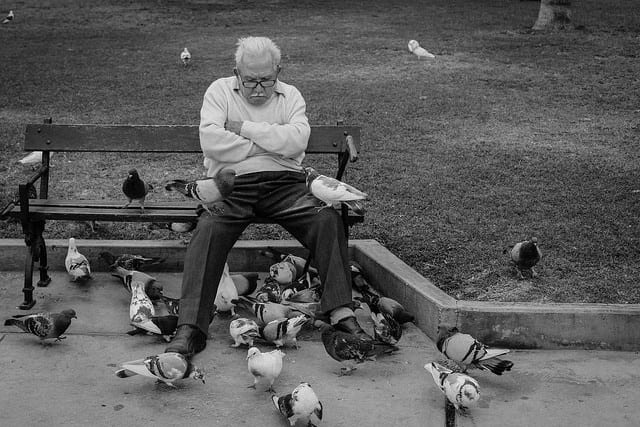
“Many socially marginalized people — people who are homeless or elderly — fed the pigeons and out of it developed pet-like relationships that were very meaningful to them,” says Jerolmack.
“It may sound crazy, but pigeons do have different personalities and they would recognize the feeders and sit on their shoulders and wrists and show them affection.”
Also kids love pigeons and it is often their first close encounter with wildlife if they live in the city, Jerolmack says.
Jerolmack, Carlen and Blechman agree the solution is not to ban feeding pigeons, mostly because a ban is unlikely to work.
Blechman says that the people most likely to be feeding pigeons the most know it’s wrong, but they can’t help themselves. They’re obsessed. They’re up at 4 a.m., dumping an entire bag of birdfeed for the pigeons. They’re hard to catch.
“If you’re going to feed a pigeon, feed responsibly — a teaspoon or a tablespoon of bird-feed, that’s it,” says Blechman, who favours public education campaigns.
Keeping a pigeon as a pet is allowed in Toronto, as long as it is kept exclusively on private property, but Wong-Tam says people feeding wild pigeons from their homes can also create a problem for the neighbourhood if it draws flocks of birds.
The city receives about 60 complaints a year related to pigeons, including pet pigeons, wild pigeons and pigeon droppings, under various bylaws, according to data supplied by the city.
Other forms of population control are more likely to work better than a poorly enforced ban, say experts.
Blechman says some cities control their pigeon populations by building coops on top of buildings, feeding the birds where they roost. The eggs laid there are not allowed to hatch.
He finds it hard not to respect pigeons. They are gentle, monogamous and they raise their offspring together. They like humans. They can fly 900 kilometres at a stretch, at an average speed of 95 km/h, from a place they’ve never been to their home, like laser missiles.
“Pigeons have been beloved all through human history. It’s only the last 60 years that people have been nagging on them,” Blechman says.
“Cities can be awfully concrete, it’s awfully nice to see something that we’re not in control of, that’s a piece of nature, like a squirrel, like a bird, like a pigeon,” Blechman adds. “They animate our lives and that’s why people like to sit on a bench and feed them a piece of crust.”
Source
Pigeon Patrol Products & Services is the leading manufacturer and distributor or bird deterrent (control) products in Canada. Pigeon Patrol products have solved pest bird problems in industrial, commercial, and residential settings since 2000, by using safe and humane bird
deterrents with only bird and animal friendly solutions. At Pigeon Patrol, we manufacture and offer a variety of bird deterrents, ranging from Ultra-flex Bird Spikes with UV protection, Bird Netting, 4-S Bird Gel and the best Ultrasonic and audible sound devices on the market today.
Voted Best Canadian wholesaler for Bird Deterrent products ten years in a row.
Contact us at 1 877-4-NO-BIRD,(604) 585-9279 or visit our website at www.pigeonpatrol.ca
Pigeon/Pigeon Patrol / Pigeons Roosing / Vancouver Pigeon Control / Bird Spikes / Bird Control / Bird Deterrent / PIgeon Deterrent / Surrey Pigeon Control / Pest / Seagull deterrent / Vancouver Pigeon Blog / Birds Inside Home / Pigeons in the cities / Ice Pigeons / What to do about pigeons / sparrows, Damage by Sparrows, How to Keep Raccoons Away, Why Are Raccoons Considered Pests / De-fence / Pigeon Nesting / Bird Droppings / Pigeon Dropping / woodpecker control / Professional Bird Control Company / Keep The Birds Away / Birds/rats/seagull/pigeon/woodpecker/dove/sparrow/pidgeon control/pidgeon problem/pidgeon control/flying rats/pigeon problems/ bird netting/bird gel/bird spray/bird nails/bird guard
by Pigeon Patrol | Apr 26, 2023 | history of pigeons, MBCA, pet bird, Pigeon Control, Pigeon Droppings, Pigeon Patrol's Services, Pigeon Predators
Pigeons like to land, roost, nest, and make a mess of your roof and they’re not easy to get rid of. Persistence, bird deterrents, and bird exclusion is the key.
Get rid of pigeons on the roof by removing food and water
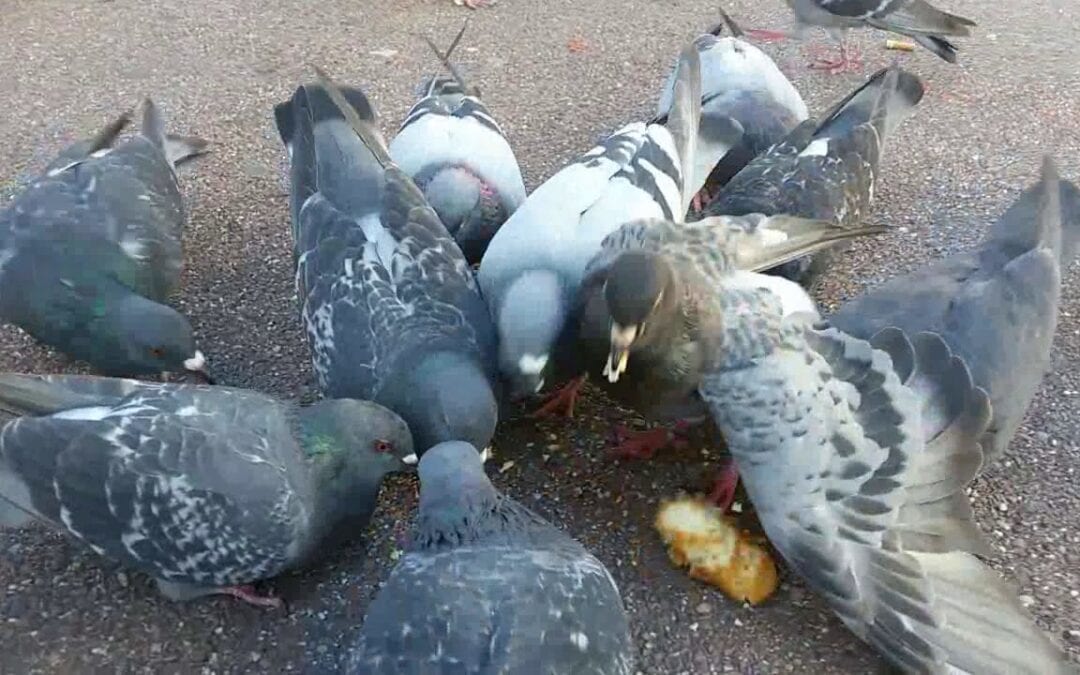
Remove all food and water sources and never feed the pigeons! In addition, don’t let your neighbors feed the pigeons. The pigeons can eat at your neighbors and nest on your roof!
Pigeons mainly like to eat seeds and grains such as oats, wheat, corn, cereal, sorghum, rice, beans, barley, millet, peas, and sunflower. They also like to eat food scraps left behind by people, including bread crumbs and popcorn. Birdseed is their favorite because it contains a variety of seeds and grains.
When grains or seeds aren’t available pigeons will eat fruit, greens, and occasionally insects, earthworms, and snails. They especially like apples, grapes, berries, lettuce, spinach, and sprouted seeds.
Pigeons need a constant water source. If water isn’t readily available they will leave to find a more suitable place to live. They can find water in birdbaths, gutters, pools, decorative water fountains, puddles, ponds, streams, and even leaves after a rain storm.
Easy to use deterrents to get rid of pigeons on the roof
Aluminum foil, bird deterrent tape, shiny Mylar balloons, wind propelled shiny spinning objects, and plastic decoy scare owls are scary objects to pigeons. Place scary objects on the roof, under the eves, or on the patio. Pigeons don’t like or feel comfortable with scary objects next to their nesting area. They would rather live in a more peaceful environment. One thing to remember, when installing scary objects, is to move them around on a regular basis. Objects that stay in one position don’t scare pigeons.
Wind chimes may deter pigeons. You can give it a try. Pigeons have sensitive hearing and the noise from wind chimes can actually hurt their ears. Pigeons don’t particularly like to nest where loud noises come and go.
Sticky bird gel can also deter pigeons. Apply the sticky gel to your roof where the pigeons are landing and roosting. The gel will make the area uncomfortable for the pigeons to roost.
Metal bird spikes to get rid of pigeons on the roof
Metal anti bird perching spikes can be effective in the right circumstance. They can work pretty well depending on the location you put them. Install them on rooftop edges, ledges, chimneys, and anywhere you see the pigeons land, roost, or nest. Metal bird spikes are mostly maintenance free and can be a permanent solution to deter pigeons from your roof.
Metal anti-perching spikes are harder to install and are not aesthetically appealing.
Wire screens or mesh to get rid of pigeons on the roof
Exclusion is the best solution to pigeon problems in alcoves, around chimneys, under solar panels, on vents, and many other places on the roof. Exclusion with wire bird screen and mesh do offer a permanent solution to pigeon nesting problems.
Solar panels are generally raised 5-12 inches above shingled or tiled roofs, thus creating a void between the panel and the roof. Pigeons can easily go underneath the panel to nest, poop, and make a noticeable and destructive mess. Most, if not all, rooftops that have solar panels need to have pigeons excluded from getting under the solar panels.
Installing wire bird screens or mesh can be difficult and hazardous. It requires being on the roof with tools, a lot of bending over (which is physically demanding), cutting the wire to the proper dimensions, and stapling or screwing on the wire. It is not advised for a home or business owner to install wire screens or mesh because it isn’t safe. You can fall off the roof and get seriously injured or die. To use this method, please hire a professional bird control company.
Bird netting to get rid of pigeons on the roof
If your roof is large and flat, bird netting is an excellent method to use to keep pigeons off your roof. It physically blocks the birds from the roof. If the birds can’t get on the roof, they can’t roost or nest. Bird netting is an exclusion method primarily used for large commercial bird and pigeon control.
A professional bird control operator should install bird netting. If not installed correctly the pigeons can still land on the area and get trapped, as well as other birds. This is cruel. Please hire a professional bird control company for bird netting. It will cost money but it is the safest and most humane way to have bird netting installed.
Remove bird nesting materials and droppings
It is important to remove all pigeon nesting and feces prior to excluding pigeons. Nesting materials and droppings left on the roof will continue to cause damage.
If the roof has a pitch, using a power washer is generally the best way to get rid of pigeon waste. Put a tarp on the ground next to the roof to catch the debris as it is rinsed off the roof. It will be much easier to clean up the pigeon feces on the ground if it is contained on a tarp. Wear a mask to prevent inhaling fumes from pigeon feces and wet the feces down before rinsing off. Histoplasmosis is zoonotic disease that can be found in pigeon feces. Zoonotic diseases are caused by harmful germs like viruses, bacteria, parasites, and fungi that are spread between animals and people.
If the roof is flat, you will have to wet the roof down (to prevent spreading contaminants and disease through the air), then rake and sweep up the pigeon waste prior to rinsing. Again, wear a mask to prevent inhaling fumes from pigeon feces.
Please be careful or better yet, call a professional. Using a power washer on the roof can be slippery and dangerous. Inhaling noxious pigeon feces can cause disease – it is a biohazard.
Importance of discouraging pigeons from nesting on your roof
Pigeons spread disease. There are over 60 diseases birds and their droppings can carry. Some of the diseases from pigeon droppings include salmonella, toxoplasmosis, cryptococcosis, St Louis encephalitis, E.coli, and more. In addition, fungus can grow in pigeon droppings which can cause histoplasmosis. Histoplasmosis is a respiratory disease that may be fatal. Pigeons are also carriers of pests including fleas, mites, ticks, and lice as well as West Nile virus. All of these diseases can pose a serious threat to human health.
Property damage is a big concern with pigeon nesting and droppings. Nests can clog gutters, ventilation pipes, chimneys, and damage electrical equipment. Damaged electrical wires from pigeon nests can even lead to fires. Pigeon droppings are very acidic. The droppings can actually eat away at the roof structure and cause roof leakage.
Pigeon droppings are unsightly. Nobody likes to see or walk on pigeon droppings.
People can slip and fall where pigeon droppings accumulate. When pigeon feces are fresh or rained on it is slippery.
Call a professional
Installing wire bird spikes, wire screens, wire mesh, or bird netting is difficult and hazardous. People can, and do, fall off roofs. People who fall off roofs get seriously injured and even die. It is best to call a professional bird control company when using these methods. Companies that specialize in removing and excluding bird pests (like pigeons) have the know how and safety equipment to get rid of pigeons in a safe and efficient manner from rooftops, alcoves, solar panels, chimneys, window sills, and other areas.
Source
Pigeon Patrol Products & Services is the leading manufacturer and distributor or bird deterrent (control) products in Canada. Pigeon Patrol products have solved pest bird problems in industrial, commercial, and residential settings since 2000, by using safe and humane bird
deterrents with only bird and animal friendly solutions. At Pigeon Patrol, we manufacture and offer a variety of bird deterrents, ranging from Ultra-flex Bird Spikes with UV protection, Bird Netting, 4-S Bird Gel and the best Ultrasonic and audible sound devices on the market today.
Voted Best Canadian wholesaler for Bird Deterrent products ten years in a row.
Contact us at 1 877-4-NO-BIRD,(604) 585-9279 or visit our website at www.pigeonpatrol.ca
Pigeon/Pigeon Patrol / Pigeons Roosing / Vancouver Pigeon Control / Bird Spikes / Bird Control / Bird Deterrent / PIgeon Deterrent / Surrey Pigeon Control / Pest / Seagull deterrent / Vancouver Pigeon Blog / Birds Inside Home / Pigeons in the cities / Ice Pigeons / What to do about pigeons / sparrows, Damage by Sparrows, How to Keep Raccoons Away, Why Are Raccoons Considered Pests / De-fence / Pigeon Nesting / Bird Droppings / Pigeon Dropping / woodpecker control / Professional Bird Control Company / Keep The Birds Away / Birds/rats/seagull/pigeon/woodpecker/dove/sparrow/pidgeon control/pidgeon problem/pidgeon control/flying rats/pigeon problems/ bird netting/bird gel/bird spray/bird nails/bird guard
by Pigeon Patrol | Apr 18, 2023 | history of pigeons, MBCA, pet bird, Pigeon Control, Pigeon Droppings, Pigeon Patrol's Services, Pigeon Predators
When travelling in groups, animals frequently have to make decisions on the direction of travel. These decisions can be based on consensus, when all individuals take part in the decision (i.e. democratic decision; social information), or leadership, when one member or a minority of members make the decision (i.e. despotic decision; personal information). Here we investigated whether decision-making on the navigation of small flocks is based on democratic or despotic decisions. Using individual and flock releases as the experimental approach, we compared the homing performances of homing pigeons that fly singly and in groups of three. Our findings show that although small groups were either governed (i.e. when individuals in the flock had age differences) or not (i.e. when individuals in the flock had the same age) by leaders, with concern to decision-making they were all ruled by democratic decisions. Moreover, the individual homing performances were not associated with leadership. Because true leaders did not assume right away the front position in the flock, we suggest that as in human groups, starting from a central position is more effective as it allows leaders to not only transmit their own information but also to average the tendencies of the other group members. Together, the results highlight the importance of democratic decisions in group decision-making.
Source
Pigeon Patrol Products & Services is the leading manufacturer and distributor or bird deterrent (control) products in Canada. Pigeon Patrol products have solved pest bird problems in industrial, commercial, and residential settings since 2000, by using safe and humane bird
deterrents with only bird and animal friendly solutions. At Pigeon Patrol, we manufacture and offer a variety of bird deterrents, ranging from Ultra-flex Bird Spikes with UV protection, Bird Netting, 4-S Bird Gel and the best Ultrasonic and audible sound devices on the market today.
Voted Best Canadian wholesaler for Bird Deterrent products ten years in a row.
Contact us at 1 877-4-NO-BIRD,(604) 585-9279 or visit our website at www.pigeonpatrol.ca
Pigeon/Pigeon Patrol / Pigeons Roosing / Vancouver Pigeon Control / Bird Spikes / Bird Control / Bird Deterrent / PIgeon Deterrent / Surrey Pigeon Control / Pest / Seagull deterrent / Vancouver Pigeon Blog / Birds Inside Home / Pigeons in the cities / Ice Pigeons / What to do about pigeons / sparrows, Damage by Sparrows, How to Keep Raccoons Away, Why Are Raccoons Considered Pests / De-fence / Pigeon Nesting / Bird Droppings / Pigeon Dropping / woodpecker control / Professional Bird Control Company / Keep The Birds Away / Birds/rats/seagull/pigeon/woodpecker/dove/sparrow/pidgeon control/pidgeon problem/pidgeon control/flying rats/pigeon problems/ bird netting/bird gel/bird spray/bird nails/bird guard
by Pigeon Patrol | Mar 23, 2023 | Columbidae, Doves, history of pigeons, MBCA, pet bird, Pigeon Control, Pigeon Droppings, Pigeon Patrol's Services
A recent first detection of pigeon aviadenovirus-1 and pigeon circovirus co-infection associated with Young Pigeon Disease Syndrome (YPDS) in a pigeon flock in Turkey, prompted a study focused on documenting the distribution of Pigeon aviadenovirus (PiAdV-1 and PiAdV-2), Pigeon circovirus (PiCV), Columbid alphaherpesvirus 1 (pigeon herpesvirus (PiHV)) and Fowl aviadenovirus (FAdV) in the country. These viruses were selected as they are associated with severe disease in pigeons across the world. A total of 192 cloacal swabs were collected from young (<1 year old) pigeons from 16 different private pigeon flocks across Turkey, between 2018 and 2021 as part of routine diagnostic sampling. PiCV genetic material was the most frequently detected 4/16 (25%), PiAdV-1 and CoHV-1 DNA were both found in one flock each, while neither PiAdV-2 and FAdV were detected in any of the studied pigeon flocks. PiCV and PiHV genetic material were both detected in the same pigeon flock’s cloacal samples as a co-infection with the identification of PiHV being a first in Turkey.
Source
Pigeon Patrol Products & Services is the leading manufacturer and distributor or bird deterrent (control) products in Canada. Pigeon Patrol products have solved pest bird problems in industrial, commercial, and residential settings since 2000, by using safe and humane bird
deterrents with only bird and animal friendly solutions. At Pigeon Patrol, we manufacture and offer a variety of bird deterrents, ranging from Ultra-flex Bird Spikes with UV protection, Bird Netting, 4-S Bird Gel and the best Ultrasonic and audible sound devices on the market today.
Voted Best Canadian wholesaler for Bird Deterrent products ten years in a row.
Contact us at 1 877-4-NO-BIRD,(604) 585-9279 or visit our website at www.pigeonpatrol.ca
Pigeon/Pigeon Patrol / Pigeons Roosing / Vancouver Pigeon Control / Bird Spikes / Bird Control / Bird Deterrent / PIgeon Deterrent / Surrey Pigeon Control / Pest / Seagull deterrent / Vancouver Pigeon Blog / Birds Inside Home / Pigeons in the cities / Ice Pigeons / What to do about pigeons / sparrows, Damage by Sparrows, How to Keep Raccoons Away, Why Are Raccoons Considered Pests / De-fence / Pigeon Nesting / Bird Droppings / Pigeon Dropping / woodpecker control / Professional Bird Control Company / Keep The Birds Away / Birds/rats/seagull/pigeon/woodpecker/dove/sparrow/pidgeon control/pidgeon problem/pidgeon control/flying rats/pigeon problems/ bird netting/bird gel/bird spray/bird nails/bird guard
by Pigeon Patrol | Mar 23, 2023 | Columbidae, Doves, history of pigeons, MBCA, pet bird, Pigeon Control
Pigeons may seem harmless, but these pest birds cause millions of dollars in damage every year to buildings, ventilation systems, machinery, statues, roofs, and much more. Bird droppings and nesting materials left by pigeons pose physical problems and health hazards that can become very serious if not corrected quickly making prompt and effective professional bird control is often essential.
Potential Health Hazards:
There are many health risks associated with pigeons and their droppings. The bacteria, fungi, and ectoparasites that they and their droppings harbor are numerous. The four most common ways disease is passed by bird to human are: inhalation of fecal dust, food and water contaminated with bird feces, direct contact with feces, and parasitic transfer.
Pigeon droppings can expose humans to many diseases, including salmonella, Newcastle disease, candidiasis, encephalitis, orthosis, and toxoplasmosis. In addition, they can also carry cryptococcosis, and coccidiodomycosis, which cause meningitis. The droppings may also harbor growth of fungus, which causes histoplasmosis. Fleas, lice, mites, and other pests often live on these birds, hitching a ride to where ever they want to jump off. Pigeons may also attract other pests, such as rats, which feed on dead pigeons and food that well-intentioned bird lovers may scatter for them.
In addition to disease, bird droppings are known for triggering people to slip and fall, which makes it especially important to rid the birds from highly trafficked areas.
Damage Caused by Pigeons:
These are messy birds, leaving droppings everywhere they go, particularly near their roost sites. Pigeon droppings are not just gross, they are also full of uric acid which makes them extremely corrosive. The droppings are the direct cause of millions of dollars in damage to buildings and other structures. Particularly vulnerable are painted surfaces, awnings, signs, and other similar surfaces. A tragic example of the corrosiveness of pigeon droppings is the Minnesota bridge accident in 2007, which was found to be the direct result of bird droppings eating away at the metal bridge supports until they weakened.
In addition to the damage cause by their acidic droppings, pigeon nests can also cause damage. Pest birds will often build nests in gutters or on roof corners blocking essential drainage systems. Every year several warehouses experience roof damage, and even collapse, when drainage systems have been blocked and standing water rises just six inches. Bird nests can also block ventilation systems, which not only prevents exhaust of potentially harmful gases, but also has the potential to spread diseases. Fire is also a potential hazard. Nesting materials are usually flammable, consisting of twigs, straw, grasses and dried droppings. When pest birds build their nests inside electric signs or other machinery there is a great risk of fire.
Pigeons are creatures of habit and highly social. Once they have found a cozy spot the will return again and again, bringing along more of their pigeon pals. Prolific breeders, pigeons can hatch several broods a year, sometimes even laying a new clutch before the previous have even hatched. Often our buildings and structures have architectural features such as drain spouts and eaves that make perfect nesting spots for these birds. Pigeons are comfortable around humans and they’re hard to scare away or deter. Once a flock of stubborn unwanted pigeons have set up shop in/on your building, it can be stubbornly resistant to removal, often requiring the services of a pest control or animal control professional. As is true of many pests that invade our homes and businesses, the first step to controlling feral pigeons is to remove their food source.
Tips to deter pigeons:
- Don’t feed the pigeons.
- Screen drains and gutters to make your property less attractive to pigeons.
- Encourage children to pick up spilled food – and teach them NOT to feed pigeons
- Keep areas around trash bins and outdoor dining areas clean
- Eliminate water sources such as bird baths, over-watered lawns, or kiddy pools.
Source
Pigeon Patrol Products & Services is the leading manufacturer and distributor or bird deterrent (control) products in Canada. Pigeon Patrol products have solved pest bird problems in industrial, commercial, and residential settings since 2000, by using safe and humane bird
deterrents with only bird and animal friendly solutions. At Pigeon Patrol, we manufacture and offer a variety of bird deterrents, ranging from Ultra-flex Bird Spikes with UV protection, Bird Netting, 4-S Bird Gel and the best Ultrasonic and audible sound devices on the market today.
Voted Best Canadian wholesaler for Bird Deterrent products ten years in a row.
Contact us at 1 877-4-NO-BIRD,(604) 585-9279 or visit our website at www.pigeonpatrol.ca
Pigeon/Pigeon Patrol / Pigeons Roosing / Vancouver Pigeon Control / Bird Spikes / Bird Control / Bird Deterrent / PIgeon Deterrent / Surrey Pigeon Control / Pest / Seagull deterrent / Vancouver Pigeon Blog / Birds Inside Home / Pigeons in the cities / Ice Pigeons / What to do about pigeons / sparrows, Damage by Sparrows, How to Keep Raccoons Away, Why Are Raccoons Considered Pests / De-fence / Pigeon Nesting / Bird Droppings / Pigeon Dropping / woodpecker control / Professional Bird Control Company / Keep The Birds Away / Birds/rats/seagull/pigeon/woodpecker/dove/sparrow/pidgeon control/pidgeon problem/pidgeon control/flying rats/pigeon problems/ bird netting/bird gel/bird spray/bird nails/bird guard
by Pigeon Patrol | Feb 25, 2023 | history of pigeons, MBCA, pet bird, Pigeon Control, Pigeon Droppings, Pigeon Patrol's Services, Pigeon Predators
The politicians are seated in a semi-circle at a meeting of the council. One by one, they raise their voices as part of the deliberation. “I believe it is time we took a position on this,” says a black-blazered woman. “It’s not an industry that I want to support,” a second woman, wearing dark-rimmed glasses, reads into the official record.
“It’s time,” concludes the mayor, donning the heavy chain that is the insignia of his office, “to end the practice in our community.”
It is a fall meeting of the District of North Vancouver’s city council and they are discussing whether people should be allowed to keep pigeons. Councillors Lisa Muri, in the blazer, and Megan Curren, with the glasses, ultimately vote with the mayor in favour of an outright pigeon ban.
Coun. Matthew Bond, one of those who votes against, says skeptically, “I don’t necessarily see this as a good use of our time.” But the bylaw passes, four to two.
Something smells, though. Only one property in the community is known to harbour pet pigeons. Only one complaint about pigeons, dating back several years, is known to be active. Only one city councillor has recused herself from the discussion. “I have been in a situation like this,” Coun. Betty Forbes says, at the same meeting. “So I’m stepping aside.”
One plus one plus one equals . . . a conflict of interest?
Documents obtained by the CBC under access-to-information seem to bolster that view of events. The “situation” was that Forbes lived next-door to pigeons. That she did not like pigeons. And that after complaining to the city as a private citizen to no avail, she took matters into her own hands; after being elected to council in 2018, in an email to two fellow councillors, she requested a bylaw banning residents from keeping the birds.
Emails viewed by Maclean’s suggest that during the spring, Muri initiated a process to change the district’s pigeon ownership rules, and kept Forbes up to date on its progress. But the whole project has since run into trouble because it turns out Kulwant Dulay, Forbes’ neighbour, cares deeply about his pigeons. He cares enough to go to court.
His petition to B.C. Supreme Court, dated Dec. 4, seeks to have the bylaw declared illegal and set aside. It relies heavily on the CBC’s reporting, referencing emails between Forbes and Muri earlier this year that appear to reveal a plot to hatch the bylaw.
Dulay is arguing that Forbes’s involvement was “biased and bad faith and acting in a conflict of interest,” says Camille Chisholm, a lawyer representing the pigeon enthusiast. The district has retained its own lawyers and was expected to respond in January.
The same week as Dulay’s petition was filed, the District of North Vancouver announced it was tasking former B.C. privacy commissioner David Loukidelis with investigating how the pigeon ban came to be. His review, the district announced, will assess the “awareness” of conflict-of-interest rules by councillors. The process is expected to take a couple of months.
Dulay, Chisholm adds, has kept homing pigeons as pets for years—including during his time in India before he immigrated to Canada. “My neighbours in the front and back, everybody loves my pigeons,” says Dulay, adding that other than Forbes’s, he hasn’t had a complaint in 17 years. “Everybody comes to my house and looks at them. It looks cool, them flying around.” Some have names. One is called “Big Boss.” His favourite pigeon is blue and white. He said it always comes to his hand.
Dulay keeps his 15 birds in a coop that’s about as tall as the backyard fence and roomy enough for him to enter and move around. During the warmer months, he lets them out to fly around the neighbourhood, including over other people’s yards. He said they always return.
Lately, he has wondered whether Forbes has a problem with him, not his pigeons. He said she “never talks” to him, and notes that he has never complained about her two barking dogs, though he believes he might have reason to.
His across-the-street neighbour, meanwhile, has spoken in his support. “I’ve had opportunity to go over and see the coop,” Krista Page told council on Nov. 18. ”It is clean. There’s no foul smell. I’ve never met neighbours that keep a tidier driveway and home and everything.” Page noted there have been no complaints from the Dulays’ other next-door neighbour, adding: “I just feel that this is very much a misuse of power.”
Forbes declined an interview request from Maclean’s but insisted in an email that there is “another set of correct facts” to the story. “However, because the mayor has requested an inquiry of all council and himself,” the email added, “I am unable to make any comments at this time.”
Her only public response came at the end of the same meeting Krista Page attended. “If I have erred in any way,” she said, “I assure council and the community that it was done inadvertently and in good faith with my understanding, as a new councillor, of the conflict-of-interest rules.”
Muri echoed Forbes in an email to Maclean’s, saying: “We are currently reviewing the process of this bylaw, so it would be inappropriate for me to comment.” But a response to the petition later filed in court by her lawyers denies the councillor was aware of any interest Forbes could’ve had in a pigeon ban beyond one “in common with electors of the municipality generally.”
The submission argues that neither councillor stood to gain financially from the bylaw and doubles down on the councillors’ position that the ban is legitimate and serves to protect residents from current and future pigeon keepers who might “adversely impact them or their property.”
To some, this is more than a dispute between neighbours. Givo Hassko, who is on the board of the Vancouver Poultry & Fancy Pigeon Association, told council in November he believed this was a test case for corruption in Canadian politics writ large. “If there are no consequences to how council goes to change bylaws here locally or Canada-wide,” he said, “then anyone—anyone—would get a green light.”
Hassko set up a GoFundMe to help with Dulay’s legal fees. At the time of writing, it had raised $700. A single commenter named Wayne, who pitched in $55, offered this input: “It is important that pigeons are not homeless.”
Source
Pigeon Patrol Products & Services is the leading manufacturer and distributor or bird deterrent (control) products in Canada. Pigeon Patrol products have solved pest bird problems in industrial, commercial, and residential settings since 2000, by using safe and humane bird
deterrents with only bird and animal friendly solutions. At Pigeon Patrol, we manufacture and offer a variety of bird deterrents, ranging from Ultra-flex Bird Spikes with UV protection, Bird Netting, 4-S Bird Gel and the best Ultrasonic and audible sound devices on the market today.
Voted Best Canadian wholesaler for Bird Deterrent products ten years in a row.
Contact us at 1 877-4-NO-BIRD,(604) 585-9279 or visit our website at www.pigeonpatrol.ca
Pigeon/Pigeon Patrol / Pigeons Roosing / Vancouver Pigeon Control / Bird Spikes / Bird Control / Bird Deterrent / PIgeon Deterrent / Surrey Pigeon Control / Pest / Seagull deterrent / Vancouver Pigeon Blog / Birds Inside Home / Pigeons in the cities / Ice Pigeons / What to do about pigeons / sparrows, Damage by Sparrows, How to Keep Raccoons Away, Why Are Raccoons Considered Pests / De-fence / Pigeon Nesting / Bird Droppings / Pigeon Dropping / woodpecker control / Professional Bird Control Company / Keep The Birds Away / Birds/rats/seagull/pigeon/woodpecker/dove/sparrow/pidgeon control/pidgeon problem/pidgeon control/flying rats/pigeon problems/ bird netting/bird gel/bird spray/bird nails/bird guard