by Pigeon Patrol | Nov 12, 2021 | 4-S Gel Bird repellent, Animal Deterrent Products, Bird Deterrent Products, Bird Law, Bird Netting, Bird Spikes
Poor urban pigeons, they’re raised in the slipstream between double decker buses tumbling along ancient, polluted roads, feeding on grains, bread and whatever else is flung their way. They’re too inedible to fall under the remit of the Game Farmers Association (GFA), and they’re too abundant in cities to be important to the Royal Society for the Protection of Birds (RSPB) meaning they receive no ecological protection. Besides, most of us see them as a blight of flying rats. So they are left to fend for themselves, living in a kind of Dickensian dystopia, thriving on the rubbish the rest of us throw away.
This hunt for survival has taken an unseemly turn. If you live in a city, you will probably have seen it a hundred times, maybe without even thinking about it: pigeons eating chicken bones. They feast on discarded boxes of chicken and chips like they were a Serengeti watering hole, prodding, pecking and poking at the innards of its carcass. They gorge on its flesh near-cannibalistically, before flinging its bones like majorettes twirling batons.
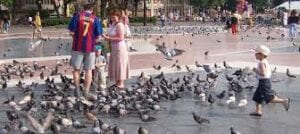
I know we all hate pigeons, but that can’t be good for them, can it? Aren’t they supposed to be herbivores? A spokesperson for the GFA, which focuses on breeding wood pigeons to make them hunt-ready tells VICE: “I certainly haven’t heard of pigeons eating chicken bones. Pigeons, like doves and all of those sorts of birds, are not meat eaters. But urban pigeons are very different to the ones we get in the countryside.”
The feral pigeon, these mongrel bastard birds, have fallen through the cracks. So I turned to the British Trust for Ornithology’s spokesperson and ornithologist himself, Paul Sandcliffe, in the hopes he might know a bit more about why a herbivore bird would want to feast on chicken bones.
VICE: Hi Paul. Why do you think pigeons might eat bits of chicken bones? Are they just feral compared to their rural cousins?
Paul: When we get back to basics, urban pigeons are not that different to rural pigeons, they will feed in large flocks, and once one pigeon is on the ground, it will attract other pigeons. The major difference between these birds, though, is their diet. Rural pigeons are looking for large seeds or cereal grains like rapeseed which are high in energy and can actually fill them. Whereas urban pigeons are just looking for any food that’s available and will test out anything.
So when they’re pecking the chicken they’re just trying it out?
Yes. Pigeons aren’t carnivorous but they’ve come across this potential food, they’ve checked it out, and if it’s edible, they’ll eat it.
Is it possible that the way fried or marinaded chicken is cooked; in flour and batter and sauces makes it less like chicken and more appealing to the pigeon?
I think the big thing making this chicken appealing to the pigeon is that it’s cooked. Lots of birds aren’t specifically carnivorous but if they come across a dead bird they’ll have a peck at it and take some of the meat. I’ve seen it in footage of coal tits in Northern Scotland, pecking at a deer carcass. They can do it because, ostensibly they’re insectivorous [vegetarian except for insects], so they do have this element of a carnivorous diet. But pigeons are granivorous [grain-eating] so their beak is designed for grains. If they come across a corpse they just can’t deal with it; the skin’s too tough to peck through. But if the corpse has been cooked then the texture is soft. So they can peck at it and bits come away. They’re probably not even thinking of it as meat if they’re thinking at all. It’s just food.
Let’s say a pigeon managed to eat a chicken nugget’s worth of chicken, though. Is that any good for its digestion?
I’m not particularly sure there would be a negative impact. Really? But it sounds so gross.
Birds, by their very physiology, won’t eat more than they should eat. Pigeons can’t afford to be fat because it affects their weight and then they can’t fly. And when they can’t fly it makes them vulnerable to predation
Do pigeons actually go through that thought process? Or do they simply stop when they’re full?
It’s just nature for them to stop when they’re full. You could give a blackbird a bucket of worms and it will only eat the amount it needs to survive in that moment and still make a quick escape if needs be. Same goes for a pigeon.
That’s smart. A farmer once told me that chickens will eat concrete to get the right nutrients to make its eggs. Is there any chance pigeons are eating chicken bones to get the right nutrients to make their own eggs?
Female pigeons will be looking for a source of calcium and calcium is hard to come by. They do eat grit and small stones so they probably get a little bit of calcium that way. It’s not impossible that they could eat bones too. I have a wildebeest skull on the shed at the bottom of my garden and over time, the bone has started to break down and become porous and soft inside. Now the blue tits are coming and taking bits of that skull as a source of calcium. I’ve never seen pigeons on that skull, but it’s probably because they’re not agile enough to get up to it. They have to find sources of calcium somewhere, so it could be that the small pieces of bone on the chicken provide that.
So they’re not gross for eating chicken, just resourceful?
All a bird does all day every day is search for food because they can’t have a big breakfast and be done with it. They have to eat small amounts throughout the day. So they’re spending all day every day looking for food and that includes checking out bits of chicken.
Pigeon Patrol Products & Services is the leading manufacturer and distributor of bird deterrent (control) products in Canada. Pigeon Patrol products have solved pest bird problems in industrial, commercial, and residential settings since 2000, by using safe and humane bird deterrents with only bird and animal friendly solutions. At Pigeon Patrol, we manufacture and offer a variety of bird deterrents, ranging from Ultra-flex Bird Spikes with UV protection, Bird Netting, 4-S Bird Gel and the best Ultrasonic and audible sound devices on the market today.
Voted Best Canadian wholesaler for Bird Deterrent products ten years in a row.
Contact us at 1- 877– 4– NO-BIRD, (604) 585-9279 or visit our website at www.pigeonpatrol.ca
Pigeon/Pigeon Patrol / Pigeons Roosting / Vancouver Pigeon Control /Bird Spikes / Bird Control / Bird Deterrent / Pigeon Deterrent? Surrey Pigeon Control / Pest /Seagull deterrent / Vancouver Pigeon Blog / Birds Inside Home / Pigeons in the cities / Ice Pigeons/ What to do about pigeons/ sparrows , Damage by Sparrows, How To Keep Raccoons Away, Why Are Raccoons Considered Pests/ De-fence / Pigeon Nesting/ Bird Droppings / Pigeon Dropping/ woodpecker control/ Professional Bird Control Company/ Keep The Birds Away/ Birds/rats/ seagull/pigeon/woodpecker/ dove/sparrow/pidgeon control/pidgeon problem/ pidgeon control/flying rats/ pigeon Problems/ bird netting/bird gel/bird spray/bird nails/ bird guard
by Pigeon Patrol | Nov 1, 2021 | Pigeon Predators, Pigeon Spikes, Pigeons, Pigeons in the News, Raccoons, Sparrows, UltraSonic Bird Control
For some people, pigeons serve as entertainment that can be bought with a few stale crusts of bread. For others, pigeons are nothing more than “rats with wings” that carry pathogens that spread harmful diseases. The question is, do pigeons spread diseases or is that just an urban myth?
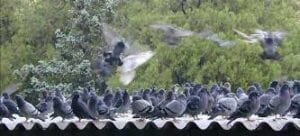
Unfortunately, the rumors are true. Pigeons carry a surprising number of pathogens that spread diseases — more than 60 varieties — but it is extremely rare that any of these are fatal to humans.
How do pigeons spread disease?
Pigeons transmit diseases through their droppings. While we all know we shouldn’t touch or pick up pigeon droppings with our hands, it’s a bit trickier than that. Pigeon droppings that are infected with bacteria or viruses are often left on the street, windowsills and cars to dry out. Once they do, they become a powder, which is blown or kicked into the air and then inhaled. The inhalation of this powder is one way that the pathogens that can cause disease can be spread to humans.
According to Medical News Today, the most common pathogens which can cause disease transmitted from pigeons to humans are:
- E. coli. This occurs when bird droppings land in a water or food supply and are then consumed by humans. This can typically be avoided by washing food thoroughly before eating. Symptoms include nausea, fever and cramps.
- St. Louis encephalitis.This disease is spread by mosquitoes after they feed on a bird that carries the pathogen that spreads St. Louis encephalitis. This inflammation of the nervous system is dangerous to all age groups, but can be particularly dangerous and even fatal in adults over 60 years old. Symptoms include drowsiness, headache and fever.
- Histoplasmosis.This respiratory disease occurs as a result of a fungus growing in pigeon droppings and can be fatal.
- Candidiasis.This disease is also a respiratory condition caused by a fungus or yeast found in droppings. The areas affected include skin, mouth, the respiratory system, intestines and the urogenital tract, particularly in women.
- Salmonellosis.This disease is commonly called “food poisoning” and spreads via infected droppings turning into dust and contaminating food and food preparation surfaces prior to consumption.
Pigeons are also carriers of mites, fleas, and West Nile virus, all of which can cause discomfort and potentially serious health issues in humans.
How to get rid of pigeons
In addition to carrying diseases, pigeons can also wreak havoc on your property. Flocks damage buildings, and their nests interfere with electrical elements and air conditioners. Also, pigeon droppings are not only unsanitary, but can create slippery and hazardous conditions.
To keep your risk of disease down and help keep your property free of pigeon waste, clean up any detectable pigeon droppings as soon as possible. Use disposable protective clothing, shoe coverings, an air-purifying respirator, and gloves.
Reducing birds on your property is a positive thing to do to help prevent the spread of disease. Terminix® offers various bird control solutions, including:
- Control gel
- Wire barriers
- Spikes
- Shock
Read more about each solution and when each one is appropriate on our bird control solutions page.
Source
Pigeon Patrol Products & Services is the leading manufacturer and distributor of bird deterrent (control) products in Canada. Pigeon Patrol products have solved pest bird problems in industrial, commercial, and residential settings since 2000, by using safe and humane bird deterrents with only bird and animal friendly solutions. At Pigeon Patrol, we manufacture and offer a variety of bird deterrents, ranging from Ultra-flex Bird Spikes with UV protection, Bird Netting, 4-S Bird Gel and the best Ultrasonic and audible sound devices on the market today.
Voted Best Canadian wholesaler for Bird Deterrent products ten years in a row.
Contact us at 1- 877– 4– NO-BIRD, (604) 585-9279 or visit our website at www.pigeonpatrol.ca
Pigeon/Pigeon Patrol / Pigeons Roosting / Vancouver Pigeon Control /Bird Spikes / Bird Control / Bird Deterrent / Pigeon Deterrent? Surrey Pigeon Control / Pest /Seagull deterrent / Vancouver Pigeon Blog / Birds Inside Home / Pigeons in the cities / Ice Pigeons/ What to do about pigeons/ sparrows , Damage by Sparrows, How To Keep Raccoons Away, Why Are Raccoons Considered Pests/ De-fence / Pigeon Nesting/ Bird Droppings / Pigeon Dropping/ woodpecker control/ Professional Bird Control Company/ Keep The Birds Away/ Birds/rats/ seagull/pigeon/woodpecker/ dove/sparrow/pidgeon control/pidgeon problem/ pidgeon control/flying rats/ pigeon Problems/ bird netting/bird gel/bird spray/bird nails/ bird guard
by Pigeon Patrol | Nov 1, 2021 | Pigeon Patrol's Services, Pigeon Predators, Pigeon Spikes, Pigeons, Pigeons in the News, Raccoons
A full and independent review has been ordered into a flagship hospital in Glasgow after it was confirmed that a child patient’s death was linked to a fungal infection caused by exposure to pigeon droppings.
Announcing the probe, Scottish Health Secretary Jeane Freeman said that both the child and an elderly patient at the £842m Queen Elizabeth Hospital had died after contracting the infection, reports The Scotsman.
Freeman told the Scottish Parliament that the adult patient had died from an unrelated cause, but that the bacteria had been a “contributing factor” in the death of the child, in December.
A 12th-floor room that is not used by the public “was identified as a likely source and the droppings were removed”, says The Independent. Control measures have been put in place, although it is still unclear how the bacteria entered the ventilation system.
NHS Greater Glasgow and Clyde said medication to prevent potential infection had been administered to a small number of vulnerable patients at the hospital, which opened less than four years ago.
How dangerous are pigeon droppings?
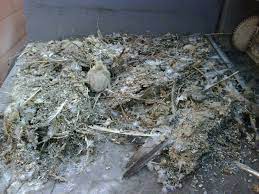
Pigeon droppings contain a fungus called Cryptococcus that can cause infections in vulnerable people if inhaled.
The child who died at the Glasgow hospital had been exposed to the fungus. Most people will not become unwell as a result, but vulnerable people with already weakened immunity “can get very ill with a chest infection or meningitis”, reports the BBC.
Infectious diseases expert Professor Hugh Pennington told the broadcaster it is very unusual to see cases in the UK.
“It is common in other parts of the world, particularly tropical parts, in the US and countries like that where they have more problems with this particular kind of fungus. But in the UK, very uncommon,” he said.
“There are cases in people who have problems with their immune systems. They’re the people who are at risk with this kind of bug.”
Are there any other risks?
Breathing dust or water droplets containing contaminated bird droppings can lead to several other diseases including psittacosis and salmonella.
Psittacosis is a rare infectious disease caused by a bacterium called Chlamydia psittaci. Symptoms “are commonly a flu-like illness and pneumonia, usually appearing five to 19 days after exposure”, says the Health and Safety Executive. Salmonella – a bacterial infection that can cause diarrhoea – may also be present in some bird droppings.
Washing your hands after cleaning up bird droppings is strongly advised, and “if you have a compromised immune system, including from HIV/Aids or cancer, you should not clean up droppings”, adds the BBC.
Source
Pigeon Patrol Products & Services is the leading manufacturer and distributor of bird deterrent (control) products in Canada. Pigeon Patrol products have solved pest bird problems in industrial, commercial, and residential settings since 2000, by using safe and humane bird deterrents with only bird and animal friendly solutions. At Pigeon Patrol, we manufacture and offer a variety of bird deterrents, ranging from Ultra-flex Bird Spikes with UV protection, Bird Netting, 4-S Bird Gel and the best Ultrasonic and audible sound devices on the market today.
Voted Best Canadian wholesaler for Bird Deterrent products ten years in a row.
Contact us at 1- 877– 4– NO-BIRD, (604) 585-9279 or visit our website at www.pigeonpatrol.ca
Pigeon/Pigeon Patrol / Pigeons Roosting / Vancouver Pigeon Control /Bird Spikes / Bird Control / Bird Deterrent / Pigeon Deterrent? Surrey Pigeon Control / Pest /Seagull deterrent / Vancouver Pigeon Blog / Birds Inside Home / Pigeons in the cities / Ice Pigeons/ What to do about pigeons/ sparrows , Damage by Sparrows, How To Keep Raccoons Away, Why Are Raccoons Considered Pests/ De-fence / Pigeon Nesting/ Bird Droppings / Pigeon Dropping/ woodpecker control/ Professional Bird Control Company/ Keep The Birds Away/ Birds/rats/ seagull/pigeon/woodpecker/ dove/sparrow/pidgeon control/pidgeon problem/ pidgeon control/flying rats/ pigeon Problems/ bird netting/bird gel/bird spray/bird nails/ bird guard
by Pigeon Patrol | Nov 1, 2021 | history of pigeons, MBCA, pet bird, Pigeon Control, Pigeon Droppings, Pigeon Patrol's Services, Pigeon Predators
An infection linked to pigeon droppings was a “contributing factor” in the death of a child at a Glasgow hospital, it has been confirmed.
The child was being treated at the Queen Elizabeth University Hospital when he or she appears to have caught the infection – a fungus called cryptococcus.
The child has not been named. The fungus did not contribute to the death in December of a second patient infected with the same pathogen, say experts.
What is it?
Cryptococcus is a yeast-like fungus that lives in the environment.
It can be found in soil contaminated by pigeon droppings.
How can you catch it?
People can become infected if they breathe it in.
The child who died in December at the hospital in Glasgow had been exposed to the fungus.
Experts say the probable source has been traced to a room on the rooftop of the hospital. Pigeon droppings appeared in the room via a small break in the wall which was “invisible to the naked eye”, Scottish Health Secretary Jeane Freeman confirmed.
The hospital says it has put infection control measures in place and no further cases have been reported.
How risky is it?
Most won’t get sick, but vulnerable people with already weakened immunity can get very ill with a chest infection or meningitis.
Expert Prof Hugh Pennington says it is very unusual to see cases in the UK.
“It is common in other parts of the world, particularly tropical parts, in the US and countries like that where they have more problems with this particular kind of fungus. But in the UK, very uncommon.
“There are cases in people who have problems with their immune systems. They’re the people who are at risk with this kind of bug.”
Cryptococcus infection cannot spread from person to person.
How dangerous is pigeon poo?
Breathing dust or water droplets containing contaminated bird droppings can lead to several diseases, including a flu-like illness called psittacosis.
Salmonella – a bacterial infection that can cause diarrhoea – may also be present in some bird droppings.
If you are cleaning up or come into contact with droppings, you should take precautions. Wash your hands and clean any exposed skin before eating, drinking or putting your hands near your mouth.
Likewise, if you are feeding or handling birds, wash your hands afterwards.
If you have a compromised immune system, including from HIV/AIDS or cancer, you should not clean up droppings.
Source
Pigeon Patrol Products & Services is the leading manufacturer and distributor of bird deterrent (control) products in Canada. Pigeon Patrol products have solved pest bird problems in industrial, commercial, and residential settings since 2000, by using safe and humane bird deterrents with only bird and animal friendly solutions. At Pigeon Patrol, we manufacture and offer a variety of bird deterrents, ranging from Ultra-flex Bird Spikes with UV protection, Bird Netting, 4-S Bird Gel and the best Ultrasonic and audible sound devices on the market today.
Voted Best Canadian wholesaler for Bird Deterrent products ten years in a row.
Contact us at 1- 877– 4– NO-BIRD, (604) 585-9279 or visit our website at www.pigeonpatrol.ca
Pigeon/Pigeon Patrol / Pigeons Roosting / Vancouver Pigeon Control /Bird Spikes / Bird Control / Bird Deterrent / Pigeon Deterrent? Surrey Pigeon Control / Pest /Seagull deterrent / Vancouver Pigeon Blog / Birds Inside Home / Pigeons in the cities / Ice Pigeons/ What to do about pigeons/ sparrows , Damage by Sparrows, How To Keep Raccoons Away, Why Are Raccoons Considered Pests/ De-fence / Pigeon Nesting/ Bird Droppings / Pigeon Dropping/ woodpecker control/ Professional Bird Control Company/ Keep The Birds Away/ Birds/rats/ seagull/pigeon/woodpecker/ dove/sparrow/pidgeon control/pidgeon problem/ pidgeon control/flying rats/ pigeon Problems/ bird netting/bird gel/bird spray/bird nails/ bird guard
by Pigeon Patrol | Nov 1, 2021 | 4-S Gel Bird repellent, Animal Deterrent Products, Bird Deterrent Products, Bird Law, Bird Netting, Bird Spikes
It has long been recognized that birds possess the ability to use the Earth’s magnetic field for their navigation, although just how this is done has not yet been clarified. However, the discovery of iron-containing structures in the beaks of homing pigeons in a new study1 by Gerta Fleissner and her colleagues at the University of Frankfurt offers a promising insight into this complex topic. The article will be published online mid-March in Springer’s journal Naturwissenschaften.
In histological and physicochemical examinations in collaboration with HASYLAB, the synchrotron laboratories based in Hamburg, Germany, iron-containing subcellular particles of maghemite and magnetite were found in sensory dendrites² of the skin lining the upper beak of homing pigeons. This research project found that these dendrites are arranged in a complex three-dimensional pattern with different spatial orientation designed to analyze the three components of the magnetic field vector separately. They react to the Earth’s external magnetic field in a very sensitive and specific manner, thus acting as a three-axis magnetometer.
The study suggests that the birds sense the magnetic field independent of their motion and posture and thus can identify their geographical position.
The researchers further believe that this ability is not unique to homing pigeons as they expect that the ‘pigeon-type receptor system … might turn out to be a universal feature of all birds’. Equally, this concept might not only exclusively apply to birds, since it has been shown that many animals display behavior that is modified or controlled by the Earth’s magnetic field.
The meaning of these minute iron oxide crystals goes farther than their amazing ability to help pigeons home. Research into how they work has caught the interest of nanotechnologists concerning their potential application for accurate drug targeting and even as a data storage device. The main problem, however, lies in their synthetic production. According to Gerta Fleissner and her colleagues, “Even though birds have been producing these particles for millions of years, the main problem for scientists who want to find benefits from their use will be the technical production of these particles”.
1. Fleissner et al (2007). A novel concept of Fe-mineral-based magnetoreception: histological and physicochemical data from the upper beak of homing pigeons. Naturwissenschaften (DOI 10.1007/s00114-007-0236-0).
2. A dendrite is a branched extension a nerve cell (neuron)
Source
Pigeon Patrol Products & Services is the leading manufacturer and distributor of bird deterrent (control) products in Canada. Pigeon Patrol products have solved pest bird problems in industrial, commercial, and residential settings since 2000, by using safe and humane bird deterrents with only bird and animal friendly solutions. At Pigeon Patrol, we manufacture and offer a variety of bird deterrents, ranging from Ultra-flex Bird Spikes with UV protection, Bird Netting, 4-S Bird Gel and the best Ultrasonic and audible sound devices on the market today.
Voted Best Canadian wholesaler for Bird Deterrent products ten years in a row.
Contact us at 1- 877– 4– NO-BIRD, (604) 585-9279 or visit our website at www.pigeonpatrol.ca
Pigeon/Pigeon Patrol / Pigeons Roosting / Vancouver Pigeon Control /Bird Spikes / Bird Control / Bird Deterrent / Pigeon Deterrent? Surrey Pigeon Control / Pest /Seagull deterrent / Vancouver Pigeon Blog / Birds Inside Home / Pigeons in the cities / Ice Pigeons/ What to do about pigeons/ sparrows , Damage by Sparrows, How To Keep Raccoons Away, Why Are Raccoons Considered Pests/ De-fence / Pigeon Nesting/ Bird Droppings / Pigeon Dropping/ woodpecker control/ Professional Bird Control Company/ Keep The Birds Away/ Birds/rats/ seagull/pigeon/woodpecker/ dove/sparrow/pidgeon control/pidgeon problem/ pidgeon control/flying rats/ pigeon Problems/ bird netting/bird gel/bird spray/bird nails/ bird guard