Long-extinct passenger pigeon finds a place in the family tree

Long-extinct passenger pigeon finds a place in the family tree

With bits of DNA extracted from century-old museum specimens, researchers have found a place for the extinct passenger pigeon in the family tree of pigeons and doves, identifying for the first time this unique bird’s closest living avian relatives.

The new analysis, which appears this month in Molecular Phylogenetics and Evolution, reveals that the passenger pigeon was most closely related to other North and South American pigeons, and not to the mourning dove, as was once suspected.

Naturalists have long lamented that one of North America’s most spectacular birds was also one of the first to be driven to extinction. In the early 1800s it was the most abundant bird species on the planet, even though its range was limited to the eastern and central forests of the United States and parts of eastern Canada. Flocks of passenger pigeons were so vast they darkened the sky; it could take days for a flock to pass overhead.
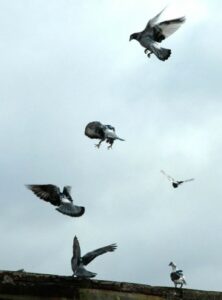
“It must have been unbelievable to see one of these flocks,” said Kevin Johnson, an ornithologist with the Illinois Natural History Survey at the University of Illinois and lead author of the study. “There is nothing in modern times that we can compare it to. The passenger pigeon was very nomadic and it formed these huge flocks, in the millions, and breeding colonies in the millions.”

Passenger pigeons followed their food, settling down in forests that periodically produced a superabundance of acorns and chestnuts. The pigeons nested in dense colonies covering hundreds of acres. This made them easy targets for human predators.

Intensive hunting of the pigeons in the mid-to-late 19th century disrupted their ability to breed, Johnson said. That and habitat destruction led to the bird’s eventual extinction. (The last of her kind, a passenger pigeon named Martha, died in the Cincinnati Zoo in 1914.)

To find the passenger pigeon’s place in the evolutionary history of pigeons and doves, Johnson and his colleagues compared sequences from two of its mitochondrial genes with those of 78 species of pigeons and doves from around the world. (There are more than 300 species of pigeons and doves worldwide.)

“We had two sequences from the mitochondrial genome, which is a separate organelle in the cell that has its own genome,” Johnson said. Mitochondrial genes are plentiful and so are easier to sequence, he said. And the mitochondrial genome evolves more rapidly than the nuclear genome, making it a good target for evolutionary studies.

The researchers first analyzed the available sequence data for all (extant and extinct) pigeons and doves together. Then they focused only on the living species, for which much more genetic information is available. They built a family tree of all living pigeons and doves, and then compared the available gene sequences of the passenger pigeon to those of its relatives to find its place in that tree. Both approaches placed the passenger pigeon on the same place in the tree.

Prior to this study, some believed that the passenger pigeon was most closely related to the mourning dove, a smaller species that also has a relatively long tail, Johnson said.

“But it turns out, based on the DNA, that it’s actually related to the New World big pigeons in a totally different genus,” he said.

The band-tailed pigeon, Patagioenas fasciata, which lives in the western mountainous regions of North and South America, was the passenger pigeon’s geographically nearest relative. Other members of this genus are found in forests in parts of Mexico, Central and South America and the Caribbean.

The passenger pigeon was fairly distinct from its relatives, however, as it belonged to a separate genus, Ectopistes, Johnson said.

“The passenger pigeon is in a monotypic genus, which means there is only one species in that genus: Ectopistes migratorius,” he said. “This bird is pretty diverged from its nearest relatives, meaning it had a unique place in the world. It represented a unique lineage that’s now gone.”

The study team included Dale Clayton, of the University of Utah; John Dumbacher of the California Academy of Sciences and the Smithsonian Conservation Biology Institute; and Robert Fleischer, of the Smithsonian Conservation Biology Institute.

Source

Pigeon Patrol Products & Services is the leading manufacturer and distributor of bird deterrent (control) products in Canada. Pigeon Patrol products have solved pest bird problems in industrial, commercial, and residential settings since 2000, by using safe and humane bird deterrents with only bird and animal friendly solutions. At Pigeon Patrol, we manufacture and offer a variety of bird deterrents, ranging from Ultra-flex Bird Spikes with UV protection, Bird Netting, 4-S Bird Gel and the best Ultrasonic and audible sound devices on the market today.

Voted Best Canadian wholesaler for Bird Deterrent products ten years in a row.

Contact us at 1- 877– 4– NO-BIRD, (604) 585-9279 or visit our website at www.pigeonpatrol.ca

Pigeon/Pigeon Patrol / Pigeons Roosting / Vancouver Pigeon Control /Bird Spikes / Bird Control / Bird Deterrent / Pigeon Deterrent?  Surrey Pigeon Control / Pest /Seagull deterrent / Vancouver Pigeon Blog / Birds Inside Home / Pigeons in the cities / Ice Pigeons/ What to do about pigeons/ sparrows , Damage by Sparrows, How To Keep Raccoons Away,  Why Are Raccoons Considered Pests/ De-fence / Pigeon Nesting/ Bird Droppings / Pigeon Dropping/ woodpecker control/ Professional Bird Control Company/ Keep The Birds Away/ Birds/rats/ seagull/pigeon/woodpecker/ dove/sparrow/pidgeon control/pidgeon problem/ pidgeon control/flying rats/ pigeon Problems/ bird netting/bird gel/bird spray/bird nails/ bird guard
Wartime hero pigeon Paddy honoured with fly-past

Wartime hero pigeon Paddy honoured with fly-past

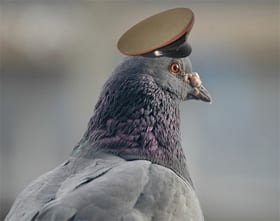
One of Northern Ireland’s smallest World War II heroes has been honoured.

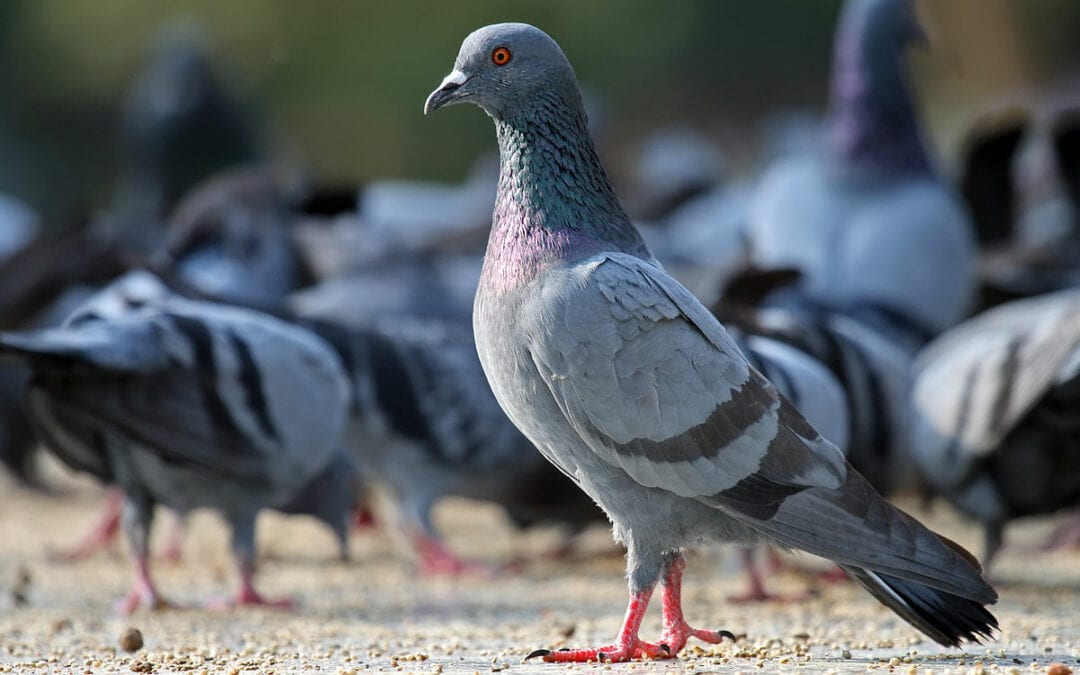
Paddy, a messenger pigeon who served with the RAF during the Normandy operations in June 1944, was remembered in his home town of Larne on Friday.

PDSA, Britain’s biggest veterinary charity, awarded Paddy the Dickin Medal, dubbed the animals’ “Victoria Cross”, 65 years ago this month.

He received it for being the fastest pigeon to reach England with a coded message from the battle-front beaches of Normandy.

The brave bird brought back vital information about the Allies’ progress, flying 230 miles in four hours 50 minutes – the fastest time of any of the messenger pigeons involved in the mission with an average speed of 56mph.

PDSA spokesman James Puxty said: “Paddy’s contribution to the D-Day operations was a credit to the thousands of messenger pigeons donated by the racing pigeon fraternity for service during World War II.

“He was one of 32 brave, feathered heroes that received the PDSA Dickin Medal for their life-saving flights during the war, and the only recipient from Northern Ireland.”

Local hero

Paddy was born and raised in Carnlough and joined thousands of other racing birds who were trained and drafted to RAF Hurn in Hampshire for military service.

Impressing military brass with his flying in the Air-Sea rescue units he was seconded to the United States First Army for undercover missions during the Normandy Landings.

In the face of poor weather conditions and the threat of German falcons, deployed to intercept Paddy and his comrades, he delivered his message to his home loft at RAF Hurn.

After the war Paddy returned to Carnlough and lived out his days with his owner Captain Andrew Hughes, until his death in 1954.

A memorial to the winged hero was erected in Carnlough harbour.

A feathered fly-past of pigeons formed part of the Paddy Memorial Day event held at Larne Museum and Arts Centre.

Larne Borough Council and the town’s historical society were joined by guests from PDSA and the owner of Paddy’s PDSA Dickin Medal, former Irish Army officer Kevin Spring.

Younger guests were entertained by Gail Seekamp, the children’s author, who read from her book “Paddy the Pigeon”.

The Dickin Medal was introduced in 1943 by Maria Dickin, PDSA’s founder. She wanted to recognise the gallantry and devotion to duty of animals serving with the Armed Forces and Civil Defence units during WWII.

Source

Pigeon Patrol Products & Services is the leading manufacturer and distributor of bird deterrent (control) products in Canada. Pigeon Patrol products have solved pest bird problems in industrial, commercial, and residential settings since 2000, by using safe and humane bird deterrents with only bird and animal friendly solutions. At Pigeon Patrol, we manufacture and offer a variety of bird deterrents, ranging from Ultra-flex Bird Spikes with UV protection, Bird Netting, 4-S Bird Gel and the best Ultrasonic and audible sound devices on the market today.

Voted Best Canadian wholesaler for Bird Deterrent products ten years in a row.

Contact us at 1- 877– 4– NO-BIRD, (604) 585-9279 or visit our website at www.pigeonpatrol.ca

Pigeon/Pigeon Patrol / Pigeons Roosting / Vancouver Pigeon Control /Bird Spikes / Bird Control / Bird Deterrent / Pigeon Deterrent?  Surrey Pigeon Control / Pest /Seagull deterrent / Vancouver Pigeon Blog / Birds Inside Home / Pigeons in the cities / Ice Pigeons/ What to do about pigeons/ sparrows , Damage by Sparrows, How To Keep Raccoons Away,  Why Are Raccoons Considered Pests/ De-fence / Pigeon Nesting/ Bird Droppings / Pigeon Dropping/ woodpecker control/ Professional Bird Control Company/ Keep The Birds Away/ Birds/rats/ seagull/pigeon/woodpecker/ dove/sparrow/pidgeon control/pidgeon problem/ pidgeon control/flying rats/ pigeon Problems/ bird netting/bird gel/bird spray/bird nails/ bird guard


Airborne pigeons obey the pecking order

Airborne pigeons obey the pecking order

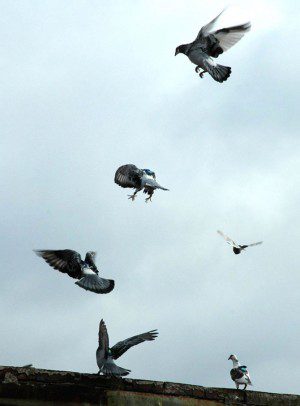
During flight, pigeons in a flock follow the leader.

Pigeons wearing miniature backpacks containing tracking devices have revealed that the birds rapidly shift direction during flight in response to cues from the leading members of their group.

“It is the first study demonstrating hierarchical decision-making in a group of free-flying birds,” says Tamás Vicsek, a biophysicist at Eötvös Loránd University in Budapest who led the study, which is published today in Nature1.

The discovery became possible only recently with the introduction of Global Positioning System (GPS) devices that can collect data at a high rate: five times per second. Vicsek’s team strapped lightweight GPS devices to individual pigeons and tracked flocks of up to 10 birds during free flights lasting around 12 minutes and 15-kilometre homing flights. In total, the GPS logged 32 hours of data and captured 15 group flights. The researchers couldn’t pinpoint individuals’ exact positions within a flock, but were able to accurately compare birds’ directions of motion.

Within flocks, the authors looked first at the behaviour of pairs of birds. For each possible pairing, the team identified a leader — the bird that changed direction first — and a follower, which copied the leader’s motion. Followers reacted very quickly, within a fraction of a second.

Next, the scientists constructed a network of relationships among birds in the group during each flight. They uncovered a robust pecking order: birds higher up the ranks had more influence over the group’s movements, and each individual’s level of influence was consistent across specific free and homing flights.

However, this influence was not always consistent between flights, with some rearrangement occurring among birds at the head of the flock. Vicsek speculates that this may have occurred because an original leader had tired. Co-author Dora Biro, an animal behaviour expert at the University of Oxford, UK, says, “This kind of group decision-making is more complicated than previous models suggested.”

Follow the leader

Although pigeons have an almost 340º field of view, the researchers found that the birds at the front of a flock tended to make the navigational decisions. Moreover, birds responded more readily to a leader’s movements if the leader was on their left side. These findings concur with previous work that indicated that social cues entering a bird’s left eye receive preferential processing in the brain2.

“No other study has contributed more to our understanding of collective decision-making in actively homing animals, not by a long shot,” says Todd Dennis, an expert in pigeon navigation at the University of Auckland in New Zealand. He likens the birds’ group behaviour to that of a cabaret dance troupe, in which less-experienced dancers towards the rear correct themselves by watching experts at the front. “The study provides a very important model for how collective behaviour and leadership can be assessed in a range of animal groups,” he says.

The authors say that a hierarchical arrangement may foster more flexible and efficient decision-making compared with that of singly led or egalitarian groups. In future studies, the scientists plan to investigate whether leaders are better navigators, and whether hierarchies persist in larger groups and in other types of social animal. “If it’s true that there’s an evolutionary advantage to making decisions in this way, then there’s absolutely a reason to assume that it could have evolved in other species too,” Biro says.

Source

Pigeon Patrol Products & Services is the leading manufacturer and distributor of bird deterrent (control) products in Canada. Pigeon Patrol products have solved pest bird problems in industrial, commercial, and residential settings since 2000, by using safe and humane bird deterrents with only bird and animal friendly solutions. At Pigeon Patrol, we manufacture and offer a variety of bird deterrents, ranging from Ultra-flex Bird Spikes with UV protection, Bird Netting, 4-S Bird Gel and the best Ultrasonic and audible sound devices on the market today.

Voted Best Canadian wholesaler for Bird Deterrent products ten years in a row.

Contact us at 1- 877– 4– NO-BIRD, (604) 585-9279 or visit our website at www.pigeonpatrol.ca

Pigeon/Pigeon Patrol / Pigeons Roosting / Vancouver Pigeon Control /Bird Spikes / Bird Control / Bird Deterrent / Pigeon Deterrent?  Surrey Pigeon Control / Pest /Seagull deterrent / Vancouver Pigeon Blog / Birds Inside Home / Pigeons in the cities / Ice Pigeons/ What to do about pigeons/ sparrows , Damage by Sparrows, How To Keep Raccoons Away,  Why Are Raccoons Considered Pests/ De-fence / Pigeon Nesting/ Bird Droppings / Pigeon Dropping/ woodpecker control/ Professional Bird Control Company/ Keep The Birds Away/ Birds/rats/ seagull/pigeon/woodpecker/ dove/sparrow/pidgeon control/pidgeon problem/ pidgeon control/flying rats/ pigeon Problems/ bird netting/bird gel/bird spray/bird nails/ bird guard

The effect of habitat and number of inhabitants on the population sizes of feral pigeons around towns in northern Poland

The effect of habitat and number of inhabitants on the population sizes of feral pigeons around towns in northern Poland

Most studies on factors influencing density of the feral pigeons Columba livia var. domestica were carried out in large cities and agglomerations. However, also in small towns, pigeons are important epidemiological and sanitary problem. In our studies, feral pigeons were censused in 33 towns located in the Pomeranian Province (northern Poland) during 2006–2008. These birds occurred in 19 (57.6%) towns. The number of pigeons was positively correlated with the area of the town, and it was significantly higher in towns localized in agricultural landscape than in towns surrounded by forests. We also found a significant effect of interactions between type of a landscape surrounding a town and residual number of inhabitants on the abundance of pigeons. In the largest towns of the Pomeranian Province, feral pigeons were concentrated mainly in central quarters. In smaller towns, they were noted in central parts or in areas with blocks of flats and even the suburbs. The obtained results suggest that food conditions in small and middle towns may be not sufficient for colonization by pigeons.

Source

Pigeon Patrol Products & Services is the leading manufacturer and distributor of bird deterrent (control) products in Canada. Pigeon Patrol products have solved pest bird problems in industrial, commercial, and residential settings since 2000, by using safe and humane bird deterrents with only bird and animal friendly solutions. At Pigeon Patrol, we manufacture and offer a variety of bird deterrents, ranging from Ultra-flex Bird Spikes with UV protection, Bird Netting, 4-S Bird Gel and the best Ultrasonic and audible sound devices on the market today.

Voted Best Canadian wholesaler for Bird Deterrent products ten years in a row.

Contact us at 1- 877– 4– NO-BIRD, (604) 585-9279 or visit our website at www.pigeonpatrol.ca

Pigeon/Pigeon Patrol / Pigeons Roosting / Vancouver Pigeon Control /Bird Spikes / Bird Control / Bird Deterrent / Pigeon Deterrent?  Surrey Pigeon Control / Pest /Seagull deterrent / Vancouver Pigeon Blog / Birds Inside Home / Pigeons in the cities / Ice Pigeons/ What to do about pigeons/ sparrows , Damage by Sparrows, How To Keep Raccoons Away,  Why Are Raccoons Considered Pests/ De-fence / Pigeon Nesting/ Bird Droppings / Pigeon Dropping/ woodpecker control/ Professional Bird Control Company/ Keep The Birds Away/ Birds/rats/ seagull/pigeon/woodpecker/ dove/sparrow/pidgeon control/pidgeon problem/ pidgeon control/flying rats/ pigeon Problems/ bird netting/bird gel/bird spray/bird nails/ bird guard
What Makes the Passenger Pigeon Different From All Other Pigeons

What Makes the Passenger Pigeon Different From All Other Pigeons

Not a Carrier Pigeon, Not a Messenger Pigeon, Not a Rock Pigeon
The passenger pigeon and the rock dove (Columba livia, aka rock pigeon, carrier pigeon, etc) are often confused in the public’s mind but they are not closely related. The dock dove is a Eurasian species that has been semi-domesticated for centuries and has been introduced into North America. They like to nest on ledges, which is one reason they have proliferated in cities around the world in a feral state.

Passenger Pigeons Were Unlike Any Other Bird in the World
in at Least Three Important Ways

The Passenger Pigeon was a bird solely of North America, with the vast majority inhabiting a region from the Gulf States to Hudson’s Bay, and from the Atlantic Ocean to the upper Missouri River. Three things made them unique in all the world:
1) they were the most abundant bird of the continent, if not the world: no one knows for sure how many there were but the most careful figure offered ranges from a low of three billion to a high of five billion individuals;
2) they aggregated in numbers that darkened the sky for as much as three days: individual flights might have exceeded two billion birds; and
3) in literally decades, human actions reduced this incredible bounty to zero, when on September 1, 1914, the last of the species died. Given that it is extinct, very little was known about its relationships to other birds until recently.


Where Passenger Pigeons Belong in the Tree of Life
Scientists divide the vast array of life forms into categories based on the similarities and relationships between organisms. From broadest to narrowest, these categories are Kingdom, Phylum, Class, Order, Family, Genus, species. All the birds of the world are in the Phylum Chordata, Kindom Animalia, Class Aves and then are divided into 26 orders. (based on the taxonomy of James Clements). These orders include the Falconiformes (hawks), Anseriformes (ducks and geese mostly), Strigiformes (owls), and Passeriformes (the largest order of all which includes the perching birds like warblers, swallows, flycatchers, finches, thrushes, and sparrows).

All pigeons are members of the order Columbiformes which have a number of characteristics that together set them apart from other birds. These include a bilobed crop that produces a sort of “milk” that is fed to the chicks (“crop” is a pocket like space near the throat); monogamous mating behavior; the ability to drink by sucking or pumping; and thick feathers set close to the skin. On a general level, pigeons possess stocky bodies with small heads, bills, and feet. (Passenger pigeons were among the sleekest of pigeons). There are 42 genera and 308 recognized species of Columbiformes.

Pigeons of the World: From 8 Pounds to 22 Grams
There is no difference between pigeons and doves: the terms are interchangeable. Pigeons are found throughout the world. Some pigeon species eat mostly fruit, whereas others forage on seeds. The fruit-eating Columbiformes tend to be much more vividly colored than the seed eating ones. The largest species is the Victoria crowned pigeon (Goura victoria) of New Guinea which approaches the size of a turkey and can weigh in excess of 8 pounds. The smallest species are members of the ground dove genus (Columbina): they can be as small as house sparrows and weigh not more than 22 grams.

Until recently, the relationship of Passenger Pigeon with respect to other pigeon species has been simply speculation based on gross plumage characteristics. However, recent genetic data published in 2010 by Johnson and colleagues (Molecular Phylogenetics and Evolution 57:455) show that, despite the gross similarity in appearance to mourning doves and its relatives (the genus Zenaida), the Passenger Pigeon is not closely related to this group of pigeons at all. In fact, its closest relatives are a group of large-bodied pigeons from the New World in the genus Patagioenas, which includes the western Band-tailed Pigeon among others. Even so, scientists believe that Passenger Pigeon is still different enough from other extant pigeons to remain in its unique genus, Ectopistes. Based on an analysis of the evolutionary tree constructed from genetic data, Johnson and colleagues (2010) hypothesized that eons ago an Asian cuckoo dove crossed into North America and provided the ancestor to both Ectopistes and Patagioenas.

Source

Pigeon Patrol Products & Services is the leading manufacturer and distributor of bird deterrent (control) products in Canada. Pigeon Patrol products have solved pest bird problems in industrial, commercial, and residential settings since 2000, by using safe and humane bird deterrents with only bird and animal friendly solutions. At Pigeon Patrol, we manufacture and offer a variety of bird deterrents, ranging from Ultra-flex Bird Spikes with UV protection, Bird Netting, 4-S Bird Gel and the best Ultrasonic and audible sound devices on the market today.

Voted Best Canadian wholesaler for Bird Deterrent products ten years in a row.

Contact us at 1- 877– 4– NO-BIRD, (604) 585-9279 or visit our website at www.pigeonpatrol.ca

Pigeon/Pigeon Patrol / Pigeons Roosting / Vancouver Pigeon Control /Bird Spikes / Bird Control / Bird Deterrent / Pigeon Deterrent?  Surrey Pigeon Control / Pest /Seagull deterrent / Vancouver Pigeon Blog / Birds Inside Home / Pigeons in the cities / Ice Pigeons/ What to do about pigeons/ sparrows , Damage by Sparrows, How To Keep Raccoons Away,  Why Are Raccoons Considered Pests/ De-fence / Pigeon Nesting/ Bird Droppings / Pigeon Dropping/ woodpecker control/ Professional Bird Control Company/ Keep The Birds Away/ Birds/rats/ seagull/pigeon/woodpecker/ dove/sparrow/pidgeon control/pidgeon problem/ pidgeon control/flying rats/ pigeon Problems/ bird netting/bird gel/bird spray/bird nails/ bird guard