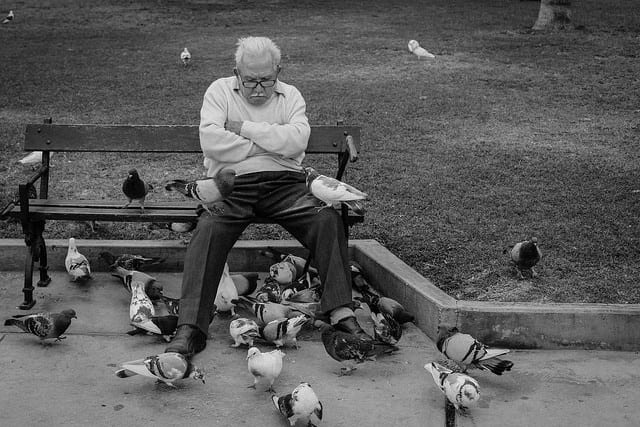
If you do a Google search for “Darwin bird” you will find endless references to the finches of the Galápagos Islands. But it took a long time for Charles Darwin to recognize their significance. When he collected them he did not even realize that they were related, considering some to be “grosbeaks,” others true finches, and others blackbirds. He even considered one warblerlike finch to be a kind of wren.
In fact, during and soon after the historic around-the-world voyage of the HMS Beagle, from 1831 to 1836, Darwin had not yet come to the idea that different islands might be inhabited by different species. As his biographer Janet Browne put it, “He experienced no legendary moment of inspiration.” He was more interested in butterflies. When he returned to London, Darwin dispersed his enormous collection of specimens to the specialists at the Royal Zoological Society. It was only then that ornithologist John Gould told him that the Galápagos birds he had thought were a mixture of blackbirds, grosbeaks, and finches were actually 12 species of finches.
A better case might be made that the most important bird in Darwin’s studies was the humble domestic pigeon. In fact, one of the first readers of the manuscript that would become On the Origin of Species, in 1859, disliked most of the book intensely. Whitwell Elwrin wrote to the publisher, John Murray, and called the text “a wild & foolish piece of imagination . . . for an outline it is too much & for a thorough discussion of the question it is not near enough.” Rather than tell the publisher to reject the manuscript, he consulted Darwin’s friend, geologist Charles Lyell, who had already suggested that the book should focus on Darwin’s observations on pigeons. Elwrin recommended that Darwin write a short book on pigeons. “Everybody is interested in pigeons,” he told him, and a book like this would “be reviewed in every journal in the kingdom and soon be on every table.”
The Origin of Pigeons? Although it sounds funny today, the breeding of fancy pigeons and other pedigreed animals was something of a craze in Victorian England, one that crossed class lines, attracting enthusiasts ranging from miners and weavers to Queen Victoria. When Darwin began studying and breeding pigeons in 1856, he soon became as enthusiastic about the wonderfully varied breeds as any working-class fancier. As Janet Browne says, “Darwin loved his pigeons . . . he spent hours reading self-help manuals and books by breeders to make sure he was doing the right thing and visiting shows and exhibitions to see what was available. He found it very entertaining hobnobbing with breeding experts and trying to exude an air of practical knowledge as he leaned over cages of absurdly ruffled feathers. The esoteric world of pigeon fanciers seemed to him delightfully fresh and curious.”
At first he was not without a little upper-class condescension. He wrote to Huxley, “I sat one evening in a gin palace in the Borrough amongst a set of pigeon fanciers, when it was hinted that Mr. Bolt had crossed his Pouters with Runts to gain size: and if you had seen the solemn, the mysterious, and awful shakes of the head, which all the fanciers gave at this scandalous proceeding, you would have recognized how little crossing has had to do with improving breeds, and how dangerous for endless generations the process was. All this was brought home far more vividly than by pages of mere statements & c.”
Soon, however, he met more scholarly and “respectable” fanciers. His most important friend in the pigeon world became the journalist and editor William Tegetmeier. Their association lasted for more than 10 years and was mutually beneficial. Tegetmeier provided Darwin with specimens, information, and contacts. Tegetmeier, who seems to have been a bit of a social climber, loved to brag about his intimacy with Darwin.
Darwin’s family fell in love with pigeons as well. His daughter Henrietta later wrote, “I can still recall their different characteristics: a cross old fantail when taking food from my hand liked to take a good peck & hurt me if he could. The Pouter pigeon was good-natured but not clever, and I remember a hen Jacobin which I considered rather feeble-minded.” Darwin wanted all of his friends to be as delighted with his pigeons as he was. He wrote Lyell, “I hope Lady Lyell & yourself will remember whenever you want a little rest & have time how very glad we should be to see you here. I will show you my pigeons! Which is the greatest treat, in my opinion, which can be offered to human beings.”
Although his study of pigeons informed The Origin of Species, Darwin’s real “pigeon book,” The Variation of Animals and Plants Under Domestication, did not come out until 1868. Its long and beautifully illustrated section on pigeons is still readable and relevant to both naturalists and pigeon fanciers today.
He begins, “I have been led to study domestic pigeons with particular care because the evidence that all the domestic races are descended from one known source is far clearer than with any other anciently domesticated animal. Secondly, because many treatises in several languages, some of them old, have been written on the pigeon, so that we are enabled to trace the history of several breeds. And lastly, because, the amount of variation has been extraordinarily great. . . . I have kept alive all the most distinct breeds, which I could procure in England or from the Continent; and have prepared skeletons of all. I received skins from Persia, and a large number from India and other quarters of the world. Since my admission to two of the London pigeon-clubs I have received the kindest assistance from some of the most eminent amateurs. . . . I do not hesitate to affirm that some domestic races of the rock-pigeon differ fully as much from each other in external characters as do the most distinct natural genera.”
Every one of the illustrated breeds in Variation exists and is shown today. Some, such as the English pouter and the African owl, have not visibly changed in the last 150 years. Others, such as the carrier, barb, and fantail, have become even more exaggerated and differentiated from the ancestral Rock Pigeon by the strange and unnatural selection of shows, just as dogs and other domestic animals have. The carriers’ already exaggerated beak wattle has grown larger than a walnut; such birds are prone to colds and eye diseases—so much so that in Germany legislation was passed limiting the size of the wattle in the breed! The barb, in Darwin’s day a short-billed bird with large circular eye ceres, now has such a short bill that it is unable to feed its own young (foster parents are required) and has a carrier-like wattle cramped between the short bill and its forehead. The engraving of the fantail in Variation shows a bird with a turkeylike fan that today’s birds possess, but Darwin’s bird has a graceful, erect, swan-like neck. Today’s birds carry their heads so far back against their tails that from the front their heads are invisible. From that vantage point they look like a headless ball in front of a circular tail.
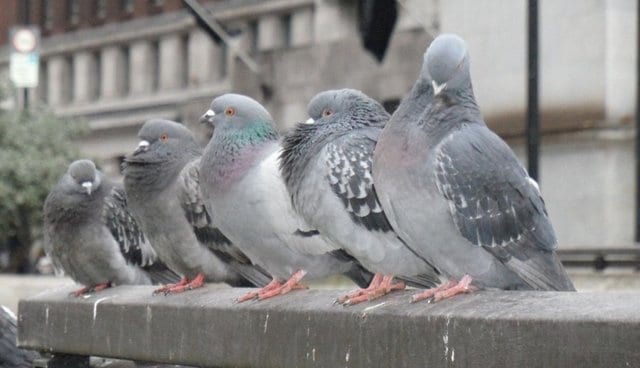
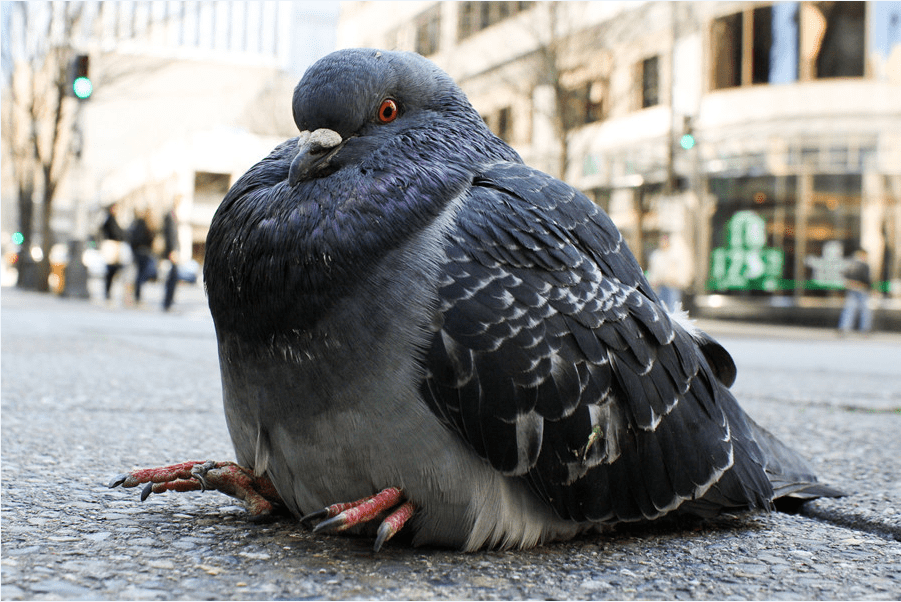
Such changes would probably have fascinated Darwin, who wrote, “There is hardly any exception to the rule that those characters vary most which are now most valued and attended to by fanciers, and which consequently are now being improved by continued selection.” Whether such exaggeration is good for the individual birds is another question. The breeding of domestic show animals is a biological art but can be warped by too much passion for the extreme and strange. One need not go to the lengths of the Germans. A pigeon fancier all my life, I gave up breeding modern carriers because curing their constant colds became depressing. Darwin himself showed that crossing the extreme varieties produced something very much like the ancestral Rock Pigeon. Most show pigeons would not survive long in the wild, but their descendents, common “street pigeons,” inhabit cities and cliffs everywhere in the world. Except for their variable colors and slightly larger size, they resemble the wild Rock Pigeon, which they have displaced in all but the most remote places. Some scientists consider them to be a “superdove,” a bird stronger and more adaptable than even its wild ancestors. Evolution, of course, is never stasis. I have seen wild Rock Pigeons only on remote cliffs on the Euphrates, but “superdoves” thrive in environments ranging from the sweltering streets of Houston to the 30-below-zero squares of Ulaan Bataar, Mongolia, in winter.
But the domestic pigeon still holds a unique charm for both fanciers and naturalists. The genetics of its colors alone support a quarterly newsletter for scientists and enthusiasts. Some show people, like dog breeders fixated on Westminster, pursue ever-more-exaggerated standards. Others prefer less “improved” birds. I started out with modern racing homers, a breed developed in Belgium and England in the early 1800s, originally a carrier of messages but also a racing competitor. It is a stout, athletic bird. Most non-fanciers see little difference between it and a common pigeon, though it is larger and more muscular, and has a larger head and wattles than the Rock Pigeon. Such a bird can survive very well in the wild. The genes of lost racers probably contribute to the continuing evolution of the “superdove.”
Over the past 20 or 30 years, naturalist and breeder friends of mine have become fascinated by the ancient, “unimproved” pigeon breeds of the Silk Road and the Mediterranean. Such breeds may have existed for thousands of years. They have enough diversity to satisfy Charles Darwin; in fact, many—such as the English barb—are exactly as Darwin, or Shakespeare (who wrote about them), saw them. I have Catalonian tumblers—small pigeons in a dazzling variety of colors—that are agile enough to evade marauding Cooper’s Hawks; Syrian owls that are short-beaked, similarly agile, and, unlike modern show owls, can feed their own young; and English barbs, which are virtual duplicates of the illustrations of them in Darwin’s Variation. I have Spanish pouters that inflate their globes just as much as do modern show pouters. But they must remain athletic, because they are used in the remarkable Spanish sport of “thieving” in which the males compete to seduce marked females to their home lofts. All of these breeds remain functional but retain enough diversity and beauty to satisfy the most aesthetically-minded fancier. And, unlike the often-inbred champions of pigeon and dog shows, they retain, as Darwin noted, enough genetic variation to make each new clutch a suspenseful delight. Show pigeons often resemble clones.
To a naturalist and biophiliac, the humble domestic pigeon can come to occupy a necessary place in one’s life, as it did in Darwin’s. Beautiful and ever-changing, they are a backyard microcosm that embodies Darwin’s most fundamental quote: “There is grandeur in this view of life, with its several powers, having been originally breathed into a few forms or into one; and that, whilst this planet has gone cycling on according to the fixed law of gravity, from so simple a beginning endless forms most beautiful and most wonderful have been, and are being, evolved.”
Pigeon Patrol Products & Services is the leading manufacturer and distributor or bird deterrent (control) products in Canada. Pigeon Patrol products have solved pest bird problems in industrial, commercial, and residential settings since 2000, by using safe and humane bird
deterrents with only bird and animal friendly solutions. At Pigeon Patrol, we manufacture and offer a variety of bird deterrents, ranging from Ultra-flex Bird Spikes with UV protection, Bird Netting, 4-S Bird Gel and the best Ultrasonic and audible sound devices on the market today.
Voted Best Canadian wholesaler for Bird Deterrent products ten years in a row.
Contact us at 1 877-4-NO-BIRD,(604) 585-9279 or visit our website at www.pigeonpatrol.ca
Pigeon/Pigeon Patrol / Pigeons Roosing / Vancouver Pigeon Control / Bird Spikes / Bird Control / Bird Deterrent / PIgeon Deterrent / Surrey Pigeon Control / Pest / Seagull deterrent / Vancouver Pigeon Blog / Birds Inside Home / Pigeons in the cities / Ice Pigeons / What to do about pigeons / sparrows, Damage by Sparrows, How to Keep Raccoons Away, Why Are Raccoons Considered Pests / De-fence / Pigeon Nesting / Bird Droppings / Pigeon Dropping / woodpecker control / Professional Bird Control Company / Keep The Birds Away / Birds/rats/seagull/pigeon/woodpecker/dove/sparrow/pidgeon control/pidgeon problem/pidgeon control/flying rats/pigeon problems/ bird netting/bird gel/bird spray/bird nails/bird guard
This week, a South African call-center business, frustrated by persistently slow Internet speeds, decided to use a carrier pigeon named Winston to transfer 4 gigabytes of data between two of its offices, just 50 miles apart. At the same time, a computer geek pushed a button on his computer to send data the old-fashioned way, through the Internet.
Winston the pigeon won. It wasn’t even close.
“Winston arrived after two hours, six minutes, and 57 seconds,” says Kevin Rolfe, head of the information technology department at Unlimited Group, a call-center business based in Durban. As for the Internet data transfer, he says, “when we finally stopped the computer, about 100 megs had transferred, which is about 4 percent of the total.”
Officially, the Unlimited Group has not given up on the Internet, nor has it any plans to embrace the use of homing pigeons that was pioneered on the battlefield by Genghis Khan. But while the pigeon-versus-Internet stunt was a resounding success in terms of satire, it also makes a point that many businesses throughout Africa are making: Africans pay some of the highest prices for some of the least reliable Internet service in the world. And if a country like South Africa – relatively prosperous and developed – can’t solve this problem, then it’s going to need a lot more pigeons.
In most parts of Africa, Internet service is provided by satellite transmission dishes, an expensive and unreliable option. Go to an Internet cafe in Kinshasa or Khartoum, and you’ll see dozens of earnest students and businessmen, typing out messages, pushing the send button, and then hoping the power doesn’t go out before the message gets sent.
Your humble correspondent in Africa last year attempted to send about one minute of digital video of displaced people in Kenya to his headquarters in Boston, through the so-called broadband Internet service provided at his Nairobi hotel. Six hours later, there was still an hourglass icon on his screen, with a message that simply read “sending.”
Undersea cable brings broadband to some
In theory, Africa’s problems are already well on their way to being solved. A $650 million undersea cable, linking the Kenyan port city of Mombasa with a larger sea cable system servicing Asia, was officially activated in late July of this year, bringing most major cities in East Africa their first taste of high-speed broadband Internet. But three months later, local Internet service providers have refused to drop their prices, offering increased bandwidth at the same price.
Some African nations have gone all-out to get the most bang out of the cable. Rwanda, for instance, has extended a high-speed fiber-optic cable network to every district and every major town in the country in anticipation of the cable, in hopes of turning itself into an information-technology hub like Singapore. Others, like South Africa, have been updating their systems, but can’t keep up with the exploding demand.
Which brings us back to Winston the pigeon. Mr. Rolfe says the idea for the pigeon race came from a member of his IT department, who remembered an April Fool’s joke of sending data by homing pigeons. After one too many incidents of a dropped line or a failed transfer, one IT tech finally blurted out, “We should just use pigeons.”
Taking a cue from former empires
As unusual as the idea sounds today, pigeons have been a powerful tool for empires, financial and otherwise. In the mid-19th century Paul Julius Reuter (founder of the Reuters news agency) used pigeons to send stock information between the cities of Aachen and Brussels, until telegraph service eventually replaced them. And as recently as World War I the British admiralty used pigeons to send battlefield information. (The Germans, predictably, trained falcons to intercept messages.)
Never a company to do things in half-measures, Unlimited Group began to promote its Pigeon Race 2009 on its website. Winston the pigeon soon had his own Facebook fan page, a website with training videos, and yes, Winston began to tweet. On Twitter. When Winston finally landed at the offices in Durban – risking hawks, gun-happy hunters, and high-winds – the results were carried by newspapers, TV stations, and were a huge sensation in the Twittersphere.
Winston’s feat illustrates larger problem
Perhaps stung by the pigeon experiment, South Africa’s giant communications company, Telkom, issued a statement to the South African Press Agency explaining that it was not to blame for Unlimited Group’s slow internet service.
“Telkom would like to clarify that the company cannot be blamed for this particular customer’s lack of throughput speeds,” Troy Hector, Telkom’s head of ICT, wrote to Sapa in an e-mail. “Several recommendations have, in the past, been made to the customer but none of these have, to date, been accepted. It must also be noted that Telkom is not the customer’s core service provider.”
Rolfe insists that the pigeon experiment was not aimed at any one particular company, but rather at the common problem that Internet have: slow Internet speed. A customer like Unlimited Group, which transmits an average of 500 megabytes of data per day, can’t afford to have unreliable connectivity.
“Look, we don’t blame Telkom or Neotel, or any of the other Internet providers,” says Rolfe. “Those guys, the providers are doing the best job that they can. But we are saying, fine, let’s sit down and think out of the box and figure out how to improve South Africa’s telecommunications.”
As for Winston, Rolfe says the pigeon is in no danger of losing his job. “He still goes out on training runs,” Rolfe says, especially when the computer lines are down. “Using pigeons, it’s not the optimal plan,” he chuckles. “But we may do it from time to time, to give Winston some airtime.”
Pigeon Patrol Products & Services is the leading manufacturer and distributor or bird deterrent (control) products in Canada. Pigeon Patrol products have solved pest bird problems in industrial, commercial, and residential settings since 2000, by using safe and humane bird
deterrents with only bird and animal friendly solutions. At Pigeon Patrol, we manufacture and offer a variety of bird deterrents, ranging from Ultra-flex Bird Spikes with UV protection, Bird Netting, 4-S Bird Gel and the best Ultrasonic and audible sound devices on the market today.
Voted Best Canadian wholesaler for Bird Deterrent products ten years in a row.
Contact us at 1 877-4-NO-BIRD,(604) 585-9279 or visit our website at www.pigeonpatrol.ca
Pigeon/Pigeon Patrol / Pigeons Roosing / Vancouver Pigeon Control / Bird Spikes / Bird Control / Bird Deterrent / PIgeon Deterrent / Surrey Pigeon Control / Pest / Seagull deterrent / Vancouver Pigeon Blog / Birds Inside Home / Pigeons in the cities / Ice Pigeons / What to do about pigeons / sparrows, Damage by Sparrows, How to Keep Raccoons Away, Why Are Raccoons Considered Pests / De-fence / Pigeon Nesting / Bird Droppings / Pigeon Dropping / woodpecker control / Professional Bird Control Company / Keep The Birds Away / Birds/rats/seagull/pigeon/woodpecker/dove/sparrow/pidgeon control/pidgeon problem/pidgeon control/flying rats/pigeon problems/ bird netting/bird gel/bird spray/bird nails/bird guard
A recent first detection of pigeon aviadenovirus-1 and pigeon circovirus co-infection associated with Young Pigeon Disease Syndrome (YPDS) in a pigeon flock in Turkey, prompted a study focused on documenting the distribution of Pigeon aviadenovirus (PiAdV-1 and PiAdV-2), Pigeon circovirus (PiCV), Columbid alphaherpesvirus 1 (pigeon herpesvirus (PiHV)) and Fowl aviadenovirus (FAdV) in the country. These viruses were selected as they are associated with severe disease in pigeons across the world. A total of 192 cloacal swabs were collected from young (<1 year old) pigeons from 16 different private pigeon flocks across Turkey, between 2018 and 2021 as part of routine diagnostic sampling. PiCV genetic material was the most frequently detected 4/16 (25%), PiAdV-1 and CoHV-1 DNA were both found in one flock each, while neither PiAdV-2 and FAdV were detected in any of the studied pigeon flocks. PiCV and PiHV genetic material were both detected in the same pigeon flock’s cloacal samples as a co-infection with the identification of PiHV being a first in Turkey.
Pigeon Patrol Products & Services is the leading manufacturer and distributor or bird deterrent (control) products in Canada. Pigeon Patrol products have solved pest bird problems in industrial, commercial, and residential settings since 2000, by using safe and humane bird
deterrents with only bird and animal friendly solutions. At Pigeon Patrol, we manufacture and offer a variety of bird deterrents, ranging from Ultra-flex Bird Spikes with UV protection, Bird Netting, 4-S Bird Gel and the best Ultrasonic and audible sound devices on the market today.
Voted Best Canadian wholesaler for Bird Deterrent products ten years in a row.
Contact us at 1 877-4-NO-BIRD,(604) 585-9279 or visit our website at www.pigeonpatrol.ca
Pigeon/Pigeon Patrol / Pigeons Roosing / Vancouver Pigeon Control / Bird Spikes / Bird Control / Bird Deterrent / PIgeon Deterrent / Surrey Pigeon Control / Pest / Seagull deterrent / Vancouver Pigeon Blog / Birds Inside Home / Pigeons in the cities / Ice Pigeons / What to do about pigeons / sparrows, Damage by Sparrows, How to Keep Raccoons Away, Why Are Raccoons Considered Pests / De-fence / Pigeon Nesting / Bird Droppings / Pigeon Dropping / woodpecker control / Professional Bird Control Company / Keep The Birds Away / Birds/rats/seagull/pigeon/woodpecker/dove/sparrow/pidgeon control/pidgeon problem/pidgeon control/flying rats/pigeon problems/ bird netting/bird gel/bird spray/bird nails/bird guard
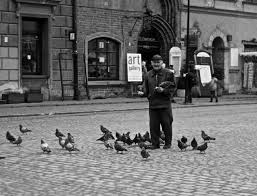
Among the most famous images of London’s Trafalgar Square is one of people feeding pigeons in its grounds. And closer to home, feeding these birds was a favourite pastime on the weekends around the Vidhana Soudha, when people flocked to it for a bit of relaxation in its gardens. But no more, as the pigeons are now as numerous in most parts of the city as they were once around it.
Far from feeding them, people have now taken to shooing them away as they invade their balconies and kitchens, building nests and dirtying them with their poop and feathers. Their numbers have become their downfall as they are no longer priced as pets either. Instead they are the flying rats of urban Bengaluru.
Observes one fed up Bengalurean, industrialist, Narendra Kumar, “Pigeons have adapted so well to our urban civilisation that they are driving other birds away. Cleaning pigeon droppings has become a huge problem today. People in high- rise buildings are the worst affected and even the plants on the balconies suffer as a result of their invasion.”
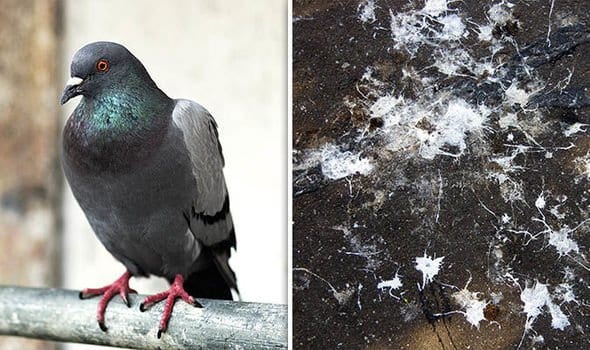
But what’s worse, the pigeon droppings are not just an eyesore, but also a health hazard, warn wildlife experts. With the pigeon population growing, they have been spreading diseases like avian influenza and castle fever through their droppings, according to them. “ The pigeon droppings contain bacteria and fungus, which can cause major lung disorders that can be fatal,” they explain.
It is also claimed that those who fall sick as a result of the pigeon droppings, find recovery hard despite downing antibiotics, because of the strong infection they transmit. Bird lovers too admit to being on their guard when it comes to these birds because of the infections and diseases they transmit.
The BBMP , which has received numerous complaints from people about the pigeon menace, is now planning to hold a meeting with wildlife experts, bird lovers , health experts and concerned citizens to deal with it, says Mr Sarfaraz Khan, BBMP joint commissioner (health).
The civic agency is reportedly considering taking a cue from other countries, which have effectively dealt with the growing population of pigeons without harming the ecology and is also planning a study on their impact on humans, animals and other bird species.
Pigeon Patrol Products & Services is the leading manufacturer and distributor or bird deterrent (control) products in Canada. Pigeon Patrol products have solved pest bird problems in industrial, commercial, and residential settings since 2000, by using safe and humane bird
deterrents with only bird and animal friendly solutions. At Pigeon Patrol, we manufacture and offer a variety of bird deterrents, ranging from Ultra-flex Bird Spikes with UV protection, Bird Netting, 4-S Bird Gel and the best Ultrasonic and audible sound devices on the market today.
Voted Best Canadian wholesaler for Bird Deterrent products ten years in a row.
Contact us at 1 877-4-NO-BIRD,(604) 585-9279 or visit our website at www.pigeonpatrol.ca
Pigeon/Pigeon Patrol / Pigeons Roosing / Vancouver Pigeon Control / Bird Spikes / Bird Control / Bird Deterrent / PIgeon Deterrent / Surrey Pigeon Control / Pest / Seagull deterrent / Vancouver Pigeon Blog / Birds Inside Home / Pigeons in the cities / Ice Pigeons / What to do about pigeons / sparrows, Damage by Sparrows, How to Keep Raccoons Away, Why Are Raccoons Considered Pests / De-fence / Pigeon Nesting / Bird Droppings / Pigeon Dropping / woodpecker control / Professional Bird Control Company / Keep The Birds Away / Birds/rats/seagull/pigeon/woodpecker/dove/sparrow/pidgeon control/pidgeon problem/pidgeon control/flying rats/pigeon problems/ bird netting/bird gel/bird spray/bird nails/bird guard
Pigeons may seem harmless, but these pest birds cause millions of dollars in damage every year to buildings, ventilation systems, machinery, statues, roofs, and much more. Bird droppings and nesting materials left by pigeons pose physical problems and health hazards that can become very serious if not corrected quickly making prompt and effective professional bird control is often essential.
Potential Health Hazards:
There are many health risks associated with pigeons and their droppings. The bacteria, fungi, and ectoparasites that they and their droppings harbor are numerous. The four most common ways disease is passed by bird to human are: inhalation of fecal dust, food and water contaminated with bird feces, direct contact with feces, and parasitic transfer.
Pigeon droppings can expose humans to many diseases, including salmonella, Newcastle disease, candidiasis, encephalitis, orthosis, and toxoplasmosis. In addition, they can also carry cryptococcosis, and coccidiodomycosis, which cause meningitis. The droppings may also harbor growth of fungus, which causes histoplasmosis. Fleas, lice, mites, and other pests often live on these birds, hitching a ride to where ever they want to jump off. Pigeons may also attract other pests, such as rats, which feed on dead pigeons and food that well-intentioned bird lovers may scatter for them.
In addition to disease, bird droppings are known for triggering people to slip and fall, which makes it especially important to rid the birds from highly trafficked areas.
Damage Caused by Pigeons:
These are messy birds, leaving droppings everywhere they go, particularly near their roost sites. Pigeon droppings are not just gross, they are also full of uric acid which makes them extremely corrosive. The droppings are the direct cause of millions of dollars in damage to buildings and other structures. Particularly vulnerable are painted surfaces, awnings, signs, and other similar surfaces. A tragic example of the corrosiveness of pigeon droppings is the Minnesota bridge accident in 2007, which was found to be the direct result of bird droppings eating away at the metal bridge supports until they weakened.
In addition to the damage cause by their acidic droppings, pigeon nests can also cause damage. Pest birds will often build nests in gutters or on roof corners blocking essential drainage systems. Every year several warehouses experience roof damage, and even collapse, when drainage systems have been blocked and standing water rises just six inches. Bird nests can also block ventilation systems, which not only prevents exhaust of potentially harmful gases, but also has the potential to spread diseases. Fire is also a potential hazard. Nesting materials are usually flammable, consisting of twigs, straw, grasses and dried droppings. When pest birds build their nests inside electric signs or other machinery there is a great risk of fire.
Pigeons are creatures of habit and highly social. Once they have found a cozy spot the will return again and again, bringing along more of their pigeon pals. Prolific breeders, pigeons can hatch several broods a year, sometimes even laying a new clutch before the previous have even hatched. Often our buildings and structures have architectural features such as drain spouts and eaves that make perfect nesting spots for these birds. Pigeons are comfortable around humans and they’re hard to scare away or deter. Once a flock of stubborn unwanted pigeons have set up shop in/on your building, it can be stubbornly resistant to removal, often requiring the services of a pest control or animal control professional. As is true of many pests that invade our homes and businesses, the first step to controlling feral pigeons is to remove their food source.
Tips to deter pigeons:
Don’t feed the pigeons.
Screen drains and gutters to make your property less attractive to pigeons.
Encourage children to pick up spilled food – and teach them NOT to feed pigeons
Keep areas around trash bins and outdoor dining areas clean
Eliminate water sources such as bird baths, over-watered lawns, or kiddy pools.
Pigeon Patrol Products & Services is the leading manufacturer and distributor or bird deterrent (control) products in Canada. Pigeon Patrol products have solved pest bird problems in industrial, commercial, and residential settings since 2000, by using safe and humane bird
deterrents with only bird and animal friendly solutions. At Pigeon Patrol, we manufacture and offer a variety of bird deterrents, ranging from Ultra-flex Bird Spikes with UV protection, Bird Netting, 4-S Bird Gel and the best Ultrasonic and audible sound devices on the market today.
Voted Best Canadian wholesaler for Bird Deterrent products ten years in a row.
Contact us at 1 877-4-NO-BIRD,(604) 585-9279 or visit our website at www.pigeonpatrol.ca
Pigeon/Pigeon Patrol / Pigeons Roosing / Vancouver Pigeon Control / Bird Spikes / Bird Control / Bird Deterrent / PIgeon Deterrent / Surrey Pigeon Control / Pest / Seagull deterrent / Vancouver Pigeon Blog / Birds Inside Home / Pigeons in the cities / Ice Pigeons / What to do about pigeons / sparrows, Damage by Sparrows, How to Keep Raccoons Away, Why Are Raccoons Considered Pests / De-fence / Pigeon Nesting / Bird Droppings / Pigeon Dropping / woodpecker control / Professional Bird Control Company / Keep The Birds Away / Birds/rats/seagull/pigeon/woodpecker/dove/sparrow/pidgeon control/pidgeon problem/pidgeon control/flying rats/pigeon problems/ bird netting/bird gel/bird spray/bird nails/bird guard