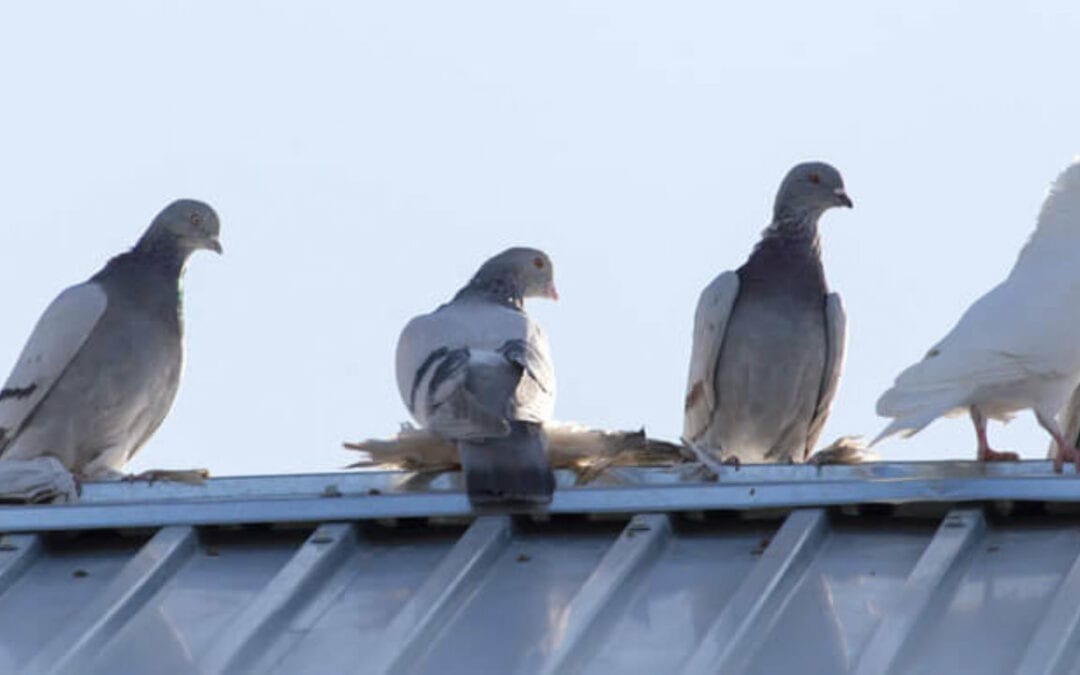
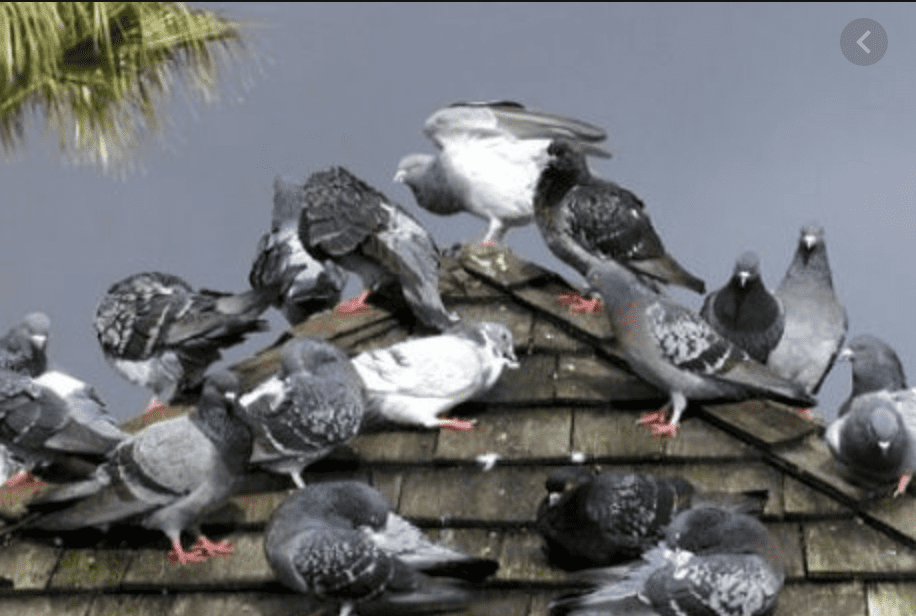
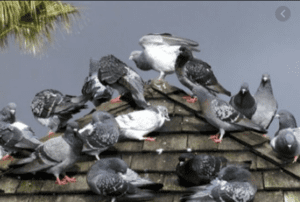
Commonly known as Pigeons, Rock Pigeons are often considered a nuisance by some city officials and some farm businesses.
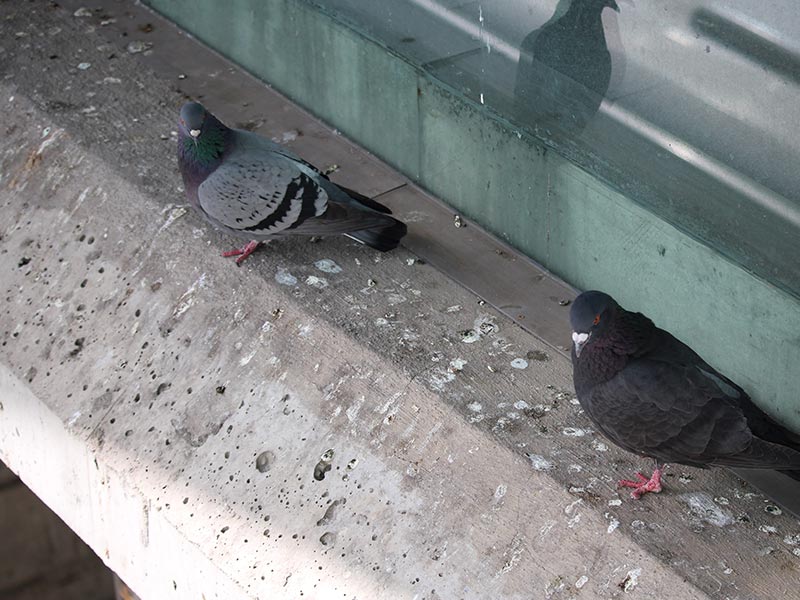
In cities they congregate in large flocks and can create messes with their droppings.
On farms, eating grains and possible harm to livestock through bacteria and viruses are concerns about these birds.
Many pigeon deterents are available online to prevent nesting in areas they’re not wanted.
Introduced into North America from Europe in the 1600’s, these birds have been associated with humans for thousands of years.
Rock Doves are thought to have been the first domesticated bird, raised for meat as far back as the time of the ancient Egyptians.
Description
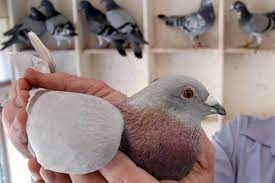
Pigeons have different colors due to breeding by humans. They are the descendants of the wild Rock Dove of Europe.
About 13 inches in length with a dark gray head, iridescent neck, with a light gray back and 2 dark wing bars.
Mating – Breeding Habits
Like Mourning Doves, pairs are monogamous, often breeding in consecutive seasons for as long as both birds of a pair live.
Most will attempt to raise several broods each year. Sometimes as many as four or five broods will be raised in a single year.
The breeding season of these birds can be all year provided climate conditions allow. There seems to be some slowing down during the winter months.
Nesting Habits
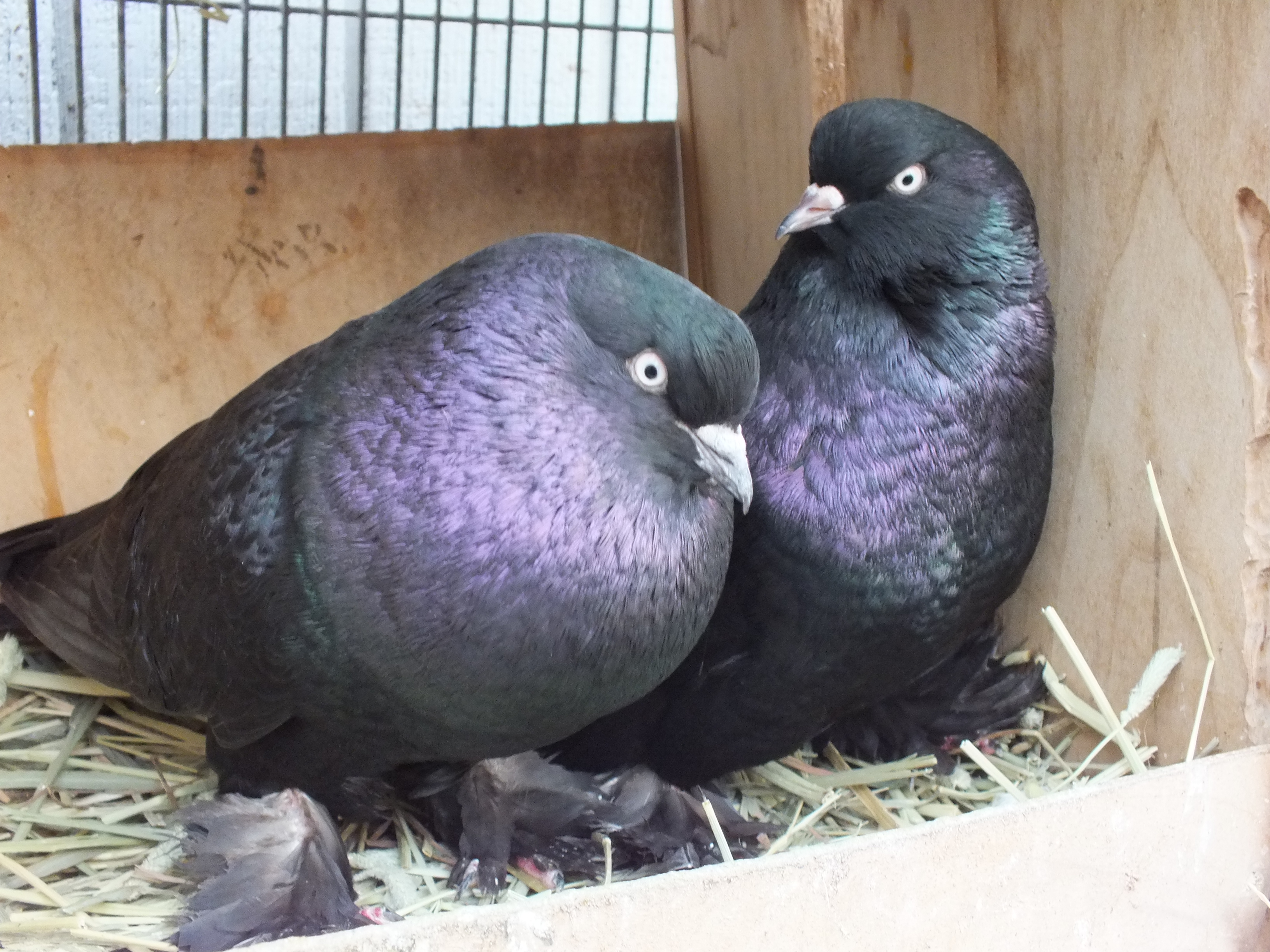
The nesting habits of Pigeons are a bit unique. The male chooses a site in view of the female, selecting one stick and bringing it back, lays it in front of his mate.
The female who stays at the nesting site accepts the sticks the male brings to her and places them underneath her.
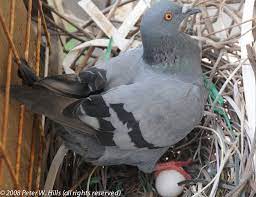
The nest of these birds can be found along building ledges, rafters, beams, under bridges or inside barns.
The nest is saucer-like in shape and made of stems and leaves.
The female may sit on the nest a day or two before the first egg is laid. Generally 2 white eggs are laid.
Both the male and female will incubate but the female will spend the most time on the eggs since she will be on the nest from mid-afternoon to mid-morning.
Incubation last for about 18 days. When the eggs hatch the young are covered in yellow down.
Young pigeons in the nest are referred to as “squabs”
Initially, the squabs are fed what is referred to as crop milk. This is a regurgitated thick liquid food that comes from the parents crops.
At about 10 days the squabs are fed increasing amounts of the food types that adults eat and are no longer dependent on crop milk.
The young will double in size in a day and a half. Making them one of the fastest growing vertebrate in the world.
Within 2 weeks the flight feathers begin to emerge and by week 3 the squabs are covered in feathers.
The tail and full feathering is completed by the 28th day and their weight is that of an adult.
The young will now leave the nest and the male will teach them what they need to know to survive.
This is 10 – 15 days longer than most of our backyard birds.
The female will begin a new clutch and this cycle will repeat about every 30 days when weather cooperates.
Do Pigeons Reuse the Same Nest
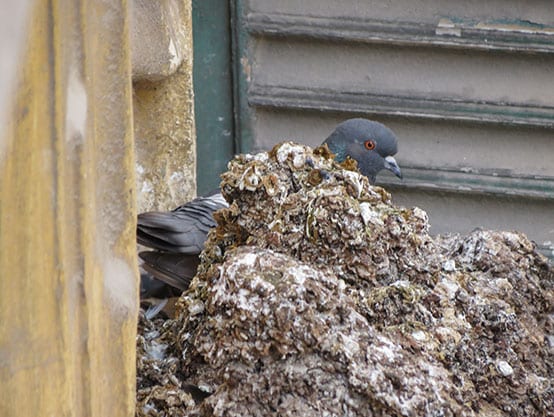
It’s more accurate to say that the same nest site is used as the second and subsequent nest are built on top of the previous nest.
Nest that are several years old can measure out to be as much as 7 inches high and 19 inches wide.
Feeding Habits – What Pigeons Eat
Rock Pigeons feed on the ground. To prevent seed spoilage and to keep the birds healthy a ground feeder is recommended for all ground feeding birds.
The best types of food to offer these birds are properly mixed seeds specifically made for doves and pigeons.
Predators
The primary preadators of pigeons include: man, peregrin falcon, and cats. Nest predators include oppossums, raccoons, crows and owls. Hawks will capture perching birds.
Are Pigeons Smart Birds?
According to Professor Richard J. Herrnstein at the Harvard Psychological Laboratories they are. Pigeons were smart enough to learn all the letters of the english alphabet.
In another study, Pigeons were able to recognize themselves in a mirror. This makes them one of six species and the only non-mammal to be able to do so.
So yes, Pigeons are a pretty smart bird.
What is the Lifespan of Pigeons?
Pigeons may live 3 – 6 years in the wild with the average being 3 – 4 years. In captivity they have lived as long as 15 years depending on the care given to the bird.
Pigeons in History
During the world wars, Homing Pigeons were trained to return to a loft in the UK.
Troops then took the pigeons with them and used them to send messages when radio and written communication were being intercepted.
Pigeon Fun Facts
Pigeons have the ability to see about 26 miles.
When fully feather, adult pigeons have around 10,000 feathers.
There are approximately 400 million pigeons in the world.
Pigeon Patrol Products & Services is the leading manufacturer and distributor of bird deterrent (control) products in Canada. Pigeon Patrol products have solved pest bird problems in industrial, commercial, and residential settings since 2000, by using safe and humane bird deterrents with only bird and animal friendly solutions. At Pigeon Patrol, we manufacture and offer a variety of bird deterrents, ranging from Ultra-flex Bird Spikes with UV protection, Bird Netting, 4-S Bird Gel and the best Ultrasonic and audible sound devices on the market today.
Voted Best Canadian wholesaler for Bird Deterrent products ten years in a row.
Contact us at 1- 877– 4– NO-BIRD, (604) 585-9279 or visit our website at www.pigeonpatrol.ca
Pigeon/Pigeon Patrol / Pigeons Roosting / Vancouver Pigeon Control /Bird Spikes / Bird Control / Bird Deterrent / Pigeon Deterrent? Surrey Pigeon Control / Pest /Seagull deterrent / Vancouver Pigeon Blog / Birds Inside Home / Pigeons in the cities / Ice Pigeons/ What to do about pigeons/ sparrows , Damage by Sparrows, How To Keep Raccoons Away, Why Are Raccoons Considered Pests/ De-fence / Pigeon Nesting/ Bird Droppings / Pigeon Dropping/ woodpecker control/ Professional Bird Control Company/ Keep The Birds Away/ Birds/rats/ seagull/pigeon/woodpecker/ dove/sparrow/pidgeon control/pidgeon problem/ pidgeon control/flying rats/ pigeon Problems/ bird netting/bird gel/bird spray/bird nails/ bird guard
For a few accessible pigeon droppings on an open balcony, the basic approach is to gently dampen the material, collect it without creating dust, and clean the surface with a suitable detergent. Disinfection, where appropriate, is a separate step that must follow the product label. Large accumulations, difficult access and enclosed spaces call for professional assessment.
Before starting, check both the condition of the droppings and the balcony surface. Concrete, waterproof coatings, timber and painted metal may need different cleaning products. A method that removes a stain can still damage the finish underneath.
Before Cleaning: Assess the Amount and Location
A few isolated droppings on an accessible outdoor floor are a different task from layers of material beneath a long-established roost. Do not assume that household cleaning equipment is suitable for every situation.
When to Arrange Professional Cleanup
Droppings form a thick layer or cover a large area.
The material is in an enclosed space or around ventilation equipment.
Cleaning would require leaning over a railing, climbing or working at height.
You cannot contain dust, debris or wastewater.
You are unsure about the contamination or the protective equipment required.
If birds are actively nesting, do not disturb the nest or block access to dependent young. Obtain appropriate wildlife advice before cleaning around the nest or installing exclusion equipment.
Why Dust Control Matters
Disturbing contaminated material can release airborne particles. Histoplasmosis is associated with inhaling fungal spores from the environment, including contaminated soil enriched by bird or bat droppings. The presence of a few droppings does not establish that this fungus is present.
How to Clean Small Amounts of Pigeon Poop Off a Balcony
The following guidance is for isolated, accessible deposits on an open balcony. It is not a procedure for a heavily contaminated roost or an enclosed area.
1. Check the Surface and Building Requirements
Identify the floor finish before choosing a cleaner. A balcony that looks like bare concrete may have a waterproof membrane, paint or a protective sealer.
Check the surface manufacturer’s care instructions and, in a rental or strata building, ask the property manager about cleaning restrictions and wastewater handling. Keep water and debris away from neighbouring balconies and public areas below.
2. Prepare the Area and Protective Equipment
Keep children and pets away while you work. Use gloves, closed footwear and clothing that protects exposed skin. Follow cleaning-product instructions for eye protection and other equipment.
Use a gentle application of water to dampen the material without splashing or creating runoff. Allow hardened deposits to soften before attempting removal.
Do not begin by sweeping or breaking up dry deposits. CDC guidance recommends wetting material to reduce dust before collection.
4. Collect the Softened Material
Lift the dampened deposits with disposable towels or a suitable plastic tool, taking care not to damage the finish. Keep the waste contained and follow local disposal requirements.
Do not push droppings over the balcony edge or wash solids into a drain. Do not use a household vacuum to collect the material.
5. Clean the Exposed Surface
Use a detergent approved for the surface, following its dilution instructions. Work gently with a non-abrasive tool and test an inconspicuous area first.
Remove cleaner residue as directed while controlling wastewater. Avoid pressure washing droppings on a residential balcony because it can spread contaminated spray and debris.
6. Finish and Wash Your Hands
Keep people off the area until it is dry and no longer slippery. Clean reusable tools appropriately, remove protective equipment carefully and wash your hands with soap and water.
First determine whether the concrete is bare, sealed, painted or covered by a waterproof coating. Choose a cleaning product approved for that exact surface rather than assuming every concrete cleaner is suitable for a balcony.
Dampen and collect the deposits before working on any remaining mark.
Use the specified dilution and a brush that will not damage the finish.
Test a small, hidden area before treating a visible section.
Check product and coating instructions before using acidic or abrasive cleaners.
Do not flood the balcony or direct dirty water towards adjoining properties.
If a mark remains, establish whether it is a stain or damage to the coating before using a stronger product. Repeated aggressive scrubbing may make a damaged finish worse. Ask your property manager or a surface-care professional when the finish is uncertain.
Cleaning Other Balcony Surfaces
Surface checks before choosing a balcony cleaner
Surface
What to check
Wood or composite decking
Follow the decking manufacturer’s instructions. Avoid sharp scraping tools and unapproved soaking or chemical treatments.
Painted or coated metal
Use a product suitable for the coating. Do not assume that a cleaner safe for bare metal is safe for painted railings.
Tile and grout
Confirm compatibility with both the tile and grout. Natural stone, glazed tile and sealed grout may have different requirements.
Waterproof balcony membrane
Ask the building manager for approved cleaning products and tools. Avoid anything that could puncture or strip the membrane.
Outdoor cushions and fabric
Follow the care label and avoid shaking contaminated fabric. Seek specialist advice for heavily soiled porous items.
Cleaning and Disinfecting Are Different Steps
Cleaning removes dirt and material from a surface. Disinfecting uses an appropriate product to kill specified microorganisms under the conditions stated on its label.
Where disinfection is appropriate, clean first, then use a product approved for the surface and intended use. Follow the required dilution, protective equipment, contact time and rinsing instructions. A fixed waiting time is not suitable for every disinfectant.
Do not assume that vinegar, baking soda or ordinary detergent disinfects the surface. Never mix cleaning chemicals, especially bleach with vinegar, acids or ammonia-based products.
If pigeons keep returning, cleaning alone does not address the landing or roosting site. Look for the surface directly above the recurring mess and note where birds enter or shelter.
Block Access to the Balcony
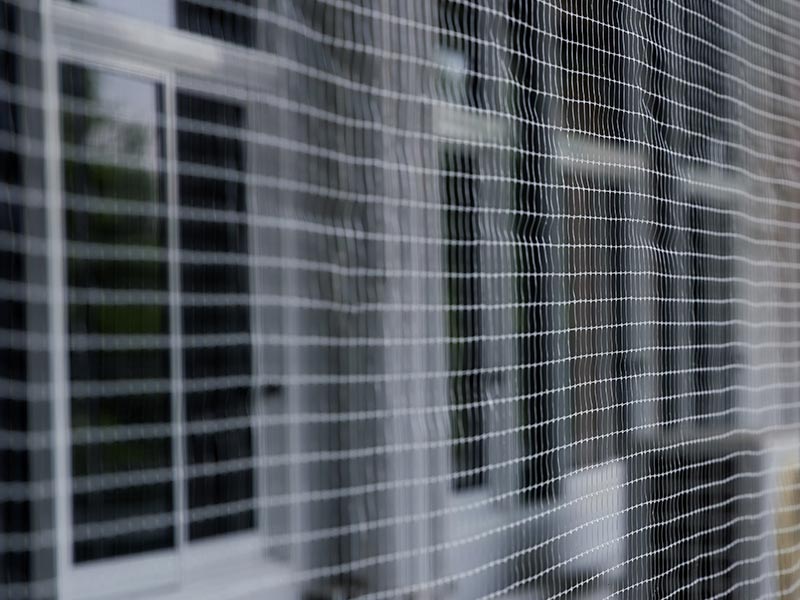
Where pigeons enter and use several parts of the balcony, properly planned bird netting can provide a physical barrier. The installation must account for secure edges, building access and birds already inside the space.
Protect Specific Perching Areas
Where the problem is a particular ledge, bird spikes may be suitable. They protect the covered surface rather than enclosing the entire balcony.
Remove Food and Unnecessary Shelter
Keep accessible food and rubbish contained, and reduce clutter that provides sheltered corners. Check the area regularly so repeat bird activity is noticed before another substantial buildup develops.
How do I clean dried pigeon poop off a concrete balcony?
For a small, accessible deposit, dampen it gently before collection, then clean with a product approved for the concrete or its coating. Avoid dry scraping and sweeping. Thick accumulations or uncertain surface finishes need professional advice.
Can I sweep pigeon droppings off my balcony?
Do not sweep dry pigeon droppings. This can create airborne dust. Dampen small deposits before collecting them, and arrange specialist advice for extensive accumulations.
Does vinegar disinfect pigeon poop?
Do not rely on household vinegar to disinfect an area contaminated by pigeon droppings. Where disinfection is appropriate, clean first and follow the label of a suitable disinfectant.
Can I pressure wash pigeon poop off a balcony?
Avoid pressure washing droppings on a residential balcony. It can spread contaminated spray and debris to nearby areas. Use a controlled cleaning approach for small deposits or arrange specialist cleanup.
When should I hire a professional for pigeon-dropping removal?
Arrange professional assessment for large accumulations, enclosed spaces, unsafe access or situations where dust and wastewater cannot be controlled. People with weakened immune systems should avoid doing this work themselves.
How do I prevent pigeon droppings from returning?
Identify where pigeons land or enter, remove accessible food and consider suitable netting or anti-perching systems. Cleaning removes the existing mess; prevention addresses the birds’ access to the area.
Get Advice on Preventing Repeat Balcony Problems
Once the cleanup has been addressed, Pigeon Patrol can help you explore bird-control products and prevention options for your balcony.
How does a lone pigeon get back home? Does it choose the fastest, the easiest or the safest route?
As flying takes a lot of energy, birds generally adapt their flight speed and trajectory to reduce how much they use.
Now researchers at Swansea University have been using high-tech tags to study homing pigeons and to discover if these crucial decisions could be linked to helping them avoid attack by predators.
When the team monitored pigeons as they flew back to their loft at the Max Planck Institute of Animal Behaviour in Germany, they observed that the birds did sometimes adopt energy-efficient flight styles such as starting their climbs ahead of hills to reduce their climb angle. But they also saw pigeons using up energy by flying at high speeds.
Baptiste Garde, of the University’s Swansea Lab for Animal Movement (SLAM) led the new research which has just been published by the journal Royal SocietyOpen Science
He said: “This might suggest that pigeons are just trying to get home as fast a possible, but by comparing the variation in their flight speed and altitude to those of an ultralight aircraft following the same path, we found that pigeon altitude and speed was, in fact, very variable.
“Flying this way is neither efficient in terms of time nor energy, but it might have an unexpected advantage. Indeed, if we look at the trajectory of a rabbit on the run, or a snipe flying away, we can see that they make unpredictable sharp turns to confuse their predators.
“That is what we call a protean behaviour. Pigeons might be using the same strategy to increase their chances of avoiding an attack.
“Protean flight has only been described in a handful of birds up until now but we think that it might be a relatively common behaviour, with birds flying in a more unpredictable way when they fly solo.”
Pigeon Patrol Products & Services is the leading manufacturer and distributor of bird deterrent (control) products in Canada. Pigeon Patrol products have solved pest bird problems in industrial, commercial, and residential settings since 2000, by using safe and humane bird deterrents with only bird and animal friendly solutions. At Pigeon Patrol, we manufacture and offer a variety of bird deterrents, ranging from Ultra-flex Bird Spikes with UV protection, Bird Netting, 4-S Bird Gel and the best Ultrasonic and audible sound devices on the market today.
Voted Best Canadian wholesaler for Bird Deterrent products ten years in a row.
Contact us at 1- 877– 4– NO-BIRD, (604) 585-9279 or visit our website at www.pigeonpatrol.ca
Pigeon/Pigeon Patrol / Pigeons Roosting / Vancouver Pigeon Control /Bird Spikes / Bird Control / Bird Deterrent / Pigeon Deterrent? Surrey Pigeon Control / Pest /Seagull deterrent / Vancouver Pigeon Blog / Birds Inside Home / Pigeons in the cities / Ice Pigeons/ What to do about pigeons/ sparrows , Damage by Sparrows, How To Keep Raccoons Away, Why Are Raccoons Considered Pests/ De-fence / Pigeon Nesting/ Bird Droppings / Pigeon Dropping/ woodpecker control/ Professional Bird Control Company/ Keep The Birds Away/ Birds/rats/ seagull/pigeon/woodpecker/ dove/sparrow/pidgeon control/pidgeon problem/ pidgeon control/flying rats/ pigeon Problems/ bird netting/bird gel/bird spray/bird nails/ bird guard
One of the best places for pigeons is at Markham Rd. and Lawrence Ave., where a perpetual buffet of birdie num num is on the menu.
It is also a bad place to be a pedestrian or a TTC rider. After they dine, the birds roost on overhead utility wires to digest their meal and then deposit wet, smelly droppings on the sidewalk and people below.
We’ve had several complaints over the past few years about the hundreds of pigeons drawn to the southwest corner of the busy intersection by food scattered across a parking lot.
The bird lovers’ hearts are in the right place, but the mess created by the huge number of pigeons attracted to the food is the bane of people who catch the bus at a TTC stop on the corner.
A reader told us he’s been twice bombed on his way to the TTC stop, adding that he’s heard it’s a sign of good luck to be pooped on by a bird but doesn’t believe it.
“They sit on the wires and s– on everything below,” said the reader, who asked not to be named. “One time I could see it falling in front of me, like it was raining bird s–.”
We’ve gone there several times and seen hundreds of pigeons and a few seagulls pecking at seed in the parking lot, while others that had finished dining roosted wing-to-wing on wires on the east side of Lawrence, waiting to drop a surprise on a hapless victim.
The sidewalk below the wires had a residue of guano on it, but we thought it would have been much worse. Plentiful rainfall over the past few weeks has likely washed away some of it.
Dumped next to a concrete barrier on the north side of the parking lot was a huge pile of stale white bread cut into pieces — enough to fill a couple big garbage bags — along with several pounds of white rice.
The situation raises a couple questions, like who’s doing it and what can be done, if anything, to stop them.
STATUS: We asked the city if any rules prohibit the feeding of birds. City spokesperson Angelica Santos sent us an email that said “feeding wildlife can increase the population of wild animals in a community and cause the animal to lose its natural fear of people.” Yeah, but we’re talking about pigeons, not raccoons or bears. Santos went on to cite bylaws that say “a person feeding wildlife in a public area can be fined by the city, if the person is observed by an officer throwing waste.” In other words, unless a bylaw enforcement officer stakes out the parking lot and catches someone feeding them, there are no repercussions. We also found a page on the city’s website that says “there are no specific bylaws that restrict the feeding of wildlife outside of a city park.” Since the feeding is done in a private parking lot, it looks the feeders are home free.
Pigeon Patrol Products & Services is the leading manufacturer and distributor of bird deterrent (control) products in Canada. Pigeon Patrol products have solved pest bird problems in industrial, commercial, and residential settings since 2000, by using safe and humane bird deterrents with only bird and animal friendly solutions. At Pigeon Patrol, we manufacture and offer a variety of bird deterrents, ranging from Ultra-flex Bird Spikes with UV protection, Bird Netting, 4-S Bird Gel and the best Ultrasonic and audible sound devices on the market today.
Voted Best Canadian wholesaler for Bird Deterrent products ten years in a row.
Contact us at 1- 877– 4– NO-BIRD, (604) 585-9279 or visit our website at www.pigeonpatrol.ca
Pigeon/Pigeon Patrol / Pigeons Roosting / Vancouver Pigeon Control /Bird Spikes / Bird Control / Bird Deterrent / Pigeon Deterrent? Surrey Pigeon Control / Pest /Seagull deterrent / Vancouver Pigeon Blog / Birds Inside Home / Pigeons in the cities / Ice Pigeons/ What to do about pigeons/ sparrows , Damage by Sparrows, How To Keep Raccoons Away, Why Are Raccoons Considered Pests/ De-fence / Pigeon Nesting/ Bird Droppings / Pigeon Dropping/ woodpecker control/ Professional Bird Control Company/ Keep The Birds Away/ Birds/rats/ seagull/pigeon/woodpecker/ dove/sparrow/pidgeon control/pidgeon problem/ pidgeon control/flying rats/ pigeon Problems/ bird netting/bird gel/bird spray/bird nails/ bird guard
Pet lovers are embracing the joys of adopting dogs and cats from shelters in ever greater numbers, but few people realize how many birds there are in shelters and rescues needing to be adopted.
Pigeons Make Great Pets — And They Need Our Help
I started Palomacy (originally named MickaCoo Pigeon & Dove Rescue) in San Francisco, CA when I discovered domestic (unreleasable) pigeons were being killed in shelters for lack of homes. Pigeons such as Kings, Fantails, Tumblers and Homers are smart, beautiful and gentle birds. They’ve been selectively bred and tamed and, while they can’t survive in the wild, they thrive as pets. Many pigeons (and other birds as well) wind up in animal shelters, either surrendered or found as strays, but they need adopters to get out alive.
Pigeons make great pets both indoors as part of the family or outside in a rodent and predator-proof aviary.
Pigeons as Pets in an Outdoor Aviary
Rescued pigeons can’t be safely flown (they are easy targets for hawks and cats) and so, when outside, must be protected in an aviary. It needs to be predator-proof (sturdy and securely built all the way around including top and bottom), rodent-proof (use 16 gauge or better hardware mesh with openings half inch or smaller) and include a sheltered corner that will stay shady on the hottest days and dry during the rainiest. No one has ever wished for a smaller aviary so make it as big as possible. Minimum size for four birds would be at least 6 feet long by 4 feet deep and 6 feet high.
Pigeons excel at the leisure arts and spend their time bathing, preening, lounging in the sun, foraging for favorite seeds, watching the sky, napping, showing off and courting. Every four to five weeks, mated couples will lay a pair of eggs (which need to be replaced with fake eggs for pigeon birth control) and take turns sitting on them. Pigeons are extremely devoted to their family and mate for life. They require fresh food and water and a quick poop-scrape daily and a thorough aviary cleaning weekly. Pigeons are beautiful, peaceful and full of personality. With time and attention, most can be hand-tamed. All can be befriended. It’s easy to create a charming, attractive and safe aviary for rescued pigeons.
Pigeons as Indoor Pets
Pigeons can also live inside with the family. They need a big cage for their home base (a double-flight cage or an extra large dog kennel is a good size for a pair) with daily out-of-cage time to stretch their legs and wings and have some fun. They’ll walk around more than fly and will pick out some favorite spots for hanging out. Pigeons are smart, easy going birds that quickly learn household routines. They do fine in homes with other pets and can live peacefully and unafraid with dogs and cats as long as they are kept safe. Pigeons are very emotional and do need a BFF, whether another bird or a human with whom they can spend the day. (Home all alone in a cage isn’t a good life for a pigeon.)
Janelle & Beep chat up Petey & Pineapple in their double-flight cage
Using Pigeon Pants for Indoor Birds
The main inconvenience to having pigeons as indoor pets is probably their droppings. Healthy pigeon poop is odorless and not too hard to manage with hardwood or tile floors or with strategic placement of liners. Pigeons can also be potty trained or they can wear pigeon pants! Pigeon pants are adorable little harnesses with a diaper to catch droppings. The pants are easy to put on and pigeons tolerate them well. Once dressed, they can walk and fly around the house and sit on laps and shoulders poop-free. The diaper, lined with half a panty-liner, should to be changed every 3 hours.
Pigeon Patrol Products & Services is the leading manufacturer and distributor of bird deterrent (control) products in Canada. Pigeon Patrol products have solved pest bird problems in industrial, commercial, and residential settings since 2000, by using safe and humane bird deterrents with only bird and animal friendly solutions. At Pigeon Patrol, we manufacture and offer a variety of bird deterrents, ranging from Ultra-flex Bird Spikes with UV protection, Bird Netting, 4-S Bird Gel and the best Ultrasonic and audible sound devices on the market today.
Voted Best Canadian wholesaler for Bird Deterrent products ten years in a row.
Contact us at 1- 877– 4– NO-BIRD, (604) 585-9279 or visit our website at www.pigeonpatrol.ca
Pigeon/Pigeon Patrol / Pigeons Roosting / Vancouver Pigeon Control /Bird Spikes / Bird Control / Bird Deterrent / Pigeon Deterrent? Surrey Pigeon Control / Pest /Seagull deterrent / Vancouver Pigeon Blog / Birds Inside Home / Pigeons in the cities / Ice Pigeons/ What to do about pigeons/ sparrows , Damage by Sparrows, How To Keep Raccoons Away, Why Are Raccoons Considered Pests/ De-fence / Pigeon Nesting/ Bird Droppings / Pigeon Dropping/ woodpecker control/ Professional Bird Control Company/ Keep The Birds Away/ Birds/rats/ seagull/pigeon/woodpecker/ dove/sparrow/pidgeon control/pidgeon problem/ pidgeon control/flying rats/ pigeon Problems/ bird netting/bird gel/bird spray/bird nails/ bird guard
Police in India took a pigeon into custody Monday after the bird was found carrying a warning note to the country’s Prime Minister Narendra Modi.
According to Agence France-Presse (AFP) news agency, Border Security Force (BSF) officers found the pigeon in the northern state of Punjab, where clashes between Indian and Pakistani troops have intensified.
“We took it into custody last evening,” a police investigator told the news agency. “The BSF found it with a note in Urdu saying something like ‘Modi, we’re not the same people from 1971. Now each and every child is ready to fight against India’.”
The note was apparently signed by the banned Pakistani militant group Lashkar-e-Taiba.
According to English language newspaper The Indian Express, this is the second time in just over a week a pigeon has been found with some sort of note apparently sent from Pakistan.
On Sept. 23, a bird was found in Hoshiarpur district with “some words written in Urdu,” the newspaper reported.
“We are investigating the matter,” inspector Ramesh Kumar told the Express.
Pigeon Patrol Products & Services is the leading manufacturer and distributor of bird deterrent (control) products in Canada. Pigeon Patrol products have solved pest bird problems in industrial, commercial, and residential settings since 2000, by using safe and humane bird deterrents with only bird and animal friendly solutions. At Pigeon Patrol, we manufacture and offer a variety of bird deterrents, ranging from Ultra-flex Bird Spikes with UV protection, Bird Netting, 4-S Bird Gel and the best Ultrasonic and audible sound devices on the market today.
Voted Best Canadian wholesaler for Bird Deterrent products ten years in a row.
Contact us at 1- 877– 4– NO-BIRD, (604) 585-9279 or visit our website at www.pigeonpatrol.ca
Pigeon/Pigeon Patrol / Pigeons Roosting / Vancouver Pigeon Control /Bird Spikes / Bird Control / Bird Deterrent / Pigeon Deterrent? Surrey Pigeon Control / Pest /Seagull deterrent / Vancouver Pigeon Blog / Birds Inside Home / Pigeons in the cities / Ice Pigeons/ What to do about pigeons/ sparrows , Damage by Sparrows, How To Keep Raccoons Away, Why Are Raccoons Considered Pests/ De-fence / Pigeon Nesting/ Bird Droppings / Pigeon Dropping/ woodpecker control/ Professional Bird Control Company/ Keep The Birds Away/ Birds/rats/ seagull/pigeon/woodpecker/ dove/sparrow/pidgeon control/pidgeon problem/ pidgeon control/flying rats/ pigeon Problems/ bird netting/bird gel/bird spray/bird nails/ bird guard