by Pigeon Patrol | Jan 30, 2020 | Bird Deterrent Products, Bird Netting, Bird Spikes, Pigeon Droppings, Pigeon Patrol's Services, Pigeons in the News, UltraSonic Bird Control
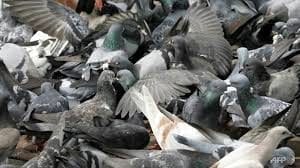
Is Hutchinson facing growing pigeon problems? The experts agree: There are definitely more pigeons in Hutchinson these days.
And with the increased population comes growing pigeon problems related both to public health and property maintenance.
Pigeons plague the Reno County Courthouse, several churches and most of the downtown area.
Many people are resigned that pigeons are a natural addition to any tall building, but some Hutchinson business owners are taking a stand.
Last week, Advance Pest Control performed a “baiting” of pigeons in the downtown area.
Advance was hired by a coalition of business owners – who have remained anonymous to The Hutchinson News – who sought to reduce the pigeon population downtown because of health concerns and property damage.
In the baiting, toxic corn was strategically placed about the downtown area.
The birds who eat the bait eventually die but first display intoxicated behavior.
“Basically, this behavior is a stress signal to the other birds, which leave the area because they sense that something is not right,” said Jeff Wells, vice president of Advance. “So it results in a great reduction in population in a specific area because of the birds who take a toxic dose as well as the repellency issue.”
The baiting has resulted in a reduced population of pigeons downtown, but Wells said he has noticed that there are more birds roosting on nearby buildings that weren’t baited.
Health, property concerns
Pigeon droppings aren’t just a nuisance or an extra chore for property owners. Because they are acidic, they actually cause property damage, eating through metal and deteriorating signs and other metal objects at a rapid rate.
The biggest growing pigeon problems, though, comes in cleaning the droppings.
Pigeon fecal matter is a breeding ground for a spore called histoplasmosis, which can cause an infection that leads to respiratory disease, according to the Centers for Disease Control and Prevention. The infection, if it affects other organs, can be fatal if untreated.
Workers cleaning up the droppings cause histoplasmosis spores to become airborne and are infected when they breathe them in.
Pigeons are also known to carry or transmit pigeon ornithosis, encephalitis, Newcastle disease, cryptococcosis, toxoplasmosis, salmonella food poisoning and several other diseases, according to the Kansas Department of Wildlife and Parks.
For that reason, the Kansas Department of Agriculture files the use of certain pigeon-control products under the category of public health and safety.
It’s a problem not lost on local businesses.
Next week, workers trained in safely removing pigeon waste will clean piles of pigeon droppings from the Fox Theatre marquee, which is being eroded by the waste, said board president Greg Payton.
Payton added that some theater employee illnesses have been blamed on the droppings.
Birds not protected
Pigeons are not protected by Kansas law, meaning property owners are free to dispose of them as they wish, Wells said.
But until the recent baiting, little has been done over the past seven years to control the pigeon population, which has led to the increase Hutchinson is seeing now, Wells said.
“The population has definitely increased,” Wells said. “There’s no question about that.”
In 2001, a baiting occurred, although it wasn’t performed by Advance, Wells said. A reduction in the pigeon population followed, but then the pigeon population was generally left alone except for some property owners putting up spikes or other roosting deterrents.
“These birds breed so quickly that the population explodes when nothing is done to limit them,” Wells aid.
Even some pigeon enthusiasts seem to understand the need for the population control.
“I don’t know the real solution,” said Mel Voth, a Garden City man who raises homing pigeons. “There are ways to divert them to other places, but I think a lot of folks feel like the baiting is the easiest way to reduce the population.”
Wells said there will always be a struggle between people who want pigeons eliminated and those who believe it’s wrong to kill them off, but he believes there can be a healthy compromise.
“Ultimately, we are trying to protect public health and safety, not eliminate a species of birds,” he said. “I place the safety of my kids above the population of pigeons. When the population reaches a certain point, it becomes an issue and something needs to be done.”
Source of the Story
About Pigeon Patrol
Pigeon Patrol Products & Services is the leading manufacturer and distributor of bird deterrent (control) products in Canada. Pigeon Patrol products have solved pest bird issues in industrial, commercial, and residential settings since 2000, by using safe and humane bird deterrents with only bird and animal friendly solutions.
At Pigeon Patrol, we manufacture and offer a variety of bird deterrents, ranging from Ultra-flex Bird Spikes with UV protection, Bird Netting, 4-S Gel and the best Ultrasonic and audible sound devices on the market today.
Contact us at 1- 877– 4– NO-BIRD, (604) 585-9279 or visit our website at www.pigeonpatrol.ca
Bird Gone, Pigeon Gone, Seagull Gone, Pigeon issue, pigeon spikes, 1-877-4NO-BIRD, 4-S Gel, Bird Control, Pigeon Control, bird repellent, Bird Spikes, sonic bird repellent, stainless steel bird spikes, bird spikes Vancouver, Ultra Sonic Bird Control, Bird Netting, Plastic Bird Spikes, Canada bird spike deterrents, Pigeon Pests, B Gone Pigeon, Pigeon Patrol, pest controller, pest control operator, pest control technician, Pigeon Control Products, humane pigeon spikes, pigeon deterrents, pigeon traps, Pigeon repellents, Sound & Laser Deterrents, wildlife control, raccoon, skunk, squirrel deterrent, De-Fence Spikes, Dragons Den, Canada bird spikes, Canada pigeon, pigeon control, pigeon patrol, pigeon. Kill pigeons, crow, starling
by Pigeon Patrol | Jan 30, 2020 | Bird Netting, Bird Spikes, Pigeon Control, Pigeon Droppings, Pigeon Patrol's Services, Pigeon Spikes, Pigeons in the News
The New Pigeon Wars. Rats with wings, or majestic streetwise bird? It’s a debate that’s raged almost as long as New York City has been called that. And this week, the war of pigeon between the two sides boiled over again.
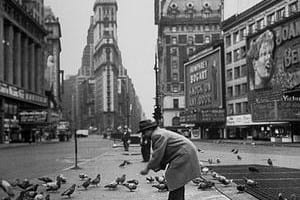
A man feeds the pifeons in Times Square in 1949 (and was probably beaten a short time later.)
Pigeon wars started when the exclusive University Club had its feathers ruffled. It wanted to drape its storied building in netting, to protect it from pigeon poo, which eats away at stone and metal. But the Landmarks Commission said it would have to wait for approval, as it would be a “visible change” to the land marked Italian Renaissance building’s facade. As if the crap wasn’t a “visible change” enough.
Meanwhile, over on East 93rd Street, there was a scuffle involving longtime pigeon activist Anna Dove and her neighbor, who snatched away her bag of seed after he saw her feeding the pigeons on the sidewalk. The police were summoned.
“It’s disgusting,” said her nemesis, retired teacher Arthur Schwartz. “She’s feeding the rats.”
And with the live pigeon-shooting state championships in Pennsylvania coming up, it’s almost guaranteed that there will be an increase in demand of pigeon-poaching — New York City is a favorite spot for trapping them and transporting them to be used as live targets. The animal-rights activists will be out with their cameras and signs to stop them.
No matter which side you’re on, one things for certain — by the end, things are going to get a little birdbrained.
“It’s not the pigeons that are the problem, it’s the number of them,” says Andrew D. Blechman, author of “Pigeons: The Fascinating Saga of the World’s Most Revered and Reviled Bird.” “They’re gentle creatures. The problem is that they get in our face, just like we get in each other’s faces.”
No one one’s quite sure of how many pigeons are in New York City. One adage is “one pigeon per person,” which would put their numbers at about 7 million. They each produce about 25 pounds of waste per year.
Pigeons love cities because of the many ledges, windowsills, eaves and rooftops available for them to roost in, which mimics their natural habitat of high cliffs. Pigeon pairings are monogamous, often mating for life, and both parents raise the babies — called squab — for a time, sitting on the eggs in shifts.
The pigeon includes about 298 species of bird, but the Rock Dove is the most common to the New York area, according to the Parks Department. The grey, bobbing-headed birds usually have purple-green iridescence around the neck area. They’re the scruffiest members of the dove family — although “dove” usually connotes the pure white symbols of peace, not the pizza scavengers of city streets. (Just say they’ve been pigeonholed.)
“If they were white,” Blechman says, “people would love them.”
Blame the French for our pigeon problems. The little pluckers first arrived in the early 1600s with French settlers who used them for meat. They were easy to raise — they could be kept in a barn, where they’d perch on the rafters, and young pigeons served as a good source of protein.
But they soon escaped their confines and went feral.
City life agreed with them and allowed them to flourish — and in some cases, over-flourish. Their natural predators, like falcons and hawks, aren’t found here in great numbers.
Courtney Humphries, author of “Superdove: How the Pigeon Took Manhattan . . . And the World,” concedes that pigeon are pilloried partly because of their “persistence. They nest on the buildings we consider our territory, and they don’t like to be moved.”
The average city pigeon has a lifespan of three to five years. With all the food scattered throughout the garbage cans and sidewalks — plus well-meaning human feeders — they spend less time looking for grub, which leaves more time for mating.
“The biggest problem is the people who overfeed them,” says Blechman. “Every city has about a dozen of them, and they’re the ones who cause the [overpopulation] problem.”
He suggests that if you want to feed the birds, hand out just a teaspoon full of birdseed for a flock. “It’s just enough to give them a little extra energy while they’re out trying to find their own food.”
“If nobody fed pigeons, I think things would look a lot different,” agrees Humphries, who says that human feeders end up creating dense flocks. “A lot of the problem with pigeons comes from people.”
If you can’t freeze the hearts of little old ladies, though, you could try eating them (the pigeons, that is). Squab — baby pigeons that haven’t flown yet — is on the menu at many restaurants around the city, particularly French. They’re “basically the milk-fed veal of the sky,” says Blechman — tender, mostly dark meat, and one of the only poultry that can be eaten rare. (Pigeons produce their own milk-like substance, which they feed to their young by regurgitation.)
Pigeon pot pie was a huge colonial favorite. Today, try the Squab and Foie Croustillant at the Modern, Danny Meyer’s restaurant at the Museum of Modern Art.
*
Unless the appetite for squab skyrockets, New York’s options are few. Avicide — poisoning birds — was made illegal in 2000, when the state Legislature passed a bill outlawing the use of “flock dispersal agents” like Avitrol in cities with more than 1 million people.
Before that, property managers regularly hired pest control services to dole out Avatrol to flocks of pigeons.
“In theory, you would mix it with feed, and when one pigeon ate some of the treated food, they would begin to suffer from neurological toxicity,” explained Stephanie Boyles, wildlife expert at the Humane Society of the United States. “When their flockmates saw them suffering, it would prompt them to leave the area.”
In practice, however, overdosing often led to large numbers of birds convulsing and writhing in pain on the street before their deaths. Welcome to New York!
The last major flare-up of pigeon wars was in 2007, when City Councilman Simcha Felder released a report plaintively titled, “Curbing the Pigeon Conundrum.”
Claiming that their droppings carried a host of diseases like histoplasmosis, he proposed a $1,000 fine to anyone feeding them, as well as curbing their numbers through birth control (a measure that cities like Los Angeles have adopted, although some argue that it’s unsustainable), and appointing a city “Pigeon Czar” to oversee other pigeon-control issues.
The NYC Department of of Health and Mental Hygiene maintains that contact with their droppings only poses a small health risk, and that “routine cleaning of droppings (e.g. from windowsills) does not pose a serious health risk to most people,” although disposable gloves are a good idea.
The Humane Society came out against the anti-feeding fine because they weren’t sure it would actually make a difference in reducing flocks, said Boyles. “We still suggest working with communities to create places where pigeons are welcome, and discouraging them where they’re not.”
While Felder’s bill didn’t fly, it was only one of many efforts to keep pigeons clipped.
In 2006, pigeon loitering was so dense near the Army Recruitment Center in Times Square, speakers were set up to broadcast sounds of falcons and pigeons being attacked, in hopes of scaring them away. In 2003, they had so overwhelmed Bryant Park that the operators invited a falconer and his hawk to the park for a week to scare away (not eat) the pigeons.
In 2007, the MTA installed Bird-B-Gone on some of its elevated stations along the 7 line, as well as others. The electronic system zapped birds that got too close.
In the ’80s, plastic owls were a big seller. Today, a slightly more high-tech version, called the RoboHawk, moves its head, wings, and makes what its creators hope are pigeon-threatening sounds.
Every so often, a politician considers reviving an overall anti-feeding bill, since, for now, it’s only illegal in city parks where signs are posted (the fine is usually $50).
Some cling to the hope that the city will come to its senses and declare war. Because they’re a non-native species, pigeons are not protected by either the Federal Migratory Birds Act or New York state laws. Can anyone say hunting season?
It’s got to be done mafia-style, though. Culling is only a temporary solution — as with most wild birds, quick breeding will put their numbers back to pre-cull figures within weeks, according to Pigeon Control Advisory Service.
*
But spare a thought, pigeon haters, for your majestic foe. Pigeons have more qualities than you think.
Although city birds aren’t particularly active, pigeons are built to be athletes — a trained bird can fly up to 60 miles per hour, and they can stay in the air for 500 miles. They’re meant for flying long distances, and have “homing” instincts, which means they will naturally find their way back.
This talent is why they were literally drafted into the United States Army Pigeon Service.
A million served in both world wars, where they delivered messages across enemy lines and saved thousands of soldiers’ lives. One pigeon, Cher Ami, won a French medal for his bravery for flying through gunfire, finally delivering the message dangling from what was left of his foot. He’s now stuffed and in the Smithsonian.
The army’s Pigeon Breeding and Training Center was based at Fort Monmouth, NJ, and opened in 1917. Many of its “Pigeoneers” were “basically just boys out of Brooklyn, and they’d just bring their best birds,” Humphries says. (The training center was closed in 1957 when the Army stopped using them as messengers.)
Keeping pigeons on rooftops — and racing them — used to be much more popular. Who can forget Marlon Brando’s character in the 1954 film “On the Waterfront” shouting up to his friend Joey, “I got one of your birds!” right before Joey “accidentally” falls off the roof?
The city is full of equally vocal bird-lovers.
“They animate our lives,” argues Blechman, who says that despite writing a book on pigeons, he is not a “bird person,” and admits to having eaten them before. He’s come around, though. “You look out the window and you can have a pigeon land on your windowsill, and the same one will come back every day, and at the same time.
“What would the lonely, the unemployed, and the elderly do every day if it weren’t for pigeons?”
The Internet is atwitter with kooky pigeon fans. There’s a pigeon appreciation society on Facebook. On photo-sharing site Flickr, there’s a group called The Global Pigeon Art Appreciation Society.
“You are not alone,” the site reads. “Many artists have been inspired by pigeons.”
There is also a city listserv called “New York Pigeon People,” where members discuss how to rescue birds and share pigeon news.
You can eat them, race them, breed them, feed them, but you can’t escape them, whether you consider them the most misunderstood creatures of the flying community or the world’s worst bird. As Blechman put it, “We’re just going to have to learn to co-exist.”
The Source from NY Post
About Pigeon Patrol
Pigeon Patrol Products & Services is the leading manufacturer and distributor of bird deterrent (control) products in Canada. Pigeon Patrol products have solved pest bird issues in industrial, commercial, and residential settings since 2000, by using safe and humane bird deterrents with only bird and animal friendly solutions.
At Pigeon Patrol, we manufacture and offer a variety of bird deterrents, ranging from Ultra-flex Bird Spikes with UV protection, Bird Netting, 4-S Gel and the best Ultrasonic and audible sound devices on the market today.
Contact us at 1- 877– 4– NO-BIRD, (604) 585-9279 or visit our website at www.pigeonpatrol.ca
Bird Gone, Pigeon Gone, Seagull Gone, Pigeon issue, pigeon spikes, 1-877-4NO-BIRD, 4-S Gel, Bird Control, Pigeon Control, bird repellent, Bird Spikes, sonic bird repellent, stainless steel bird spikes, bird spikes Vancouver, Ultra Sonic Bird Control, Bird Netting, Plastic Bird Spikes, Canada bird spike deterrents, Pigeon Pests, B Gone Pigeon, Pigeon Patrol, pest controller, pest control operator, pest control technician, Pigeon Control Products, humane pigeon spikes, pigeon deterrents, pigeon traps, Pigeon repellents, Sound & Laser Deterrents, wildlife control, raccoon, skunk, squirrel deterrent, De-Fence Spikes, Dragons Den, Canada bird spikes, Canada pigeon, pigeon control, pigeon patrol, pigeon. Kill pigeons, crow, starling

by Pigeon Patrol | Jan 30, 2020 | Bird Netting, Bird Spikes, Pigeon Droppings, Pigeon Patrol's Services, Pigeon Spikes, Pigeons in the News
People facing pigeon
I never thought much about people facing pigeon excrement until I moved into a condo several years ago and discovered two birds nesting on the balcony. Because my daughter was worried about the cute little eggs, I waited till the squabs were old enough to fly before clearing out the nest and piles of excrement, along with all my pigeon-defaced outdoor furniture. Then a building reno temporarily solved the problem, but as soon as the jackhammers stopped, the pigeons were back and defecating with impunity
I decided to take action, and quickly discovered some hard facts. Pigeons, instead of nesting in trees, prefer buildings, especially tall buildings with ledges and balconies – i.e., condos. This was bad news in a city undergoing an extended real-estate boom, and this past week analysts were guessing the condo market’s record growth (about 40,000 a year for the past five years) will continue at least until 2010 – which means even more condos, i.e., more perfect pigeon abodes, i.e., more excrement.
Though there’s no pigeon census, many Toronto residents are feeling plagued by pigeons this summer. And it’s possible with the rise of condos, people will be facing the increase in pigeon population, says Tom Mason, curator of invertebrates and birds at the Toronto Zoo.
“As the human population has increased, the pigeon population has increased with it.”
Homeowners are complaining of backyard birdfeeders being overrun with pigeons. And certain areas – like the “pigeon gauntlet” north of Broadview subway station – have become legendary. “When they’re not feasting on bread strewn by crazy old people, they’re packed onto the hydro lines above,” says a Riverdale resident. She cited a recent incident involving a man in a crisp suit, “obviously a stranger to the neighbourhood,” who walked straight under the line of fire. “It looked like someone had upended a container of yogurt on him, honestly, it was that copious. He started running around in circles, screaming, then ran off.”
So Toronto’s people facing pigeon problem was bigger than I’d bargained for – but surely I could get them off my own balcony. I started with humane pigeon deterrents: a bobble-headed “scary” owl, fluttering strips of aluminum foil, twirly children’s toys. Nothing worked.
Whenever I heard pigeons cooing on the balcony, I hammered on the window, or leaped out the door shrieking, “Get out of here, you bastards!” In fact, I got so used to the routine that I stopped explaining the outbursts during business calls. As the battle escalated, I laid in wait with water guns, ambushing the enemy as they landed on my railing, or sneaking over to my neighbour’s balcony – where I knew pigeons were nesting behind a deck chair. There, I would jump up, crane around the partition and blast away at the cornered pigeons as they ran around in circles. One day, it occurred to me that I might encounter – and shoot – the neighbour, so I stopped.
It was time to do more research.
Know the enemy
Toronto’s feral pigeons are descended from domestic birds brought over by early settlers. Males and females look the same, are monogamous and take turns incubating eggs, which arrive two at a time. Both parents nurse the babies with a nutrient-laden “crop milk,” which can double the wee ones’ weight in 34 hours.
“What’s also amazing,” said ornithologist Mark Peck of the Royal Ontario Museum, “is that, as far as I know, they are the only bird in Ontario that breeds throughout the entire year,” which means up to nine “clutches” per annum.
Pigeons are also uniquely skilled at navigation – able to fly 70 kilometres per hour, covering up to 1,000 kilometres in a single race. In wartime, pigeons saved lives by carrying military messages across enemy lines. Science hasn’t figured out the exact mechanism, but the motivation, explains the zoo’s Mr. Mason, is that they’re frantically trying to get back to their nestlings.
This is the trouble with research. You seek data to support a pigeon-killing spree, and you end up discovering pigeons are a lot like humans, except pigeons have a lower divorce rate.
So let’s not forget their capital offences. The Nixalite Architectural Bird Control website states that pigeons are “a vector for more than 50 human and livestock diseases.” Their droppings fade finishes on cars and planes, can destroy wood, stone and marble, corrode I-beams, ruin cloth awnings, short out electrical equipment and fill attics with so much excrement “that the actual ceiling collapses.”
On an excrement-removal website, the U.S. General Services Administration warns that pigeon excrement can “lead to potentially fatal diseases of the lungs and central nervous system such as histoplasmosis and cryptococcosis.”
In fact, the Web is packed with anti-pigeon content. The problem: There seems to be no evidence of pigeon-caused plagues in real life. “That’s correct,” said Dr. David McNeely, associate professor of infectious diseases at University of Toronto. Avian-related diseases are rare to begin with, he said, and they’re usually caused by other species. “Don’t pick on poor pigeons,” Dr. McNeely said. “If you want to worry about bird-related diseases, worry about budgie dander.”
Similarly, Mr. Mason, who works at the zoo with pigeons and other birds daily, has never heard of a case. Nor has Mr. Peck at the ROM, who adds how important pigeons have been to science, from Darwin and B.F. Skinner to the present. “Pigeons are not bad birds,” Mr. Peck said. “They’re just successful.”
Taking action
These scientist types weren’t helping my of people facing pigeon problems at all. I phoned the city to ask if it was legal to kill them. “There are no bylaws that apply to wild pigeons,” said Rishma Govani in the public health department, though “there are rules” about owned pigeons.
Next, I spoke with Donald Fraser, principal of Beacon Environmental impact-assessment (and a former researcher on goose defecation habits, which I figured was close enough to my area of interest), who explained: “It is legal to shoot or kill pigeons because they are a non-migratory bird, and thus not covered by the migratory bird act between Canada and the United States.” You need a permit to shoot gulls, or a hunting licence to shoot geese or ducks, for example, but pigeons are fair game. Mr. Fraser did caution, however, that there might be consequences if firearms were discharged within the city.
Indeed, Constable Wendy Drummond of Toronto Police Services confirmed that, while feral pigeons were not protected by the Criminal Code (the sections on animal cruelty pertain mainly to owned animals such as cattle, she said), any discharge of a pellet gun with intent to kill would result in a weapons charge. Snapping their little necks, quickly and humanely, would be tolerated, she said, “unless, you know, we find 100 dead pigeons.”
So pigeons are good family birds, heroic during wartime and, as Mr. Fraser also pointed out, good scavengers who help keep city streets clean (when not filling them with excrement, that is, but never mind). So maybe we shouldn’t kill them. But feed and encourage them? No way.
On this point, I agreed with London Mayor Ken Livingstone, who reduced pigeon numbers in Trafalgar Square by imposing a controversial feeding ban in 2003. A friend recommended I speak to a woman who fed pigeons in her local park. Oh goody, I thought – my anti-pigeon case would definitely be enhanced by a real-live wacko, probably wearing old rags and a squashed hat covered in excrement, ranting about pigeon rights.
Well, the crazy pigeon lady turned out to be novelist Barbara Gowdy, who may or may not be as deranged as the next writer, but who is undeniably smart, attractive, well-groomed and socially responsible.
“I only feed them at the end of the park, away from homes, during inclement weather, when there is snow and ice on the ground and it’s impossible for them to get food,” Ms. Gowdy said.
For a while, when she was facing people having problems on her feeding pigeons, she handed out pamphlets from the Centers for Disease Control and Prevention, which stated, she said, that “even if you ate pigeon excrement, the only thing you’d get is a mild stomach ache.”
Ms. Gowdy is nothing if not persuasive. Or maybe I was ready to crack. After starting out on a crusade to kill all pigeons, I now considered eating pigeon excrement in order to properly research this article.
In any case, the fight had gone out of me – mainly, I think, because of one detail I couldn’t get out of my head: The reason pigeons love condos is because the high-rise towers resemble ancient cliff faces, near Asian seas, where rock doves originally made their homes. That image of our city’s condos as soaring cliffs along the edge of Lake Ontario transformed my view of both the buildings and pigeons.
Ms. Gowdy was right: Toronto’s feral rock pigeons have as much right to live here as we do, and the city would be a much poorer place without its wild animals. I’m willing to live and let live – though it would still be nice to find a way to stop them from living on my particular balcony.
Special to The Globe and Mail
About Pigeon Patrol
Pigeon Patrol Products & Services is the leading manufacturer and distributor of bird deterrent (control) products in Canada. Pigeon Patrol products have solved pest bird issues in industrial, commercial, and residential settings since 2000, by using safe and humane bird deterrents with only bird and animal friendly solutions.
At Pigeon Patrol, we manufacture and offer a variety of bird deterrents, ranging from Ultra-flex Bird Spikes with UV protection, Bird Netting, 4-S Gel and the best Ultrasonic and audible sound devices on the market today.
Contact us at 1- 877– 4– NO-BIRD, (604) 585-9279 or visit our website at www.pigeonpatrol.ca
Bird Gone, Pigeon Gone, Seagull Gone, Pigeon issue, pigeon spikes, 1-877-4NO-BIRD, 4-S Gel, Bird Control, Pigeon Control, bird repellent, Bird Spikes, sonic bird repellent, stainless steel bird spikes, bird spikes Vancouver, Ultra Sonic Bird Control, Bird Netting, Plastic Bird Spikes, Canada bird spike deterrents, Pigeon Pests, B Gone Pigeon, Pigeon Patrol, pest controller, pest control operator, pest control technician, Pigeon Control Products, humane pigeon spikes, pigeon deterrents, pigeon traps, Pigeon repellents, Sound & Laser Deterrents, wildlife control, raccoon, skunk, squirrel deterrent, De-Fence Spikes, Dragons Den, Canada bird spikes, Canada pigeon, pigeon control, pigeon patrol, pigeon. Kill pigeons, crow, starling
by Pigeon Patrol | Jan 13, 2020 | Animal Deterrent Products, Bird Deterrent Products, Bird Netting, Bird Spike, Bird Spikes, Pigeon Control, Pigeon Droppings, Pigeon Patrol's Services, Pigeon Spikes, Pigeons in the News
Every summer we’re stuck with the same dilemma. We can park the car out in the sun, which will inevitably will lead to scorching hot interior temperatures.
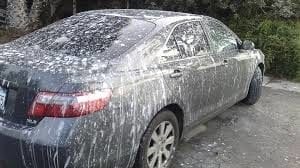
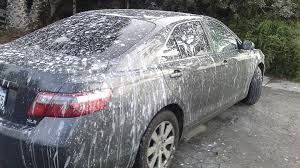
The alternative is to park under a shady tree, where birds will undoubtedly poop all over our freshly washed ride.
We usually opt for the sun out of auto vanity,
but at least we don’t have to worry about bird poop messing with the paint.
We’ve heard that acid from the bird droppings is the reason for the doo-doo perforations, but a study by UK car care experts Autoglym reveals that the excrement is only part of the problem.
The real culprit is the sun, which expands and warms the paint on your vehicle.
When the sun hits that bird poop, the poo hardens at the same time the paint expands.
When the sun sets and the vehicle cools, the paint then contracts and forms itself around the hardened crap.
If a bird does his or her business on your vehicle, the best thing to do is remove it, and fast.
A moist cloth will do the trick in most instances, or if you’re not into close encounters of the rectal kind, you could also hit the car wash.
We would go into more detail, but we’re thinking that’s enough excrement talk for one day
About Pigeon Patrol
Pigeon Patrol Products & Services is the leading manufacturer and distributor of bird deterrent (control) products in Canada. Pigeon Patrol products have solved pest bird problems in industrial, commercial, and residential settings since 2000, by using safe and humane bird deterrents with only bird and animal friendly solutions.
At Pigeon Patrol, we manufacture and offer a variety of bird deterrents, ranging from Ultra-flex Bird Spikes with UV protection, Bird Netting, 4-S Gel and the best Ultrasonic and audible sound devices on the market today.
Contact us at 1- 877– 4– NO-BIRD, (604) 585-9279 or visit our website at www.pigeonpatrol.ca
Bird Gone, Pigeon Gone, Seagull Gone, Pigeon problems, pigeon spikes, 1-877-4NO-BIRD, 4-S Gel, Bird Control, Pigeon Control, bird repellent, Bird Spikes, sonic bird repellent, stainless steel bird spikes, bird spikes Vancouver, Ultra Sonic Bird Control, Bird Netting, Plastic Bird Spikes, Canada bird spike deterrents, Pigeon Pests, B Gone Pigeon, Pigeon Patrol, pest controller, pest control operator, pest control technician, Pigeon Control Products, humane pigeon spikes, pigeon deterrents, pigeon traps, Pigeon repellents, Sound & Laser Deterrents, wildlife control, raccoon, skunk, squirrel deterrent, De-Fence Spikes, Dragons Den, Canada bird spikes, Canada pigeon, pigeon control, pidgon patrol, pidgon. Kill pigeons, crow, starling
by Pigeon Patrol | Jan 13, 2020 | Animal Deterrent Products, Bird Deterrent Products, Bird Netting, Bird Spike, Bird Spikes, Pigeon Control, Pigeon Droppings, Pigeon Patrol's Services, Pigeon Spikes
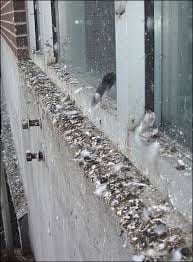
Bird droppings on building window
Feral pigeons (Columbia livia) are not harmless birds. Many potential infections of humans silently exist in pigeons which are not apparent. They have the potential for transmission of over 30 diseases to humans plus another ten to domestic animals. Environmental pollution from pigeon droppings is quite evident. Air pollution involves more than noxious gases from automobile exhausts and belching smokestacks. One serious air pollutant is air-borne fungi, which are agents for infectious diseases. There is much information written about the problem, but it remains primarily in the professional journals and technical references, neatly stacked away on library shelves. The objective of this paper is to provide a brief account of the major diseases and to assess their importance. Feral pigeons have been identified with mycotic, bacterial, protozoal, chlamydial, rickettsial, and parasitic diseases as well as dermatosis (Weber 1979). MYCOTIC diseases are not transmitted from humans to humans. Perhaps this is why they do not make the headlines. The fungi causing the diseases are acquired by inhaling the fruiting bodies or spores along with particles of dust. The fungi live saprophytically in feces and soil. Aspergillosis is caused by Aspergillus fumagatus. The fungus produces toxins which poison the victim’s blood. Pigeons assist the spread of the spores in airborne dust. Blastomycosis is caused by Blastomyces dermatitidus. It primarily affects the lungs; the main route of infection is by inhalation of spores. The organism has been isolated from pigeon manure. Candidiasis is caused by Candida spp., chiefly C. albicans. Nearly one-fourth of all mycotic deaths are caused by this yeast. It often affects the mouth, respiratory system, intestines, and urogenital tract, especially the vagina. Incidence of candidiasis (yeast infection) in women is an increasing problem. The discomfort of the itching, pain, and discharge caused by the growth of this fungus is.
ignificant enough to warrant the elimination of pigeons which are one of the three wild birds most frequently infected with Candida. Cryptococcosis is caused by a systemic pathogenic yeast called Cryptococcosus neoformans. No organ or tissue of the body is exempt. It very frequently involves the brain covering as cryptococcal meningitis. One Indianapolis victim spent 91 days in the hospital with cryptococcosis. The yeast is carried in the intestinal tract of pigeons and deposited in their feces (Newberry 1967). One Kansas City survey showed that 93% of the pigeon coops were infected. Histoplasmosis is caused by Histoplasma capsulatum. It is interesting to note that the disease was suggested at one time as a biological warfare agent because of its airborne route (Furcolow, personal communication, 1960). It is probably the second most significant fungus disease. The “summer flu” that midwesterners used to get is now thought to have been histoplasmosis (Personal communication, American Lung Association, 1974). It is basically a pulmonary disease but may extend to the liver, lymph nodes, and spleen. The organism may disseminate to the blood and bone marrow and be fatal. It may lodge in the eye to cause ocular histoplasmosis. Twenty-two cases were reported to the Indiana Board of Health in 1976. Pigeon feces fertilize the soil in such a way as to give the fungus competitive advantage over other soil microorganisms. The largest outbreak ever recorded occurred in Indianapolis during the winter of 1978-79 with over 450 confirmed cases. There were 18 deaths. BACTERIAL DISEASES identified with pigeons are listed. Erysipeloid generally starts in a break in the skin and is accompanied with a sensation of burning, throbbing pain, and intense itching. It is caused by Erysipelothrus insidiosis. Pigeons are involved in its transmission. Listeriosis is caused by Listeria monocytogenes. It causes changes in the cells of the nervous system. It may cause conjunctivitis, endocarditis, and skin infections. It can also cause meningitis in newborns, abortions, premature delivery, stillbirths, and death. The organism has been isolated from pigeons. Parteurellosis is caused by a highly contagious bacteria, Pasteurella multicida. The 157 disease may be divided in four groups of syndromes: 1) infection of the upper respiratory tract as nasal discharge or conjuntivitis, 2) infection of the lower respiratory tract as bronchitis or pneumonia, 3) infecton of internal organs as appendicitis or inflammation of the urinary tract, 4) abscessed wound infections. Pigeons can spread the bacteria through their droppings or nasal discharge. The organism can live as long as a month in pigeon manure or three months in a dead pigeon. Salmonellosis is more than food poisoning. Gastroenteritis is the most common manifestation. Enteric fever or septicemia may follow several weeks later as a relapse. Septicemias often terminate fatally. Persistent infections are less common but very important. There may be an abscess or local infection as arthritis, bronchopneumonia, endocarditis, meningitis, osteomyelitis, or pyeleonephritis. Pigeons are important in the spread of salmonellae, since the bacteria are left wherever the pigeons defecate (MÜller 1965). They trample back and forth through their copious excretion on window ledges and air intake vents. Dusts to contaminate food or homes enter through air conditioners and ventilators. The most common salmonella Isolated from pigeons is Salmonella typhimurum var. Copenhagen, which is found in about 2% of pigeon feces (MÜller 1965). Yersiniosis is a plague-like disease by Yersinia pseudotuberculosos and Y. enterocolitica. The disease is clinically indistinguishable from appendicitis. Both diseases cause fever, nausea, headache, hard and painful stomachs. Because of the similarity, there were 32 school children hospitalized in Oneida County, New York in September 1976. Fourteen were reported to have had unnecessary appendectomies. Y.enterocolitica serotype 8 was isolated from the ill children. It was first isolated from pigeons in 1916. Transmission may be through the feces, eggs, or ticks of pigeons (Hubert 1972). PROTOZOAN diseases include American trypansomiasis, toxoplasmosis, and trichomoniasis. American trypanosomiasis is caused by Trypanosoma cruzi. There is no vaccine, effective treatment, or cure for the disease. It is transmitted through the feces of infected triatimid bugs, as the pigeon kissing bug (Triatoma rubrofasciata). The bugs tend to feed at night while the victim is asleep the bug defecates during or soon after engorgement, and most human infections occur when the bug feces are rubbed into eyes or mucous membranes following a bite. Toxoplasmosis may be one of the most widespread zoonotic diseases in the United States. It is caused by Toxoplasma gondii. It has been shown to cause abortions in women (W.J. Schneider, personal communication, 1977). The organism seems to have an affinity for brain tissue; it may cause mental retardation and death. Pigeons frequently transmit toxoplasmosis through fecal contamination, respiratory droplets, eye secretions, contact with infected tissue, or through ectoparasites. Trichomoniasis is caused by Trichomonas gallinae. It may affect the genital tract. Pigeons are considered the primary host, with about 80-90% of the adults infected. VIRAL diseases include encephalitis, meningitis, and Newcastle. Eastern equine encephalomyelitis (EEE) is the most deadly of the North American arbovirus diseases. It has been known to cause mental retardation, convulsions, and paralysis. The mortality rate may be around 60%. Pigeons are considered an amplifying host for the virus (Fothergill et. al. 1938). St. Louis encephalitis (SLE) affects the nervous system, ranging from complete recovery to disorganization, paralysis, coma, and death. The mortality rate is usually 5-10%, in some cases up to 33%. Pigeons, English sparrows, and house finches are the three birds labeled as main reservoirs of SLE. West Nile encephalitis ranges from mild to fatal Infections. The virus has been isolated from pigeons. Western equine encephalomyelitis is much more present and dangerous than most people think. The fatality rate has been between 5 and 15%. Children under one year of age may never recover from an infection of the virus, often becoming total vegetables. Pigeons are one of the amplifying hosts (W.F. Rathel, personal communication, 1977). Meningitis causes as inflammation of the brain and its covering. Pigeons are subject to meningo-encephalitis. Newcastle disease often involves conjunctivitis, lacrimation, and a mild influenza-like infection. Pigeons are the third largest common carrier; the virus has been detected in their feces. CHLAMYDIAL and RICKETTSIAL diseases. Chlamydiosis, caused by Chlamydia psittiaci, is a generalized infectious disease that causes a flu-like respiratory infection with high fever, severe headache, and generalized aches and pains. Mortality is usually 158 restricted to the old, the weak, or those with concurrent disease. Pigeons are the most common and consistent source of all known hosts (Terskiph 1961). Over half of the pigeon population is or has been infected. Q fever is caused by Coxiella burnetti. It is characterized by a sudden onset of pneumonitis, sometimes causing death. Pigeons are involved as carriers (Syrcuek et al. 1956). Investigators have isolated C. burnetti from the Kidneys of a large number of pigeons. The disease can be transmitted by infected ticks, ingestion, or by inhalation of dust contaminated with the organism. PARASITIC WORMS include cestodes and trematodes. Taeniasis by large tapeworm is caused by Taenia saginata, with specimens up to 50 feet having been recovered. Pigeons have been incriminated as potential vectors. Schistosomiasis, one of the most prevalent diseases throughout the world, is caused by a water-borne trematode. Pigeons are associated with flukes in the watery areas where they exist. Other pigeon associated trematodes include Echinoparyphium paraulum, Echinoparyphium recurvatum, Echinostoma revolutum, Haplorchis pulimio, and Hypoderaeum conoideum. DERMATOSIS. Acariasis is caused by infection of mites. Bird mites were responsible for a case of pruritis in a North Carolina hospital. The mites originated in a pigeon nest in the ventilator.
About Pigeon Patrol:
Pigeon Patrol Products & Services is the leading manufacturer and distributor of bird deterrent (control) products in Canada. Pigeon Patrol products have solved pest bird problems in industrial, commercial, and residential settings since 2000, by using safe and humane bird deterrents with only bird and animal friendly solutions. At Pigeon Patrol, we manufacture and offer a variety of bird deterrents, ranging from Ultra-flex Bird Spikes with UV protection, Bird Netting, 4-S Gel and the best Ultrasonic and audible sound devices on the market today.
Contact us at 1- 877– 4– NO-BIRD, (604) 585-9279 or visit our website at www.pigeonpatrol.ca
Bird Gone, Pigeon Gone, Seagull Gone, Pigeon problems, pigeon spikes, 1-877-4NO-BIRD, 4-S Gel, Bird Control, Pigeon Control, bird repellent, Bird Spikes, sonic bird repellent, stainless steel bird spikes, bird spikes Vancouver, Ultra Sonic Bird Control, Bird Netting, Plastic Bird Spikes, Canada bird spike deterrents, Pigeon Pests, B Gone Pigeon, Pigeon Patrol, pest controller, pest control operator, pest control technician, Pigeon Control Products, humane pigeon spikes, pigeon deterrents, pigeon traps, Pigeon repellents, Sound & Laser Deterrents, wildlife control, raccoon, skunk, squirrel deterrent, De-Fence Spikes, Dragons Den, Canada bird spikes, Canada pigeon, pigeon control, pidgon patrol, pidgon. Kill pigeons, crow, starling
by Pigeon Patrol | Dec 17, 2019 | 4-S Gel Bird repellent, Animal Deterrent Products, Bird Deterrent Products, Bird Netting, Bird Spikes, Pigeon Control
Pigeon Ban Leads To Conflict Of Interest Allegations In B.C. Community
The District of North Vancouver is now investigating council after it passed a bylaw targeting a councillor’s neighbour and pet pigeons.
A new pigeon prohibition in a North Vancouver community has roused suspicions that a councillor’s continued grudge against the birds has led to a serious conflict of interest.
Thursday, in response to concerns from the public, district Mayor Mike Little ordered an independent investigation into the events leading up to and the passage the controversial ban known as the “Pigeon Prohibition Bylaw.” It bans residents from harbouring what some consider intelligent animals (who mate for life!), and others believe are rats with wings.
The chief administrative officer will look into the conduct of all councillors, including Little.
The pigeon squabble started almost three years ago, when Kulwant Dulay and his multi-generational family moved to the north shore neighbourhood and transformed a dilapidated backyard chicken coop into a charming miniature cottage for his homing pigeons.
“I fixed it up. I wash the coop every week. I keep it clean. There’s no smells at all,” Dulay told councillors Nov. 18. He and his family wash the pigeons and clean up their droppings.
His neighbour, councillor Betty Forbes, saw the situation differently. She declined to comment, as the independent review is being conduct and therefore would not be “appropriate.”
In emails to staff, released through a freedom of information request and first provided to CBC News, Forbes complained of her neighbour’s pigeons flying over her house and landing on her roof, and requested staff review a bylaw from 1971 to “control” the look of the coups, and limit the number allowed.
“Both chickens and pigeons can carry disease and are dirty,” Forbes wrote to staff in May 2017, before she was councillor. “How can you control health risks, monitor that the chickens or pigeons are being kept in approved coups, under humane living conditions, food is stored so as not to attract other animals, the number of kept birds is within the by-law?”
Forbes was elected Oct. 20, 2018. Five days later she requested staff act on her “pigeon complaint.”
“I have been patient but I feel that 1.5 years of asking for this issue to be dealt with in accordance with the bylaw is long enough,” Forbes said in her email.
About Pigeon Patrol:
Pigeon Patrol Products & Services is the leading manufacturer and distributor of bird deterrent (control) products in Canada. Pigeon Patrol products have solved pest bird problems in industrial, commercial, and residential settings since 2000, by using safe and humane bird deterrents with only bird and animal friendly solutions. At Pigeon Patrol, we manufacture and offer a variety of bird deterrents, ranging from Ultra-flex Bird Spikes with UV protection, Bird Netting, 4-S Gel and the best Ultrasonic and audible sound devices on the market today.
Contact us at 1- 877– 4– NO-BIRD, (604) 585-9279 or visit our website at www.pigeonpatrol.ca
Bird Gone, Pigeon Gone, Seagull Gone, Pigeon problems, pigeon spikes, 1-877-4NO-BIRD, 4-S Gel, Bird Control, Pigeon Control, bird repellent, Bird Spikes, sonic bird repellent, stainless steel bird spikes, bird spikes Vancouver, Ultra Sonic Bird Control, Bird Netting, Plastic Bird Spikes, Canada bird spike deterrents, Pigeon Pests, B Gone Pigeon, Pigeon Patrol, pest controller, pest control operator, pest control technician, Pigeon Control Products, humane pigeon spikes, pigeon deterrents, pigeon traps, Pigeon repellents, Sound & Laser Deterrents, wildlife control, raccoon, skunk, squirrel deterrent, De-Fence Spikes, Dragons Den, Canada bird spikes, Canada pigeon, pigeon control, pidgon patrol, pidgon. Kill pigeons, crow, starling