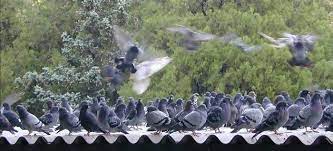
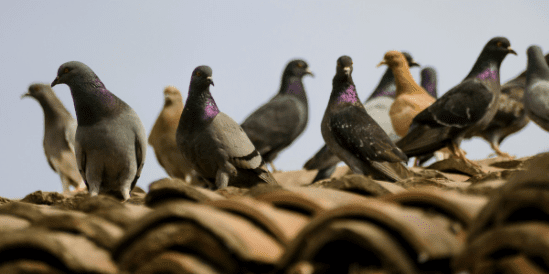
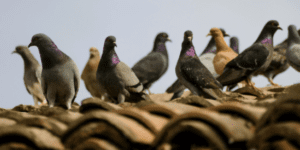
Whether you’re sick of cleaning bird droppings off your windows or the constant cooing is driving you mad, our pigeon pest control technicians have listed below some great ways to keep pigeons off your roof.
Install scare-pigeons
These lightweight kites are usually sold in the form of hawk silhouettes and are great at scaring away pigeons. Simply place them where the birds usually roost, remembering to move them around on a regular basis. If pigeons get used to its presence, they’ll pretty much become immune to it and won’t be scared anymore.
Use reflective surfaces
When the sun hits a reflective object, it creates a prism effect which interferes with pigeons’ eyesight. If your roof is covered with anything reflective such as reflective tape or foil balloons, it’s highly unlikely they will settle.
If you’ve been wondering what to do with those old CDs you never listen to anymore, you could also hang them from nearby trees or along awnings and this should be enough to keep pigeons away.
Install sloped sheathing
To keep pigeons off ledges and other flat surfaces, cover them with a sloping piece of sheet metal. If they physically can’t settle somewhere then they won’t.
Use natural repellents
There are a number of homemade remedies which can be pretty effective at keeping pigeons away. Try placing balls or containers of strong spices where the birds tend to gather on your roof. The best spices to use include chili powder, cayenne pepper, black pepper and cinnamon.
Please refrain from putting down poison because you may inadvertently cause harm to innocent wildlife, pets or children if the poison gets carried elsewhere. Always speak to a professional pest controller if you do wish to go down this route.
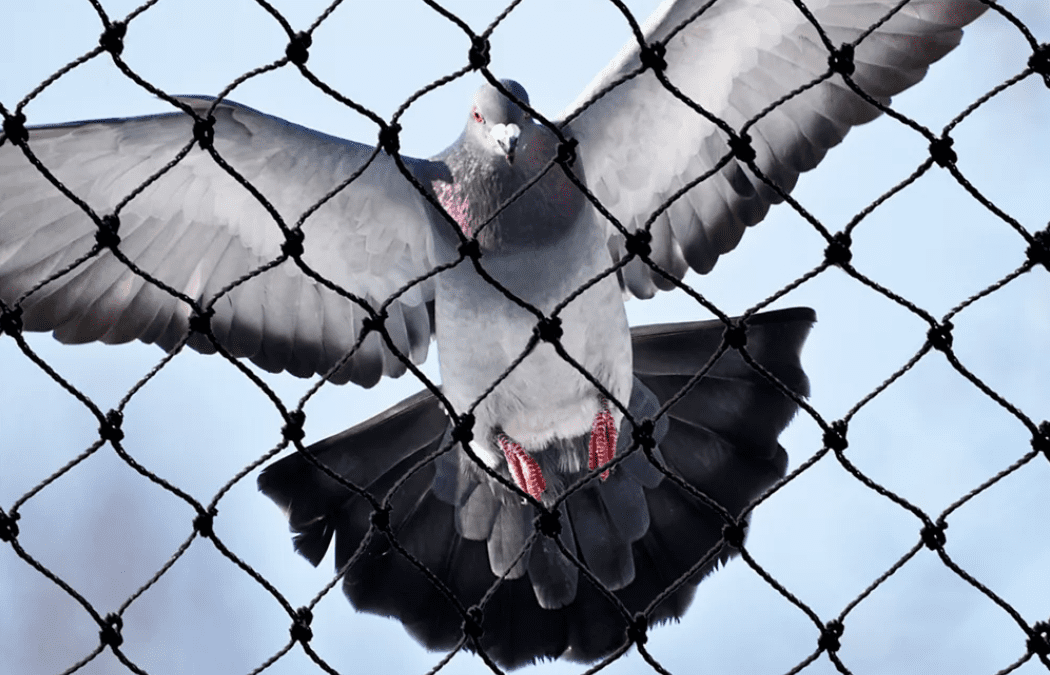
Use bird netting
Netting can be used to seal off spaces above barn rafters and any other potential roosting spots.
Don’t make your property pigeon-friendly
If it’s easy for pigeons to settle, you can guarantee they will. Check your property for any pigeon-friendly areas such as soffits, vents, chimneys, gutters and large gaps. Anywhere up high is naturally going to be an inviting place for these birds to nest and chances are you hardly ever go up there so they’re going to remain undisturbed.
As well as checking for potential nesting spots, try to make sure there are no potential food sources for pigeons to live off. Store rubbish bags in metal bins with securely fitted lids so that they can’t gain access to the contents and take it up to their nest. Also try to avoid feeding pets outside or remember to clean away their bowl as soon as they’ve finished eating.
Call a pest controller
The best way to deal with a pigeon problem is to call a pest controller. They will know exactly how to get rid of them and what’s more, they will also be able to tell you how to keep them away for good.
Pigeon Patrol Products & Services is the leading manufacturer and distributor of bird deterrent (control) products in Canada. Pigeon Patrol products have solved pest bird problems in industrial, commercial, and residential settings since 2000, by using safe and humane bird deterrents with only bird and animal friendly solutions. At Pigeon Patrol, we manufacture and offer a variety of bird deterrents, ranging from Ultra-flex Bird Spikes with UV protection, Bird Netting, 4-S Bird Gel and the best Ultrasonic and audible sound devices on the market today.
Voted Best Canadian wholesaler for Bird Deterrent products ten years in a row.
Contact us at 1- 877– 4– NO-BIRD, (604) 585-9279 or visit our website at www.pigeonpatrol.ca
Pigeon/Pigeon Patrol / Pigeons Roosting / Vancouver Pigeon Control /Bird Spikes / Bird Control / Bird Deterrent / Pigeon Deterrent? Surrey Pigeon Control / Pest /Seagull deterrent / Vancouver Pigeon Blog / Birds Inside Home / Pigeons in the cities / Ice Pigeons/ What to do about pigeons/ sparrows , Damage by Sparrows, How To Keep Raccoons Away, Why Are Raccoons Considered Pests/ De-fence / Pigeon Nesting/ Bird Droppings / Pigeon Dropping/ woodpecker control/ Professional Bird Control Company/ Keep The Birds Away/ Birds/rats/ seagull/pigeon/woodpecker/ dove/sparrow/pidgeon control/pidgeon problem/ pidgeon control/flying rats/ pigeon Problems/ bird netting/bird gel/bird spray/bird nails/ bird guard
Feral pigeons are also known as city doves or street pigeons, they are descents of the wild rock doves. Many people appropriately call them rats of the sky as they can carry more diseases than rats therefore they are a serious risk to health. Examples of bacteria associated with pigeons are aspergillosis, cryptococcosis, histoplasmosis, listeriosis, psittacosis and salmonella.
Pigeons carry more diseases than rats
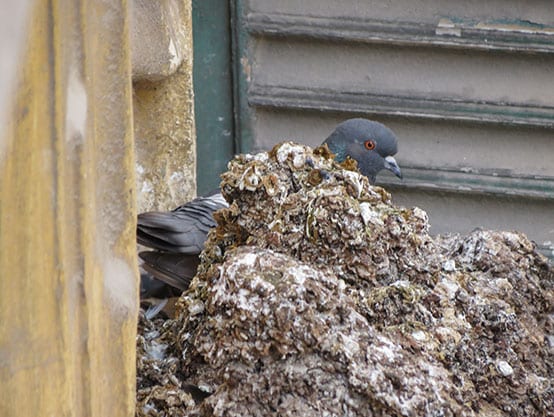
Bird fouling or guano contains various bacteria and the spores from the bacteria can become airborne. When these spores are breathed in they can be extremely hazardous.
People with compromised immune systems are particularly at risk as once the bacteria enters the bloodstream it can cause lung infections, sepsis, meningitis, encephalitis and sometimes even lifelong illness or death.
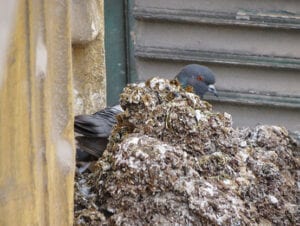
a pigeon bird standing by guano manure
In 2017 the biggest listeriosis outbreak in the world occurred in South Africa when 1,065 cases of listeriosis were confirmed and 218 deaths were caused by contaminated food originating in a factory owned by South Africa’s largest food company Tiger Brands. While it is unsure where the listeriosis originated, it is an example of the destruction a disease carried by birds can cause.
Bird control is not only necessary in order to keep our environments healthy and to prevent disease, but also to prevent secondary infestations such as rodents (which also carry diseases), maggots, flies and bird fleas.
Birds thrive in an urban environment and only require the smallest amount of shelter on buildings. All birds can cause damage to buildings through nesting activity and by eroding surfaces with their faeces which contains uric acid, eventually, this causes water ingress to buildings. Solar Panels are also at risk of damage as they are often used by pigeons and seagulls for shelter. Fouling on the surface also reduces their effectiveness
Pigeon Patrol Products & Services is the leading manufacturer and distributor of bird deterrent (control) products in Canada. Pigeon Patrol products have solved pest bird problems in industrial, commercial, and residential settings since 2000, by using safe and humane bird deterrents with only bird and animal friendly solutions. At Pigeon Patrol, we manufacture and offer a variety of bird deterrents, ranging from Ultra-flex Bird Spikes with UV protection, Bird Netting, 4-S Bird Gel and the best Ultrasonic and audible sound devices on the market today.
Voted Best Canadian wholesaler for Bird Deterrent products ten years in a row.
Contact us at 1- 877– 4– NO-BIRD, (604) 585-9279 or visit our website at www.pigeonpatrol.ca
Pigeon/Pigeon Patrol / Pigeons Roosting / Vancouver Pigeon Control /Bird Spikes / Bird Control / Bird Deterrent / Pigeon Deterrent? Surrey Pigeon Control / Pest /Seagull deterrent / Vancouver Pigeon Blog / Birds Inside Home / Pigeons in the cities / Ice Pigeons/ What to do about pigeons/ sparrows , Damage by Sparrows, How To Keep Raccoons Away, Why Are Raccoons Considered Pests/ De-fence / Pigeon Nesting/ Bird Droppings / Pigeon Dropping/ woodpecker control/ Professional Bird Control Company/ Keep The Birds Away/ Birds/rats/ seagull/pigeon/woodpecker/ dove/sparrow/pidgeon control/pidgeon problem/ pidgeon control/flying rats/ pigeon Problems/ bird netting/bird gel/bird spray/bird nails/ bird guard
Last year, one of Mauritius’ best-loved birds hit a milestone that delighted the conservation world. In the 2018 Red List update, the Pink Pigeon Nesoenas mayeri was downlisted from Endangered to Vulnerable, building upon the success of 2000, when it was downlisted from Critically Endangered to Endangered. But behind the scenes of this happy news lies over 30 years of gruelling devotion, with conservationists tackling the numerous threats to the pigeon from every possible angle in their bid to bring it back from the brink.
For a while, we were worried it might go the same way as its fellow Mauritian endemic, the Dodo Raphus cucullatus. An even closer relative, the Reunion Pigeon Nesoenas duboisi, went extinct on the neighbouring Reunion Island in the late 18th century thanks to introduced cats and rats. The Pink Pigeon now holds the unenviable title of the last native pigeon in the whole Mascarene archipelago.
Predictably, it was the arrival of humans that heralded the Pink Pigeon’s decline. The species was once widely distributed across Mauritius, but by the 19th century its population had become extremely fragmented and confined to the upland forests. Humans had destroyed native vegetation to the extent that only 1.5% of the original, good-quality forest remained. They also hunted the plump bird and introduced a panoply of predators such as Black Rat Rattus rattus, Small Indian Mongoose Herpestes auropunctatus and Crab-eating Macaque Macaca fascicularis.
It wasn’t just animal predators: what little forest remained was soon invaded by non-native plants such as Chinese Guava Psidium cattleianum and the privet species Ligustrum robustum which choke vegetation, preventing the regeneration of native plants. By the mid-1970s, the species had plummeted to a single population of 20 birds in the upland forest of Black River Gorges, an area now known as Pigeon Wood. Just 12 Pink Pigeons remained in 1986, and of the five nesting attempts recorded that year, all were thwarted by rats. The wild population hit an all-time low of nine birds in 1990. The chances for long-term survival of the species looked bleak.
But the Mauritian Wildlife Foundation wasn’t going to let it go without a fight. With help from organisations across the world [see With Thanks, below], we set up an intensive conservation programme starting with captive breeding set up in 1976, followed by the first wild releases in 1987. We now have nine subpopulations centred around our field stations. Six of these are within the Black River Gorges National Park, close to the original Pigeon Wood. A sub-population can be found on the predator-free nature reserve island Ile aux Aigrettes, and two additional subpopulations are being created on private land at Ferney on the east of Mauritius and in Chamarel Ebony Forest in the south west. The purpose of these captive-reared birds is to bolster wild populations, and we encourage the dispersal of birds between the different areas in order to maintain genetic diversity. In total we now have 470 wild Pink Pigeons at these sites, a dramatic improvement compared to the species’ darkest hour.
But captive-breeding won’t help unless the wild habitat is made safe for these newcomers. That’s why wild populations are carefully managed using a three-pronged technique. Firstly, every Pink Pigeon is ringed with its own metal ID band and unique plastic colour combination. Each bird can therefore be identified and followed individually. All nests are checked regularly and the results documented. A large dataset has now been collected and continues to grow. This precise information helps us to understand in more depth the factors affecting the survival of the Pink Pigeon, and how to shape our management strategies accordingly.
Another priority is food. The Pink Pigeon is herbivorous, feeding mainly on fruit, leaves and flowers. But its natural habitat is so degraded that the birds are often unable to find enough food to support themselves. In order to supplement their diet, whole wheat and cracked maize is provided at each of the field sites. The food is placed on specially-designed platforms to prevent other species from obtaining it.
Introduced predators are, without a doubt, a major limiting factor to the survival of this species. Much energy is devoted to removing or controlling them from around the field sites. We are also researching and tackling diseases, in particular trichomonosis, an illness introduced by alien pigeons that can be especially fatal to Pink Pigeon chicks.
In the long term, large areas of forest will need to be restored so that the Pink Pigeon can spread into the uplands and breed in safe nesting sites with fewer predators. But for now, we are working on reinforcing numbers at the recently-created release sites. In order to increase genetic diversity, birds from captive populations in Europe will be repatriated to Mauritius. Research has shown that these birds have genetic variations no longer found in the wild population.
We are constantly seeking to improve our knowledge of the Pink Pigeon’s biology and behaviour, conducting studies into factors limiting the recovery of this species. We have examined the fruiting and flowering of plants that the pigeons feed on which, combined with feeding observations, will enable us to tailor our supplementary feeding more precisely. Ultimately, we have high hopes that all of these measures should enable us to meet our target of 600 wild Pink Pigeons in the next decade.
The future looks bright for other species, too. When working out how to save the Pink Pigeon, some techniques were inspired by previous pigeon rearing projects, but others have been perfected or developed on Mauritius. We can now pass these new techniques on to the rest of the world to help others restore threatened pigeons worldwide. Hundreds of field biologists trained in our methods have gone on to work in important conservation positions elsewhere. They now have the ability to disseminate what they learned globally, ensuring the Pink Pigeon’s success can spread beyond Mauritius’ borders.
Pigeon Patrol Products & Services is the leading manufacturer and distributor of bird deterrent (control) products in Canada. Pigeon Patrol products have solved pest bird problems in industrial, commercial, and residential settings since 2000, by using safe and humane bird deterrents with only bird and animal friendly solutions. At Pigeon Patrol, we manufacture and offer a variety of bird deterrents, ranging from Ultra-flex Bird Spikes with UV protection, Bird Netting, 4-S Bird Gel and the best Ultrasonic and audible sound devices on the market today.
Voted Best Canadian wholesaler for Bird Deterrent products ten years in a row.
Contact us at 1- 877– 4– NO-BIRD, (604) 585-9279 or visit our website at www.pigeonpatrol.ca
Pigeon/Pigeon Patrol / Pigeons Roosting / Vancouver Pigeon Control /Bird Spikes / Bird Control / Bird Deterrent / Pigeon Deterrent? Surrey Pigeon Control / Pest /Seagull deterrent / Vancouver Pigeon Blog / Birds Inside Home / Pigeons in the cities / Ice Pigeons/ What to do about pigeons/ sparrows , Damage by Sparrows, How To Keep Raccoons Away, Why Are Raccoons Considered Pests/ De-fence / Pigeon Nesting/ Bird Droppings / Pigeon Dropping/ woodpecker control/ Professional Bird Control Company/ Keep The Birds Away/ Birds/rats/ seagull/pigeon/woodpecker/ dove/sparrow/pidgeon control/pidgeon problem/ pidgeon control/flying rats/ pigeon Problems/ bird netting/bird gel/bird spray/bird nails/ bird guard
How do animals become problems? Drawing on interactionist theories of social problems and cultural geography, I argue that the construction of animals as problems relies upon cultural understandings of nature/culture relationships, which in turn entail “imaginative geographies.” Specifically, modernity posits a firm boundary between nature and culture. Animals have their place, but are experienced as “out of place”—and often problematic—when they are perceived to transgress spaces designated for human habitation. Relying on New York Times articles from 1851 to 2006, and articles from 51 other newspapers from 1980 to 2006, this article focuses on the process by which pigeons as a species were problematized. I contend that pigeons have come to represent the antithesis of the ideal metropolis, which is orderly and sanitized, with nature subdued and compartmentalized. While typified as a health issue, the pigeon’s primary “offense” is that it “pollutes” habitats dedicated for human use. The catch phrase “rats with wings” neatly summarizes society’s evaluations of, and anxieties about, this bird. This metaphor reflects a framing of pigeons by claims-makers that renders them out of place in the cityscape.
Pigeon Patrol Products & Services is the leading manufacturer and distributor of bird deterrent (control) products in Canada. Pigeon Patrol products have solved pest bird problems in industrial, commercial, and residential settings since 2000, by using safe and humane bird deterrents with only bird and animal friendly solutions. At Pigeon Patrol, we manufacture and offer a variety of bird deterrents, ranging from Ultra-flex Bird Spikes with UV protection, Bird Netting, 4-S Bird Gel and the best Ultrasonic and audible sound devices on the market today.
Voted Best Canadian wholesaler for Bird Deterrent products ten years in a row.
Contact us at 1- 877– 4– NO-BIRD, (604) 585-9279 or visit our website at www.pigeonpatrol.ca
Pigeon/Pigeon Patrol / Pigeons Roosting / Vancouver Pigeon Control /Bird Spikes / Bird Control / Bird Deterrent / Pigeon Deterrent? Surrey Pigeon Control / Pest /Seagull deterrent / Vancouver Pigeon Blog / Birds Inside Home / Pigeons in the cities / Ice Pigeons/ What to do about pigeons/ sparrows , Damage by Sparrows, How To Keep Raccoons Away, Why Are Raccoons Considered Pests/ De-fence / Pigeon Nesting/ Bird Droppings / Pigeon Dropping/ woodpecker control/ Professional Bird Control Company/ Keep The Birds Away/ Birds/rats/ seagull/pigeon/woodpecker/ dove/sparrow/pidgeon control/pidgeon problem/ pidgeon control/flying rats/ pigeon Problems/ bird netting/bird gel/bird spray/bird nails/ bird guard
Thousands of pigeons released during the opening ceremony of the 1936 Olympic Games pooped on much of the audience after being frightened by ceremonial cannon fire.
Context
Tens of thousands of pigeons were released during the opening ceremony of the 1936 Olympic Games. The claim that these birds pooped on the athletes after they were scared by ceremonial cannon fire originates with a single person: long-distance runner and WWII veteran Louis Zamperini. While it seems that some people truly got pooped on by pigeons during this incident, we can’t determine just how much of the audience was covered in excrement.
Origin
As the start of the 2020 Olympics approached in July 2021 (the games were delayed due to the COVID-19 pandemic), an old meme started to make its way around social media about how tens of thousands of pigeons pooped on the audience during the opening ceremonies of the 1936 Olympic Games after they were scared by the noise of a firing cannon:
Generally speaking, there is some truth to this humorous anecdote. It should be noted that the above-displayed picture actually comes from the 1952 Olympics in Helsinki, Finland, not the 1936 games in Germany.
When we first came across the pigeon meme, we had three immediate questions: Were thousands of pigeons released during the opening ceremonies of the 1936 Olympic Games? Did these pigeons actually poop on the audience? And just how devastating was this doo-doo drop?
The answer to the first question is yes, approximately 30,000 pigeons were released during the opening ceremonies of the 1936 Olympic Games. The Star Tribune reported on Aug. 1, 1936, that 30,000 pigeons would be released and cannons would fire once German Chancellor Adolf Hitler announced the start of the games:
We were not able to find any newspaper articles from the 1930s that reported on a mass pooping event. To answer our second question — did the pigeons poop on the audience — we turned to a 2012 documentary produced by PBS about Jesse Owens. While the “American Experience” documentary focuses on Owens’ accomplishments and the historical impact of a Black man dominating the track and field event in front of a Germany chancellor who sought to showcase the superiority of the white race, long-distance runner and World War II veteran Louis Silvie Zamperini (whose life was turned into the 2014 film “Unbroken”) provided a humorous anecdote about another way that Hitler’s Olympics didn’t go as planned.
While we do not doubt Zamperini’s telling of this event, it does not answer our third question: Just how many people were pooped on during this incident? Did they only poop on the people in Zamperini’s vicinity? Furthermore, were the pigeons really scared by the cannon fire or was this just incidental?
Unfortunately, we have not been able to find an answer to these pressing matters.
What we can say is that thousands of pigeons were truly released during the 1936 Olympics (the photo above is from 1952, though) and that this anecdote about pooping pigeons originated with an athlete who was in attendance at these games. Just how messy of a situation this really was, however, we’ll leave up to your imagination.
Pigeon Patrol Products & Services is the leading manufacturer and distributor of bird deterrent (control) products in Canada. Pigeon Patrol products have solved pest bird problems in industrial, commercial, and residential settings since 2000, by using safe and humane bird deterrents with only bird and animal friendly solutions. At Pigeon Patrol, we manufacture and offer a variety of bird deterrents, ranging from Ultra-flex Bird Spikes with UV protection, Bird Netting, 4-S Bird Gel and the best Ultrasonic and audible sound devices on the market today.
Voted Best Canadian wholesaler for Bird Deterrent products ten years in a row.
Contact us at 1- 877– 4– NO-BIRD, (604) 585-9279 or visit our website at www.pigeonpatrol.ca
Pigeon/Pigeon Patrol / Pigeons Roosting / Vancouver Pigeon Control /Bird Spikes / Bird Control / Bird Deterrent / Pigeon Deterrent? Surrey Pigeon Control / Pest /Seagull deterrent / Vancouver Pigeon Blog / Birds Inside Home / Pigeons in the cities / Ice Pigeons/ What to do about pigeons/ sparrows , Damage by Sparrows, How To Keep Raccoons Away, Why Are Raccoons Considered Pests/ De-fence / Pigeon Nesting/ Bird Droppings / Pigeon Dropping/ woodpecker control/ Professional Bird Control Company/ Keep The Birds Away/ Birds/rats/ seagull/pigeon/woodpecker/ dove/sparrow/pidgeon control/pidgeon problem/ pidgeon control/flying rats/ pigeon Problems/ bird netting/bird gel/bird spray/bird nails/ bird guard
LITTLE ROCK — Missing for months, colorful flocks of birds suddenly reappear.
And they’ve navigated with such precision – despite lengthy journeys with no maps – that they return to the same park, the same yard or even the same tree.
bird netting vancouver
Do they hear their way home?
That’s a new theory proposed by U.S. Geological Survey geophysicist Jon Hagstrum, whose research suggests that birds navigate using earth’s low-frequency sound waves to identify the “address” of home.
“They are imprinting on the characteristic sound” of where they live, he told a crowd at the survey’s headquarters in Menlo Park, Calif. “The terrain has characteristic frequencies. I think that is the sound they are listening to.”
He thinks that birds perceive the world as a vast sonic environment, hearing many frequencies bouncing off different landmarks, such as mountains and buildings, generated by the earth’s movement.
It has long been known that birds use celestial and magnetic compass senses to orient their flight. But how do they determine their location, so they can select the correct homeward bearing? That remains controversial.
Using a body of homing-pigeon data, along with weather records and atmospheric-modeling software, Hagstrum found strong correlations between pigeon races gone haywire and disrupted “infrasonic” waves.
Humans can’t hear infrasound, but birds can. These very low-frequency acoustic waves come from different natural sources, but particularly the subtle tremors of the earth’s crust – so each part of the planet has its own distinct “sonic signature.” And these infrasonic sounds travel thousands of miles, far longer than ordinary sound waves.
The finely calibrated and seasonal pull of migration is a longstanding mystery, especially to those of us who manage to miss well-marked exit ramps on the highway.
A creature weighing mere ounces can fly thousands of miles, through darkness and storm, then land at our modest feeder.
“Site specificity is fascinating,” said Bob Power, director of the Santa Clara County Audubon Society. “Birds return to the exact same backyard, or corner of the park, year after year. Anybody who has had a bird that disappeared for six months, and returned in the exact same spot, has to be puzzled. How do they do that?
“Many, many theories, from many different experts, have been put forth,” he said.
Birds wintering down in South America are unlikely to hear the sounds of their final Bay Area destination thousands of miles away, Hagstrum said. Rather, he proposes that they break up their journey into sections – then fly from one distinctive set of sounds, or “wave points,” to another.
Because they fly in flocks, younger birds learn these distinctive wave points while traveling with their elders. And when they get lost, they circle, perhaps to re-orient what they’re hearing, he said.
Hagstrum was intrigued by pigeon-racing disasters and, in his spare time, decided to investigate what went wrong.
The most infamous incident took place on June 29, 1997, at a celebration of Britain’s Royal Pigeon Racing Association’s 100th anniversary. More than 60,000 trained birds – the best of the best – were released from southern France. Then, the crowd anxiously awaited their arrival home in southern England.
Just a few thousand of the birds were ever seen again.
What happened? Pigeon fanciers fear losing one or two birds, but tens of thousands?
Hagstrum noticed a curious coincidence. That same morning, the Concorde supersonic transport plane was flying across the English Channel en route to New York from Paris. But its departure time was 8:30 a.m.- far earlier than the birds’ 10 a.m. release time.
Phoning the Concorde office, he asked: “Was your plane late that day?” Their response: “Are you a magician?It was two and a half hours late!”
“It was probably the most exciting moment of my career,” he said. “I realized I was onto something.”
He has analyzed three other botched races and also found sources of interrupted infrasonic sound waves.
SIGHT AND SMELL
Other theories hold that sight, smell or magnetism helps orient birds.
While sight and probably smell are useful for local orientation by pigeons, it is unlikely to help long-distance travel, Hagstrum said. Studies show that pigeons can find their lofts even when wearing frosted contact lenses. Secondly, they can’t smell very well. And although wind-borne odors could be brought from afar, it is difficult to imagine how birds, especially in a tail wind, could navigate accurately using odors delivered on variable winds.
He also dismisses the magnetism theory. While the magnetic sense of birds provides an excellent compass for orientation, geomagnetic fields make poor maps, he said. Research shows that pigeons usually depart from the release site in the direction of their home loft – and follow nearly straight-line courses along the way that are inconsistent with magnetic field gradients.
A magnetic map also cannot explain why pigeons have difficulty orienting over large bodies of water. But the infrasonic signals emitted by the earth ’s crust can be confused by similar signals emitted by water waves, he said.
Much work remains to be done, he said. Hagstrum, who studies the earth ’s magnetism in his day job as a geophysicist, hopes to publish the findings of his pigeon hobby in a peer-reviewed scientific journal within a year.
Pigeon Patrol Products & Services is the leading manufacturer and distributor of bird deterrent (control) products in Canada. Pigeon Patrol products have solved pest bird problems in industrial, commercial, and residential settings since 2000, by using safe and humane bird deterrents with only bird and animal friendly solutions. At Pigeon Patrol, we manufacture and offer a variety of bird deterrents, ranging from Ultra-flex Bird Spikes with UV protection, Bird Netting, 4-S Bird Gel and the best Ultrasonic and audible sound devices on the market today.
Voted Best Canadian wholesaler for Bird Deterrent products ten years in a row.
Contact us at 1- 877– 4– NO-BIRD, (604) 585-9279 or visit our website at www.pigeonpatrol.ca
Pigeon/Pigeon Patrol / Pigeons Roosting / Vancouver Pigeon Control /Bird Spikes / Bird Control / Bird Deterrent / Pigeon Deterrent? Surrey Pigeon Control / Pest /Seagull deterrent / Vancouver Pigeon Blog / Birds Inside Home / Pigeons in the cities / Ice Pigeons/ What to do about pigeons/ sparrows , Damage by Sparrows, How To Keep Raccoons Away, Why Are Raccoons Considered Pests/ De-fence / Pigeon Nesting/ Bird Droppings / Pigeon Dropping/ woodpecker control/ Professional Bird Control Company/ Keep The Birds Away/ Birds/rats/ seagull/pigeon/woodpecker/ dove/sparrow/pidgeon control/pidgeon problem/ pidgeon control/flying rats/ pigeon Problems/ bird netting/bird gel/bird spray/bird nails/ bird guard