by Pigeon Patrol | Jun 30, 2023 | Bird Spike, Pigeon Spikes, Pigeons, Pigeons in the News, Raccoons, Sparrows, UltraSonic Bird Control
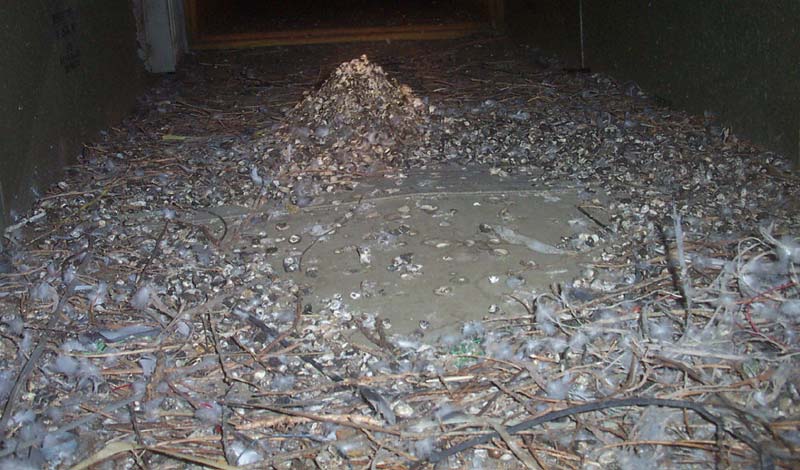
Q: I live on the 15th floor of an Upper East Side co-op with windows facing First Avenue. Pigeons are roosting on my window ledge. The birds’ vocalization is loud enough to wake me up in the morning and they leave behind gray and white stains from their droppings. I shoo the birds away when I’m home, but cannot do this all day. I want to be able to open my window in the spring without worrying that the germs from their droppings will enter my room. What can I place on my window ledge to discourage the pigeons from roosting there? I do not want to use anything that could fall off the ledge, endangering a pedestrian below, or poison the birds. What is a safe remedy?
A: You should be able to open your windows this spring without worrying that a pigeon will fly into your apartment or its droppings will soil your home. While their droppings do not generally pose a serious health risk, they are still unsanitary, and gross. But your building, not you, should get the birds off your ledge. As a shareholder, you are responsible for everything inside the walls of your apartment, and the co-op board is responsible for the building. So the board needs to figure out how to get the birds to find a new home.
“Residents should not attempt a solution on their own,” said Daniel Wollman, the chief executive of Gumley Haft, a Manhattan property manager.
Write the managing agent and the co-op board a letter alerting them to the pigeon problem and insisting that they fix it. If the birds are nesting on your ledge, they are probably nesting on another resident’s, too. In the letter, ask that management also clean the ledge of any droppings.
The building should be able to get the birds to nest elsewhere without damaging the facade or risking the safety of anyone on the street below. For example, at a Gumley Haft-managed property with a pigeon problem in its inner courtyard, management suspended netting over the area to keep the birds away.
Netting will not solve the problem at your building, but there are other methods. John McGowan, the director of operations for Bugged Out Pest Management in Brooklyn suggested that your building consider using Bird Barrier Optical Gel, a bird deterrent, which he described as “awesome.”
Source
Pigeon Patrol Products & Services is the leading manufacturer and distributor or bird deterrent (control) products in Canada. Pigeon Patrol products have solved pest bird problems in industrial, commercial, and residential settings since 2000, by using safe and humane bird
deterrents with only bird and animal friendly solutions. At Pigeon Patrol, we manufacture and offer a variety of bird deterrents, ranging from Ultra-flex Bird Spikes with UV protection, Bird Netting, 4-S Bird Gel and the best Ultrasonic and audible sound devices on the market today.
Voted Best Canadian wholesaler for Bird Deterrent products ten years in a row.
Contact us at 1 877-4-NO-BIRD,(604) 585-9279 or visit our website at www.pigeonpatrol.ca
Pigeon/Pigeon Patrol / Pigeons Roosing / Vancouver Pigeon Control / Bird Spikes / Bird Control / Bird Deterrent / PIgeon Deterrent / Surrey Pigeon Control / Pest / Seagull deterrent / Vancouver Pigeon Blog / Birds Inside Home / Pigeons in the cities / Ice Pigeons / What to do about pigeons / sparrows, Damage by Sparrows, How to Keep Raccoons Away, Why Are Raccoons Considered Pests / De-fence / Pigeon Nesting / Bird Droppings / Pigeon Dropping / woodpecker control / Professional Bird Control Company / Keep The Birds Away / Birds/rats/seagull/pigeon/woodpecker/dove/sparrow/pidgeon control/pidgeon problem/pidgeon control/flying rats/pigeon problems/ bird netting/bird gel/bird spray/bird nails/bird guard
by Pigeon Patrol | Jun 21, 2023 | Bird Spike, Pigeon Predators, Pigeon Spikes, Pigeons, Pigeons in the News, Raccoons, Sparrows
A pigeon takeover can really disrupt your outdoor space. One day you see a few, the next day, a few hundred. Not to mention their droppings can stain or even corrode metal and painted surfaces.
Getting rid of pigeons starts with finding the root cause and planning your defense strategy accordingly. Here’s what could be attracting them and how to humanely get rid of them.
Why Do I Have Pigeons Around My Home?
Especially if you’re not in an urban location, it can be a mystery why pigeons have chosen to flock to your home. Despite their well-known tendency to inhabit cities, pigeons can be found just about anywhere, from large farmlands to small suburban apartments.
These are the main culprits that could be attracting pigeons to your home.
1. There’s a Feast Around
Above all, the pigeon’s main objective is to eat—and their peckish beaks will go for just about anything. They might go for the crops around your home, such as fruits (especially berries), grains, and beans.
If you have a bird feeder, they’ll bully smaller birds away and call upon their pigeon pals to come gorge. There could also be some trash can or compost munchies they’re going after.
Not sure what’s giving them a meal ticket? It helps to observe the pesky birds and note where they gather. Once you pinpoint what they’re pecking at, it will be that much easier to remove the temptation.
2. There’s a Good Perching Spot
Pigeons love a birds-eye view of the surrounding area—what better way to scope out a place to feed or nest? If you’ve got some prime perching real estate around, they’ll be all the more attracted to your property.
Here are a few of their top picks for perching:
- Ledges
- Balconies
- Gutter
- Roof
3. There’s a Suitable Nesting Area
Aside from eating, nesting is a pigeon’s other main objective. They prefer flat, warm, secluded surfaces such as:
- Barns
- Chimneys
- Garages
- Window sills
- Window AC units
- Solar panels
How to Get Rid of Pigeons
Whether it’s the noms or the nesting that has pigeons hooked on your turf, here’s what you can do to keep them away.
Adjust Your Bird Feeders
Bird feeders are a major attraction to pigeons, but that doesn’t mean you need to bid farewell to all your hungry feathered visitors. By getting feeders pigeons can’t (or don’t want to) access, your favorite songbirds can have their seed and eat it too.
Get a Weight-Sensitive Feeder
Weight-sensitive bird feeders are a great pigeon deterrent (and they’ll also keep ravenous squirrels at bay). These allow lightweight songbirds to munch freely while using weight-sensitive springs to shut feeding ports for pigeons and other heavier visitors.
Use Pigeon-Proof Feeders
Pigeons are large and heavy—and they’re no acrobats. You can deter them by selecting a feeder they can’t use, such as a hanging tube feeder, suet cake, or anything with tiny perches that they won’t be able to sit on.
Put Out Food They Don’t Like
As undiscerning as the pigeon’s appetite is, there are some seeds they tend to stay away from. Here are a few songbird-attracting seeds that pigeons don’t care for:
- Suet
- Nyjer
- Striped sunflower
Avoid the Food They Do Like
In the same vein, you’ll want to avoid the seeds that pigeons find scrumptious, which are often found in less-expensive seed mixes. These include:
Use a Seed Catcher
Those pretty songbirds aren’t the neatest eaters, and pigeons will happily flock to any seed that falls to the ground. If you’re having trouble in this area, consider adding a seed catcher, which is a wide tray that hangs just below the feeder. You can purchase a seed catcher online or attach a tray to your feeder with rope or chains.
Get Anti-Roosting Spikes
Anti-roosting spikes might seem painful at a glance, but they’re more of a visual deterrent than a physical one. Since birds can easily see the spikes, they know they aren’t able to perch and won’t try to do it.
Use a Fearsome Decoy
To keep pigeons away, try putting out a realistic decoy of a predatory animal, such as a snake or an owl. Pigeons tend to wise up to this tactic after a while, so it’s more effective if you move the decoy to different spots periodically. Even still, this is best paired with other solutions and deterrents.
Try a Repellent
Ultrasonic emitters and slippery gel repellents can keep pigeons from hanging out in your yard. However, the downside is that they’ll keep other birds away too. Avoid sticky repellents, as these can trap and injure smaller birds.
Tips for Dealing With Pigeons Around Your Home
While you’re working on giving them the permanent boot, use these tips to manage the pigeons around your home.
1. Don’t Feed the Birds
When pigeons disrupt the feeding of your regular songbird clientele, it’s tempting to throw some bread or cheap seed in a separate location as a diversion. While this presents a temporary solution, you’ll run into trouble when those pigeons tell their buddies about the free food and they all make it a regular place to frequent.
Along with that, be sure to close off or remove other potential food sources, such as trash cans and compost piles.
2. Keep a Consistent Cleanup Routine
While you’re in the midst of a pigeon problem, become well-acquainted with your hose’s power-spray setting. Their corrosive droppings can do serious damage to the surfaces and finishes around your yard, so you’ll want to stay on top of cleanup. Along with that, sweeping and keeping garbage in well-sealed containers can eliminate potential food sources.
3. Deter Pigeons With Reflective Materials
Shiny materials are disorienting and can keep pigeons away from their usual landing spot. Aluminum foil, reflective tape, shiny ribbon, and your old CD collection are all great options.
4. Cap Your Chimney
While it won’t single-handedly prevent a pigeon invasion, investing in a chimney cap is a wise thing to do if you haven’t already. Pigeons have a tendency to nest in chimneys, where they can often get stuck and pass away. That’s not ideal for either of you to go through, so you won’t regret being proactive.
DIY vs. Hire a Pro
Although the risk of pigeon-related illness is low, these birds can harbor disease and parasites. A local bird control service can help you safely deal with them and keep them from coming back. The cost to remove a bird’s nest ranges anywhere from $100 to $2,000.
If you decide to DIY, it’s best practice to wear protective clothing, including eyewear, a mask, and gloves when handling a bird or its droppings.
Additional Questions
How do I get rid of pigeons naturally?
Here are a few scents pigeons can’t stand:
- Cinnamon
- Hot peppers
- Peppermint
- Onion
- Garlic
What are pigeons most afraid of?
Pigeons are most deterred by the sight of predatory birds. These include owls, hawks, and other birds of prey.
Source
Pigeon Patrol Products & Services is the leading manufacturer and distributor or bird deterrent (control) products in Canada. Pigeon Patrol products have solved pest bird problems in industrial, commercial, and residential settings since 2000, by using safe and humane bird
deterrents with only bird and animal friendly solutions. At Pigeon Patrol, we manufacture and offer a variety of bird deterrents, ranging from Ultra-flex Bird Spikes with UV protection, Bird Netting, 4-S Bird Gel and the best Ultrasonic and audible sound devices on the market today.
Voted Best Canadian wholesaler for Bird Deterrent products ten years in a row.
Contact us at 1 877-4-NO-BIRD,(604) 585-9279 or visit our website at www.pigeonpatrol.ca
Pigeon/Pigeon Patrol / Pigeons Roosing / Vancouver Pigeon Control / Bird Spikes / Bird Control / Bird Deterrent / PIgeon Deterrent / Surrey Pigeon Control / Pest / Seagull deterrent / Vancouver Pigeon Blog / Birds Inside Home / Pigeons in the cities / Ice Pigeons / What to do about pigeons / sparrows, Damage by Sparrows, How to Keep Raccoons Away, Why Are Raccoons Considered Pests / De-fence / Pigeon Nesting / Bird Droppings / Pigeon Dropping / woodpecker control / Professional Bird Control Company / Keep The Birds Away / Birds/rats/seagull/pigeon/woodpecker/dove/sparrow/pidgeon control/pidgeon problem/pidgeon control/flying rats/pigeon problems/ bird netting/bird gel/bird spray/bird nails/bird guard
by Pigeon Patrol | Jun 21, 2023 | Bird Spike, Pigeon Predators, Pigeon Spikes, Pigeons, Pigeons in the News, Raccoons, Sparrows, UltraSonic Bird Control
Regardless of whether it’s around your home or a business premises, pigeons can be a nuisance.
While the odd one here or there is, of course, to be expected, if your property has become a popular place for these creatures to hang out, it can cause a number of problems.
• Bird droppings not only look unsightly, when wet they can be a serious slip hazard
• Pigeons do unfortunately deserve their reputation for being unhygienic and they do in fact carry more harmful diseases to humans than rats do
• Pigeon fouling and nest materials attract a whole host of insects including fleas, carpet beetles, flies, clothes moths and mealworm beetles
• Pigeon faeces is highly corrosive and can, therefore, cause extensive damage to your building if it sits there for an extended period of time
• Debris from flocks of pigeons can build up causing blockages to drains and gutters which can cause flooding and roof damage
• Clean-up costs can be high
As you may have gathered by now, it’s advisable to deal with pigeons before they become a huge problem. How exactly do you get rid of pigeons?
Remove any food sources
Pigeons are scavengers and will feed on nearly anything so make sure there are no possible food sources around your home or business premises. Don’t forget to check your roof and ensure that any outdoor areas are clean, no food scraps have been left out and that rubbish hasn’t been pulled out of your bins by other animals.
Store rubbish bags in metal bins with securely fitted lids so that pigeons can’t gain access to the contents. Try to avoid feeding pets outside or if you have to, clean away their bowl as soon as they’ve finished eating.
Install a decoy
If you look up at buildings you will probably notice some of them have fake Owls, lightweight kites in the form of hawk silhouettes, which are placed as a scare tactic. A good tip is to move the decoy on a regular basis because pigeons will get used to its presence and won’t be scared of t anymore – especially because it doesn’t make a noiseHomemade remedies
Some organic, homemade remedies have been known to be pretty effective. Try placing balls or containers of strong spices around your patio, exterior windowsills or wherever else pigeons tend to gather around your property. The best spices to use are chili powder, cayenne pepper, black pepper or cinnamon.
Don’t make your property pigeon-friendly
If it’s easy for pigeons to settle, they will. Check your property for pigeon-friendly places such as soffits, vents, chimneys, gutters and large gaps. Anywhere up high is naturally going to be an inviting place for these birds to nest and start a family. You can use a fine mesh screen to cover these areas to discourage pigeons from setting up home there.
Call a pest controller
The best thing to do if you’re faced with a pigeon problem is to call a pest controller. Highly experienced in this field, they will be able to provide you with a range of deterrent and proofing solutions which will provide a long-term solution.
Source
Pigeon Patrol Products & Services is the leading manufacturer and distributor or bird deterrent (control) products in Canada. Pigeon Patrol products have solved pest bird problems in industrial, commercial, and residential settings since 2000, by using safe and humane bird
deterrents with only bird and animal friendly solutions. At Pigeon Patrol, we manufacture and offer a variety of bird deterrents, ranging from Ultra-flex Bird Spikes with UV protection, Bird Netting, 4-S Bird Gel and the best Ultrasonic and audible sound devices on the market today.
Voted Best Canadian wholesaler for Bird Deterrent products ten years in a row.
Contact us at 1 877-4-NO-BIRD,(604) 585-9279 or visit our website at www.pigeonpatrol.ca
Pigeon/Pigeon Patrol / Pigeons Roosing / Vancouver Pigeon Control / Bird Spikes / Bird Control / Bird Deterrent / PIgeon Deterrent / Surrey Pigeon Control / Pest / Seagull deterrent / Vancouver Pigeon Blog / Birds Inside Home / Pigeons in the cities / Ice Pigeons / What to do about pigeons / sparrows, Damage by Sparrows, How to Keep Raccoons Away, Why Are Raccoons Considered Pests / De-fence / Pigeon Nesting / Bird Droppings / Pigeon Dropping / woodpecker control / Professional Bird Control Company / Keep The Birds Away / Birds/rats/seagull/pigeon/woodpecker/dove/sparrow/pidgeon control/pidgeon problem/pidgeon control/flying rats/pigeon problems/ bird netting/bird gel/bird spray/bird nails/bird guard
by Pigeon Patrol | Jun 14, 2023 | Bird Spike, Pigeon Predators, Pigeon Spikes, Pigeons, Pigeons in the News, Raccoons, Sparrows, UltraSonic Bird Control
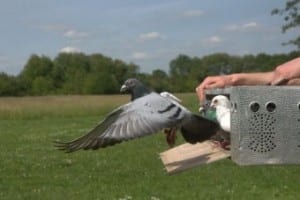
A study on a population of pigeons on the University of South Africa’s Muckleneuk campus was conducted over 2 years. Counts were conducted during a baseline year (March 2013–February 2014) to establish the pigeon population index inhabiting the campus buildings, and again in the management year (August 2014–August 2015) once Eagle Eyes™, Fire (Flash) Flags, bird spikes and a combination thereof were implemented on the buildings. An efficacy reduction percentage was determined for each of the control structures. The total pigeon index on the campus declined by 50 % once the control structures were implemented. Control structures; however, differed markedly in efficacy from each other. Whilst bird spikes indicated the highest efficacy at reducing the pigeon population index, seasonality also influenced the efficacy of the control structure. Quantified understanding of the efficacy of pigeon control measures allows urban management to make informed decisions about reducing pigeon populations.
Source
Pigeon Patrol Products & Services is the leading manufacturer and distributor or bird deterrent (control) products in Canada. Pigeon Patrol products have solved pest bird problems in industrial, commercial, and residential settings since 2000, by using safe and humane bird
deterrents with only bird and animal friendly solutions. At Pigeon Patrol, we manufacture and offer a variety of bird deterrents, ranging from Ultra-flex Bird Spikes with UV protection, Bird Netting, 4-S Bird Gel and the best Ultrasonic and audible sound devices on the market today.
Voted Best Canadian wholesaler for Bird Deterrent products ten years in a row.
Contact us at 1 877-4-NO-BIRD,(604) 585-9279 or visit our website at www.pigeonpatrol.ca
Pigeon/Pigeon Patrol / Pigeons Roosing / Vancouver Pigeon Control / Bird Spikes / Bird Control / Bird Deterrent / PIgeon Deterrent / Surrey Pigeon Control / Pest / Seagull deterrent / Vancouver Pigeon Blog / Birds Inside Home / Pigeons in the cities / Ice Pigeons / What to do about pigeons / sparrows, Damage by Sparrows, How to Keep Raccoons Away, Why Are Raccoons Considered Pests / De-fence / Pigeon Nesting / Bird Droppings / Pigeon Dropping / woodpecker control / Professional Bird Control Company / Keep The Birds Away / Birds/rats/seagull/pigeon/woodpecker/dove/sparrow/pidgeon control/pidgeon problem/pidgeon control/flying rats/pigeon problems/ bird netting/bird gel/bird spray/bird nails/bird guard
by Pigeon Patrol | Jun 14, 2023 | Bird Spike, Pigeon Predators, Pigeon Spikes, Pigeons, Pigeons in the News, Raccoons, Sparrows, UltraSonic Bird Control
Being a peregrine fanatic I’m kind of fond of pigeons – at least from the prey point of view – so when I was in downtown Pittsburgh on Sunday I stopped by Mellon Square to check out the scene.
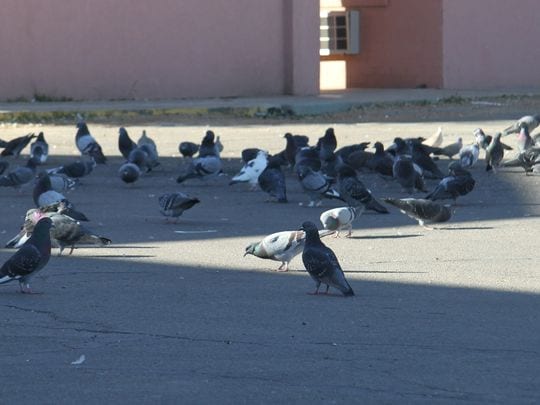
Even for a peregrine falcon the number of pigeons at Mellon Square is way too much of a good thing. I counted more than 150 and I couldn’t see all of them. The pigeons outnumbered people more than 30 to 1.
This explains why peregrines hang out on the Oliver Building window sills. It’s like visiting an all-you-can-eat restaurant. The food may not be that great but there’s so much of it!
This kind of pigeon over-population repulses most people and they want a quick fix, the quickest being poison. But if you poison a pigeon, you’ll poison a peregrine. After a culling episode pigeons reproduce fast to fill the void – in fact lethal control actually increases the flock – but the peregrines take years to recover. And peregrines are endangered in Pennsylvania. It’s bad, bad, bad to poison an endangered species.
So what to do?
Pigeons need two things to reach the numbers found at Mellon Square: lots of food and places to nest. They reproduce in direct proportion to their food supply. If food is scarce some won’t nest at all. If food is plentiful they lay the next clutch of eggs before the first set has hatched, producing more than 12 chicks per year.
The food problem is obvious. Sidewalks at Mellon Square are coated with bird seed. Control the food source (the people who feed them) and you’ve got most of the problem licked. To make a really dramatic difference, control the nest sites as well.
City pigeons nest on buildings and bridges. They also nest in buildings. Find the buildings involved and spend the time and money to block the access holes. Last summer the University of Pittsburgh cleaned the Cathedral of Learning and blocked off the pigeon nest holes as part of the cleaning job. One year later there are far fewer pigeons at Schenley Plaza.
And finally, there’s a foolproof solution that makes both the pigeon-feeders and the pigeon-haters happy. Many European cities have solved their pigeon problem permanently by building dovecotes and pigeon lofts. Yes, they built nest sites. They control the population at the dovecotes by substituting dummy eggs and they control the food level by giving pigeon lovers an approved place to feed and interact with the birds.
This keeps the pigeons and the birdseed off the street. An elegant solution.
Source
Pigeon Patrol Products & Services is the leading manufacturer and distributor or bird deterrent (control) products in Canada. Pigeon Patrol products have solved pest bird problems in industrial, commercial, and residential settings since 2000, by using safe and humane bird
deterrents with only bird and animal friendly solutions. At Pigeon Patrol, we manufacture and offer a variety of bird deterrents, ranging from Ultra-flex Bird Spikes with UV protection, Bird Netting, 4-S Bird Gel and the best Ultrasonic and audible sound devices on the market today.
Voted Best Canadian wholesaler for Bird Deterrent products ten years in a row.
Contact us at 1 877-4-NO-BIRD,(604) 585-9279 or visit our website at www.pigeonpatrol.ca
Pigeon/Pigeon Patrol / Pigeons Roosing / Vancouver Pigeon Control / Bird Spikes / Bird Control / Bird Deterrent / PIgeon Deterrent / Surrey Pigeon Control / Pest / Seagull deterrent / Vancouver Pigeon Blog / Birds Inside Home / Pigeons in the cities / Ice Pigeons / What to do about pigeons / sparrows, Damage by Sparrows, How to Keep Raccoons Away, Why Are Raccoons Considered Pests / De-fence / Pigeon Nesting / Bird Droppings / Pigeon Dropping / woodpecker control / Professional Bird Control Company / Keep The Birds Away / Birds/rats/seagull/pigeon/woodpecker/dove/sparrow/pidgeon control/pidgeon problem/pidgeon control/flying rats/pigeon problems/ bird netting/bird gel/bird spray/bird nails/bird guard
by Pigeon Patrol | Jun 14, 2023 | Bird Spike, Pigeon Droppings, Pigeon Patrol's Services, Pigeon Predators, Pigeon Spikes, Pigeons, Pigeons in the News
Rats with wings, or majestic streetwise bird? It’s a debate that’s raged almost as long as New York City has been called that. And this week, the war between the two sides boiled over again.
It started when the exclusive University Club had its feathers ruffled. It wanted to drape its storied building in netting, to protect it from pigeon poo, which eats away at stone and metal. But the Landmarks Commission said it would have to wait for approval, as it would be a “visible change” to the landmarked Italian Renaissance building’s façade. As if the crap wasn’t a “visible change” enough.
Meanwhile, over on East 93rd Street, there was a scuffle involving longtime pigeon activist Anna Dove and her neighbor, who snatched away her bag of seed after he saw her feeding the pigeons on the sidewalk. The police were summoned.
“It’s disgusting,” said her nemesis, retired teacher Arthur Schwartz. “She’s feeding the rats.”
And with the live pigeon-shooting state championships in Pennsylvania coming up, it’s almost guaranteed that there will be an increase in demand of pigeon-poaching — New York City is a favorite spot for trapping them and transporting them to be used as live targets. The animal-rights activists will be out with their cameras and signs to stop them.
No matter which side you’re on, one things for certain — by the end, things are going to get a little birdbrained.
*
“It’s not the pigeons that are the problem, it’s the number of them,” says Andrew D. Blechman, author of “Pigeons: The Fascinating Saga of the World’s Most Revered and Reviled Bird.” “They’re gentle creatures. The problem is that they get in our face, just like we get in each other’s faces.”
No one one’s quite sure of how many pigeons are in New York City. One adage is “one pigeon per person,” which would put their numbers at about 7 million. They each produce about 25 pounds of waste per year.
Pigeons love cities because of the many ledges, windowsills, eaves and rooftops available for them to roost in, which mimics their natural habitat of high cliffs. Pigeon pairings are monogamous, often mating for life, and both parents raise the babies — called squab — for a time, sitting on the eggs in shifts.
The pigeon includes about 298 species of bird, but the Rock Dove is the most common to the New York area, according to the Parks Department. The grey, bobbing-headed birds usually have purple-green iridescence around the neck area. They’re the scruffiest members of the dove family — although “dove” usually connotes the pure white symbols of peace, not the pizza scavengers of city streets. (Just say they’ve been pigeonholed.)
“If they were white,” Blechman says, “people would love them.”
Blame the French for our pigeon problems. The little pluckers first arrived in the early 1600s with French settlers who used them for meat. They were easy to raise — they could be kept in a barn, where they’d perch on the rafters, and young pigeons served as a good source of protein.
But they soon escaped their confines and went feral.
City life agreed with them and allowed them to flourish — and in some cases, over-flourish. Their natural predators, like falcons and hawks, aren’t found here in great numbers.
Courtney Humphries, author of “Superdove: How the Pigeon Took Manhattan . . . And the World,” concedes that pigeon are pilloried partly because of their “persistence. They nest on the buildings we consider our territory, and they don’t like to be moved.”
The average city pigeon has a lifespan of three to five years. With all the food scattered throughout the garbage cans and sidewalks — plus well-meaning human feeders — they spend less time looking for grub, which leaves more time for mating.
“The biggest problem is the people who overfeed them,” says Blechman. “Every city has about a dozen of them, and they’re the ones who cause the [overpopulation] problem.”
He suggests that if you want to feed the birds, hand out just a teaspoon full of birdseed for a flock. “It’s just enough to give them a little extra energy while they’re out trying to find their own food.”
“If nobody fed pigeons, I think things would look a lot different,” agrees Humphries, who says that human feeders end up creating dense flocks. “A lot of the problem with pigeons comes from people.”
If you can’t freeze the hearts of little old ladies, though, you could try eating them (the pigeons, that is). Squab — baby pigeons that haven’t flown yet — is on the menu at many restaurants around the city, particularly French. They’re “basically the milk-fed veal of the sky,” says Blechman — tender, mostly dark meat, and one of the only poultry that can be eaten rare. (Pigeons produce their own milk-like substance, which they feed to their young by regurgitation.)
Pigeon pot pie was a huge colonial favorite. Today, try the Squab and Foie Croustillant at the Modern, Danny Meyer’s restaurant at the Museum of Modern Art.
*
Unless the appetite for squab skyrockets, New York’s options are few. Avicide — poisoning birds — was made illegal in 2000, when the state Legislature passed a bill outlawing the use of “flock dispersal agents” like Avitrol in cities with more than 1 million people.
Before that, property managers regularly hired pest control services to dole out Avatrol to flocks of pigeons.
“In theory, you would mix it with feed, and when one pigeon ate some of the treated food, they would begin to suffer from neurological toxicity,” explained Stephanie Boyles, wildlife expert at the Humane Society of the United States. “When their flockmates saw them suffering, it would prompt them to leave the area.”
In practice, however, overdosing often led to large numbers of birds convulsing and writhing in pain on the street before their deaths. Welcome to New York!
The last major flare-up between pigeons and people was in 2007, when City Councilman Simcha Felder released a report plaintively titled, “Curbing the Pigeon Conundrum.”
Claiming that their droppings carried a host of diseases like histoplasmosis, he proposed a $1,000 fine to anyone feeding them, as well as curbing their numbers through birth control (a measure that cities like Los Angeles have adopted, although some argue that it’s unsustainable), and appointing a city “Pigeon Czar” to oversee other pigeon-control issues.
The NYC Department of of Health and Mental Hygiene maintains that contact with their droppings only poses a small health risk, and that “routine cleaning of droppings (e.g. from windowsills) does not pose a serious health risk to most people,” although disposable gloves are a good idea.
The Humane Society came out against the anti-feeding fine because they weren’t sure it would actually make a difference in reducing flocks, said Boyles. “We still suggest working with communities to create places where pigeons are welcome, and discouraging them where they’re not.”
While Felder’s bill didn’t fly, it was only one of many efforts to keep pigeons clipped.
In 2006, pigeon loitering was so dense near the Army Recruitment Center in Times Square, speakers were set up to broadcast sounds of falcons and pigeons being attacked, in hopes of scaring them away. In 2003, they had so overwhelmed Bryant Park that the operators invited a falconer and his hawk to the park for a week to scare away (not eat) the pigeons.
In 2007, the MTA installed Bird-B-Gone on some of its elevated stations along the 7 line, as well as others. The electronic system zapped birds that got too close.
In the ’80s, plastic owls were a big seller. Today, a slightly more high-tech version, called the RoboHawk, moves its head, wings, and makes what its creators hope are pigeon-threatening sounds.
Every so often, a politician considers reviving an overall anti-feeding bill, since, for now, it’s only illegal in city parks where signs are posted (the fine is usually $50).
Some cling to the hope that the city will come to its senses and declare war. Because they’re a non-native species, pigeons are not protected by either the Federal Migratory Birds Act or New York state laws. Can anyone say hunting season?
It’s got to be done mafia-style, though. Culling is only a temporary solution — as with most wild birds, quick breeding will put their numbers back to pre-cull figures within weeks, according to Pigeon Control Advisory Service.
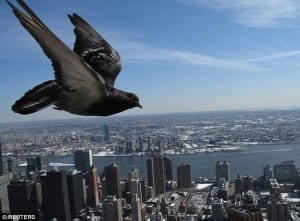
But spare a thought, pigeon haters, for your majestic foe. Pigeons have more qualities than you think.
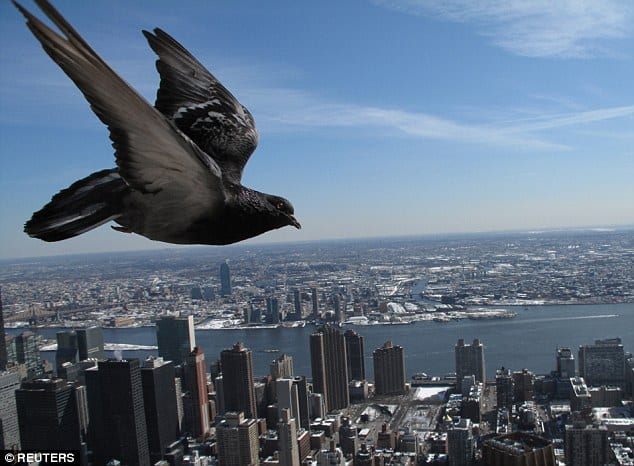
Although city birds aren’t particularly active, pigeons are built to be athletes — a trained bird can fly up to 60 miles per hour, and they can stay in the air for 500 miles. They’re meant for flying long distances, and have “homing” instincts, which means they will naturally find their way back.
This talent is why they were literally drafted into the United States Army Pigeon Service.
A million served in both world wars, where they delivered messages across enemy lines and saved thousands of soldiers’ lives. One pigeon, Cher Ami, won a French medal for his bravery for flying through gunfire, finally delivering the message dangling from what was left of his foot. He’s now stuffed and in the Smithsonian.
The army’s Pigeon Breeding and Training Center was based at Fort Monmouth, NJ, and opened in 1917. Many of its “Pigeoneers” were “basically just boys out of Brooklyn, and they’d just bring their best birds,” Humphries says. (The training center was closed in 1957 when the Army stopped using them as messengers.)
Keeping pigeons on rooftops — and racing them — used to be much more popular. Who can forget Marlon Brando’s character in the 1954 film “On the Waterfront” shouting up to his friend Joey, “I got one of your birds!” right before Joey “accidentally” falls off the roof?
The city is full of equally vocal bird-lovers.
“They animate our lives,” argues Blechman, who says that despite writing a book on pigeons, he is not a “bird person,” and admits to having eaten them before. He’s come around, though. “You look out the window and you can have a pigeon land on your windowsill, and the same one will come back every day, and at the same time.
“What would the lonely, the unemployed, and the elderly do every day if it weren’t for pigeons?”
The Internet is atwitter with kooky pigeon fans. There’s a pigeon appreciation society on Facebook. On photo-sharing site Flickr, there’s a group called The Global Pigeon Art Appreciation Society.
“You are not alone,” the site reads. “Many artists have been inspired by pigeons.”
There is also a city listserv called “New York Pigeon People,” where members discuss how to rescue birds and share pigeon news.
You can eat them, race them, breed them, feed them, but you can’t escape them, whether you consider them the most misunderstood creatures of the flying community or the world’s worst bird. As Blechman put it, “We’re just going to have to learn to co-exist.”
Source
Pigeon Patrol Products & Services is the leading manufacturer and distributor or bird deterrent (control) products in Canada. Pigeon Patrol products have solved pest bird problems in industrial, commercial, and residential settings since 2000, by using safe and humane bird
deterrents with only bird and animal friendly solutions. At Pigeon Patrol, we manufacture and offer a variety of bird deterrents, ranging from Ultra-flex Bird Spikes with UV protection, Bird Netting, 4-S Bird Gel and the best Ultrasonic and audible sound devices on the market today.
Voted Best Canadian wholesaler for Bird Deterrent products ten years in a row.
Contact us at 1 877-4-NO-BIRD,(604) 585-9279 or visit our website at www.pigeonpatrol.ca
Pigeon/Pigeon Patrol / Pigeons Roosing / Vancouver Pigeon Control / Bird Spikes / Bird Control / Bird Deterrent / PIgeon Deterrent / Surrey Pigeon Control / Pest / Seagull deterrent / Vancouver Pigeon Blog / Birds Inside Home / Pigeons in the cities / Ice Pigeons / What to do about pigeons / sparrows, Damage by Sparrows, How to Keep Raccoons Away, Why Are Raccoons Considered Pests / De-fence / Pigeon Nesting / Bird Droppings / Pigeon Dropping / woodpecker control / Professional Bird Control Company / Keep The Birds Away / Birds/rats/seagull/pigeon/woodpecker/dove/sparrow/pidgeon control/pidgeon problem/pidgeon control/flying rats/pigeon problems/ bird netting/bird gel/bird spray/bird nails/bird guard