by Ryan Ponto | Dec 7, 2016 | Animal Deterrent Products
Power outages, however long they may be, slippery walking conditions, snow-covered ground and very cold temperatures all let us know we are in a Maine winter. These conditions rule our lives and the lives of all creatures in the natural world for awhile, but as we all know, life goes on, and we adapt the best we can. Some humans and some other forms of wildlife revel in the snow and ice.
Getting food is very important for all creatures in order to survive. Feathered residents and visitors to the islands keep feeders especially busy in December. Redpolls arrive and stay through the first part of April. They come with the snowflakes and leave when spring approaches. These birds are about the size of chipping sparrows, are darkly streaked, grayish brown and have white wing bars. The breast and rump are pink, and the adult has a red cap and a black chin. You’ll notice them when they arrive. These colorful wanderers drift into the Northeast every winter in considerable numbers and are lovely to see. From a distance, you could easily mistake them for goldfinches until they get close enough for you to see the pink breast and red cap of the male redpoll. Redpolls often flock with goldfinches and pine siskins.
In the winter, they spend the short days searching for food and eating. At darkness, they retire to a thicket of evergreens to sleep. Their food consists mostly of the seeds of birches, alders and grasses. At your feeder, offer them sunflower seeds, millet, hemp, hayseed and rolled oats.
If you notice a new or different bird at your feeder, make note of the kind of bill the bird has. Grosbeaks, for instance, have thick, large bills rounded in outline. Finches, sparrows and buntings have bills much like that of a canary. A crossbill‘s bill is like none other, with its unusual crossed mandibles. Noting these facts makes identification so much easier.
Also note how the bird searched for food. Did it look for insects and grubs beneath the bark? Such birds usually have tweezer-like bills in order to grab tiny pieces of food. Owls and hawks have hooked bills for ripping apart their food. Birds flying through the air catching insects have big mouths and small bills. Noting these different characteristics will help you identify a new bird very well. It’s also good to snap a photo if you can. Even a poor photo is helpful sometimes.
Wherever I have traveled in the world, I’ve been able to figure out a new bird or at least the type of bird I was seeing for the first time by these methods. A memorable moment for me in Greece happened when I saw a nuthatch around the walls of some ancient temple. The bird was going in and out of a nest. There was no doubt that it was some sort of nuthatch, a new one on my “life list.” In South America, an oriole-type bird attracted my attention, and I was able to key it down using these helpful hints. Kingfishers, of course, are easy. Wherever you are in the world, if you see a small or large kingfisher, you know to which family it belongs even if you don’t recognize that particular kingfisher. Here on Mount Desert Island, we only see the belted kingfisher. Tropical kingfishers may be very large or small and different colors, but their shapes and habits loudly say, “I am a kingfisher.”
Where you see the new bird should be noted as well, and note what it was doing. Be a good detective and gather lots of clues to help with identification. I’m always glad to help if I can.
Mallards display their courtship antics in November and December, so watch them if you get a chance. When their favorite ponds freeze, you’ll find them in local harbors. You can even do your bird watching from the comfort of your car if you have good binoculars with you. The courtship ritual is often done after they have fed well. It’s fascinating to watch and sometimes very funny.
One chilly day, I passed several mourning doves drinking and bathing in some melted waters next to the road. In spite of the snow and cold temperatures, the birds were splashing and preening. There’s nothing like a good bath. During our winter, mourning doves gather in large flocks and roost together. If the winter snows are not too crusty, they will winter well, for they feed on grass and weed seeds and any berries they can find. In periods of freezing snow and when an icy covering encases seeds and everything else out of doors, they have great difficulty in finding food, except at a feeder. Their feet are not strong enough to scratch through crusted snow. Some mourning doves do migrate, but others stay here all year.
In the air, mourning doves are quite special to watch, for they bend their wings back after each wing stroke, and their long, pointed tails stream elegantly behind them. If you are close enough to hear them take off, their wings make a whistling sound you can hear easily. The call of the mourning dove is a plaintive “coo-coo coo coo” rising and falling in pitch and repeated many times. You probably won’t hear them call until spring. It is then they pair off and do their cooing.
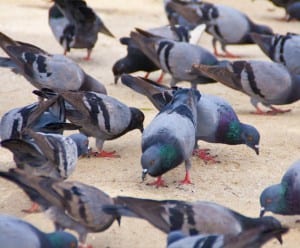
You commonly see larger doves or pigeons at local docks. Actually, these larger doves are not native to America but were brought by the European settlers. They have adapted well. The tall buildings of a city are similar to the cliffs on which they prefer to live. If you live near a dock or the water where they hang about, you may have them coming to your feeder in large numbers. My suggestion to this situation, if you don’t want them coming, is to stop feeding for a week or so in hopes of discouraging them so they will go find food elsewhere.
About Pigeon Patrol:
Pigeon Patrol Products & Services is the leading manufacturer and distributor of bird deterrent (control) products in Canada. Pigeon Patrol products have solved pest bird problems in industrial, commercial, and residential settings since 2000, by using safe and humane bird deterrents with only bird and animal friendly solutions. At Pigeon Patrol, we manufacture and offer a variety of bird deterrents, ranging from Ultra-flex Bird Spikes with UV protection, Bird Netting, 4-S Gel and the best Ultrasonic and audible sound devices on the market today.
Voted Best Canadian wholesaler for Bird Deterrent products four years in a row.
Contact Info: 1- 877– 4– NO-BIRD (www.pigeonpatrol.ca)
by Ryan Ponto | Dec 5, 2016 | Animal Deterrent Products
 Five-year-old Jannatul Maida was having the day of her life to see so many colourful exotic birds up close under one roof.
The exuberant young girl was seen enjoying herself and moving from one stall to another with her father at the fancy birds and pigeons exhibition in the city yesterday, held at Chittagong Veterinary and Animal Sciences University (CVASU).
The exhibition was jointly organised by Chittagong Bird Breeders’ Association, Chittagong Fancy Pigeon Breeders’ Association and Association of Avian Veterinarians, Bangladesh. Workshops and training for pet bird owners were also organised during the event.
Sakhawat Hossain, father of nursery student Jannat, said, “My daughter loves birds very much. I brought her to this exhibition since it’s a great opportunity for seeing varieties of fancy birds and pigeons in one place.”
Emon Chowdhury, a student of Premier University, and his two friends were among the hundreds of bird lovers who thronged the day-long exposition with their family and friends.
“We didn’t want to miss this chance of seeing so many beautiful birds at the same time,” Emon said in between taking photographs and selfies with his friends and the colourful birds.
Shamsul Arefin, deputy commissioner of Chittagong, told reporters at the exhibition, “Never before have I seen such a large number of birds at one place.”
Chief patron of the exhibition, CVASU Vice-Chancellor Prof Goutam Buddha Das, said, breeding of pet birds needs to be encouraged to save wild birds and such breeding of birds could “generate income as well”.
Near about 50 species of 150 fancy foreign birds and 100 species of around 200 pigeons were on display as well as on sale during the event, said Dr Saddam Hossain, executive secretary of Association of Avian Veterinarians, Bangladesh.
Budgerigar, Cockatiel, Lorikeet, Goldfinch, Eastern Rosella, Western rosella, Sun Conure, Blue Crowned Conure, Love Bird, Long-tailed Finch and White Finch were a few to name among the fancy birds displayed at the show.
A few noteworthy varieties of pigeons were Jacobin, American Fantail, Bokhara, Potter and Shakar.
About Pigeon Patrol:
Pigeon Patrol Products & Services is the leading manufacturer and distributor of bird deterrent (control) products in Canada. Pigeon Patrol products have solved pest bird problems in industrial, commercial, and residential settings since 2000, by using safe and humane bird deterrents with only bird and animal friendly solutions. At Pigeon Patrol, we manufacture and offer a variety of bird deterrents, ranging from Ultra-flex Bird Spikes with UV protection, Bird Netting, 4-S Gel and the best Ultrasonic and audible sound devices on the market today.
Voted Best Canadian wholesaler for Bird Deterrent products four years in a row.
Contact Info: 1- 877– 4– NO-BIRD (www.pigeonpatrol.ca)
by Ryan Ponto | Nov 29, 2016 | Animal Deterrent Products
The city’s Department of Environmental Protection has suspended its plans to string bird-deterrent wires across Jerome Park Reservoir, officials told The Press this week, after the community denounced the project as a needless expense that would further blight the historic reservoir’s natural beauty.
When the DEP submits its “rehabilitation project” for the reservoir to the city’s Public Design Committee for approval in January, “this submission will exclude the bird deterrent system,” DEP deputy commissioner Eric Landau said in a letter to the chairwoman of the Community Board 8 environment and sanitation committee, Laura Spalter, a copy of which his office provided to The Press.
The letter, dated Dec. 7, indicated, however, that the bird-deterrent system was not completely off the table and that plans to build it may be restored later.
When the DEP had developed its plans for bird-deterrent wires at Jerome Park Reservoir, the goal was to reduce pollutants, particularly fecal coliform bacteria, from waterbirds and to allow the Croton Filtration Plant – which purifies the reservoir’s water before it flows into the city’s taps – to “run more efficiently,” Mr. Landau said in his letter.
“As the plant has been up and running for only a year and half, we have determined that it is prudent to collect additional data on operational efficiency, especially now that the plant is running at full capacity, before a decision about whether to install the bird-deterrent system is made,” Mr. Landau said. But he reiterated that the bird-deterrent system will be “removed from the current construction contract … to rehabilitate the reservoir.”
Ms. Spalter described the letter as “excellent news,” saying in an interview with The Press on Tuesday: “We’re very pleased that this [bird-deterrent system] has been removed” from the project.
The DEP presented its reservoir-rehabilitation project to Community Board 8’s environment and sanitation committee on Nov. 16. The large-scale project included building a fence-like structure around the reservoir, which is already encircled by two fences. The new structure was to comprise poles set about 25 feet apart to hold wires that were to stretch across the reservoir to deter birds from landing on its surface.
Critics, who included a dozen or so board members at the gathering and several environmental activists from outside the board, charged that the wire system would further add to the array of barriers surrounding the reservoir. A bird-deterrent system is not required by any environmental laws or regulations, according to the DEP, and the reservoir holds only untreated water, which then goes for purification at the nearby filtration plant.
After the DEP scrapped the bird-deterrent plan, Karen Argenti of the Bronx Council for Environmental Quality praised the city agency as being “very reasonable” in rescinding the plan. An ardent advocate of opening the reservoir for public access, Ms. Argenti has been a vocal opponent opponent of the bird-deterrent plans during the November meeting.
“I think it’s good that they [DEP officials] listened to the people,” she told The Press this week.
Community Board 8 chairman Daniel Padernacht also had only words of appreciation for the DEP, saying Mr. Landau and others seem to “really make an effort” to heed community views.
With the bird-deterrent plan scrapped, the DEP has addressed what Mr. Padernacht said appeared to have been “the two biggest concerns” raised at the Nov. 16 meeting. The other involved the DEP’s plan to reduce the height of the reservoir’s inner fence to 4 feet from the current 10 feet or so. Community activists worried that lowering the fence would provide the city with a pretext to further block public access, as a security measure. But the DEP’s Mr. Landau has provided written assurances this would not be the case, Mr. Padernacht told The Press on Tuesday.
Jerome Park Reservoir opened for public access for one weekend in late November – although visitors had to pass through security gates manned by officers armed with automatic rifles and to leave all cameras, bags or cellphones outside. The DEP also plans to open the reservoir for another weekend in May.
After the DEP suspended the bird-wire plan, Mr. Landau also expressed hope in his letter that the environment and sanitation committee of Community Board 8 will support other parts of the department’s reservoir-rehabilitation project.
The committee was to adopt a resolution on the project at its next meeting, scheduled for Dec. 21, and planned to send the document to the city’s Public Design Committee.
The chairpeople of Community Board 8 and of its environment and sanitation committee declined to say whether they would back the remaining parts of the DEP project.
“I’m going to wait until the community discusses it that night,” Mr. Padernacht said.
About Pigeon Patrol:
Pigeon Patrol Products & Services is the leading manufacturer and distributor of bird deterrent (control) products in Canada. Pigeon Patrol products have solved pest bird problems in industrial, commercial, and residential settings since 2000, by using safe and humane bird deterrents with only bird and animal friendly solutions. At Pigeon Patrol, we manufacture and offer a variety of bird deterrents, ranging from Ultra-flex Bird Spikes with UV protection, Bird Netting, 4-S Gel and the best Ultrasonic and audible sound devices on the market today.
Voted Best Canadian wholesaler for Bird Deterrent products four years in a row.
Contact Info: 1- 877– 4– NO-BIRD (www.pigeonpatrol.ca)
by Ryan Ponto | Nov 24, 2016 | Animal Deterrent Products
25 years ago
NOV. 28, 1991
Senate Minority Leader Bob Dole on Wednesday secured $56.2 million to make U.S. 81 a four-lane expressway between Concordia and the Nebraska border. “This will help Salina a lot,” the Kansas Republican said. “It will create a lot of jobs in the area, there will be twice as many people coming through and there will be a lot more commerce.” Dole made a last-minute amendment to the nation’s six-year highway bill to get $73.6 million in reimbursements for the state’s construction of portions of interstate highways. Of that, $49.2 million goes to U.S. 81 along with $7 million he had previously secured.
NOV. 29, 1991
More than two years after a pigeon panel was convened to determine how to control pigeons in downtown Salina, the pigeon panel is no more. The pigeons? They’re still happy in downtown Salina, merrily making life interesting for downtown visitors who dare look up to the pigeons perched atop building roofs. Pigeons became a concern because of their droppings, which some found offensive and a possible health risk. The city is still on a waiting list to have some rare peregrine falcons relocated in Salina. The peregrine falcon is a raptor that preys solely on birds and has been used successfully in other cities to control pigeons.
DEC. 1, 1991
Three or four times a week by his estimate — through messages left with the court clerk, the defendant’s attorney, or on a hurriedly scribbled note — another domestic abuse case dissolves before City Prosecutor Gary Denning’s eyes. A new law that takes effect statewide Jan. 1 requires law officers arrest people suspected of abusing their mates. The law applies to any parties in a close relationship — be they married, unmarried, heterosexual or homosexual. The policy is at work in Salina and Saline County, where abusers are held in jail for up to six hours before being allowed to post bond. Most are charged with misdemeanors and referred to Salina Municipal Court for prosecution.
DEC. 3, 1991
The 1991 Smoky Hill River Festival turned a profit of $23,472, which is attributed mostly to the excellent weather for the three-day festival in June, festival organizers said. It was the first time since 1988 that the festival turned a profit. The biggest income producers continued to be button sales ($94,788) and vendor/exhibitor fees ($63,084). The festival generated income of $259,448. Expenses were $235,976.
50 years ago
NOV. 28, 1966
GOODLAND — Construction of a sugar beet factory near Goodland is expected to begin within one week. The new plant is an economic shot in the arm for the Goodland area. During construction, 300 workers will be employed. Construction will take around one and a half years to complete. The new plant will also provide stable year-round employment. About 50 persons will man the plant after its completion. During peak processing months, at least 200 persons will work in the various departments.
NOV. 29, 1966
A decision on ambulance service in Salina and for much of the rest of Saline county may be near.The two Salina funeral homes, Chapel and Rush Smith, which now provide ambulance service, want to discontinue it Dec. 23. The new plan calls for the director’s office to be set up in the sheriff’s department. One of the ambulances also would be housed near the sheriff’s office with the city providing places for two other ambulances and for personnel to sleep. The housing and telephone service available from the law enforcement agencies would save on the expenses of operation.
DEC. 2, 1966
COLBY — Cable TV will soon be at Colby. Construction of a reception tower will begin Jan. 2 and the system will be on the air shortly after this. The tower will be 350 to 400 feet tall and on land owned by Francis Dible, one and a half miles southeast of the Colby Community junior college. Services will be provided by Multi-Vue TV and besides the networks, there will also be a 24-hour weather scanner channel and 24-hour program of music.
DEC. 4, 1966
Appropriately, the information came in during the “graveyard” shift. The increase in traffic deaths is almost 10 percent. Through November, across the nation, 28,590 persons have died this year. In 1965, 26,379 persons had died. Saline County has also added to totals in the first half of the year. There have been no deaths in the county since June 24, but by then 30 persons had died in 12 accidents.
75 years ago
NOV. 28, 1941
BELLEVILLE — Whether it’s a two-penny or six-penny nail, a nail from Sweden, Arabia or Iceland, an 18-inch cotter key or an odd-sized screw that you want, you can probably find it at 2110 H. Street. For W.E. Muth of Belleville has assembled more than 2,000 nails, screws and fasteners during the first six months of effort in that direction … and he says that he’s barely started. Although handicapped by ill health, which doesn’t permit him to get away from home often, Mr. Muth has developed a “sixth sense” for nails. For seldom does he return from even a short jaunt without some new specimens and he has his friends organized and working for him too, 79 of them. Begun in May of this year, his collection of 2,000 items includes 729 different nails, 448 screws, 203 tacks, 72 set screws, 110 screw eyes and screw hooks, 66 staples, 128 rivets and 64 cotter keys.
NOV. 29, 1941
Officers of this county are sitting back at present and watching the fun at Abilene, where the state seeks to convict Emerson Nichols, of Harlan, on a charge of possessing the liquor that intoxicates. For Saline county has a “hold order” on Nichols. It was November 5 when Sheriff Paul Shanahan came up on a bootlegger’s car a short distance east of Salina on the North Street Road and would have succeeded in running it down had it not been for the mud. Two men in the car fought off the sheriff, who fell as the auto drew away, tearing his topcoat and burning a shoulder. The ‘leggers threw out six pints of alcohol as they left and later abandoned their car at Bennington.
DEC. 1, 1941
McPHERSON — Mrs. Chester Ribeau, slight, dark-haired 60-year-old housewife, was held without bond for trial in the current term of district court on a first degree murder charge in the slaying of her 34-year-old fourth husband early today. Mrs. Ribeau broke into sobs as county attorney Kenneth Hodge read the murder charge , filed a few hours after she appeared before dawn at the county jail and told officers her husband had beaten her most of the night. When Sheriff’s deputies went to the residence they found Ribeau seated in a rocking chair beside a radio that still was playing and a shotgun wound in the back of the head.
DEC. 2, 1941
HAYS — A Hays bachelor got up with the sun as usual Tuesday morning and went off to work in the oil fields north of Hays. Later that morning, as usual, his landlord showed up to clean his room and tidy things up a bit. The landlord opened the door to the bachelor’s room — gasped, and immediately closed it again. Determined he set out looking for his tenant. After all, he told himself, no renters of his were going to take advantage of him and have women in their rooms. Finding his bachelor tenant, he proceeded to discuss in pointed, emphatic language, exactly what he thought of his renter’s actions. “But,” the bachelor said, barely squeezing a word in edge-wise, “that’s my wife. We were married last night.” The landlord apologized profusely.
100 years ago
NOV. 28, 1916
The November term of district court opened this morning with the heaviest docket ever listed in the county. One hundred and seventy seven cases are listed on the docket prepared by District Clerk Hedquist. Eleven naturalization cases, the first work of the term, are under way this afternoon. The jury men have been summoned to report and it is not anticipated that court will get under way much before the beginning of next week.
NOV. 29, 1916
Boy Scouts will shine again. This time they will help the board of public welfare in distributing baskets of food to the poor Thursday. Two Boy Scouts to the car will be the arrangement and by this plan welfare officers says the food would be quickly distributed. The city will be divided into districts similar to those used during the clean up campaign.
DEC. 4, 1916
McPHERSON — Should a minister of the gospel use more moral discretion than a justice of the peace when performing a marriage ceremony, or should he consider himself performing an ordinary legal act and forget his technical moral obligation? This question is now under advisement in the divorce suit of Mrs. Sadie Rollings against Harry Rollings. Mrs. Rollings claimed she was intoxicated. She testified she would not have done so had she been sober. The Rev. Mr. Jacob Rader admitted to the court that he performed the ceremony while Mrs. Rollings was considerably under the influence of intoxicants, but said she appeared to know what she was doing, and, as it was a civil contract under the law, he merely performed a legal duty.
125 years ago
NOV. 28, 1891
The council met in special session to consider the matter of city lights. An ordinance was passed abrogating the gas lights and accepting a contract with the company by which the city is to take seven arc lights in the place of the gas street lights now used. In the 1st ward, one light will be on Third and Ash and one at Second and Elm. One will be located at Fourth and Walnut in the 4th ward and one at Oakdale and Iron between 1st and 4th wards. The light now located at Prescott and Eighth is to be removed to Santa Fe and Prescott. This will make 26 arc lights in all, and as they are to be raised several feet higher, the light will be greatly improved.
NOV. 29, 1891
TESCOTT — In this country town there lives a little old man who sells milk, carrying it from house to house morning and evening in a small handcart. There is nothing strange about that, but his companion on these daily trips is the very strangest you ever heard of — an old gray goose, who follows him about in the most dignified manner, and stands watch over the cart, letting no one go near it in his master’s absence. His name is Major, and his master says that he is just as useful as a dog would be.
DEC. 4, 1891
ABILENE — The sensational disappearance of the Simmons children, who have been missing the past four days, was settled today. They were found several miles out in the country, where they had wandered on a runaway tour. The parents’ theory of abduction by an alien was due to their excited imagination.
About Pigeon Patrol:
Pigeon Patrol Products & Services is the leading manufacturer and distributor of bird deterrent (control) products in Canada. Pigeon Patrol products have solved pest bird problems in industrial, commercial, and residential settings since 2000, by using safe and humane bird deterrents with only bird and animal friendly solutions. At Pigeon Patrol, we manufacture and offer a variety of bird deterrents, ranging from Ultra-flex Bird Spikes with UV protection, Bird Netting, 4-S Gel and the best Ultrasonic and audible sound devices on the market today.
Voted Best Canadian wholesaler for Bird Deterrent products four years in a row.
Contact Info: 1- 877– 4– NO-BIRD (www.pigeonpatrol.ca)
by Ryan Ponto | Nov 22, 2016 | Animal Deterrent Products
BEIJING — With the arrival of winter in the Northern Hemisphere, one billion birds are migrating or have migrated to warmer climates. Nearly a quarter of them were expected to pass through China as part of their journey.
In recent years, however, much of the country has become a treacherous place to fly for the 1,300 species of birds passing through. Once inside China’s borders, many of them fall prey to poachers who supply the country’s thriving underground wildlife trade.
In early October, animal rights volunteers dismantled more than 20,000 metres of bird nets near the northern cities of Tianjin and neighbouring Tangshan, Hebei province. More than 5,000 dead birds were caught in the traps. Later that month, 233 swans and 26 mallards were found dead in Inner Mongolia’s Hongtu Lake, also known as “Swan Lake”. The birds were found to contain traces of carbofuran, an agricultural pesticide that poachers use to kill birds they later sell for food.
China’s demand for migratory birds, whether for meat, Chinese medicine or gambling fights, is not new. But the scale of the current underground trade has put many species on a path toward endangerment, or even extinction.
The State Forestry Administration is currently in the middle of a national crackdown on poaching nets in the countryside. The “net-clearing operation” also aims to clamp down on all aspects of the thriving illegal trade, including transportation and sales.
Still, the trade flourishes. Legal loopholes, lenient penalties and regulators who lack expertise and enforcement jurisdiction have failed to deter poachers and traders.
Even if the birds can manage to elude capture, they are left searching in vain for rest spots that no longer exist. Rapid construction and development have reduced their habitats in China by nearly 80 per cent in just a few decades.
In the rural areas of Shandong province’s Shen county, or Shenxian, bird nets cascade from the roofs of houses down into the adjoining wheat fields. Next to the nets, loudspeakers project quail calls to lure birds in.
Ms Liu Yidan, a volunteer at an animal rights organisation called Let Migratory Birds Fly, had not expected to stop here. She was on her way to the nearby wetlands, a known rest stop for migratory waterfowl, when she saw the nets. Apparently, news of the ban on netting birds had not reached Shenxian. After reporting the illegal nets, Ms Liu and local forestry officials took down nearly 8,000m of nets.
“Many people told us that no one had ever told them not to put up bird nets,” Ms Liu said. “No one had told them that catching and selling birds was illegal.”
In this relatively affluent county, the local thrushes are valued for their mild calls, and quail fighting is a local tradition. The thrush cannot be artificially bred, and the quail is a migratory bird, arriving in China each winter from Siberia.
Trading in the birds requires virtually no investment besides the net, and the work can be very profitable. At the local market, a male quail can fetch up to 30 yuan (S$6.20), and depending on the quality of their songs, thrushes can sell for over 100 yuan each. The local farmers catch about 75 birds per day in their nets, and up to 200 on a good day, according to an investigation by Ms Liu and other volunteers.
But the scope of China’s illegal bird trade goes way beyond small markets trading in the local catches. On Nov 16, forestry officials in the Guangxi region identified four underground wholesale dens trading in migratory birds in Pingle county. One of them was in an abandoned school building.
As part of the raid, they discovered more than 30,000 live chestnut and chestnut-eared buntings, migratory birds that come from Siberia to Guangxi’s Guilin each winter. Frozen specimens, including some Class 2 protected owls, were also found. A volunteer who helped lead authorities to the warehouses saw refrigerator trucks with Guangdong province license plates at the scene. The volunteer thinks the birds were being trafficked to Guangdong to be eaten.
China’s appetite for wild-bird meat has already pushed some species to near-extinction. In 2004, the yellow-breasted bunting, a small bird that migrates each year between northern Europe and South-east Asia, was considered a “species of least concern” by the International Union for the Conservation of Nature (IUCN).
But prized in China for its fatty meat and supposed nutritional value, the bunting has been the target of rampant hunting. Since 1980, the global population has decreased by 90 per cent, and in 2012 it was officially declared endangered by the IUCN, and hunting it was banned.
Beijing veterinarian Dr Ren Pu recalled seeing more than 600 yellow-breasted buntings killed and sold when visiting a bird market in Tianjin over a decade ago.
“Now there is less and less of this,” he said. “In the early 2000s, you could find all kinds of wild-bird meat in Beijing’s private clubs, including swan and even great bustard.” Known in China as the “flying pandas”, the great bustard is the world’s heaviest flying bird and a Class 1 protected animal in China.
Even the increasing awareness and sympathy for the plight of wild birds has been exploited for business gain. Some merchants coerce animal rights volunteers into buying the merchants’ supply to save the animals’ lives. Ms Liu has personally spent millions of yuan buying wild birds from dealers in order to save them. Even on her trip to Shenxian, she could not help but buy 45 thrushes at the local market.
Every weekend in Beijing, the more than 20 illegal bird markets highlighted on a Let Migratory Birds Fly map bustle with activity. On Nov 12, with the national “net-clearing operation” underway, many have closed their doors. But illegal sales persist in nearby alleyways.
After discovering a shop selling a variety of protected species, a Beijing volunteer from the organisation who asked not to be named called the Forestry Department to report the violation. Four hours later, officials showed up. They could not identify the species of the birds, and only after the volunteer’s help in doing so do could they confiscate some of the protected birds.
They did not issue a fine or punishment, saying that the shop was operating an illegal business, which was outside their jurisdiction and regulated by the Business Administration Department.
Ms Liu encountered the same thing in Shandong. The Forestry Department could punish only poaching. Once at the market, sellers could avoid punishment simply by denying any poaching activity.
Ms Liu and the volunteers’ experiences can be explained by gaps in China’s legal framework for regulating the wild-bird trade. Most of the migratory birds that are hunted are classified as Level 3 protected animals, a category that includes animals that are beneficial and have economic and scientific research value. The hunting of Level 3 animals is considered criminal under Chinese law only when over 30 animals are hunted. Furthermore, no specific laws address their breeding or sale. The result is that only very-large-scale cases are penalised.
“It is really difficult to find a basis for punishment,” according to Mr Zhou Haixiang, director of the Ecology and Environment Research Office at the Shenyang University of Science and Technology. He said that the mere possession of protected animals should be criminalised. This way, prosecution can occur no matter at what level of the supply chain the animals are discovered.
But even if China was able to put a dent in the wild-bird trade and save its avian migrants from death at the hands of poachers, human activity on migration routes is in itself a threat to survival.
Of the eight main avian migration routes, three pass through China. The most threatened is the East Asian-Australasian Flyway, on which migratory birds travel north from Australia, New Zealand and the Western Pacific islands through China’s most densely populated eastern coastal provinces.
During the journey, the birds inhabit the muddy beaches of China’s coastal wetlands. But studies have shown that more than 60 per cent of the country’s natural coastal wetlands have disappeared in the last 50 years. From 2006 to 2010, an average of nearly 100,000 acres of coastal wetlands were encroached upon each year to build industrial zones, ports, and other coastal infrastructure projects.
And demand for the land shows no sign of stopping. According to the latest coastal development plans, there is a need to reclaim more than 1.4 million acres of wetlands to meet demand.
In September 2015, a wetland protection system was put in place by the central government. But local governments have still found ways around the rules. For example, any wetland reclamation project larger than 125 acres must be approved by the central government. In response, local governments simply reclassify one large project into many smaller projects, all involving less than 125 acres of wetlands.
If loopholes like these stay on the books, China will remain unable to protect the migratory birds within its borders. CAIXIN
About Pigeon Patrol:
Pigeon Patrol Products & Services is the leading manufacturer and distributor of bird deterrent (control) products in Canada. Pigeon Patrol products have solved pest bird problems in industrial, commercial, and residential settings since 2000, by using safe and humane bird deterrents with only bird and animal friendly solutions. At Pigeon Patrol, we manufacture and offer a variety of bird deterrents, ranging from Ultra-flex Bird Spikes with UV protection, Bird Netting, 4-S Gel and the best Ultrasonic and audible sound devices on the market today.
Voted Best Canadian wholesaler for Bird Deterrent products four years in a row.
Contact Info: 1- 877– 4– NO-BIRD (www.pigeonpatrol.ca)
by Ryan Ponto | Nov 20, 2016 | Animal Deterrent Products, Bird Netting
Avoid pigeon poop because of this emerging disease:
Verotoxigenic Escherichia coli infections in humans cause disease ranging from uncomplicated intestinal illnesses to bloody diarrhea and systemic sequelae, such as hemolytic uremic syndrome (HUS). Previous research indicated that pigeons may be a reservoir for a population of verotoxigenic E. coli producing the VT2f variant.
We used whole-genome sequencing to characterize a set of VT2f-producing E. coli strains from human patients with diarrhea or HUS and from healthy pigeons. We describe a phage conveying the vtx2f genes and provide evidence that the strains causing milder diarrheal disease may be transmitted to humans from pigeons.
The strains causing HUS could derive from VT2f phage acquisition by E. coli strains with a virulence genes asset resembling that of typical HUS-associated verotoxigenic E. coli.
Whole-genome characterization and strain comparison of VT2f-producing Escherichia coli causing hemolytic uremic syndrome
About Pigeon Patrol:
Pigeon Patrol Products & Services is the leading manufacturer and distributor of bird deterrent (control) products in Canada. Pigeon Patrol products have solved pest bird problems in industrial, commercial, and residential settings since 2000, by using safe and humane bird deterrents with only bird and animal friendly solutions. At Pigeon Patrol, we manufacture and offer a variety of bird deterrents, ranging from Ultra-flex Bird Spikes with UV protection, Bird Netting, 4-S Gel and the best Ultrasonic and audible sound devices on the market today.
Voted Best Canadian wholesaler for Bird Deterrent products four years in a row.
Contact Info: 1- 877– 4– NO-BIRD (www.pigeonpatrol.ca)