n Hollywood’s beloved holiday blockbuster Home Alone 2: Lost in New York, protagonist Kevin’s worst fears come not from his bloodthirsty assailants—the self-proclaimed “Sticky Bandits”—but in the form of a homeless “Pigeon Lady” living in Central Park. As a child watching the film, I thought she seemed intimidating with her cloak of flapping birds, grubby face, and austere expression. However, as the movie unfolds, Kevin gets to know the Pigeon Lady (actual name notwithstanding), discovering a kind, gentle woman scarred by a tragic history of heartbreak and abandonment. Much like her feathered companions, she has faced rejection and chooses to live with them on the fringes of society. She acknowledges the similarity, explaining to Kevin: “Like the birds I care for, people pass me in the street. They see me but try to ignore me. They’d prefer it if I wasn’t part of their city.”
Touched by Kevin’s amity, her bitterness subsides and, in a climatic display, she unleashes her pigeon flock against Kevin’s pursuers. Overwhelmed by the winged warriors, the robbers are taken down and, consequently feathered, are arrested. To show his gratitude, Kevin later gifts her one of a pair of ceramic turtle doves, which he’s told by the toyshop owner signify everlasting friendship.
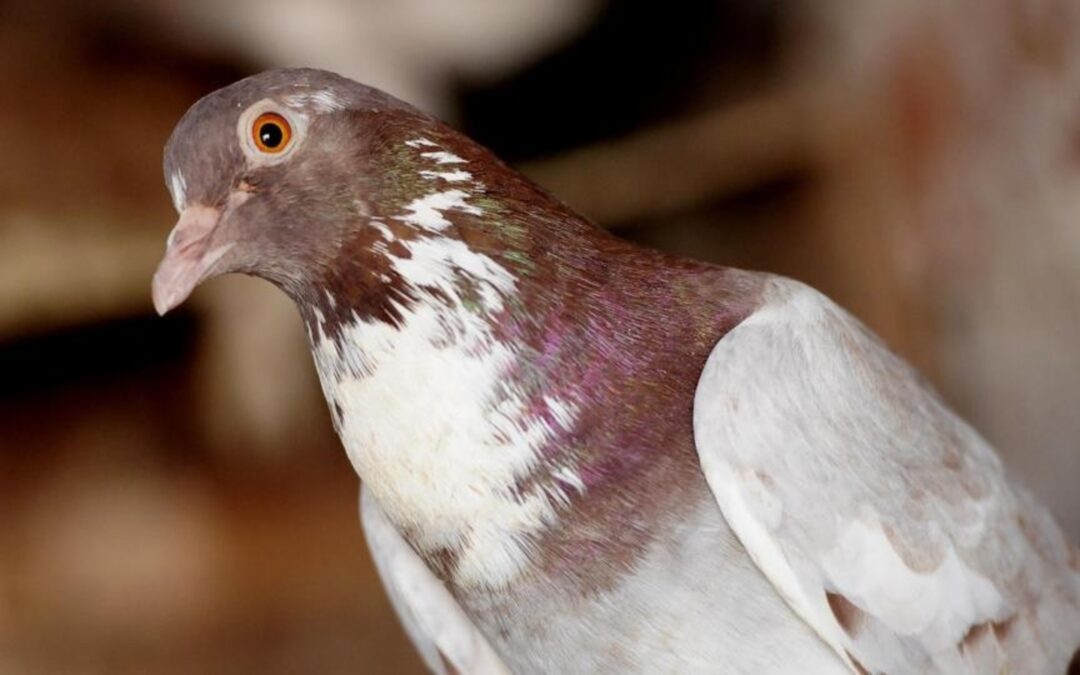
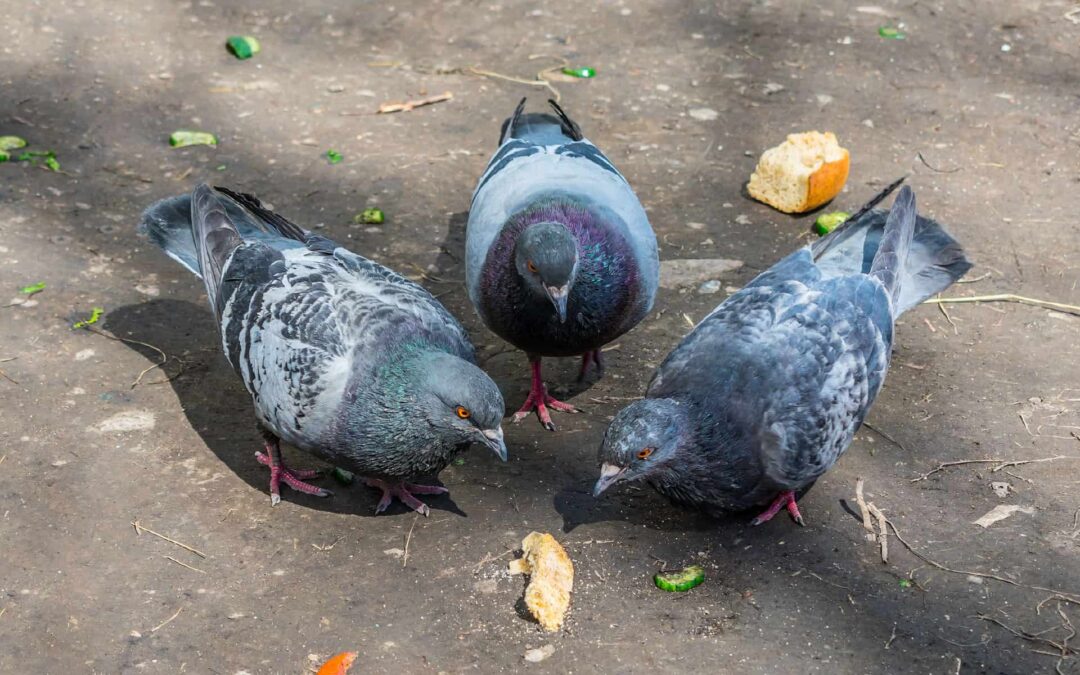
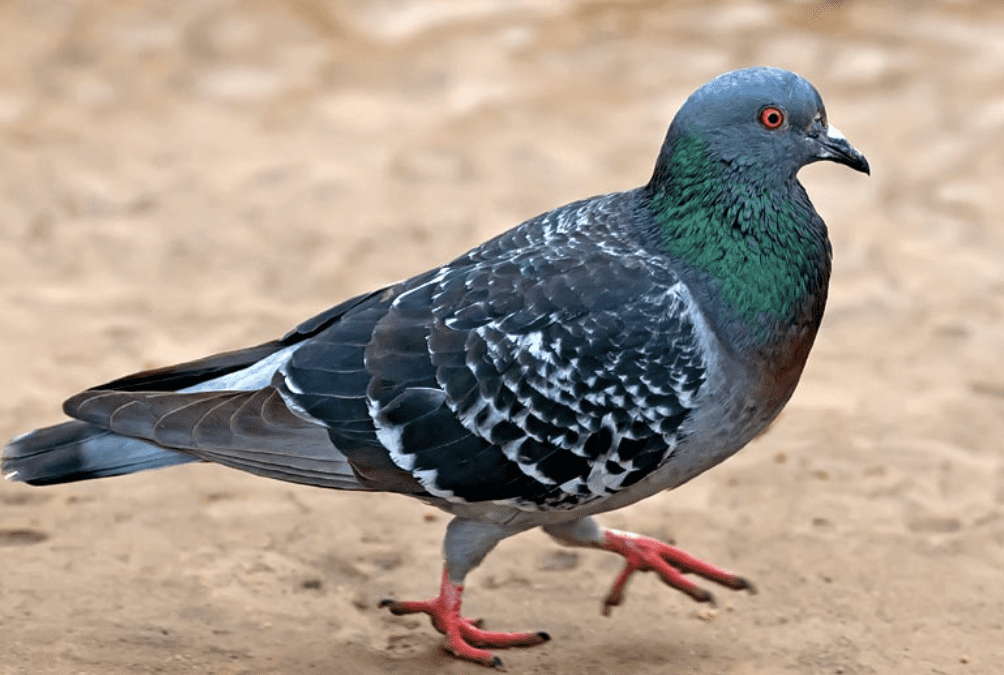
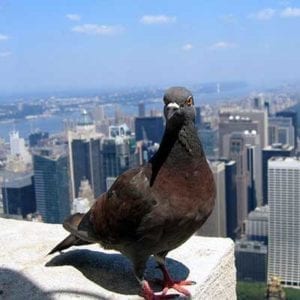
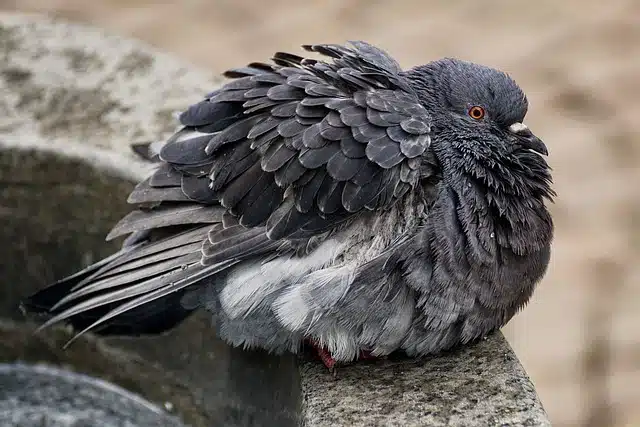
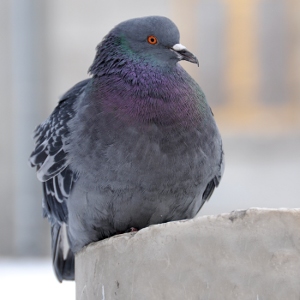
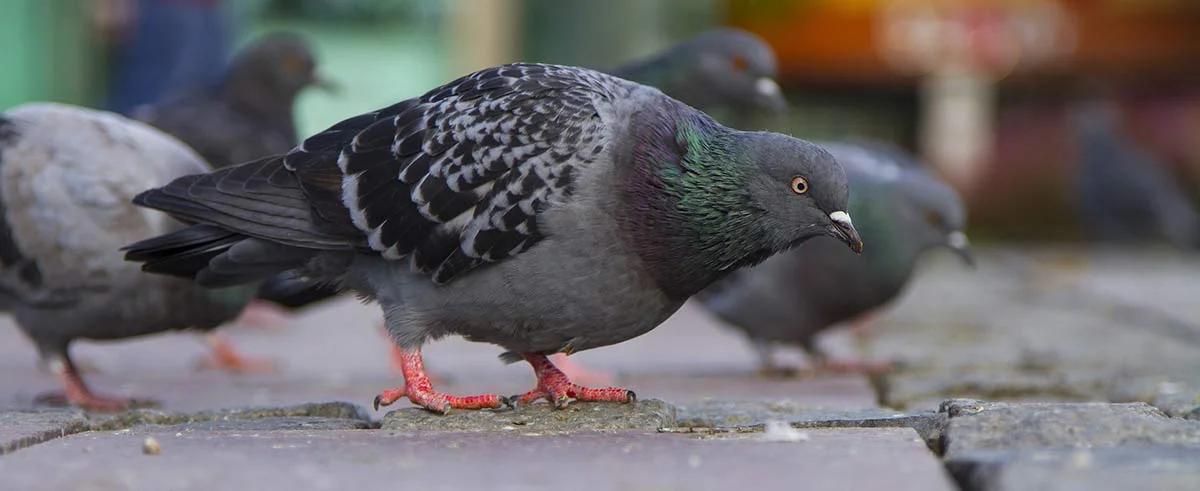
Like their cinematic counterparts, the common pigeon—that squat, ash-grey bird with a shimmering neckline and (if you’ve cared to look closely enough) striking orange eyes, whose ancestry is traced to the cliff-dwelling Rock Dove—is indeed a symbol of fidelity and friendship, owing to its loyal and affectionate nature. Yet, like the Pigeon Lady, it’s been cast aside by humans who have revered, bred, and even depended on the bird they once dubbed the “athlete of the sky” for thousands of years. Now, on a daily basis, these gentle birds are kicked at, shot at, poisoned, and kept at arm’s length by all manner of insidious spikes and nets.
So what happened to these affectionate, docile birds, which have shown humans such loyalty, tenderness and trust for millennia, now advocated for by a limited few and persecuted by so many?
Pigeon symbolism runs deep through human history. The world’s oldest domesticated bird frequently appears across religious texts, where doves are famously a motif for peace and purity, idealized for their white feathers. However, doves and pigeons are all part of the same family, known as Columbidae. And as author Andrew D Blechman describes, the differentiation is all down to ‘linguistic bias.’ As he notes in his book, Pigeons: The Fascinating Saga of the World’s Most Reviled and Revered Bird, the word “dove,” in 14th century French, translates to “pigeon.”
Blechman explains that, although they’re essentially the same bird, the more delicate members of the Columbidae family are considered “doves” while the supposedly less graceful members are “pigeons,” giving rise to an old adage that “all pigeons are doves but not all doves are pigeons.” He gives the example that if a bigger pigeon (i.e. not delicate) is white, it may still be referred to as a “dove.” He continues: “Doves have come to mean petite and pure. Colloquial use of the word pigeon, on the other hand, emphasizes the dove’s docile nature and places it in a negative light.”Phrases like “stool pigeon”—which originates from the practice of tying pigeons to a stool to attract and trap predators—and “pigeonholed” are examples of how the word serves to describe inferiority.
In fact, Charles Darwin was among the first to demonstrate that the distinction between pigeons and doves is merely a biased interpretation of the same species. To support his argument for the theory of evolution, he selectively bred the birds in his backyard, often noting stark differences, like large fan-tails and feathery feet, all the while acknowledging their shared Rock Dove ancestor. He discussed his observations extensively in his famous 1859 work On the Origin of Species. Darwin’s fascination led him to join a pigeon fancier club, the Southwark Columbarium Society, in which members collected and bred “fancy” pigeons.
Appearances aside, people have observed remarkable tenderness in pigeons for millennia, regardless of color or size. This trait is especially noticeable in their mating rituals. When a female pigeon wants a male to care for her, and ultimately their children, she places her beak inside his. By graciously accepting this gesture, the male is committing to his paternal responsibility. Blechman describes the sexual act itself as “very gentle and completely consensual,” followed by “affectionate cooing and preening of each other’s feathers.”
It’s this exchange of affection and responsibility of successful mating pairs which gives rise to pigeons’ role as a symbol for chasteness and purity in many cultures—as well as the idiom “billing and cooing,” used to describe couples showing affection (or “PDA” in today’s terms).
The birds also share parenting responsibilities, including egg sitting and feeding. And, if this doesn’t already present a glowing example of gender equality, both males and females secrete a milk-like substance, produced by prolactin—the hormone behind lactation—in their throats (or crops), which is fed to newborn squabs and is crucial to their development. Pigeons are one of only three birds, including flamingos and penguins, who nurse their young in this way.
It’s these qualities that earned the birds reverence in antiquity. Historical records, including on stone tablets in Mesopotamia (the area known as Iran and Iraq today) from 3000 BCE, indicate the birds were sacrificial assets and frequently offered to gods, while also serving as a food staple. In fact, the ubiquity of stone temples meant rock pigeons were right at home, while historic dovecotes—earthen houses for pigeons—date back some 2,000 years in Egypt, suggesting the birds were intentionally domesticated.
Pigeons’ fine parenting skills also cast them as symbols of fertility. The Babylonian goddess Ishtar, “Queen of Heaven and Earth and of the Evening Star,” was often depicted holding a pigeon or as the winged bird herself. The Phoenecian goddess of love and fertility, Astarte, was also represented as a pigeon, as were the Greek goddess Aphrodite and her Roman counterpart, Venus.
Pigeons also appear in Judeo-Christian narratives, most memorably, perhaps, in the story of Noah’s Ark in which a dove is sent to determine whether the floods have subsided. The dove—or white pigeon to today’s ornithologists—returns with an olive branch to indicate dry land. This is in contrast to the first attempt by a raven, which does not return.
Appearances aside, people have observed remarkable tenderness in pigeons for millennia, regardless of color or size. This trait is especially noticeable in their mating rituals. When a female pigeon wants a male to care for her, and ultimately their children, she places her beak inside his. By graciously accepting this gesture, the male is committing to his paternal responsibility. Blechman describes the sexual act itself as “very gentle and completely consensual,” followed by “affectionate cooing and preening of each other’s feathers.”
It’s this exchange of affection and responsibility of successful mating pairs which gives rise to pigeons’ role as a symbol for chasteness and purity in many cultures—as well as the idiom “billing and cooing,” used to describe couples showing affection (or “PDA” in today’s terms).
The birds also share parenting responsibilities, including egg sitting and feeding. And, if this doesn’t already present a glowing example of gender equality, both males and females secrete a milk-like substance, produced by prolactin—the hormone behind lactation—in their throats (or crops), which is fed to newborn squabs and is crucial to their development. Pigeons are one of only three birds, including flamingos and penguins, who nurse their young in this way.
It’s these qualities that earned the birds reverence in antiquity. Historical records, including on stone tablets in Mesopotamia (the area known as Iran and Iraq today) from 3000 BCE, indicate the birds were sacrificial assets and frequently offered to gods, while also serving as a food staple. In fact, the ubiquity of stone temples meant rock pigeons were right at home, while historic dovecotes—earthen houses for pigeons—date back some 2,000 years in Egypt, suggesting the birds were intentionally domesticated.
Pigeons’ fine parenting skills also cast them as symbols of fertility. The Babylonian goddess Ishtar, “Queen of Heaven and Earth and of the Evening Star,” was often depicted holding a pigeon or as the winged bird herself. The Phoenecian goddess of love and fertility, Astarte, was also represented as a pigeon, as were the Greek goddess Aphrodite and her Roman counterpart, Venus.
Pigeons also appear in Judeo-Christian narratives, most memorably, perhaps, in the story of Noah’s Ark in which a dove is sent to determine whether the floods have subsided. The dove—or white pigeon to today’s ornithologists—returns with an olive branch to indicate dry land. This is in contrast to the first attempt by a raven, which does not return.
Pigeon Patrol
Pigeon Patrol Products & Services is the leading manufacturer and distributor of bird deterrent (control) products in Canada. Pigeon Patrol products have solved pest bird problems in industrial, commercial, and residential settings since 2000, by using safe and humane bird deterrents with only bird and animal -friendly solutions. At Pigeon Patrol, we manufacture and offer a variety of bird deterrents, ranging from Ultra-flex Bird Spikes with UV protection, Bird Netting, 4-S Bird Gel and the best Ultrasonic and audible sound devices on the market today.
Best Types of Pigeon Repellent
Bird Spikes– Pigeons can’t land on surfaces with bird spikes—perfect for ledges, sills, signs, and fences.
Shop Bird Spikes: https://www.pigeonpatrol.ca/bird-spikes/
First, there were complaints from people who had to walk and drive
under two Red Line overpasses where thick swarms of the birds had
decided to roost.
Now, Metro’s efforts to get rid of the pigeons have created a flap
between two animal welfare organizations, which disagree over whether
the methods used — including the use of pellet guns — are humane.
“I think they’re doing an excellent job,” said Brenda Parvis of the
Washington Humane Society, which has been monitoring the cleanup work
under the bridges over Van Buren and Aspen streets NW, near the Takoma
station.
“They are doing it the wrong way,” said Jackie Freitag, president of
the Wildlife Rescue League, a regional group based in Falls Church.
“Let’s do it in a humane way.”
Both groups agreed with Metro that something had to be done about the
pigeons, which apparently were attracted to the steel girders under the
bridges by bird lovers who leave food nearby.
Before the cleanup, a person “couldn’t walk or drive underneath
without being bombarded with pigeon feces,” Parvis said. “People were
walking through inches of pigeon excrement.”
“I understand the problem,” Freitag said.
Metro spokeswoman Beverly Silverberg said the pigeons, which carry
disease-bearing lice, also create a health hazard.
Metro hired a pest control firm, J.C. Ehrlich Co. Inc., of Reading,
Pa., which has been clearing out the underpasses during the past two
weeks. The firm attached a large net just below the girders where the
pigeons roost. Then it drove most of the birds out the sides with water
and air hoses before beginning to steam clean and disinfect the area,
Silverberg said.
But many birds did not leave. Friday, dead pigeons’ bodies were lying
in the netting, while live pigeons flapped around inside.
The Humane Society has been allowed to use the contractor’s equipment
to leave food and water so that the remaining birds inside don’t starve,
Parvis said.
But Freitag said the birds had no food for three days, and said there
are baby birds trapped inside that have been abandoned and cannot feed
themselves.
Parvis said an exterminator took all the fledglings out and turned
them over to the care of league members.
The biggest disagreement has been over the decision to shoot the
remaining pigeons with pellet guns.
The Humane Society views this as the most humane alternative, Parvis
said. Allowing them to starve or leaving poison would cause slow,
painful death, while continuing to feed them would cause them to
reproduce, she said.
But league members said the pellet guns do not kill the birds
instantly, and cause the birds to suffer.
“We had offered numerous alternative solutions, all of which were
pooh-pooh’d,” said Linda Lieberman, a league member.
Pigeon Patrol
Pigeon Patrol Products & Services is the leading manufacturer and distributor of bird deterrent (control) products in Canada. Pigeon Patrol products have solved pest bird problems in industrial, commercial, and residential settings since 2000, by using safe and humane bird deterrents with only bird and animal -friendly solutions. At Pigeon Patrol, we manufacture and offer a variety of bird deterrents, ranging from Ultra-flex Bird Spikes with UV protection, Bird Netting, 4-S Bird Gel and the best Ultrasonic and audible sound devices on the market today.
Best Types of Pigeon Repellent
Bird Spikes– Pigeons can’t land on surfaces with bird spikes—perfect for ledges, sills, signs, and fences.
Shop Bird Spikes: https://www.pigeonpatrol.ca/bird-spikes/
It is nothing less than annoying if pigeon droppings land in the garden. It is all the more serious when the droppings are contaminated with radioactivity.
The environment campaigners Greenpeace are calling for an end to all nuclear reprocessing at the Sellafield nuclear plant in Cumbria following the publication of an official report yesterday. It discovered that wild pigeons roosting at the site and contaminated with radioactivity had carried it to a garden two miles away in Seascale.
The pigeons, described by Greenpeace as “flying nuclear waste”, were contaminated after roosting in old buildings at Sellafield. They began feeding in the garden over a two-year period and the soil was contaminated to such an extent that the garden was dug up by British Nuclear Fuels Ltd (BNFL) and sent to a nuclear dump along with a number of garden gnomes. The pigeons were destroyed last year. The report, published by the Committee on Medical Aspects of Radiation in the Environment (Comare) and the Radioactive Waste Management Advisory Committee (RWMAC), acknowledged that the contamination of the garden was not significant.
The radioactive dose received by the residents was about half the annual limit for members of the public while the doses received by neighbours in adjacent properties were “not of any radiological concern”, according to the report.
But the report recommends that further research into possible contamination at nuclear sites, including the risk posed to other wildlife such as insects and other birds should be carried out. It also reported that authorised discharges of radioactive gases from Sellafield’s chimneys might have caused some of the radiation contamination.
Prof Bryn Bridges, chairman of Comare, said it was possible the doses could have been higher. He described the contamination as a “worrying discovery”.
BNFL apologised for the contamination and said it was pleased the report acknowledged the steps it had taken to remedy the situation. It also accepted the report’s criticism that mismanagement was at the heart of the problem.
In a statement yesterday, BNFL said it had committed considerable resources to resolve the issue: “This involved culling the birds, controlling the birds’ feeding, restricting access to these older buildings and completing a site habitat control programme. A programme of remediation was also carried out in Seascale, after discussion with the property owners and the regulator.”
Greenpeace described decisionmaking at Sellafield as “hopelessly inadequate” and said the problem did not die when BNFL culled the birds. Dr Helen Wallace of Greenpeace said: “Nuclear waste could still be spreading through wildlife into people’s homes and gardens. Today’s reports warn that other wildlife, such as insects and doves, may also be involved in the spread of nuclear waste from nuclear sites into people’s homes and gardens.”
BNFL should be made to properly contain and monitor all existing waste, she added.
Pigeon Patrol
Pigeon Patrol Products & Services is the leading manufacturer and distributor of bird deterrent (control) products in Canada. Pigeon Patrol products have solved pest bird problems in industrial, commercial, and residential settings since 2000, by using safe and humane bird deterrents with only bird and animal -friendly solutions. At Pigeon Patrol, we manufacture and offer a variety of bird deterrents, ranging from Ultra-flex Bird Spikes with UV protection, Bird Netting, 4-S Bird Gel and the best Ultrasonic and audible sound devices on the market today.
Best Types of Pigeon Repellent
Bird Spikes– Pigeons can’t land on surfaces with bird spikes—perfect for ledges, sills, signs, and fences.
Shop Bird Spikes: https://www.pigeonpatrol.ca/bird-spikes/
A town south of London is facing a bombardment of bird poop brought on by a “growing” influx of winged interlopers that officials just don’t have an answer for.
“You walk around and they are cooing above you. All the babies are squawking, and then they could poo on you,” Ashford business owner Vince Monticelli told South West News Service.
“Our town has been taken over by seagulls and pigeons.”
The Ashford Borough Council has been gliding around the issue after walking back April’s plans to get a hawk that would ward off the unwanted new residents in the Kent nabe.
“We have researched carefully, and following consultation with relevant stakeholders and local businesses, we believe at this time there is an insufficient need for a hawk service to be introduced to the town center,” a government spokesperson said.
The situation is “under review” and could include a four-month trial with the predatory bird, though the idea has reportedly been dropped for now.
Initially, the locale also felt that a hawk being walked around by a professional caretaker also would make for an especially appealing “attraction.”
Monticelli, also, stood firm: “I think they are an issue and the council probably should’ve got the hawk.”
Other locals, like Russell Green, doubled down on the problems pigeons are causing, too.
Troves of pigeons and seagulls are pooping all over an English town.KM / SWNS
“I don’t see why they couldn’t get [a hawk] in for a couple of days a month,” he said. “Once pigeons and seagulls know there is a hawk here, they won’t bother coming back.”
Another man who works in the town, Connor Moon, suggested the winged visitors “don’t do us any harm” and blamed the poop-apalooza on bird brains who feed the avians, inadvertently inviting them to come back — with friends.
Pigeon Patrol
Pigeon Patrol Products & Services is the leading manufacturer and distributor of bird deterrent (control) products in Canada. Pigeon Patrol products have solved pest bird problems in industrial, commercial, and residential settings since 2000, by using safe and humane bird deterrents with only bird and animal -friendly solutions. At Pigeon Patrol, we manufacture and offer a variety of bird deterrents, ranging from Ultra-flex Bird Spikes with UV protection, Bird Netting, 4-S Bird Gel and the best Ultrasonic and audible sound devices on the market today.
Best Types of Pigeon Repellent
Bird Spikes– Pigeons can’t land on surfaces with bird spikes—perfect for ledges, sills, signs, and fences.
Shop Bird Spikes: https://www.pigeonpatrol.ca/bird-spikes/
I think that’s the first time I’ve ever used the word “poop” in a blog title, but I digress…
The infamous “Bird Poop Building” on Yonge Street has been vacant for 25 years, and surprise, surprise – it’s going to be turned into a condo…
If you know me, you know that I have a serious man-love for old, historic, Toronto buildings.
I’m fascinated by our city’s history, and while we simply can’t compete with the thousand-year-old structures in Europe, we do have our own little slice of history here in Toronto.
One of the most fun blog features I ever worked on was The Buildings of The St. Lawrence Market, back in 2009. I did a three-part series on all the historic buildings in the area; a must-read for many of you who missed it! You can read Part One HERE.
I’ve always admired the Bank of Commerce on Yonge Street, in between Queen & Shuter, but it’s a little…..ummmm……dirty, shall we say?
Over the years, this building has been used and abused by some of the most carefree and unpoliced members of our society: pigeons.
For some reason, pigeons love to empty their bowels (if birds have bowels…..any bird enthusiasts among my readers who can shed some light??) on this building and the neighbouring building immediately north. Over time, these two buildings have simply become known as “the bird poop buildings.”
And seeing the photos I took below, can you argue?
Wow. I don’t know what to say…
I’ve walked by these buildings many, many times over the years, and I’ve always thought, “I really wish somebody would do something with those buildings!” It’s such a shame that a great piece of Toronto’s history is just sitting there getting crapped on by these guys:
Damn pigeons!
Well, time hasn’t been kind to the Bank of Commerce at 197-199 Yonge Street, but the future is bright!
I suppose it’s a bit of a double-edged sword, however. I had always hoped that this beautiful building would be restored and turned into a library, museum, or event hall, but in actual fact, it’s going to be turned into yet another condo. I suppose it’s the lesser of two evils; that is, it would be worse to see the building torn down or have it fall into even worse disrepair, although I’m not sure that’s possible…
Built in 1905, the Bank of Commerce has actually been abandoned since 1987! It’s had many different uses over the years, and you can actually still see the words “DENTIST” on the second floor of the building where somebody probably practiced in the 60’s or 70’s:
Little-known developer, MOD Developments will be turning the historical building into a 60-storey condominium called “Massey Towers,” which already has a large advertisement up at the current site. MOD Development’s only other project to date is FIVE Condos at St. Joseph’s & Yonge Street, but Massey Towers will be designed by renowned firm Hariri Pontarini Architects, whose projects are too many to name, but include One City Hall, Minto775, ART, Shangri-La, and my current residence, Vu Condos.
Like I said – it’s cliche that this site will become “yet, another condo,” but it’s better than letting it sit there and rot.
The article in this past week’s Globe & Mail, quoted the owner of MOD Developments, Gary Switzer, as saying, “What does it say about our city to have a building like this empty right on the main street?”
I couldn’t possibly agree more.
Yonge Street is famous! It’s the best-known street in Toronto, and one of the most well-known streets in our entire country!
How could we let this happen?
Yet we have a poo-covered building sitting there, rotting away.
It reminds me of this:
Those of you that read my blog during its infancy in 2007 will recall the photos and blog posts from my trip to Serbia.
These buildings are on the Belgrade’s equivalent of Yonge Street, and the city doesn’t have the money to fix them, so they don’t. These buildings have been sitting here in this condition for almost twenty years, and they’ll likely remain as such indefinitely.
Toronto is not Serbia, but yet the Bank of Commerce and its sister building at 205 Yonge Street, the Bank of Toronto, draw some eerie similarities to the photo above:
Two buildings, both beautiful and historic, and both ruined by time. And poo…
The crazy thing is – the Bank of Toronto is an even more impressive structure! I wonder what will become of that building? Perhaps, phase two of the condominium development at Massey Towers?
Dare to dream…
Pigeon Patrol
Pigeon Patrol Products & Services is the leading manufacturer and distributor of bird deterrent (control) products in Canada. Pigeon Patrol products have solved pest bird problems in industrial, commercial, and residential settings since 2000, by using safe and humane bird deterrents with only bird and animal -friendly solutions. At Pigeon Patrol, we manufacture and offer a variety of bird deterrents, ranging from Ultra-flex Bird Spikes with UV protection, Bird Netting, 4-S Bird Gel and the best Ultrasonic and audible sound devices on the market today.
Best Types of Pigeon Repellent
Bird Spikes– Pigeons can’t land on surfaces with bird spikes—perfect for ledges, sills, signs, and fences.
Shop Bird Spikes: https://www.pigeonpatrol.ca/bird-spikes/