by Pigeon Patrol | Mar 30, 2026 | Bird Netting, Bird Spikes, Bird Trap, Pigeon Control, Pigeon History, Pigeons, Pigeons in the News
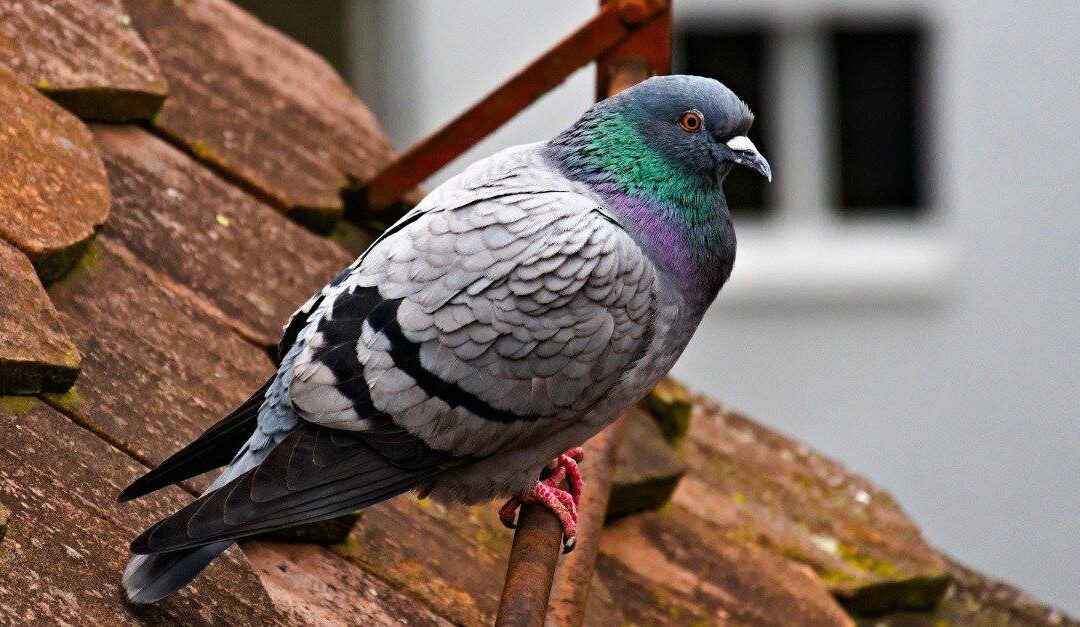
I URGE Wycombe District Council to move away from their barbaric, ineffective and costly proposal to kill pigeons, and to instead consider the humane and intelligent alternatives to reduce the pigeon population humanely.
Lethal culling through the use of birds of prey, etc, will produce some temporary reduction in pigeon population numbers but, just as with the culling of stray dogs in urban environments overseas, the area vacated by the culled pigeons will be taken up by other pigeons, unless the council is prepared to maintain the intensive use of a hawk in perpetuity, all making their proposal an expensive and inhumane solution.
by Pigeon Patrol | Mar 23, 2026 | Bird Law, Bird Netting, history of pigeons, Pigeon History, Pigeon Predators, Pigeons, Pigeons in the News
Summary
Feral pigeons (Columbia livia var. domestica) can be a nuisance and may cause significant damage to buildings. If feral pigeons take up residence within a disused property they can seriously damage the interior historic fabric, contents and finishes. It is vital to take measures to minimise pigeon activity in and around buildings in order to avoid additional maintenance issues and significant problems for renovation projects.
Rectifying the damage caused to the fabric of a property by pigeon guano (bird excreta) is expensive and in most cases avoidable. There are many methods of pigeon control including bird proofing, wire deterrent systems, netting, bird spikes and a large variety of electrical and sonic bird deterrent solutions.
Introduction
Feral pigeons and other birds make nests regularly and roost outside and inside our buildings. Architects, surveyors, construction professionals and maintenance staff are all familiar with the damage that can be caused by these birds sharing our environment.
History
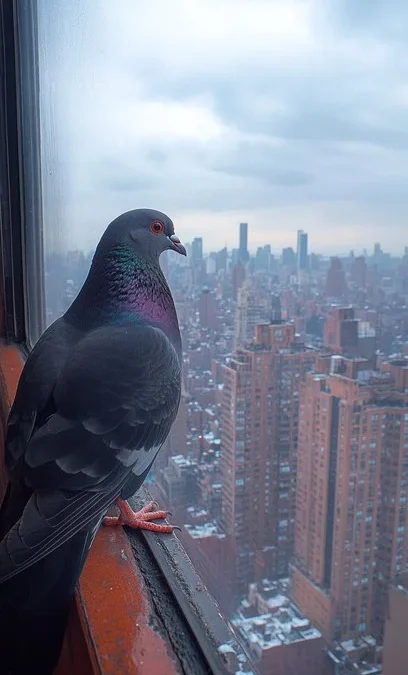
Feral pigeons are believed to have descended from rock doves that interbred with racing pigeons and pigeons from domestic pigeon lofts. Skyscrapers and similar tall buildings provide ideal habitats, very similar to the cliff homes of their pigeon ancestors.
These pigeons have thrived by adapting to life in and around our buildings and have learnt to roost and breed very successfully within this environment. They thrive on a plentiful supply of our dropped and dumped food scraps. As they have adapted so excellently to this style of living, they have sometimes been called “the flying rat”. It’s no surprise that over recent years there has been a marked increase in the numbers of feral pigeons.
Adult Pigeons
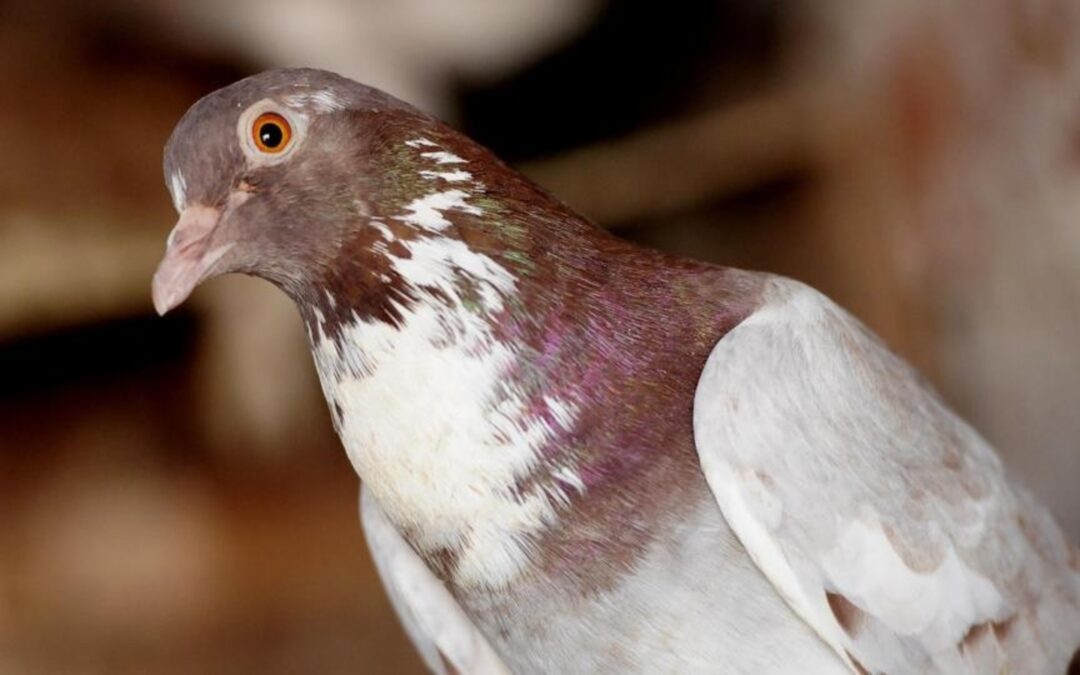
The adult pigeon is about 33cm in length and weighs between 280 and 560g, an average of about 350g. Its plumage can vary considerably, from a close resemblance to that of the original rock dove (with blue-grey plumage, double black wing bars and a white rump), through to various blues, reds, chequered and almost black types. Colours vary considerably from blue-grey, through blues, reds, mottled patterns and charcoal to almost pure white (Simms, 1979).
The birds will roost and nest on horizontal building surfaces and any other structures that provide a small amount of shelter from the elements. Balconies, flat roofs, ledges, loft spaces and empty buildings are often used if the birds have access.
Nests are constructed of twigs but can also contain pieces of plastic and other debris. They may even be built on or near the dead bodies of other pigeons. Their natural food is grain and green vegetable matter but they will scavenge food and eat almost any foodstuff available such as dropped takeaway foods.
Life Cycle
The Feral Pigeon is capable of breeding throughout the year and nests may be found in any month. However the peak occurs between March and July. Usually, two white eggs are laid on consecutive days and incubation is shared between both adults. Incubation lasts for about 18 days, with fledging taking place about 4 ½ weeks later. A new clutch can be laid when the first young are just 20 days old. Therefore up to nine broods may be produced per year by just one female pigeon and pigeons may live as long as thirty years (P Ehrlich et al, 1988)
Deterioration and Damage to Buildings
Pigeon droppings are not only unsightly; their acid content can lead to the deterioration of soft stone and cause long-term damage to buildings (Bassi and Chiantante, 1976; Howard and Oldsbury 1991). The accumulation of pigeon droppings can deface the finishes of the exterior facade and the interior of the building. Removal is not only difficult and expensive but can cause more damage than the droppings in the first place (D Channon, 2004).
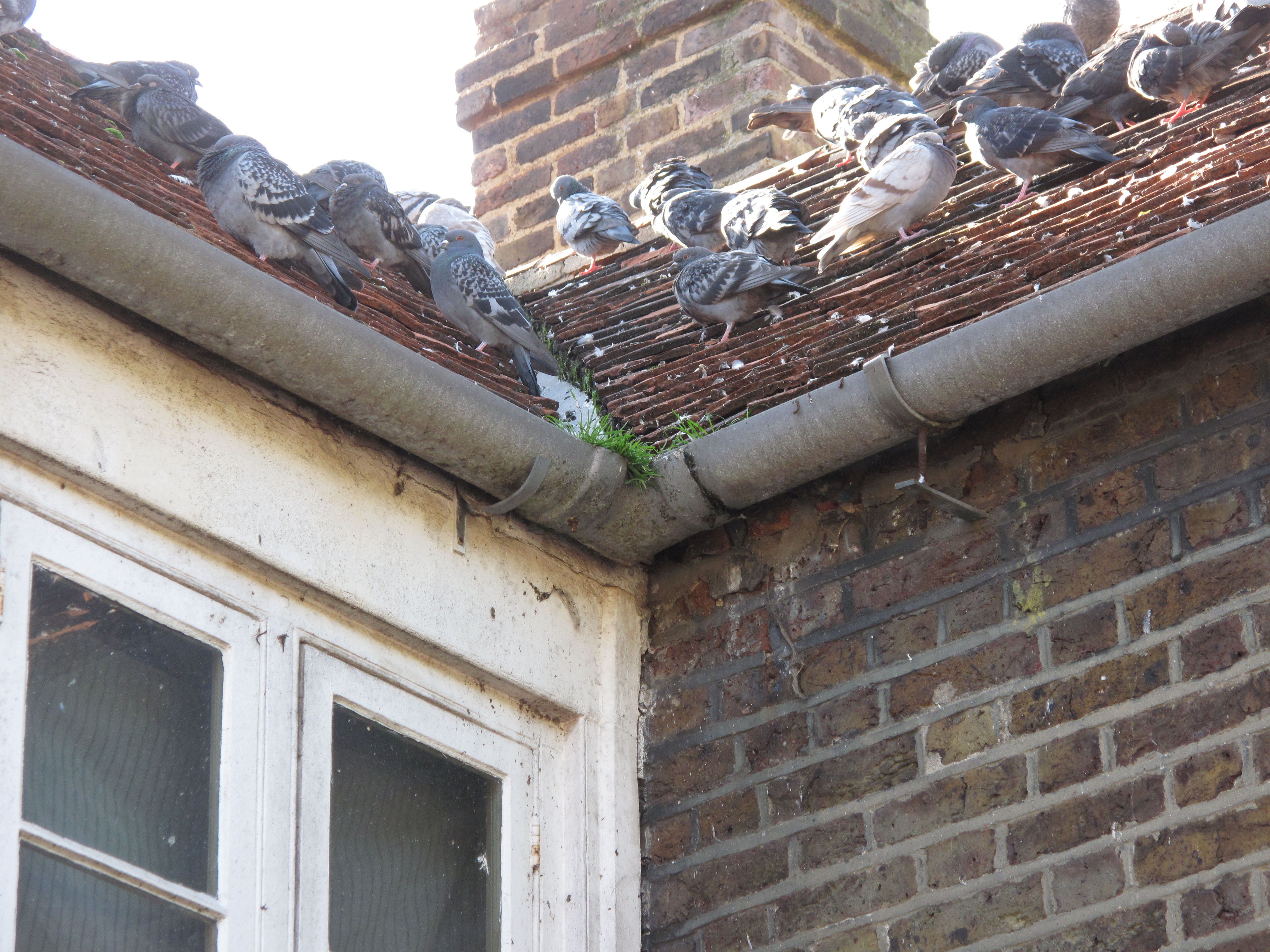
Nest droppings and feathers block gutters and rainwater pipes causing water damage to buildings. Their droppings can lead to hazards on pavements, especially for the elderly. Pigeons are capable of lifting loose roof coverings, tiles and battens to gain entry into the roof voids. This can significantly damage the structure by allowing water penetration, providing the ideal environmental conditions for the growth and proliferation of wood rotting fungi. Wood boring insects are attracted to this damp, rotting environment, leading to substantial further decay (Singh 1995).
Pigeon nesting materials, feathers and faeces can block parapet gutters and hopper heads, allowing water penetration into the building fabric and providing the ideal environmental conditions for the growth and development of decay organisms (Singh 1994a, & Singh 1999).
In poorly maintained and unoccupied buildings, where significant undetected water ingress has occurred, major outbreaks of dry rot (Serpula lacrymans) and wet rots establish and thrive. These include (Coniophora puteana, Antrodia xantha, A. searilis, A. vaillantti & Phellinus contiguus). Thesubsequent deterioration to the historic fabric, finishes and contents is an inevitable consequence (Singh 1994). Sometimes this deterioration is so dramatic that many of the important historical and architectural features are destroyed beyond repair.
Early-morning activity around nesting areas can cause a public nuisance, as can pestering for food. Around public and buildings of historic and touristic interest further problems can arise as the visitors start feeding pigeons. Their numbers will increase dramatically, leading to extensive faeces and fouling.
Ladders and fire escapes coated in pigeon droppings become slippery and unsafe to use particularly in wet conditions. Startled pigeons may take flight suddenly and cause a hazard to road traffic.
Pigeons and the Law
- Most birds, their nests and eggs are protected under the Wildlife and Countryside Act 1981.
- The act allows the control of certain birds, including feral pigeons, by authorised people using specified methods.
- The use of spring traps, poisons, certain types of nets, gassing and sticky substances that may entangle a bird is illegal.
Health Hazards
Large populations of pigeons and other birds inhabiting buildings or living on the facade for many years may present a potential risk of disease to people in and around these buildings (Weber, 1979).
The organic, nutrient rich accumulation of pigeon droppings, including feathers, detritus and debris under a nest provides an ideal environment for disease. This encourages fungi and bacteria to grow and proliferate. External parasites may also become a problem when infested pigeons or bats leave their roosts or nests. These parasites can infest buildings and cause health problems to people. Pigeons can also carry a number of potentially infectious diseases such as salmonella, tuberculosis and ornithosis (a mild form of psittacosis with pneumonia-like symptoms).
They are also a source of allergens, which can cause respiratory ailments like pigeon fancier’s lung, aspergillosis and allergic skin reaction. There is potential for these illnesses to be spread to people through contact with pigeon droppings, dandruff and feathers, pigeon parasites, or where dead infected pigeons get into food or water sources. Health and safety issues and site access problems are also caused by the build up of faeces due to the slippery and unsafe footing it provides on walkways and ledges, hindering proper maintenance. This may be a particular problem during building works and renovation. Pigeon faeces represent a health and safety hazard for staff working in contaminated buildings and for employees and operators who have to carry out remediation works. Pigeon infestation in and around buildings therefore represent an added problem in the renovation of buildings where large accumulations have been allowed to build-up, and this nutrient rich guano combined with moisture ingress in buildings provides an ideal environment for the growth and proliferation of moulds (Singh 1994a, Singh & Walker 1996).
Pigeon Patrol
Pigeon Patrol Products & Services is the leading manufacturer and distributor of bird deterrent (control) products in Canada. Pigeon Patrol products have solved pest bird problems in industrial, commercial, and residential settings since 2000, by using safe and humane bird deterrents with only bird and animal -friendly solutions. At Pigeon Patrol, we manufacture and offer a variety of bird deterrents, ranging from Ultra-flex Bird Spikes with UV protection, Bird Netting, 4-S Bird Gel and the best Ultrasonic and audible sound devices on the market today.
Best Types of Pigeon Repellent
- Bird Spikes– Pigeons can’t land on surfaces with bird spikes—perfect for ledges, sills, signs, and fences.
Shop Bird Spikes: https://www.pigeonpatrol.ca/bird-spikes/
- Bird Sound Deterrents / Ultrasonic Repellers– Emit high-frequency sound to drive pigeons away without harming them.
Browse Ultrasonic Bird Repellers: https://www.pigeonpatrol.ca/bird-repeller/
- Pigeon Netting– Blocks pigeons from accessing nesting zones permanently.
See Pigeon Netting: https://www.pigeonpatrol.ca/bird-netting/
Canada’s top wholesaler for bird deterrent products for twelve consecutive years.
Contact us at 1- 877– 4– NO-BIRD, (604) 585-9279 or visit our website at https://www.pigeonpatrol.ca/
Bird Gone, Pigeon Gone, Pigeon problems, pigeon spikes, 1-877-4NO-BIRD, 4-S Gel, Bird Control, Pigeon Control, bird repellent, Bird Spikes, sonic bird repellent, stainless steel bird spikes, bird spikes Vancouver, Ultra Sonic Bird Control, Bird Netting, Plastic Bird Spikes, Canada bird spike deterrents, Pigeon Pests, B Gone Pigeon, Pigeon Patrol, pest controller, pest control operator, pest control technician, Pigeon Control Products, humane pigeon spikes, pigeon deterrents, pigeon traps, Pigeon repellents, Sound & Laser Deterrents, wildlife control, raccoon, skunk, squirrel deterrent, De-Fence Spikes, Dragons Den, Pigeon, Pigeon Patrol, Pigeons Roosting, Vancouver Pigeon Control, Bird Spikes, Bird Control, Bird Deterrent, Pigeon Deterrent, Surrey Pigeon Control, Pest, Seagull deterrent Vancouver Pigeon Blog, Birds Inside Home De-fence, Pigeon Nesting, Bird Droppings, Pigeon Dropping, woodpecker control, Keep The Birds Away, Birds/rats, seagull, pigeon, woodpecker, dove, sparrow, pidgeon control, pidgeon problem, pidgeon control, flying rats, pigeon Problems, bird netting, bird gel, bird spray, bird nails, bird guard, Pigeon control, Bird deterrents, Pigeon deterrents, Bird control, solutions, Pigeon prevention, Pigeon repellent, Bird proofing, Pest bird management, Pigeon spikes, Bird netting, Humane bird control, Bird exclusion, Urban bird control, Anti-roosting devices, Pigeon removal, Bird barriers
by Pigeon Patrol | Mar 20, 2026 | Animal Deterrent Products, Bird Law, Bird Trap, pet bird, Pigeon Control, Pigeon Droppings, Pigeons, Pigeons in the News
Metro’s pigeon problems just keep piling up.
First, there were complaints from people who had to walk and drive
under two Red Line overpasses where thick swarms of the birds had
Now, Metro’s efforts to get rid of the pigeons have created a flap
between two animal welfare organizations, which disagree over whether
the methods used — including the use of pellet guns — are humane.
“I think they’re doing an excellent job,” said Brenda Parvis of the
Washington Humane Society, which has been monitoring the cleanup work
under the bridges over Van Buren and Aspen streets NW, near the Takoma
“They are doing it the wrong way,” said Jackie Freitag, president of
the Wildlife Rescue League, a regional group based in Falls Church.
“Let’s do it in a humane way.”
Both groups agreed with Metro that something had to be done about the
pigeons, which apparently were attracted to the steel girders under the
bridges by bird lovers who leave food nearby.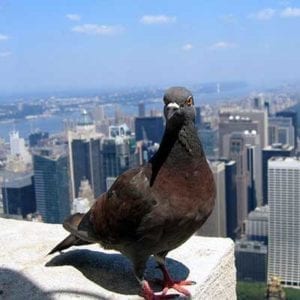
Before the cleanup, a person “couldn’t walk or drive underneath
without being bombarded with pigeon feces,” Parvis said. “People were
walking through inches of pigeon excrement.”
“I understand the problem,” Freitag said.
Metro spokeswoman Beverly Silverberg said the pigeons, which carry
disease-bearing lice, also create a health hazard.
Metro hired a pest control firm, J.C. Ehrlich Co. Inc., of Reading,
Pa., which has been clearing out the underpasses during the past two
weeks. The firm attached a large net just below the girders where the
pigeons roost. Then it drove most of the birds out the sides with water
and air hoses before beginning to steam clean and disinfect the area,
But many birds did not leave. Friday, dead pigeons’ bodies were lying
in the netting, while live pigeons flapped around inside.
The Humane Society has been allowed to use the contractor’s equipment
to leave food and water so that the remaining birds inside don’t starve,
But Freitag said the birds had no food for three days, and said there
are baby birds trapped inside that have been abandoned and cannot feed
Parvis said an exterminator took all the fledglings out and turned
them over to the care of league members.
The biggest disagreement has been over the decision to shoot the
remaining pigeons with pellet guns.
The Humane Society views this as the most humane alternative, Parvis
said. Allowing them to starve or leaving poison would cause slow,
painful death, while continuing to feed them would cause them to
But league members said the pellet guns do not kill the birds
instantly, and cause the birds to suffer.
“We had offered numerous alternative solutions, all of which were
pooh-pooh’d,” said Linda Lieberman, a league member.
Pigeon Patrol
Pigeon Patrol Products & Services is the leading manufacturer and distributor of bird deterrent (control) products in Canada. Pigeon Patrol products have solved pest bird problems in industrial, commercial, and residential settings since 2000, by using safe and humane bird deterrents with only bird and animal -friendly solutions. At Pigeon Patrol, we manufacture and offer a variety of bird deterrents, ranging from Ultra-flex Bird Spikes with UV protection, Bird Netting, 4-S Bird Gel and the best Ultrasonic and audible sound devices on the market today.
Best Types of Pigeon Repellent
- Bird Spikes– Pigeons can’t land on surfaces with bird spikes—perfect for ledges, sills, signs, and fences.
Shop Bird Spikes: https://www.pigeonpatrol.ca/bird-spikes/
- Bird Sound Deterrents / Ultrasonic Repellers– Emit high-frequency sound to drive pigeons away without harming them.
Browse Ultrasonic Bird Repellers: https://www.pigeonpatrol.ca/bird-repeller/
- Pigeon Netting– Blocks pigeons from accessing nesting zones permanently.
See Pigeon Netting: https://www.pigeonpatrol.ca/bird-netting/
Canada’s top wholesaler for bird deterrent products for twelve consecutive years.
Contact us at 1- 877– 4– NO-BIRD, (604) 585-9279 or visit our website at https://www.pigeonpatrol.ca/
Bird Gone, Pigeon Gone, Pigeon problems, pigeon spikes, 1-877-4NO-BIRD, 4-S Gel, Bird Control, Pigeon Control, bird repellent, Bird Spikes, sonic bird repellent, stainless steel bird spikes, bird spikes Vancouver, Ultra Sonic Bird Control, Bird Netting, Plastic Bird Spikes, Canada bird spike deterrents, Pigeon Pests, B Gone Pigeon, Pigeon Patrol, pest controller, pest control operator, pest control technician, Pigeon Control Products, humane pigeon spikes, pigeon deterrents, pigeon traps, Pigeon repellents, Sound & Laser Deterrents, wildlife control, raccoon, skunk, squirrel deterrent, De-Fence Spikes, Dragons Den, Pigeon, Pigeon Patrol, Pigeons Roosting, Vancouver Pigeon Control, Bird Spikes, Bird Control, Bird Deterrent, Pigeon Deterrent, Surrey Pigeon Control, Pest, Seagull deterrent Vancouver Pigeon Blog, Birds Inside Home De-fence, Pigeon Nesting, Bird Droppings, Pigeon Dropping, woodpecker control, Keep The Birds Away, Birds/rats, seagull, pigeon, woodpecker, dove, sparrow, pidgeon control, pidgeon problem, pidgeon control, flying rats, pigeon Problems, bird netting, bird gel, bird spray, bird nails, bird guard, Pigeon control, Bird deterrents, Pigeon deterrents, Bird control, solutions, Pigeon prevention, Pigeon repellent, Bird proofing, Pest bird management, Pigeon spikes, Bird netting, Humane bird control, Bird exclusion, Urban bird control, Anti-roosting devices, Pigeon removal, Bird barriers
by Pigeon Patrol | Mar 13, 2026 | Bird Netting, crows, Pigeon Control, Pigeons, Pigeons in the News
Alfred Hitchcock couldn’t have choreographed it better.
Every sunset since mid-December, the sky above St. Luke’s Hospital in Fountain Hill turns black with the fluttering swarm of 5,000 to 10,000 crows that fly from feeding grounds around the Lehigh Valley to roost on a nearby wooded knoll.
During their noisy, cawing arrival and even noisier pre-dawn departure — and much of the time between — the large birds have been bombarding the hospital, homes, streets, cars, woods and, yes, residents themselves with the natural end-result of their daylong feedings.
The problem has gotten so noxious that the U.S. Department of Agriculture has been summoned to harass the birds until they roost elsewhere.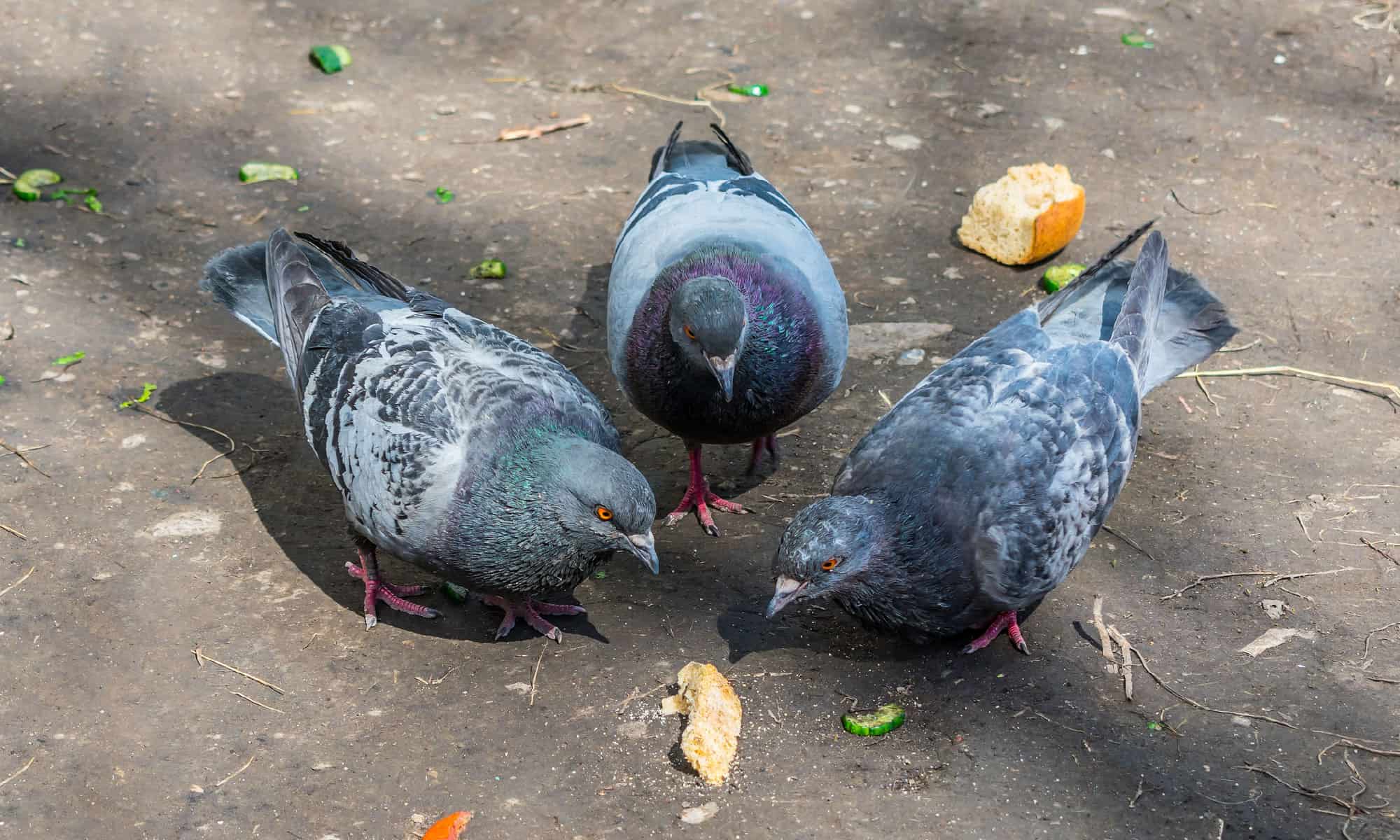
Beginning at dusk today, the USDA and members of St. Luke’s security staff will roust the crows with loud explosives and whistling pyrotechnics, and chase them with amplified crow distress calls until theyflee.
“It’s not so much that they’re causing a lot of problems, it’s just that they’re a health hazard. With 5,000 birds, that’s a lot of bird droppings, and that can become a potential health hazard,” said hospital spokesman Steve Andrews.
The most significant health threat from crow droppings is a fungal respiratory disease called histoplasmosis, according to Thomas N. Tomsa Jr., district supervisor for USDA Wildlife Services.
“The spores can become airborne, and this respiratory fungal disease can develop,” Tomsa said.
Though there are no indications that the birds have brought the disease to the wooded area behind the hospital, St. Luke’s officials are taking no chances.
St. Luke’s Security Director John Hrubenak said the hospital installed an amplified distress-call sound system two weeks to chase the birds from the roof, which has ventilation ducts and a helicopter landing pad.
“We didn’t want them hanging around on our heliport. We just didn’t want to take any chances,” Hrubenak said. “Certainly there was concern about a flock flying into the path of a helicopter.”
So far, the distress calls have kept the birds about 300 feet from the roof, he said.
It’s not unusual to see so many crows in one place, according to Kevin J. McGowan, a crow expert at Cornell University. American crows are most noticeable when the short winter day comes to an end. Streams of them can be seen flying high overhead, with a sense of purpose.
Thousands or tens of thousands converge at a winter roost, congregating from as far away as 20 miles. In the ’70s, a flock in Fort Cobb, Okla., was recorded at 2 million.
They like urban areas because the artificial light helps protect them from the great horned owl, their natural enemy, and because urban areas are warmer than the countryside.
Crows that breed near the roost site mix with migrants from thousands of miles away.
Besides raising concerns at St. Luke’s, the birds have created problems for residents living near the wooded knoll and hospital employees using the lower parking lot off Ostrum Street.
The tree-lined path from the front door of Kim Gencarelli’s home at 500 Ostrum St. has turned into a nightly obstacle course.
“You’ll walk out of your house and get hit or nearly hit with their stuff,” Gencarelli said. “In order to keep clean from my door to my car, I need an umbrella.”
The daily bombardment has also taken its toll on cars. The matter had been compounded by voluntary water rationing, which limited car washing.
“On my way to the car wash, I had people staring, pointing and laughing. My car was covered. You really couldn’t see it was brown, it was white,” Gencarelli said.
On nearby Brighton Street, Robert Guerriere finds nightly challenges while walking his dog.
“I have to look up to see exactly where they are so I don’t get dropped on,” Guerriere said.
The birds’ nightly droppings are so prolific, Guerriere said, “It sounds like rain. It’s not fun. It stinks and smells.”
But not all have had their feathers ruffled.
Ed Sinkler, who lives a block from Gencarelli, said birds are supposed to be in the woods and wondered where they would go when they left.
“It’s sort of majestic watching 10,000 crows come in. They make a nice little chorus at 5:30 in the morning,” Sinkler said.
“I wish there was a way to lure them somewhere else. That would be a better solution than to scare them up and let them go. These are woods and … that’s where they’re supposed to be.”
Tomsa acknowledges the birds may make trouble at another location but prefers to address one problem at a time.
Before this year, the birds roosted in the wooded knoll and on the Hill-to-Hill Bridge. But their numbers were only a fraction of what they are this year.
In December, Tomsa said, his agency harassed a similar number of crows that had been dumping all over the Capitol complex in Harrisburg. It took about five nights of harassment to make them fly the coop. Similarly, Tomsa said he expects the birds will be flushed from their Fountain Hill roost by the weekend.
Even though the nightly two-hour bursts of sound should be enough to force the crows to take flight, the noise will be muffled in the hospital and homes and should present a fraction of the nuisance the birds cause, according to Tomsa.
In a letter to Hrubenak, Tomsa wrote that once the birds are gone, they probably won’t return this winter. But they may be back next year.
Pigeon Patrol
Pigeon Patrol Products & Services is the leading manufacturer and distributor of bird deterrent (control) products in Canada. Pigeon Patrol products have solved pest bird problems in industrial, commercial, and residential settings since 2000, by using safe and humane bird deterrents with only bird and animal -friendly solutions. At Pigeon Patrol, we manufacture and offer a variety of bird deterrents, ranging from Ultra-flex Bird Spikes with UV protection, Bird Netting, 4-S Bird Gel and the best Ultrasonic and audible sound devices on the market today.
Best Types of Pigeon Repellent
- Bird Spikes– Pigeons can’t land on surfaces with bird spikes—perfect for ledges, sills, signs, and fences.
Shop Bird Spikes: https://www.pigeonpatrol.ca/bird-spikes/
- Bird Sound Deterrents / Ultrasonic Repellers– Emit high-frequency sound to drive pigeons away without harming them.
Browse Ultrasonic Bird Repellers: https://www.pigeonpatrol.ca/bird-repeller/
- Pigeon Netting– Blocks pigeons from accessing nesting zones permanently.
See Pigeon Netting: https://www.pigeonpatrol.ca/bird-netting/
Canada’s top wholesaler for bird deterrent products for twelve consecutive years.
Contact us at 1- 877– 4– NO-BIRD, (604) 585-9279 or visit our website at https://www.pigeonpatrol.ca/
Bird Gone, Pigeon Gone, Pigeon problems, pigeon spikes, 1-877-4NO-BIRD, 4-S Gel, Bird Control, Pigeon Control, bird repellent, Bird Spikes, sonic bird repellent, stainless steel bird spikes, bird spikes Vancouver, Ultra Sonic Bird Control, Bird Netting, Plastic Bird Spikes, Canada bird spike deterrents, Pigeon Pests, B Gone Pigeon, Pigeon Patrol, pest controller, pest control operator, pest control technician, Pigeon Control Products, humane pigeon spikes, pigeon deterrents, pigeon traps, Pigeon repellents, Sound & Laser Deterrents, wildlife control, raccoon, skunk, squirrel deterrent, De-Fence Spikes, Dragons Den, Pigeon, Pigeon Patrol, Pigeons Roosting, Vancouver Pigeon Control, Bird Spikes, Bird Control, Bird Deterrent, Pigeon Deterrent, Surrey Pigeon Control, Pest, Seagull deterrent Vancouver Pigeon Blog, Birds Inside Home De-fence, Pigeon Nesting, Bird Droppings, Pigeon Dropping, woodpecker control, Keep The Birds Away, Birds/rats, seagull, pigeon, woodpecker, dove, sparrow, pidgeon control, pidgeon problem, pidgeon control, flying rats, pigeon Problems, bird netting, bird gel, bird spray, bird nails, bird guard, Pigeon control, Bird deterrents, Pigeon deterrents, Bird control, solutions, Pigeon prevention, Pigeon repellent, Bird proofing, Pest bird management, Pigeon spikes, Bird netting, Humane bird control, Bird exclusion, Urban bird control, Anti-roosting devices, Pigeon removal, Bird barriers
by Pigeon Patrol | Mar 9, 2026 | pet bird, Pigeon Control, Pigeon Droppings, Pigeons, Pigeons in the News
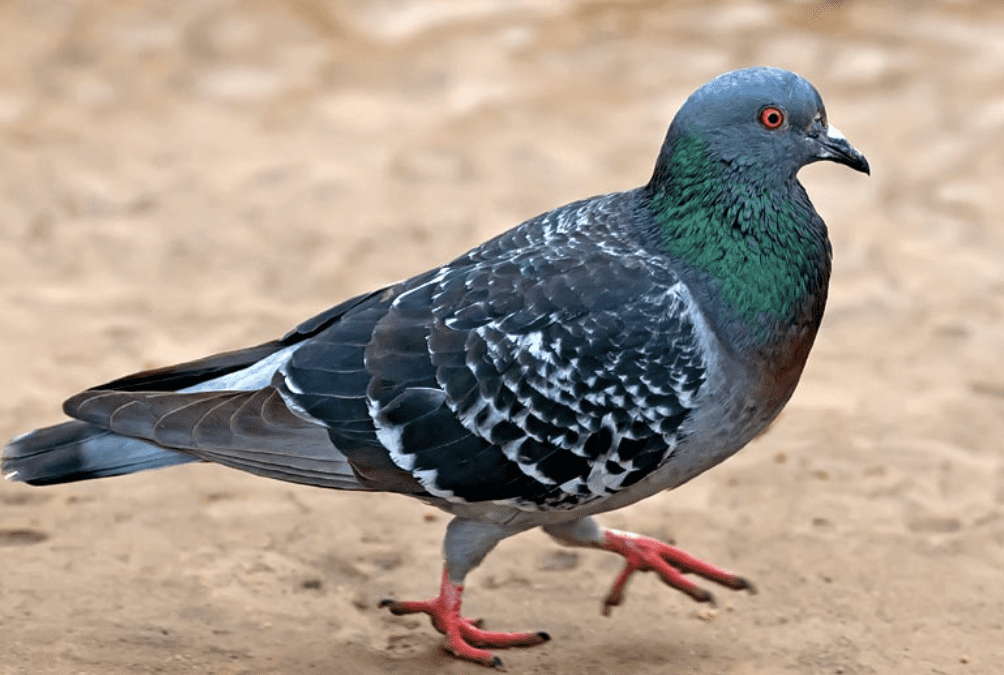
Eighteen frozen pigeons were recently shipped north to the suburban Albany labs of New York State wildlife pathologist Ward Stone. The birds, poisoned by pesticide-spiked rice, were a familiar sight to the medical examiner. He had already autopsied several victims, and this latest batch of corpses, found scattered around a supermarket parking lot in the Bushwick section of Brooklyn, put the murder tally in the hundreds – and confirmed Stone’s suspicion that he is on the Carbofuran-laced-birdseed trail of an avian serial killer.
The pigeons were added to a pile of more than 400 New York City birds Stone has examined over the past two years. He’s been cataloguing causes of death in our 126-species bird habitat, and his pigeon report joined a folder filled with more exotic necropsies: a Jamaica Bay loon with its waterproofing washed away by detergent; a swan found in Central Park Lake with a lead sinker stuck in its gizzard; two red-tailed hawks from Mary Tyler Moore’s building; and a black-crowned night heron from Prospect Park loaded with four pesticides.
Besides the vigilante avicides and high-profile mortalities, Stone has examined dozen s of birds killed by the commercial agent Avitrol, used legally by exterminators all over the city. “You can get caught up in the ‘Carbofuran Killer,’ but Avitrol is what’s killing most of the birds in New York City,” argues anti-Avitrol activist Mary Kelly, whose outrage at the sight of dead pigeons plopping to the pavement from lofty aeries on York and 86th Street in 1997 prompted Stone’s larger inquiry. After autopsying Kelly’s birds, Stone recommended a statewide ban on Avitrol (his employers at the state Department of Environmental Conservation issue licenses to exterminators). He has also found the toxic substance in at least one peregrine falcon – evidence, he says, that the agent is passed to other birds up the food chain, since peregrines love pigeon pie.
Thanks to Stone and Kelly, avian awareness has roosted in Albany: An Avitrol-ban bill flew through the State Assembly last year but crashed in the Senate under pesticide-lobby pressure. This year’s version would have given individual localities the right to ban the pesticide, but Governor Pataki clipped the bill’s wings when he vetoed it at the end of July.
Stone’s activism also prompted wildlife rehabilitators, bird-loving bureaucrats, and other nature freaks to begin scooping and sending the dead crows, starlings, and grackles in their neighborhoods and parks, and Stone plans to release his first-ever comprehensive city bird-necropsy report shortly. He says he was surprised at the “incredible array” of local birds he encountered, “much more than a country boy like me could have expected,” and cites improved water quality – hell, there are cormorants cruising in the Gowanus Canal – as a critical factor in maintaining the city’s “splendiferous” habitat.
The pathologist has lost track of the number of times he’s been compared to seventies television hero Quincy, M.E., but he has his own unsolved mysteries to take care of: Those Brooklyn birds, it turns out, were done in by a copycat using a different pesticide (Methomyl) and bait than the Carbofuran Killer. Still, says the scientist, a bit optimistically, “only two purposeful poisoners in a city of millions – that’s not bad.”
Pigeon Patrol
Pigeon Patrol Products & Services is the leading manufacturer and distributor of bird deterrent (control) products in Canada. Pigeon Patrol products have solved pest bird problems in industrial, commercial, and residential settings since 2000, by using safe and humane bird deterrents with only bird and animal -friendly solutions. At Pigeon Patrol, we manufacture and offer a variety of bird deterrents, ranging from Ultra-flex Bird Spikes with UV protection, Bird Netting, 4-S Bird Gel and the best Ultrasonic and audible sound devices on the market today.
Best Types of Pigeon Repellent
- Bird Spikes– Pigeons can’t land on surfaces with bird spikes—perfect for ledges, sills, signs, and fences.
Shop Bird Spikes: https://www.pigeonpatrol.ca/bird-spikes/
- Bird Sound Deterrents / Ultrasonic Repellers– Emit high-frequency sound to drive pigeons away without harming them.
Browse Ultrasonic Bird Repellers: https://www.pigeonpatrol.ca/bird-repeller/
- Pigeon Netting– Blocks pigeons from accessing nesting zones permanently.
See Pigeon Netting: https://www.pigeonpatrol.ca/bird-netting/
Canada’s top wholesaler for bird deterrent products for twelve consecutive years.
Contact us at 1- 877– 4– NO-BIRD, (604) 585-9279 or visit our website at https://www.pigeonpatrol.ca/
Bird Gone, Pigeon Gone, Pigeon problems, pigeon spikes, 1-877-4NO-BIRD, 4-S Gel, Bird Control, Pigeon Control, bird repellent, Bird Spikes, sonic bird repellent, stainless steel bird spikes, bird spikes Vancouver, Ultra Sonic Bird Control, Bird Netting, Plastic Bird Spikes, Canada bird spike deterrents, Pigeon Pests, B Gone Pigeon, Pigeon Patrol, pest controller, pest control operator, pest control technician, Pigeon Control Products, humane pigeon spikes, pigeon deterrents, pigeon traps, Pigeon repellents, Sound & Laser Deterrents, wildlife control, raccoon, skunk, squirrel deterrent, De-Fence Spikes, Dragons Den, Pigeon, Pigeon Patrol, Pigeons Roosting, Vancouver Pigeon Control, Bird Spikes, Bird Control, Bird Deterrent, Pigeon Deterrent, Surrey Pigeon Control, Pest, Seagull deterrent Vancouver Pigeon Blog, Birds Inside Home De-fence, Pigeon Nesting, Bird Droppings, Pigeon Dropping, woodpecker control, Keep The Birds Away, Birds/rats, seagull, pigeon, woodpecker, dove, sparrow, pidgeon control, pidgeon problem, pidgeon control, flying rats, pigeon Problems, bird netting, bird gel, bird spray, bird nails, bird guard, Pigeon control, Bird deterrents, Pigeon deterrents, Bird control, solutions, Pigeon prevention, Pigeon repellent, Bird proofing, Pest bird management, Pigeon spikes, Bird netting, Humane bird control, Bird exclusion, Urban bird control, Anti-roosting devices, Pigeon removal, Bird barriers
by Pigeon Patrol | Mar 8, 2026 | Bird Netting, Bird Trap, Pigeon Control, Pigeons, Pigeons in the News
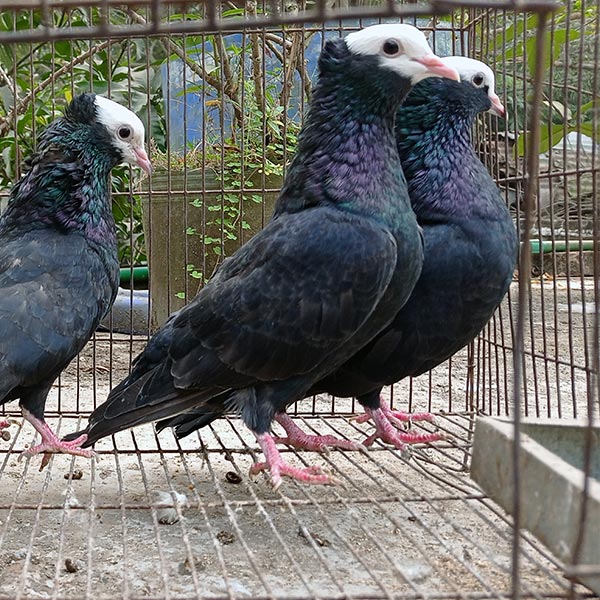
Many bird species are attracted to landfills which take domestic or putrescible waste. These sites provide a reliable, rich source of food which can attract large concentrations of birds. The birds may cause conflicts with human interest with respect to noise, birds carrying litter off site, possible transmission of pathogens in bird droppings and the potential for birdstrikes. In the UK there is an 8 mile safeguarding radius around an airfield, within which any planning applications must pass scrutiny from regulatory bodies to show they will not attract birds into the area and increase the birdstrike risk. Peckfield Landfill site near Leeds, West Yorkshire was chosen for a trial of a netting system designed to exclude birds from domestic waste landfills. The site was assessed for bird numbers before the trial, during the netting trial and after the net had been removed. A ScanCord net was installed for 6 weeks, during which time all household waste was tipped inside the net. Gull numbers decreased on the site from a mean of 107
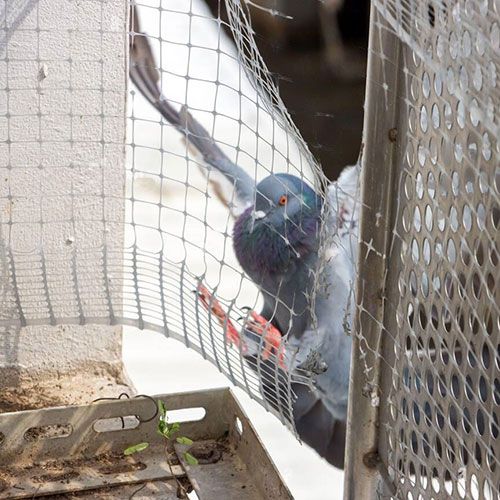
4 per hourly count to 29 per hourly count after two days. The gull numbers increased again after the net had been removed. Bird concentrations in the surroundings were also monitored to assess the effect of the net. Bird numbers in the immediate vicinity of the landfill site were higher than those further away. When the net was installed, the bird concentrations adjacent to the landfill site decreased. Corvids were not affected by the net as they fed on covered waste which was available outside the net throughout the trial. This shows that bird problems on a landfill site are complex, requiring a comprehensive policy of bird control. A supporting bird scaring system and clear operating policy for sites near to airports would be required.
Pigeon Patrol
Pigeon Patrol Products & Services is the leading manufacturer and distributor of bird deterrent (control) products in Canada. Pigeon Patrol products have solved pest bird problems in industrial, commercial, and residential settings since 2000, by using safe and humane bird deterrents with only bird and animal -friendly solutions. At Pigeon Patrol, we manufacture and offer a variety of bird deterrents, ranging from Ultra-flex Bird Spikes with UV protection, Bird Netting, 4-S Bird Gel and the best Ultrasonic and audible sound devices on the market today.
Best Types of Pigeon Repellent
- Bird Spikes– Pigeons can’t land on surfaces with bird spikes—perfect for ledges, sills, signs, and fences.
Shop Bird Spikes: https://www.pigeonpatrol.ca/bird-spikes/
- Bird Sound Deterrents / Ultrasonic Repellers– Emit high-frequency sound to drive pigeons away without harming them.
Browse Ultrasonic Bird Repellers: https://www.pigeonpatrol.ca/bird-repeller/
- Pigeon Netting– Blocks pigeons from accessing nesting zones permanently.
See Pigeon Netting: https://www.pigeonpatrol.ca/bird-netting/
Canada’s top wholesaler for bird deterrent products for twelve consecutive years.
Contact us at 1- 877– 4– NO-BIRD, (604) 585-9279 or visit our website at https://www.pigeonpatrol.ca/
Bird Gone, Pigeon Gone, Pigeon problems, pigeon spikes, 1-877-4NO-BIRD, 4-S Gel, Bird Control, Pigeon Control, bird repellent, Bird Spikes, sonic bird repellent, stainless steel bird spikes, bird spikes Vancouver, Ultra Sonic Bird Control, Bird Netting, Plastic Bird Spikes, Canada bird spike deterrents, Pigeon Pests, B Gone Pigeon, Pigeon Patrol, pest controller, pest control operator, pest control technician, Pigeon Control Products, humane pigeon spikes, pigeon deterrents, pigeon traps, Pigeon repellents, Sound & Laser Deterrents, wildlife control, raccoon, skunk, squirrel deterrent, De-Fence Spikes, Dragons Den, Pigeon, Pigeon Patrol, Pigeons Roosting, Vancouver Pigeon Control, Bird Spikes, Bird Control, Bird Deterrent, Pigeon Deterrent, Surrey Pigeon Control, Pest, Seagull deterrent Vancouver Pigeon Blog, Birds Inside Home De-fence, Pigeon Nesting, Bird Droppings, Pigeon Dropping, woodpecker control, Keep The Birds Away, Birds/rats, seagull, pigeon, woodpecker, dove, sparrow, pidgeon control, pidgeon problem, pidgeon control, flying rats, pigeon Problems, bird netting, bird gel, bird spray, bird nails, bird guard, Pigeon control, Bird deterrents, Pigeon deterrents, Bird control, solutions, Pigeon prevention, Pigeon repellent, Bird proofing, Pest bird management, Pigeon spikes, Bird netting, Humane bird control, Bird exclusion, Urban bird control, Anti-roosting devices, Pigeon removal, Bird barriers


 This dramatic increment in flock size confirmed that the city council’s lethal control policy, operated between 1963 and 1985, had not only been totally ineffective, but had actually resulted in an increase in flock size of nearly one third. As a result, the city council realized that the problem had to be tackled at source