

Summary
Feral pigeons (Columbia livia var. domestica) can be a nuisance and may cause significant damage to buildings. If feral pigeons take up residence within a disused property they can seriously damage the interior historic fabric, contents and finishes. It is vital to take measures to minimise pigeon activity in and around buildings in order to avoid additional maintenance issues and significant problems for renovation projects.
Rectifying the damage caused to the fabric of a property by pigeon guano (bird excreta) is expensive and in most cases avoidable. There are many methods of pigeon control including bird proofing, wire deterrent systems, netting, bird spikes and a large variety of electrical and sonic bird deterrent solutions.
Introduction
Feral pigeons and other birds make nests regularly and roost outside and inside our buildings. Architects, surveyors, construction professionals and maintenance staff are all familiar with the damage that can be caused by these birds sharing our environment.
History
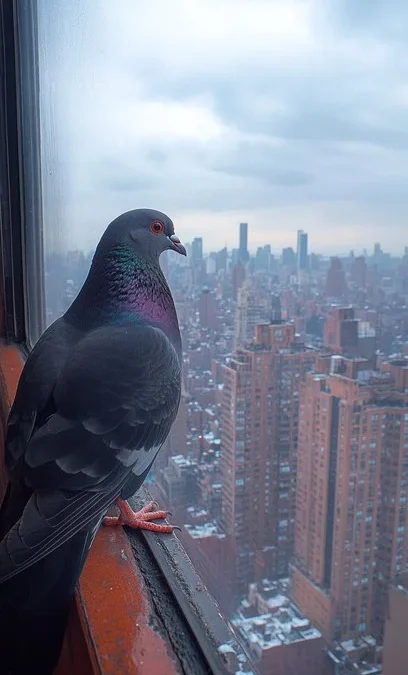
Feral pigeons are believed to have descended from rock doves that interbred with racing pigeons and pigeons from domestic pigeon lofts. Skyscrapers and similar tall buildings provide ideal habitats, very similar to the cliff homes of their pigeon ancestors.
These pigeons have thrived by adapting to life in and around our buildings and have learnt to roost and breed very successfully within this environment. They thrive on a plentiful supply of our dropped and dumped food scraps. As they have adapted so excellently to this style of living, they have sometimes been called “the flying rat”. It’s no surprise that over recent years there has been a marked increase in the numbers of feral pigeons.
Adult Pigeons
The adult pigeon is about 33cm in length and weighs between 280 and 560g, an average of about 350g. Its plumage can vary considerably, from a close resemblance to that of the original rock dove (with blue-grey plumage, double black wing bars and a white rump), through to various blues, reds, chequered and almost black types. Colours vary considerably from blue-grey, through blues, reds, mottled patterns and charcoal to almost pure white (Simms, 1979).
The birds will roost and nest on horizontal building surfaces and any other structures that provide a small amount of shelter from the elements. Balconies, flat roofs, ledges, loft spaces and empty buildings are often used if the birds have access.
Nests are constructed of twigs but can also contain pieces of plastic and other debris. They may even be built on or near the dead bodies of other pigeons. Their natural food is grain and green vegetable matter but they will scavenge food and eat almost any foodstuff available such as dropped takeaway foods.
Life Cycle
The Feral Pigeon is capable of breeding throughout the year and nests may be found in any month. However the peak occurs between March and July. Usually, two white eggs are laid on consecutive days and incubation is shared between both adults. Incubation lasts for about 18 days, with fledging taking place about 4 ½ weeks later. A new clutch can be laid when the first young are just 20 days old. Therefore up to nine broods may be produced per year by just one female pigeon and pigeons may live as long as thirty years (P Ehrlich et al, 1988)
Deterioration and Damage to Buildings
Pigeon droppings are not only unsightly; their acid content can lead to the deterioration of soft stone and cause long-term damage to buildings (Bassi and Chiantante, 1976; Howard and Oldsbury 1991). The accumulation of pigeon droppings can deface the finishes of the exterior facade and the interior of the building. Removal is not only difficult and expensive but can cause more damage than the droppings in the first place (D Channon, 2004).
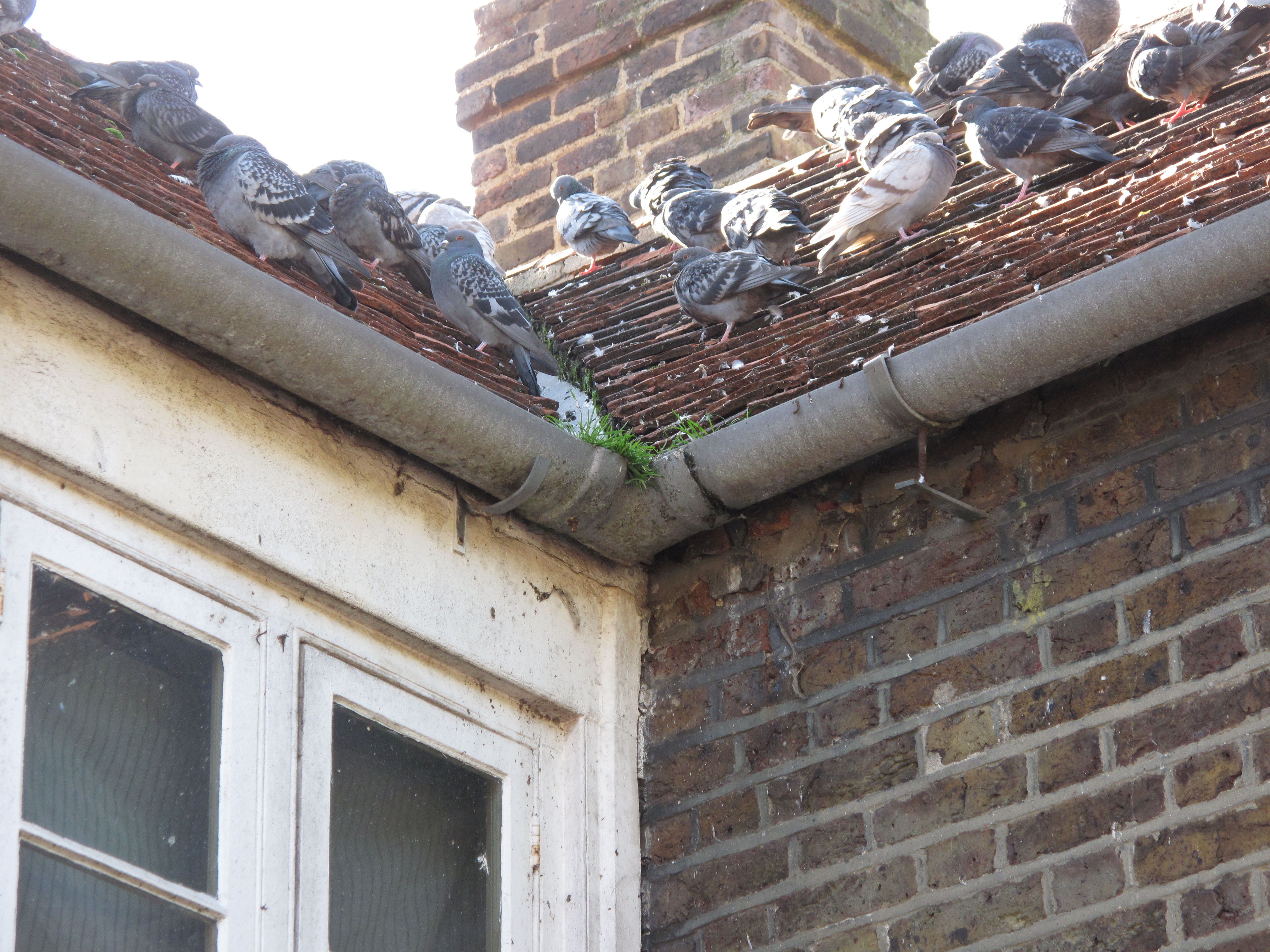
Nest droppings and feathers block gutters and rainwater pipes causing water damage to buildings. Their droppings can lead to hazards on pavements, especially for the elderly. Pigeons are capable of lifting loose roof coverings, tiles and battens to gain entry into the roof voids. This can significantly damage the structure by allowing water penetration, providing the ideal environmental conditions for the growth and proliferation of wood rotting fungi. Wood boring insects are attracted to this damp, rotting environment, leading to substantial further decay (Singh 1995).
Pigeon nesting materials, feathers and faeces can block parapet gutters and hopper heads, allowing water penetration into the building fabric and providing the ideal environmental conditions for the growth and development of decay organisms (Singh 1994a, & Singh 1999).
In poorly maintained and unoccupied buildings, where significant undetected water ingress has occurred, major outbreaks of dry rot (Serpula lacrymans) and wet rots establish and thrive. These include (Coniophora puteana, Antrodia xantha, A. searilis, A. vaillantti & Phellinus contiguus). Thesubsequent deterioration to the historic fabric, finishes and contents is an inevitable consequence (Singh 1994). Sometimes this deterioration is so dramatic that many of the important historical and architectural features are destroyed beyond repair.
Early-morning activity around nesting areas can cause a public nuisance, as can pestering for food. Around public and buildings of historic and touristic interest further problems can arise as the visitors start feeding pigeons. Their numbers will increase dramatically, leading to extensive faeces and fouling.
Ladders and fire escapes coated in pigeon droppings become slippery and unsafe to use particularly in wet conditions. Startled pigeons may take flight suddenly and cause a hazard to road traffic.
Pigeons and the Law
- Most birds, their nests and eggs are protected under the Wildlife and Countryside Act 1981.
- The act allows the control of certain birds, including feral pigeons, by authorised people using specified methods.
- The use of spring traps, poisons, certain types of nets, gassing and sticky substances that may entangle a bird is illegal.
Health Hazards
Large populations of pigeons and other birds inhabiting buildings or living on the facade for many years may present a potential risk of disease to people in and around these buildings (Weber, 1979).
The organic, nutrient rich accumulation of pigeon droppings, including feathers, detritus and debris under a nest provides an ideal environment for disease. This encourages fungi and bacteria to grow and proliferate. External parasites may also become a problem when infested pigeons or bats leave their roosts or nests. These parasites can infest buildings and cause health problems to people. Pigeons can also carry a number of potentially infectious diseases such as salmonella, tuberculosis and ornithosis (a mild form of psittacosis with pneumonia-like symptoms).
They are also a source of allergens, which can cause respiratory ailments like pigeon fancier’s lung, aspergillosis and allergic skin reaction. There is potential for these illnesses to be spread to people through contact with pigeon droppings, dandruff and feathers, pigeon parasites, or where dead infected pigeons get into food or water sources. Health and safety issues and site access problems are also caused by the build up of faeces due to the slippery and unsafe footing it provides on walkways and ledges, hindering proper maintenance. This may be a particular problem during building works and renovation. Pigeon faeces represent a health and safety hazard for staff working in contaminated buildings and for employees and operators who have to carry out remediation works. Pigeon infestation in and around buildings therefore represent an added problem in the renovation of buildings where large accumulations have been allowed to build-up, and this nutrient rich guano combined with moisture ingress in buildings provides an ideal environment for the growth and proliferation of moulds (Singh 1994a, Singh & Walker 1996).
Pigeon Patrol
Pigeon Patrol Products & Services is the leading manufacturer and distributor of bird deterrent (control) products in Canada. Pigeon Patrol products have solved pest bird problems in industrial, commercial, and residential settings since 2000, by using safe and humane bird deterrents with only bird and animal -friendly solutions. At Pigeon Patrol, we manufacture and offer a variety of bird deterrents, ranging from Ultra-flex Bird Spikes with UV protection, Bird Netting, 4-S Bird Gel and the best Ultrasonic and audible sound devices on the market today.
Best Types of Pigeon Repellent
- Bird Spikes– Pigeons can’t land on surfaces with bird spikes—perfect for ledges, sills, signs, and fences.
Shop Bird Spikes: https://www.pigeonpatrol.ca/bird-spikes/ - Bird Sound Deterrents / Ultrasonic Repellers– Emit high-frequency sound to drive pigeons away without harming them.
Browse Ultrasonic Bird Repellers: https://www.pigeonpatrol.ca/bird-repeller/ - Pigeon Netting– Blocks pigeons from accessing nesting zones permanently.
See Pigeon Netting: https://www.pigeonpatrol.ca/bird-netting/
Canada’s top wholesaler for bird deterrent products for twelve consecutive years.
Contact us at 1- 877– 4– NO-BIRD, (604) 585-9279 or visit our website at https://www.pigeonpatrol.ca/
Bird Gone, Pigeon Gone, Pigeon problems, pigeon spikes, 1-877-4NO-BIRD, 4-S Gel, Bird Control, Pigeon Control, bird repellent, Bird Spikes, sonic bird repellent, stainless steel bird spikes, bird spikes Vancouver, Ultra Sonic Bird Control, Bird Netting, Plastic Bird Spikes, Canada bird spike deterrents, Pigeon Pests, B Gone Pigeon, Pigeon Patrol, pest controller, pest control operator, pest control technician, Pigeon Control Products, humane pigeon spikes, pigeon deterrents, pigeon traps, Pigeon repellents, Sound & Laser Deterrents, wildlife control, raccoon, skunk, squirrel deterrent, De-Fence Spikes, Dragons Den, Pigeon, Pigeon Patrol, Pigeons Roosting, Vancouver Pigeon Control, Bird Spikes, Bird Control, Bird Deterrent, Pigeon Deterrent, Surrey Pigeon Control, Pest, Seagull deterrent Vancouver Pigeon Blog, Birds Inside Home De-fence, Pigeon Nesting, Bird Droppings, Pigeon Dropping, woodpecker control, Keep The Birds Away, Birds/rats, seagull, pigeon, woodpecker, dove, sparrow, pidgeon control, pidgeon problem, pidgeon control, flying rats, pigeon Problems, bird netting, bird gel, bird spray, bird nails, bird guard, Pigeon control, Bird deterrents, Pigeon deterrents, Bird control, solutions, Pigeon prevention, Pigeon repellent, Bird proofing, Pest bird management, Pigeon spikes, Bird netting, Humane bird control, Bird exclusion, Urban bird control, Anti-roosting devices, Pigeon removal, Bird barriers